DonateSupporterVisit Heritage
  • Tūrangawaewae
    Places
  • Tira Māori
    Māori Heritage
  • Poutairangahia
    Archaeology
  • Rauemi
    Resources
  • Mō Tātou
    About Us
  • New Zealand Heritage List
  • Nominate and submit
  • Explore the List
  • National Historic Landmarks
  • Plaques
  • Rainbow List Project
  • Lost heritage
  • Visit Heritage
  • Our properties
  • Turnbull House Project
  • Collections
  • Shop
  • Tohu Whenua
  • Tira Māori
  • Conserving Māori heritage
  • Marae built heritage
  • Māori heritage on the List
  • Hinemihi—Te Hokinga Mai
  • What is archaeology?
  • Is there a site on my property?
  • What are my legal requirements?
  • Affecting an archaeological site
  • Declaring an archaeological site
  • Archaeology FAQs
  • Archaeology Digital Library
  • Archaeology guidelines and templates
  • Resources
  • Funding
  • Publications
  • Sustainable management guides
  • Disaster recovery
  • Podcasts & digital resources
  • Education Hub
  • Conservation plans
  • About
  • Board
  • Māori Heritage Council
  • Senior Staff
  • Offices
  • Contact us
  • Careers
  • Covenants
  • Fast-track
  • Corporate documents
  • Currently consulting on
  • Our submissions
  • News
Quick links
Rārangi Kōrero | The List
Explore the List
National Historic Landmarks
Ngā Manawhenua o Aotearoa me ōna Kōrero Tūturu
Quick links
Tapuwae
A Vision for Places of Māori Heritage
Funding for Māori Heritage
Resources
Quick links
Archaeological Authority Portal
Applying for an archaeological authority
Archaeology FAQs
Browse the most frequently asked questions about archaeological authorities and the archaeological process.
Quick links
Quick links
Contact us
Offices
DonateSupporterVisit Heritage
  • Tūrangawaewae
    Places
  • Tira Māori
    Māori Heritage
  • Poutairangahia
    Archaeology
  • Rauemi
    Resources
  • Mō Tātou
    About Us
  • New Zealand Heritage List
  • Nominate and submit
  • Explore the List
  • National Historic Landmarks
  • Plaques
  • Rainbow List Project
  • Lost heritage
  • Visit Heritage
  • Our properties
  • Turnbull House Project
  • Collections
  • Shop
  • Tohu Whenua
  • Tira Māori
  • Conserving Māori heritage
  • Marae built heritage
  • Māori heritage on the List
  • Hinemihi—Te Hokinga Mai
  • What is archaeology?
  • Is there a site on my property?
  • What are my legal requirements?
  • Affecting an archaeological site
  • Declaring an archaeological site
  • Archaeology FAQs
  • Archaeology Digital Library
  • Archaeology guidelines and templates
  • Resources
  • Funding
  • Publications
  • Sustainable management guides
  • Disaster recovery
  • Podcasts & digital resources
  • Education Hub
  • Conservation plans
  • About
  • Board
  • Māori Heritage Council
  • Senior Staff
  • Offices
  • Contact us
  • Careers
  • Covenants
  • Fast-track
  • Corporate documents
  • Currently consulting on
  • Our submissions
  • News
Quick links
Rārangi Kōrero | The List
Explore the List
National Historic Landmarks
Ngā Manawhenua o Aotearoa me ōna Kōrero Tūturu
Quick links
Tapuwae
A Vision for Places of Māori Heritage
Funding for Māori Heritage
Resources
Quick links
Archaeological Authority Portal
Applying for an archaeological authority
Archaeology FAQs
Browse the most frequently asked questions about archaeological authorities and the archaeological process.
Quick links
Quick links
Contact us
Offices
  • Places
  • Nominate and submit
  • National Historic Landmarks
  • Places
  • Nominate and submit
  • National Historic Landmarks
  • Tira Māori
  • Conserving Māori heritage
  • Marae built heritage
  • Tira Māori
  • Conserving Māori heritage
  • Marae built heritage
  • Archaeological authorities
  • Archaeology Digital Library
  • Archaeological authorities
  • Archaeology Digital Library
  • All resources
  • Publications
  • Funding
  • All resources
  • Publications
  • Funding
  • FAQs
  • FAQs
Follow us on:
Places
  • Places
  • Nominate and submit
  • National Historic Landmarks
Tira Māori
  • Tira Māori
  • Conserving Māori heritage
  • Marae built heritage
Archaeology
  • Archaeological authorities
  • Archaeology Digital Library
Resources
  • All resources
  • Publications
  • Funding
FAQs
  • FAQs
Follow us on
HomePrivacyTerms and conditionsAbout this site
© Heritage New Zealand Pouhere Taonga 2026.
 
Miners Bath House

Roa Road, BLACKBALL

Public

Historic Place Category 2

List No. 5070

Quick links:
List GalleryLocationDetails
Constructed in circa 1941, seemingly as a replacement for an earlier timber bath house destroyed by fire, the concrete remains of the Miners Bath House on Roa Road, Blackball, are a stark reminder of our industrial past and coal miners’ struggle for better working conditions. The Miners Bath House is part of the story of Blackball’s notable union and social history and as such it has historical, social and cultural significance or value. It also has aesthetic values as a ruin, both for its visual effects and through eliciting an emotional response and curiosity regarding its former use as an industrial bath house.

The Blackball Coal Mine began development in 1889 and was one of the major West Coast producers of its day. Blackball town was the centre of early union activity, and the sordid housing and social conditions contributed to the industrial unrest associated with the colliery. In 1911 there had been large scale debate regarding the provision of bath houses for workers. Miners would return home from work sweaty and dirty and not all homes had bathtubs. In 1917 a ‘commodious bathhouse’ was erected at the Blackball Colliery. It appears this was a two storeyed timber bath house situated near the old mine entrance where miners could exit directly into it at the end of each shift. In September 1922 Maoriland Worker quoted the Grey River Argus’s Blackball Notes section: ‘Our new bath-house has at last been opened, but a slight delay was occasioned by the deputies (don’t you know!) desiring to be partitioned off from the common garden variety of coal miner!’. Perhaps that 1922 bath-house was a replacement or extension to the earlier one built in 1917. Whichever is the case, in June 1939 the timber bath house at the Blackball Mine was totally destroyed by fire. At the time, newspapers reported that the intention was to build a new one straight away. By October 1941, the new concrete bathhouse, with showers, was under construction, using mine workers’ labour.

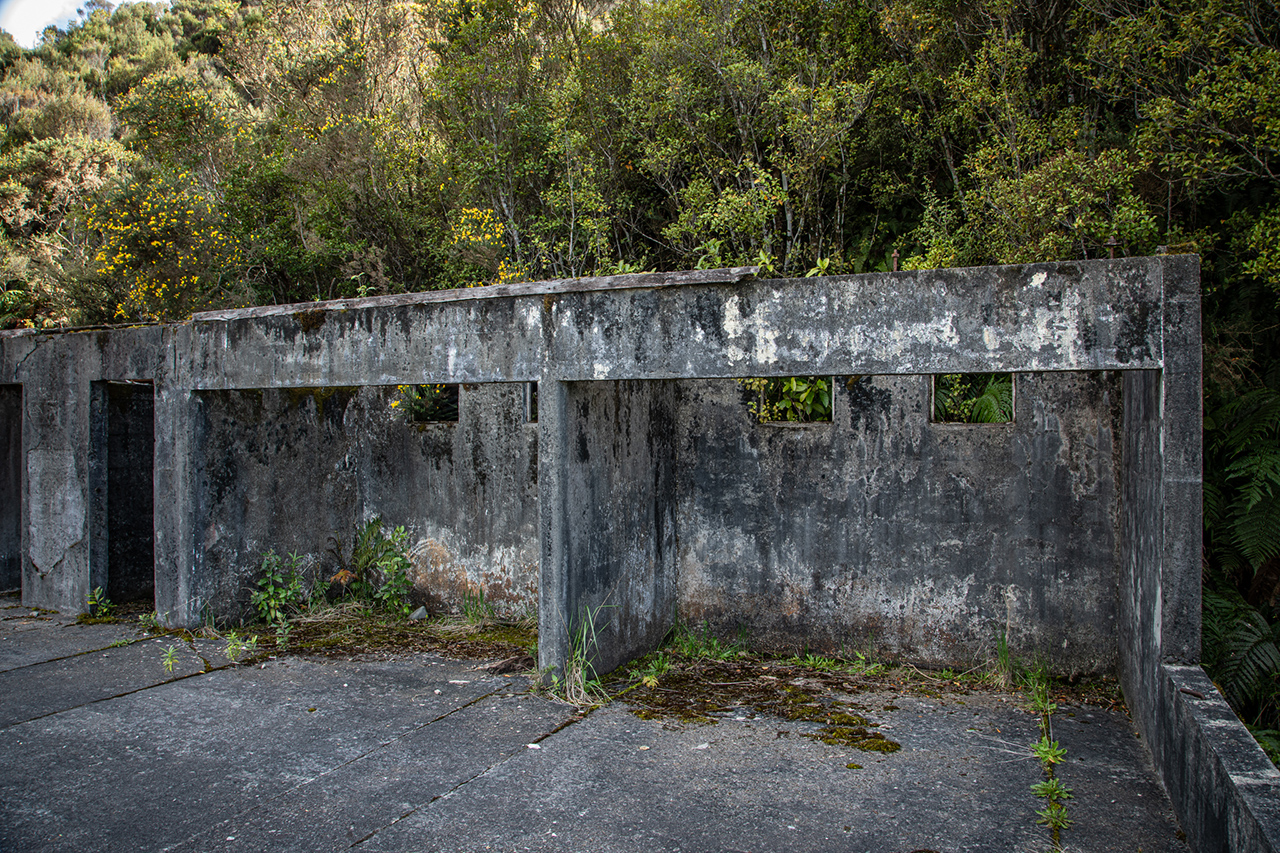
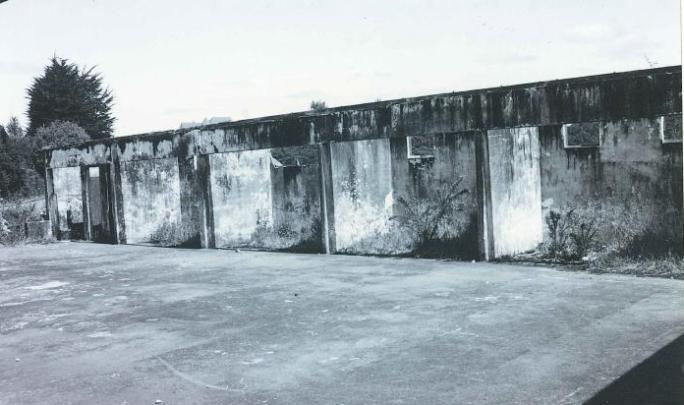
Approximately 21 metres long and nine metres wide, the Miners Bath House is no longer roofed and is now something of a ruin. However, its 2.5 metre high concrete walls and partitions remain, providing an understanding of what the place looked like. More or less rectangular in plan, the structure has concrete steps to an entrance at the south side of the east elevation, leading into a single large area that was the main bath house. Without its roof, former ventilation openings in the upper portion of the concrete walls are reminiscent of a crenelated castle. The western bay of the building is separated internally by a concrete partition. The rusted metal boiler for heating the shower house (bath house) lies on the ground at the western side of the structure.

It appears that by the early 1940s concrete bath houses were more common than timber ones. The Dobson Mine had a concrete bath house built as early as December 1926. The design of the Miners Bath House in Blackball is similar to ones built at Denniston (1940) and Millerton (early 1940s?). Bath houses were the places where the miners got changed out of their wet clothes, leaving them there to dry ready for their next shift. If a bath house temperature was not kept at the prescribed minimum, the mine could be idle as the men did not have to go to work. Bath houses were not only convenient but essential to the wellbeing of miners and, indirectly, their families. Changing in and out of wet and dirty mining work clothes at the bath house, washing/showering before going home kept up a man’s morale and lessened some of the household cleaning up. While cleaning, miners’ bath houses were a place where men talked, told tales and had a laugh after a hard day’s work.
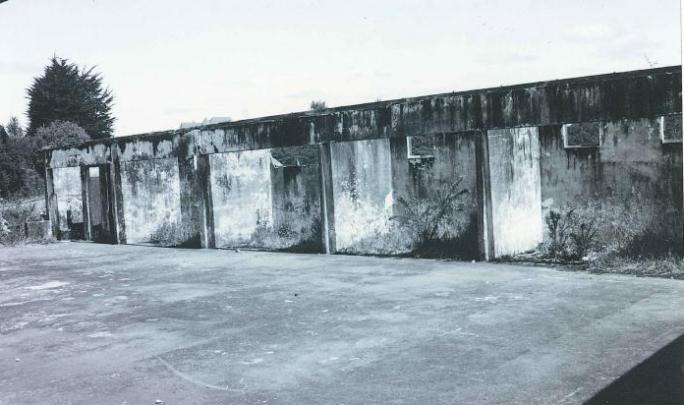
Miners Bath House, Blackball. Photo Competition Entrant 2024 | Alison Parish | 20/10/2024 | Alison Parish
Miners Bath House, Blackball. Image included in Field Record Form Collection | P Wilson | 01/11/1992 | Heritage New Zealand Pouhere Taonga
Miners Bath House, Blackball. Photo Competition Entrant 2024 | Alison Parish | 20/10/2024 | Alison Parish
Miners Bath House, Blackball. Image included in Field Record Form Collection | P Wilson | 01/11/1992 | Heritage New Zealand Pouhere Taonga

List Entry Information

Overview

Status
Listed

List Entry Status
Historic Place Category 2

Access
Able to Visit

List Number
5070

Date Entered
21st September 1989

Date of Effect
21st September 1989

City/District Council
Grey District

Region
West Coast Region

Extent of List Entry

Extent includes the land described as RS 5077 (RT WS3C/797), Westland Land District and the structure known as Miners Bath House thereon. This includes the boiler that sits adjacent to the concrete structure.

Legal description

RS 5077 (RT WS3C/797), Westland Land District

Detailed List Entry

Construction Details

Start Year

1941

Type

Original Construction

Type

Modification

Description

Roof removed

Period

Post-1960s

Reference

Completion Date

20th July 2020

Report Written By

Robyn Burgess

Information Sources

Historic Places in New Zealand

Historic Places in New Zealand

Blackball History Group, 1993

Blackball History Group, Historic Blackball: A brief history of Blackball, Roa and Moonlight Districts, 1993

Staton, 2011

Staton, Jim, Blackball Coal Mine: Historic Site Assessment and Workplan, Department of Conservation, December 2011

Report Written By

This place was identified as significant under previous legislation with different information requirements. It remains significant under the current legislation. There is opportunity under our legislation and policies to add to this information. Further information about this place may be available from the Southern Regional Office of Heritage New Zealand Pouhere Taonga. Please note that entry on the New Zealand Heritage List/Rarangi Korero identifies only the heritage values of the property concerned, and should not be construed as advice on the state of the property, or as a comment of its soundness or safety, including in regard to earthquake risk, safety in the event of fire, or insanitary conditions. A fully referenced upgrade report is available on request from the Southern Office of Heritage New Zealand.

Further Information

Current Usages

Uses: Ruin

Specific Usage: Misc Archaeological

Former Usages

General Usage:: Civic Facilities

Specific Usage: Bathhouse/ mineral baths/ geothermal baths

General Usage:: Mining

Specific Usage: Mining camp/settlement/housing

Themes

Web Links

Overview

Status

Listed

List Entry Status

Historic Place Category 2

Access

Able to Visit

List Number

5070

Date Entered

21st September 1989

Date of Effect

21st September 1989

City/District Council

Grey District

Region

West Coast Region

Extent of List Entry

Extent includes the land described as RS 5077 (RT WS3C/797), Westland Land District and the structure known as Miners Bath House thereon. This includes the boiler that sits adjacent to the concrete structure.

Legal description

RS 5077 (RT WS3C/797), Westland Land District

Status

Listed

List Entry Status

Historic Place Category 2

Access

Able to Visit

List Number

5070

Date Entered

21st September 1989

Date of Effect

21st September 1989

City/District Council

Grey District

Region

West Coast Region

Extent of List Entry

Extent includes the land described as RS 5077 (RT WS3C/797), Westland Land District and the structure known as Miners Bath House thereon. This includes the boiler that sits adjacent to the concrete structure.

Legal description

RS 5077 (RT WS3C/797), Westland Land District

Construction Information

Construction Details

Start Year

1941

startYearCirca

Type

Original Construction

Type

Modification

Description

Roof removed

Period

Post-1960s

Construction Details

Start Year

1941

startYearCirca

Type

Original Construction

Type

Modification

Description

Roof removed

Period

Post-1960s

Reference

Historical and Associated Iwi / Hapū / Whānau

Completion Date

20th July 2020

Report Written By

Robyn Burgess

Information Sources

Historic Places in New Zealand

Historic Places in New Zealand

Blackball History Group, 1993

Blackball History Group, Historic Blackball: A brief history of Blackball, Roa and Moonlight Districts, 1993

Staton, 2011

Staton, Jim, Blackball Coal Mine: Historic Site Assessment and Workplan, Department of Conservation, December 2011

Other Information

This place was identified as significant under previous legislation with different information requirements. It remains significant under the current legislation. There is opportunity under our legislation and policies to add to this information. Further information about this place may be available from the Southern Regional Office of Heritage New Zealand Pouhere Taonga. Please note that entry on the New Zealand Heritage List/Rarangi Korero identifies only the heritage values of the property concerned, and should not be construed as advice on the state of the property, or as a comment of its soundness or safety, including in regard to earthquake risk, safety in the event of fire, or insanitary conditions. A fully referenced upgrade report is available on request from the Southern Office of Heritage New Zealand.

Historical and Associated Iwi / Hapū / Whānau

Completion Date

20th July 2020

Report Written By

Robyn Burgess

Information Sources

Historic Places in New Zealand

Historic Places in New Zealand

Blackball History Group, 1993

Blackball History Group, Historic Blackball: A brief history of Blackball, Roa and Moonlight Districts, 1993

Staton, 2011

Staton, Jim, Blackball Coal Mine: Historic Site Assessment and Workplan, Department of Conservation, December 2011

Other Information

This place was identified as significant under previous legislation with different information requirements. It remains significant under the current legislation. There is opportunity under our legislation and policies to add to this information. Further information about this place may be available from the Southern Regional Office of Heritage New Zealand Pouhere Taonga. Please note that entry on the New Zealand Heritage List/Rarangi Korero identifies only the heritage values of the property concerned, and should not be construed as advice on the state of the property, or as a comment of its soundness or safety, including in regard to earthquake risk, safety in the event of fire, or insanitary conditions. A fully referenced upgrade report is available on request from the Southern Office of Heritage New Zealand.

Further Information

Current Usages

Uses: Ruin

Specific Usage: Misc Archaeological

Former Usages

General Usage: Civic Facilities

Specific Usage: Bathhouse/ mineral baths/ geothermal baths

General Usage: Mining

Specific Usage: Mining camp/settlement/housing

Current Usages

Uses: Ruin

Specific Usage: Misc Archaeological

Former Usages

General Usage: Civic Facilities

Specific Usage: Bathhouse/ mineral baths/ geothermal baths

General Usage: Mining

Specific Usage: Mining camp/settlement/housing

Location

Loading
Related listings
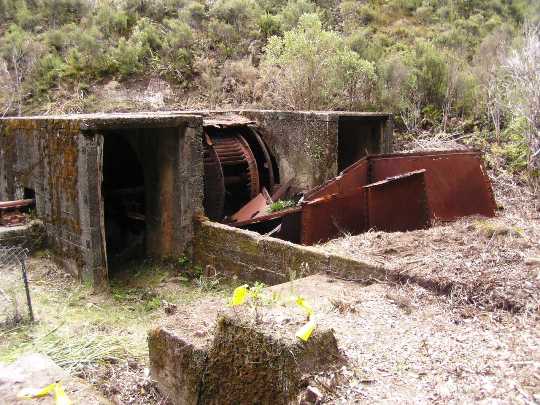
Return Air Vent and Fan Chamber, Blackball Mine, Blackball. Image courtesy of Department of Conservation
Return Air Vent and Fan Chamber, Blackball Mine
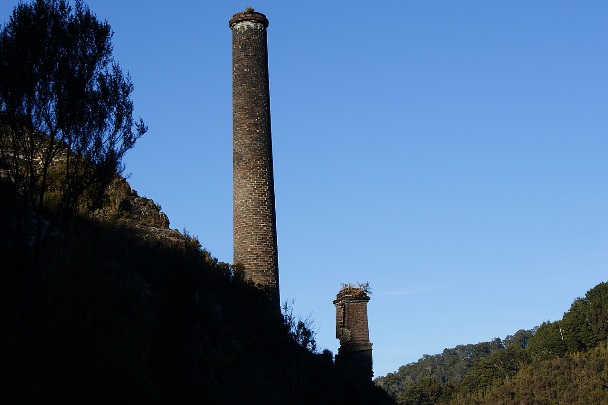
Blackball Coal Mine Chimneys, Blackball. Image courtesy of www.flickr.com
Blackball Coal Mine Chimneys
Blackball Coal Mine Chimneys, Blackball. Image courtesy of www.flickr.com
Blackball Coal Mine Chimneys
Return Air Vent and Fan Chamber, Blackball Mine, Blackball. Image courtesy of Department of Conservation
Return Air Vent and Fan Chamber, Blackball Mine
Sign up to hear more

Get the latest heritage news, features and events delivered
straight to your inbox.

Subscribe