This assessment was prepared on 08 Mar 2012 with reference to the criteria of the Historic Places Act 1993.
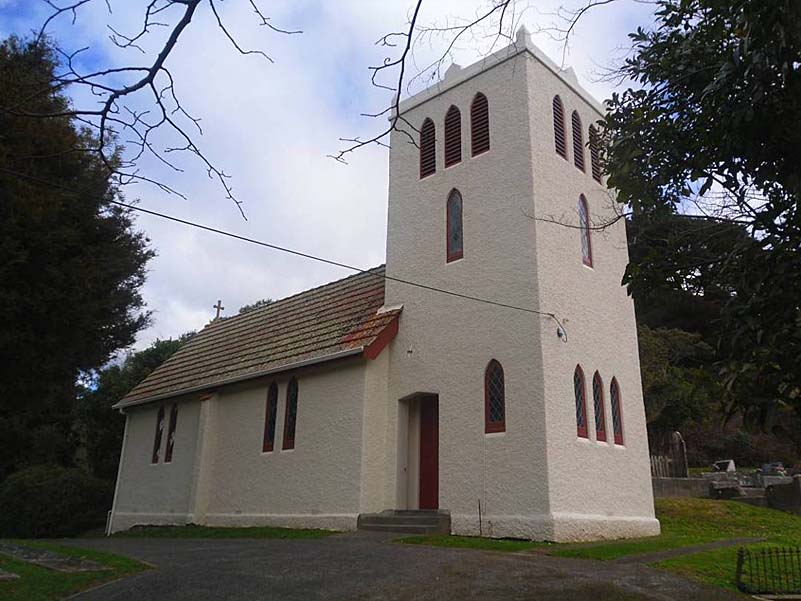
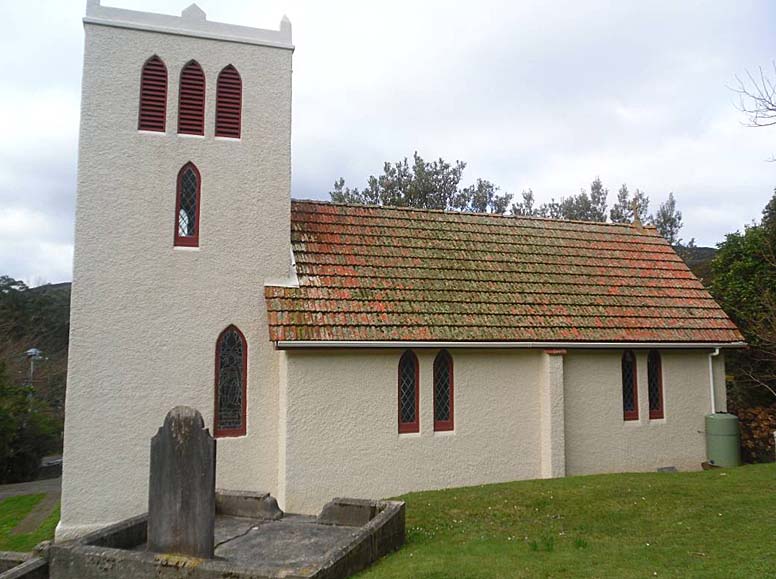
St Matthias’ Church (Anglican) in Makara was constructed in 1921, as a more permanent replacement for the first church that had been erected in 1867. Situated on a small rise at the intersection of Makara and South Makara Roads and set among the headstones of the first settlers, St Matthias’ Church is an important landmark within the Makara community and reflects the history of this rural settlement.
After the completion of the road to Makara via Karori in 1858, settlement in the district began to thrive, with more settlers moving to the area. Captain S.W. Mein Smith and Samuel Revans, joint owners of Section 23, granted part of this section – almost five acres – to the community in September 1866 for the sole purpose of constructing an Anglican church. Other donations were also gifted in contribution to the first church, which was the first public building in Makara.
The first church was a simple wooden building with a steep roof and bell tower, and most of the construction work was carried out by local residents. It was opened for divine service in February 1867. In 1892, after the construction of a new school, the church acquired the old schoolhouse; this became the church hall, and the hub of many social functions. The church was the heart of the district and highly valued by the community, as evidenced by the way the community came together in 1906 to begin fundraising for a new and more permanent church building. In 1919, a tender was accepted by the vestry of St Mary’s in Karori, and in 1921, a new more permanent St Matthias’ Church was constructed, designed by prominent architect Frederick de Jersey Clere. On 21 August 1921, six months after the foundation stone was laid, Bishop Sprott consecrated St Matthias’ Church. The church was free of debt, and this accomplishment was acknowledged by the Bishop as being an unusual and admirable feat.
St Matthias’ Church sits atop a slight rise and fits comfortably into its backdrop of surrounding bush. The building is a combination of different styles which come together to form an architecturally striking construction. Clere’s design brings together the simplistic Early Saxon style with a Norman style tower, and uses Gothic features common to most New Zealand church designs. This is a simple yet powerful design, which not only fits its surrounding landscape and environment, but also suits the community it is representing.
St Matthias’ Church is of architectural, historical, spiritual and social significance and value. The church is not only representative of the history of Anglicanism in New Zealand communities, but also the history of Makara itself, and is evidence of the growth in the area. Makara prided itself on being a very social district, and as was typical in many New Zealand communities, the church played a central role. St Matthias’ Church continues to be used for communion services as well as important rites such as funerals, christenings and weddings.