Resources and the development of hydro-electric power
When fashionable Parisians took a late evening stroll down the Avenue de l’Opera during the Paris Exposition of 1878, Yablochov Candles lit up their world, sixty four arc lights on a city street. They were among the first in the world to see electric lighting. While the technology of incandescent bulbs ultimately replaced arc lights, this illuminating event led the way for the development of electric lighting and power for a multitude of uses around the world. The glamour of Paris far away from the mountainous isolation of the Lakes District of Otago, but only eight years later New Zealand saw its own pioneering entry into the world of electric light and power generation, to power a gold mining battery (through hydro-electric generation) at the Phoenix mine at Bullendale in early 1886.
The first commercially successful arc light systems were developed by Charles Brush (1849-1929) in the United States of America. The systems featured an arc light and dynamo. The Brush Dynamo was as one writer noted, ‘a monumental achievement in power generation.’ By 1879, the Anglo-American Brush Electric Light Corporation in England had been established and had purchased Brush’s English and foreign patents. This company provided the training ground for electrical engineer Robert Ernest Fletcher who played a major part in the Bullendale story, and who carried Brush’s invention to the far end of the world – to New Zealand.
New Zealand’s early experimentation with hydro-electric power was in the hands of private operators, Otago miners leading the charge. The Phoenix Mine at Bullendale had a generator for lighting in 1884, but it was the hydro-electric plant commissioned in 1886 at Bullendale, which was, as historian Peter Chandler writes, ‘the first significant generation and transmission of hydro-electric power for industrial purposes in New Zealand.’ The scheme attracted national attention. It was an important, pioneering period in the use of electricity – just two years later the West Coast town of Reefton would become the first town to be lit by electricity, which was provided by a small hydro scheme on the Inangahua River in 1888.
Mining at Skippers Creek
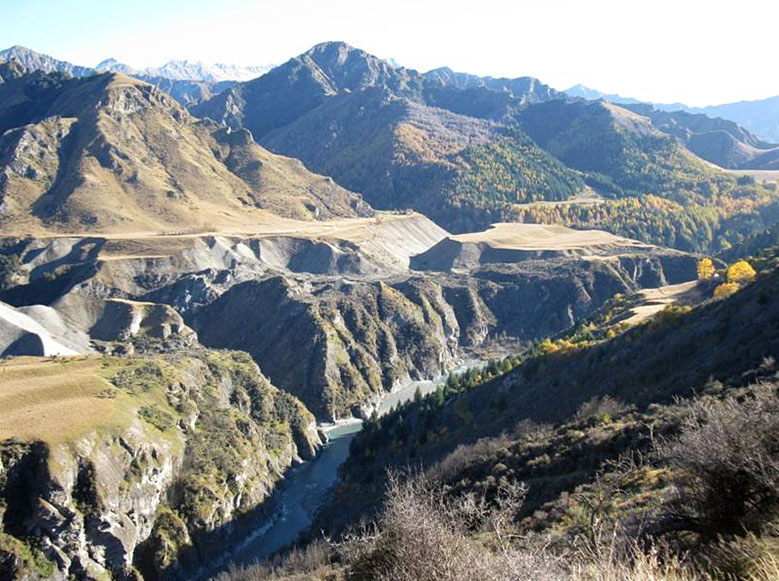
Like Ngai Tahu who have ancestral links with Whakatipu-wai-Maori (Lake Wakatipu) relating to tupuna Rakaihautu, and who valued taonga such as pounamu and gathered the mahinga kai of this mountainous region, so Europeans came inland in search resources, first pastoralism, then gold. Recorded occupation sites show that Ngai Tahu knew the Wakatipu area well, as a source of seasonal food gathering, and particularly as it was en route to the West Coast where pounamu was found. Following on from the spectacular finds at Tuapeka and Dunstan Gorge, gold prospectors swarmed over much of Otago. By the end of 1862 prospectors had reached Skippers Creek.
A reef was discovered by Jones, Murdoch, Southberg and Olsen and became known as the ‘Scandinavian Reef.’ The reef was according to archaeologist Neville Ritchie, the first quartz mine in the South Island. Quartz mining involved underground mining for gold bearing quartz which needed a heavy plant to crush the quartz and a large capital investment to build the stamper battery. The stamper battery also needed power, initially water power, thought this was a problem in an area with extremes of heat and cold.
Skippers Quartz Mining Co. Ltd was registered in March 1866 to work part of the Reef. George Francis Bullen was one of the shareholders, and it was after him that the Bullendale settlement was named. English-born Bullen was one of three brothers with mercantile interests in Melbourne, Victoria, and in Dunedin. They had branches in Queenstown, Cromwell, Hokitika and Greymouth.
Bullen was also a shareholder in the Great Scandinavian Quartz Mining Co. Ltd registered in May 1866. This company had its origins in the Scandinavian Prospectors Company of January 1864. It erected a small 4-stamp battery at their claim. The Great Scandinavian Quartz Mining Co. Ltd replaced the 4-stamp battery with a 30-stamp battery at the confluence of Murdoch and Skippers Creeks. The Scandinavian Reef was renamed the Phoenix Reef, and the company became the Phoenix Company, and was owned by the Bullen Brothers. Engaged through a Melbourne newspaper advertisement, Cornishman Fred Evans was employed as mine manager, a position he would hold for the next thirty years. The Otago Quartz Mining Co. Ltd built a 16-stamp battery in Murdoch’s Creek in 1866, which became known as Southberg’s Battery. The country was tough, the mining tougher, and there was a shortage of payable stone and though the returns through the 1880s were good, the difficulties led to a search for new technology.
The Phoenix Mine Company and the Development of Hydro-Electric Power
In 1885 George Bullen acquired Southberg’s ground and by 1888 he had purchased the British-American ground. In 1889 he bought the Phoenix Extended Claim, making him the sole owner of the field. The Phoenix and the Otago Quartz Mining Companies held a shared water right, which powered both batteries, though there were problems with water supply in dry periods. These problems led Bullen and Phoenix Mine manager Fred Evans (whom historian De La Mare credits with the initiative for pursuing hydro-electric power) advised by Walter Prince (an employee of R.E. Fletcher & Co.) to investigate the use of electric power.
In November 1884, Walter Prince visited the Phoenix mine to report on a proposal to use water from the left Hand Branch of Skippers Creek for power generation, at which time electric lighting was already being used. It was during this visit that first mention is made of a small dynamo which was already being used to provide lighting. The site chosen for the generating station was on the other side of Southberg Spur from the mine, in the Left Branch of Skippers Creek. R.E. Fletcher & Co. was contracted to supply and install the system at a cost of £2,200. A water race was already constructed in the area for Alymer Company’s sluicing claim.
R.E. Fletcher & Co. was a Dunedin firm of electrical engineers and contractors. Robert Ernest Fletcher (c.1857-1935) (an Associate of the Society of Electrical Engineers in London) was born in Dulwich, London and was trained at what was then known as the Anglo-American Brush Co (later the Brush Electrical Engineering Co). He went to Melbourne in 1882 and on behalf of the company started the Australia Electric Co. Fletcher was appointed to carry out the construction of the first hydro-electric system in Australasia in Launceston, and also for the first government hydro-electric scheme in New Zealand with the generating plant at Okere Falls in 1900. By 1884 he seems to have set up his own concern in Dunedin, specialising in mine lighting and in transmission of power over long distances (the Bullendale connection was made in 1884). His obituary in the British Journal of the Institute of Electrical Engineers in 1935 describes him as ‘one of the pioneer electrical engineers of Australasia.’ He died in Auckland in 1935.
Fletcher was involved in mine lighting in 1885, lighting the Kaitangata Railway and Coal Company’s Mine, reported one of the earliest to be electrically lit, following on from the Australian experience where electrical mine lighting was becoming common place. In August 1885 they fitted out the Mosgiel Woollen Mills with a Victoria dynamo which provided power for 300 lamps, reportedly the largest incandescent installation in New Zealand. They exhibited lighting and electrical transmission over a two mile distance powered by a Pelton wheel at an exhibition in Wellington in August 1885. Fletcher went on to supervise and specify the electrical equipment of the Brunner Coal Mine, the first in the country to use an electric plant for powering a coal mine. He later moved to Wellington, where he continued his work as an electrical engineer, including providing advice to the Government on large electrical projects.
Despite the good lighting, the path was not always clear for Fletcher. He was adjudged bankrupt in mid-1886, within two months of completing the Bullendale contract. The bankruptcy proceedings were reported in the paper and give an indication of Fletcher’s operations. The Otago Daily Times reported that Fletcher was working with Walter Prince, carrying on business in Dunedin. Prince entered into an agreement with Mr Bullen of the Phoenix mine, for transmission of electrical power with the machinery supplied by the Australasian Electric Light, Power, and Storage Company Ltd. The Court found that the Australasian Electric Light, Power, and Storage Company Ltd were entitled to claim the price of two generators but no further claim.
Walter Prince is a more elusive figure. Reefton historian Ina Lineham has followed Prince’s trail. She writes that Prince arrived in New Zealand in January 1883 and had been brought over to New Zealand as engineer for the New Zealand Electric Light and Power Company. This company installed electric lights at Lyttelton Harbour in 1883, and was involved in lighting various Dunedin businesses, but by the end of the year Prince was no longer electrician, and pops up again living in Port Chalmers in June 1884. Lineham writes that Prince and Fletcher traded together. The scheme at Bullendale was nearly the end of him, as he was kicked in the head by a horse, with ‘no hope of recovery, but despite this went on to apply his talents to other power schemes (and his inability to work brought down his and Fletcher’s operations. Prince was later linked to the generation of power for lighting Reefton (August 1888), and for lighting houses in Milton (December 1888), and is listed as an electrical engineer in Kaikorai Valley, Dunedin. Chandler states that Prince was replaced by Fletcher, but the bankruptcy proceedings seem to indicate a closer link, like the one outlined by Lineham.
Carting the heavy equipment over the precipitous and hazardous Skippers Road and then via a rough track to Bullendale was a momentous feat in itself. Each of the dynamos alone weighed three tons. The Bullendale hydro-electric power plant was commissioned in 1886, with a trial of the system held on 3 February 1886. The Otago Witness reported at some length about the event, emphasising the huge achievement in such a remote area:
‘In the battery-house, mounted on a strong wooden platform, was one of the Anglo American Brush Company’s Victoria dynamos, which had been fitted up as a motor. Standing by this machine, awaiting the starting of the generators situated at a waterfall two miles away, we were speculating on the wonders of electricity, when, suddenly, as if by magic, the wheels of the motor began to move and then to buzz round with marvellous rapidity. The current had been switched on, the electric transmission of power at the Phoenix mine was an accomplished fact, and we were among the first to witness the success of what was perhaps the first experiment of the kind on a practical scale made in the Southern Hemisphere.’
The account continued:
‘A little distance from the battery-house are two little dynamos driven by small pelton wheels and used for generating the current for lighting purposes. The generators are situated about five miles by track in what is called the left-hand branch, but more correctly speaking the right branch, of the stream which has now been appropriately christened Dynamo creek.’
After describing the spectacular setting, mountains, the backdrop of Mt Aurum (‘a fitting background to so romantic a scene’) the reporter described the dynamo-house, where the visitors were given a tour by Mr Fletcher:
‘The two large Brush dynamo machines were at work generating the electric current which was travelling over the intervening hill to the motor in the battery-house, Mr Fletcher having just that day completed his momentous undertaking. His task was by no means an easy one, for some of the parts had been damaged in transit over the Skippers track from Queenstown, and the workmanship of others did not reflect much credit on the Home makers….Mr Fletcher’s indomitable perseverance and skill, and the work which has at last been brought to a satisfactory issue may now be regarded as one of the triumphs of modern engineering. The dynamos are situated in an iron building at the foot of a perpendicular cliff about 200 feet high. An open ground race about half a mile in length brings the water from the creek to the top of the cliff, and it is then conveyed to the pelton wheels which drive the generators in a couple of wrought iron pipes....An almost perpendicular fall of 180ft is obtained, and the four or five heads of water coming down the pipes send the pelton wheels round with great velocity.’
The writer continued optimistically about the new technology: ;There can be no question of the utility of the electric principle…There can be no doubt that electricity will, before many years, play a very important part in the development of the quartz reefs in the Wakatipu district…Power in the shape of numerous never-failing streams is daily running to waste….’ The electric lighting extended to the battery house, the hall and mine office, to some of the houses, and the mine, and along one of the tramways. The isolation meant that steam driven technology (with associated fuel provision and transportation) and water power (in an area where flow would have to be maintained in dry and icy conditions) meant that electrical power appeared to offer a relatively cheap and effective solution, and stands out as a ‘shining example of the triumph of human ingenuity in the application of electric power to gold mining processes.’
The DC transmission line was mounted on poles constructed from hardwood lower sections, with softwood upper sections bolted on. Ceramic insulators were mounted on wooden cross-arm at the top. The line made its way across the gorge in front of the power house and over the high ridge of Southbergs Spur to the battery house at Murdochs Creek, a distance of over one and a half miles. The motive power may also have driven a chaff-cutter (if as local tradition maintains, Dynamo Flat was planted in oats), and the tail water drove a sawmill on at Skippers Creek.
In 1890 Fred Evans, the Phoenix mine manager, reported on the operation of the power plant. Evans said that there had been a lot of local interest about the use of electric power, with many people sceptical about its success. He stated that
‘at the present time we are driving 20 heads of stampers at a distance of two miles from the source of power, the water power at this time of the year being at its lowest and the frost at its strongest. In the morning shift we drive 10 heads, with stone crusher and air compressor, the latter providing power for winding 150ft deep trucks containing 7cwt. Quartz. The waterfall at the generating station is 168ft of five heads, supplying two 5ft Pelton wheels, driving two 40ft light machines of the Anglo-Brush pattern, the motor being a Victoria. The greatest amount of energy exerted when having seven heads of water, we drove 30 heads of stamps, stone-breaker, air compressor of 12in diameter, 2ft stroke to 40ob, and amalgamating gear equal to at least 54-h.p. The wear and tear in the machines themselves is so little beyond the brushes as to be practically not worth calculating, the brushes costing about £1 per month. The motor has given 95 per cent efficiency, which in itself is a sufficient answer to its suitability as a power, without any question it must supersede steam on our rivers if they are to be made to pay.’
There were problems with the equipment largely because of the primitive understanding of the technology. Balancing the loads from the generators was difficult, with any imbalance tending to turn one dynamo into a motor and drive it backwards. The output of the dynamos was also less than expected.
Once the technology was pioneered at Bullendale, the spread of electrical transmission to other areas of mining was swift. It was cheap and efficient power that could be transmitted over distance and the application to dredging technology was swift. The technology surrounding dynamos developed rapidly.
Bullendale Township
Bullendale miners and their families lived in a small isolated settlement that grew up on the slopes around the battery, particularly on the sunny face facing the battery building. Most of the buildings were small huts, generally made from corrugated iron on a timber framing, of which two remain standing. It is estimated that there may have been as many as 50 such huts and small houses at the mine’s peak operation. Service buildings included Bullen Hall (with electric lighting), a billiard room, the Phoenix Hotel and a combined store, butchery and bakery. The structures associated with the mine were the main battery house, the winding house, a mine office and some ancillary buildings.
The End of Mining
Access to Bullendale improved marginally with the construction of the dray road from Arthurs Point to Skippers (completed 1890), but access past Skippers remained difficult and the transport of heavy battery and mining equipment was a major undertaking.
Poor returns in the late 1880s and early 1890s led George Bullen to sell the Phoenix Mine to English company Achilles Goldfields Ltd. The old battery was rebuilt in July-August 1896. The Achilles Company sank a new main incline shaft. Material was removed via a tramway to the battery. The winding was powered by a Pelton wheel and a corrugated iron shed houses the equipment at the shaft mouth. Troubles continued and by 1897 the Company was restructured as the Achilles Gold Mines Ltd. The mine was dilapidated with workings requiring re-timbering and the machinery was run down. R.E. Fletcher reported on the outmoded equipment and made recommendations for new generators and other improvements. Despite the installation of two new 30 h.p. motors troubles continued. The mine closed in May 1901. With its closure Bullendale lost its reason to exist. The Post Office closed in 1902.
Messrs Robert Lee and party, trading as Mt Aurum Quartz Mining Ltd bought the mine in 1903 and began working it in 1904. This company’s promoters were Robert Lee (of Kaitangata Coal Co.), politician and businessman Joseph Ward and Invercargill merchant Robert Anderson. Operation concentrated on the British-American Spur. An aerial cableway was constructed to convey ore to the old battery site, where a cyanide plant was possibly installed. The operation failed and the mine closed in 1907. Some small scale prospecting and mining continued locally in the late 1920s.
When the mine shut down Bullendale was abandoned. Transport difficulties meant that the equipment was left as it stood. The town stood unchanged until World War One when shortages of corrugated iron led to the dismantling of many structures. The Phoenix Battery building was set alight around 1920 to retrieve ironwork from the roof framing. Duncan McNichol of The Branches rebuilt the Ballarat Hut on his run with material taken from Bullendale, including the hall and the manager’s house. The Dynamo House was demolished around 1930 and the iron used to construct several other structures, including the nearby Dynamo Hut. In the Dynamo Hut visitors book Arthur Borrell wrote that the Dynamo Hut was built in 1919 using material from the power house.
Recent Developments
In 1979 the remains of the Phoenix Quartz Mining Company’s crushing and generating plants were officially recorded during the course of an archaeological site survey conducted by New Zealand Historic Places Trust on behalf of the Ministry of Works and Development.
In 1984 an Electricity Generation Centennial Committee was established, which made the decision to reconstruct the major elements of the Phoenix Dynamo on site. An archaeological excavation by Neville Ritchie located evidence of the building which housed the dynamos. Ritchie reported on the site’s ‘special historic significance’ marking the first time hydro-electricity was used in New Zealand for industrial purposes (and therefore the forerunner of the massive hydro-electric projects of the mid-twentieth century), but that this significance had been largely overlooked. Ritchie emphasised that the site should be considered as a single system (and its component parts – which included the water race, mines, penstock, dynamo plant, transmission line, settlement and battery).
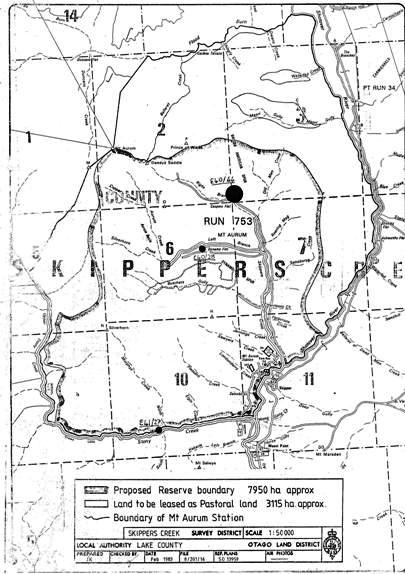
In 1985 the Mount Aurum Recreation Reserve was gazetted, which included the Bullendale site.
In 1986 the centenary of Bullendale’s power plant was celebrated with a widely attended ceremony at Arrowtown which was addressed by the Hon. R.J. Tizard, the Minister of Energy, a history, and a reconstruction project. The main dynamo components were repositioned in their original context on a reconstructed framework.
In 2011 a project team from the Wakatipu Office of the Department of Conservation, the Queenstown Historical Society, the New Zealand Historic Places Trust and goldfields archaeologist Peter Petchey are looking at the future protection and interpretation of Bullendale.