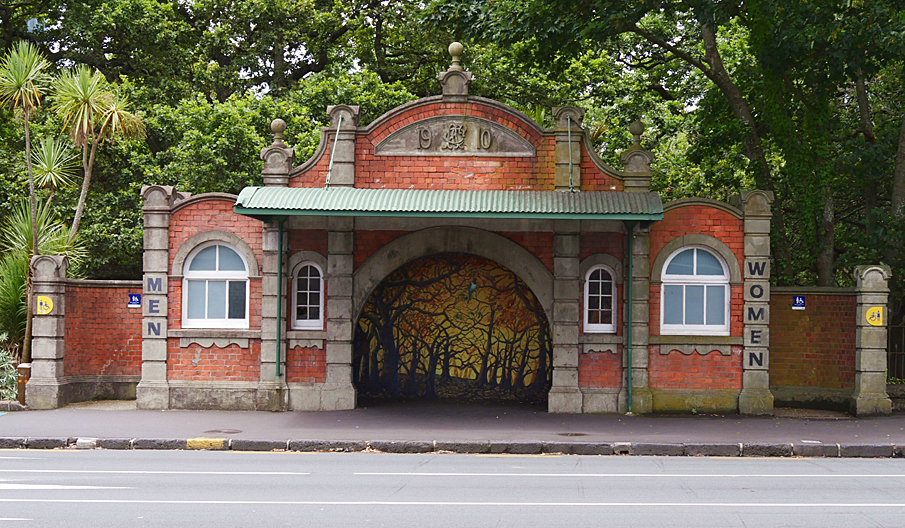
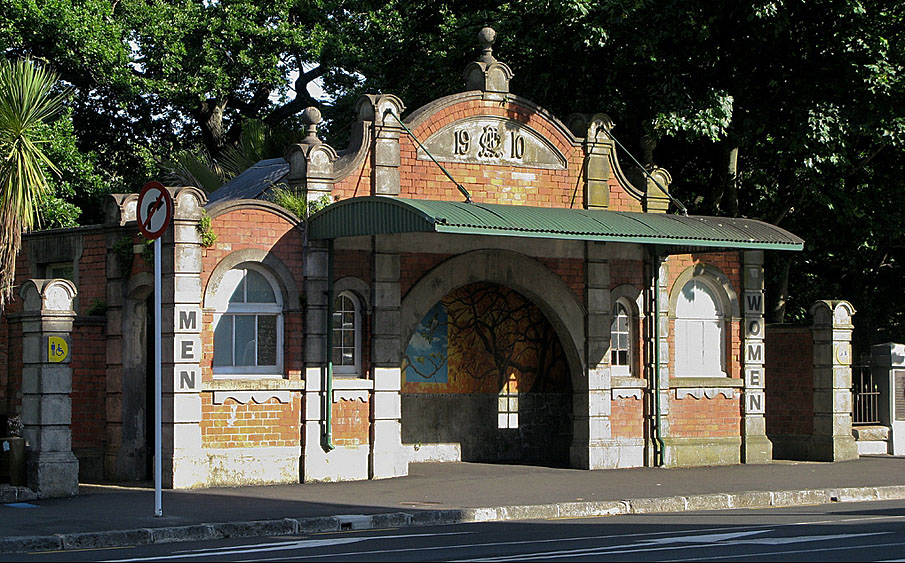
Erected in 1910, the Public Conveniences and Shelter in Symonds Street are important for their close association with nearby construction of the technologically notable Grafton Bridge, and for encompassing the first standalone street toilets in Auckland to contain facilities for women as well as men. Designed by Walter Ernest Bush (1875-1950), the visually distinctive structure is additionally significant for its Edwardian Baroque architecture and as a local landmark. The single-storey, masonry building reflects civic pride in the first years of New Zealand as a Dominion; concerns about public health and sanitation in the early 1900s; and the growing visibility and influence of women in twentieth-century urban life. Also incorporating a public transport shelter, it further forms a notable reminder of Auckland’s once-extensive tram network, and the latter’s superseding by motorised buses.
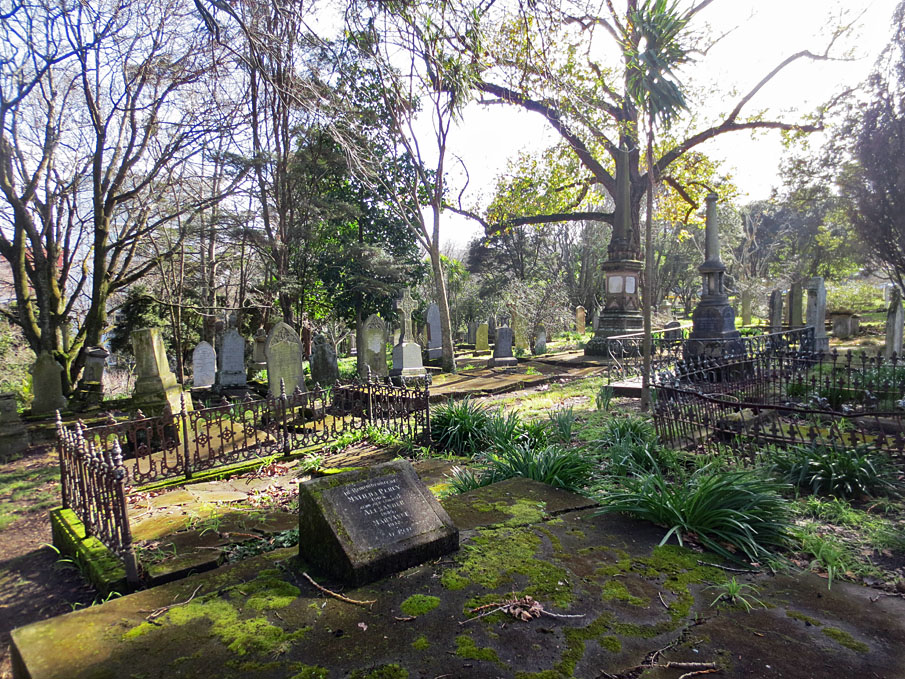
The Symonds Street and Karangahape Road ridges have long incorporated major communication routes. Prior to European arrival, Te Ara o Karangahape formed an ancestral pathway connecting the Waitematā and Manukau harbours, used by food-gathering parties. Beside it, Te Iringa o Rauru was named after an incident during struggles for control of Tāmaki Makaurau between Te Waiōhua and Ngāti Whātua. Cultivations were also maintained. After Ngāti Whātua provided land in 1840 for a colonial capital at Auckland, the city’s first public cemetery was laid out at the junction of Karangahape Road and Symonds Street, beside a route linking the early settlement with areas to the south. In the early 1900s, the civic authority - Auckland City Council - formally closed the cemetery (1909) and erected Grafton Bridge (1907-10), increasing the intersection’s importance to an expanding road and tram network servicing Auckland’s growing suburbs. Electrification of the city tram system in 1902 was the earliest in New Zealand.
Proposals for conveniences in Symonds Street were initially mooted in 1906 as part of an increase of public toilet facilities in the city. Civic improvements to urban sanitation were undertaken in response to bubonic plague fears and other public health scares in turn-of-the-century Auckland. Work at Symonds Street was delayed until designs for Grafton Bridge had been finalised, and it was not until 1909 that revised plans were prepared by City Engineer W.E. Bush - who played a leading role in modernising Auckland’s early twentieth-century infrastructure. Construction was overseen by contractor Samuel Clarke (1850-1922), then president of the New Zealand Federated Builders’ Association. The brick building was completed in March-April 1910, immediately before Grafton Bridge formally opened.
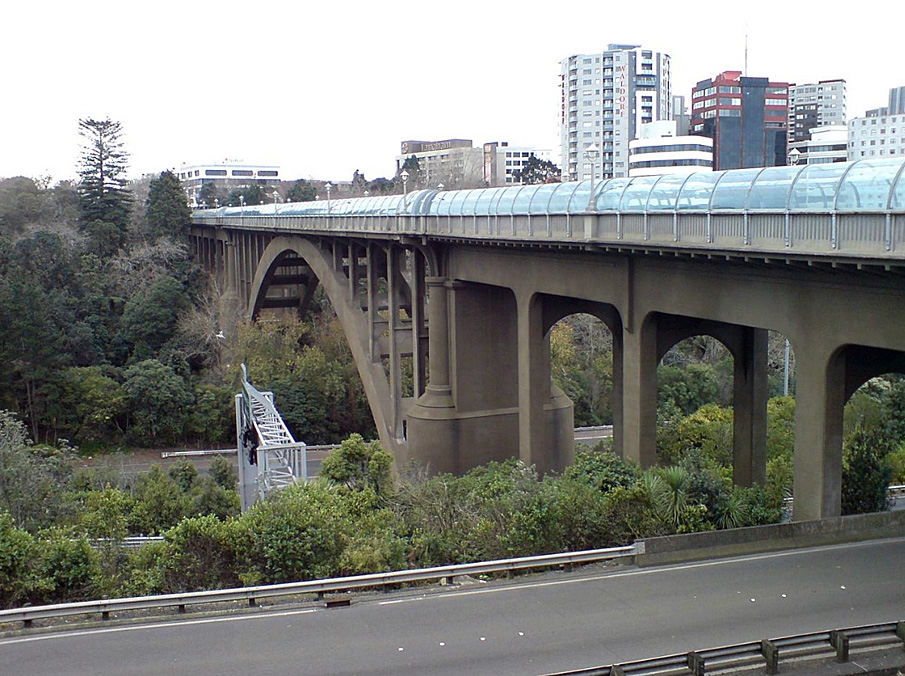
Bush’s Edwardian Baroque design applied the high visual standards usually employed for major civic buildings to one of relatively modest function, reflecting the importance of the overall Grafton Bridge project. The building’s main façade incorporated a wide central archway and flanking arched windows, potentially referencing the bridge’s impressive ferro-concrete span, said at the time to be the longest in the world. Like Grafton Bridge the new structure was innovative, accommodating both men’s and women’s toilet facilities as well as a tram shelter - the first in the city to combine these features - and the earliest stand-alone street facility for women. From 1909, the local branch of the Women’s Political League and similar groups had sought more urban public toilets for women, reflecting the growing presence and influence of women in the public life of New Zealand cities. Offering greater privacy, the women’s conveniences were initially accessed from inside a central shelter containing a bench, while those for men had an external entrance. A wide canopy extended from the building towards busy tram stops on Symonds Street.
After construction, the shelter was frequently used for purposes other than those intended, including rough sleeping. By the 1920s, the women’s access had been altered to an external arrangement that mirrored that for men, and an additional restroom solely for women was created at nearby Pigeon Park, in the former cemetery grounds. During the Second World War (1939-45), conversion of the Symonds Street toilets to a male-only facility with white-tiled walls and an attendant’s room coincided with Council attempts to inhibit men from leaving each other messages for sex, at a time when homosexuality was deemed illegal. After trams were decommissioned in 1956, the structure remained in use as a bus shelter with modified canopy, and in 2000 separate women’s conveniences were re-installed. A major conservation project in 2020-21 reinstated many earlier features that had been concealed or removed. Since continuing in use as a shelter and public conveniences, the current building forms a visually distinctive feature of the historic Symonds Street and Karangahape Road areas, and an enduring monument to improving facilities for women in Auckland.
The Symonds Street and Karangahape Road ridges have long incorporated major communication routes. Prior to European arrival, Te Ara o Karangahape formed an ancestral pathway connecting the Waitematā and Manukau harbours, used by food-gathering parties. Beside it, Te Iringa o Rauru was named after an incident during struggles for control of Tāmaki Makaurau between Te Waiōhua and Ngāti Whātua. Cultivations were also maintained. After Ngāti Whātua provided land in 1840 for a colonial capital at Auckland, the city’s first public cemetery was laid out at the junction of Karangahape Road and Symonds Street, beside a route linking the early settlement with areas to the south. In the early 1900s, the civic authority - Auckland City Council - formally closed the cemetery (1909) and erected Grafton Bridge (1907-10), increasing the intersection’s importance to an expanding road and tram network servicing Auckland’s growing suburbs. Electrification of the city tram system in 1902 was the earliest in New Zealand.
Proposals for conveniences in Symonds Street were initially mooted in 1906 as part of an increase of public toilet facilities in the city. Civic improvements to urban sanitation were undertaken in response to bubonic plague fears and other public health scares in turn-of-the-century Auckland. Work at Symonds Street was delayed until designs for Grafton Bridge had been finalised, and it was not until 1909 that revised plans were prepared by City Engineer W.E. Bush - who played a leading role in modernising Auckland’s early twentieth-century infrastructure. Construction was overseen by contractor Samuel Clarke (1850-1922), then president of the New Zealand Federated Builders’ Association. The brick building was completed in March-April 1910, immediately before Grafton Bridge formally opened.
Bush’s Edwardian Baroque design applied the high visual standards usually employed for major civic buildings to one of relatively modest function, reflecting the importance of the overall Grafton Bridge project. The building’s main façade incorporated a wide central archway and flanking arched windows, potentially referencing the bridge’s impressive ferro-concrete span, said at the time to be the longest in the world. Like Grafton Bridge the new structure was innovative, accommodating both men’s and women’s toilet facilities as well as a tram shelter - the first in the city to combine these features - and the earliest stand-alone street facility for women. From 1909, the local branch of the Women’s Political League and similar groups had sought more urban public toilets for women, reflecting the growing presence and influence of women in the public life of New Zealand cities. Offering greater privacy, the women’s conveniences were initially accessed from inside a central shelter containing a bench, while those for men had an external entrance. A wide canopy extended from the building towards busy tram stops on Symonds Street.
After construction, the shelter was frequently used for purposes other than those intended, including rough sleeping. By the 1920s, the women’s access had been altered to an external arrangement that mirrored that for men, and an additional restroom solely for women was created at nearby Pigeon Park, in the former cemetery grounds. During the Second World War (1939-45), conversion of the Symonds Street toilets to a male-only facility with white-tiled walls and an attendant’s room coincided with Council attempts to inhibit men from leaving each other messages for sex, at a time when homosexuality was deemed illegal. After trams were decommissioned in 1956, the structure remained in use as a bus shelter with modified canopy, and in 2000 separate women’s conveniences were re-installed. A major conservation project in 2020-21 reinstated many earlier features that had been concealed or removed. Since continuing in use as a shelter and public conveniences, the current building forms a visually distinctive feature of the historic Symonds Street and Karangahape Road areas, and an enduring monument to improving facilities for women in Auckland.