DonateMembershipVisit Heritage
  • Tūrangawaewae
    Places
  • Tira Māori
    Māori Heritage
  • Poutairangahia
    Archaeology
  • Rauemi
    Resources
  • Mō Tātou
    About Us
  • New Zealand Heritage List
  • Nominate and submit
  • Explore the List
  • National Historic Landmarks
  • Plaques
  • Rainbow List Project
  • Lost heritage
  • Visit Heritage
  • Our properties
  • Turnbull House Project
  • Collections
  • Shop
  • Tohu Whenua
  • Tira Māori
  • Conserving Māori heritage
  • Marae built heritage
  • Māori heritage on the List
  • Hinemihi—Te Hokinga Mai
  • What is archaeology?
  • Is there a site on my property?
  • What are my legal requirements?
  • Affecting an archaeological site
  • Declaring an archaeological site
  • Archaeology FAQs
  • Archaeology Digital Library
  • Archaeology guidelines and templates
  • Resources
  • Funding
  • Publications
  • Sustainable management guides
  • Disaster recovery
  • Podcasts & digital resources
  • Education Hub
  • Conservation plans
  • About
  • Board
  • Māori Heritage Council
  • Senior Staff
  • Offices
  • Contact us
  • Careers
  • Covenants
  • Fast-track
  • Corporate documents
  • Currently consulting on
  • Our submissions
  • News
  • Covid-19 response
Quick links
Rārangi Kōrero | The List
Explore the List
National Historic Landmarks
Ngā Manawhenua o Aotearoa me ōna Kōrero Tūturu
Quick links
Tapuwae
A Vision for Places of Māori Heritage
Funding for Māori Heritage
Resources
Quick links
Archaeological Authority Portal
Applying for an archaeological authority
Archaeology FAQs
Browse the most frequently asked questions about archaeological authorities and the archaeological process.
Quick links
Quick links
News
News Keep up to date with Heritage New Zealand Pouhere Taonga
Membership
Membership Find out more and sign up today
DonateMembershipVisit Heritage
  • Tūrangawaewae
    Places
  • Tira Māori
    Māori Heritage
  • Poutairangahia
    Archaeology
  • Rauemi
    Resources
  • Mō Tātou
    About Us
  • New Zealand Heritage List
  • Nominate and submit
  • Explore the List
  • National Historic Landmarks
  • Plaques
  • Rainbow List Project
  • Lost heritage
  • Visit Heritage
  • Our properties
  • Turnbull House Project
  • Collections
  • Shop
  • Tohu Whenua
  • Tira Māori
  • Conserving Māori heritage
  • Marae built heritage
  • Māori heritage on the List
  • Hinemihi—Te Hokinga Mai
  • What is archaeology?
  • Is there a site on my property?
  • What are my legal requirements?
  • Affecting an archaeological site
  • Declaring an archaeological site
  • Archaeology FAQs
  • Archaeology Digital Library
  • Archaeology guidelines and templates
  • Resources
  • Funding
  • Publications
  • Sustainable management guides
  • Disaster recovery
  • Podcasts & digital resources
  • Education Hub
  • Conservation plans
  • About
  • Board
  • Māori Heritage Council
  • Senior Staff
  • Offices
  • Contact us
  • Careers
  • Covenants
  • Fast-track
  • Corporate documents
  • Currently consulting on
  • Our submissions
  • News
  • Covid-19 response
Quick links
Rārangi Kōrero | The List
Explore the List
National Historic Landmarks
Ngā Manawhenua o Aotearoa me ōna Kōrero Tūturu
Quick links
Tapuwae
A Vision for Places of Māori Heritage
Funding for Māori Heritage
Resources
Quick links
Archaeological Authority Portal
Applying for an archaeological authority
Archaeology FAQs
Browse the most frequently asked questions about archaeological authorities and the archaeological process.
Quick links
Quick links
News
News Keep up to date with Heritage New Zealand Pouhere Taonga
Membership
Membership Find out more and sign up today
  • Nominate and submit
  • National Historic Landmarks
  • Nominate and submit
  • National Historic Landmarks
  • Conserving Māori heritage
  • Marae built heritage
  • Conserving Māori heritage
  • Marae built heritage
  • Archaeological authorities
  • Archaeology Digital Library
  • Archaeological authorities
  • Archaeology Digital Library
  • All resources
  • Publications
  • Funding
  • All resources
  • Publications
  • Funding
  • FAQs
  • FAQs
Follow us on:
Places
  • Nominate and submit
  • National Historic Landmarks
Tira Māori
  • Conserving Māori heritage
  • Marae built heritage
Archaeology
  • Archaeological authorities
  • Archaeology Digital Library
Resources
  • All resources
  • Publications
  • Funding
FAQs
  • FAQs
Follow us on
HomePrivacyTerms and conditionsAbout this site
© Heritage New Zealand Pouhere Taonga 2026.
 
Stewart Town

Menzies Terrace, BANNOCKBURN

Public

Historic Place Category 2

List No. 5610

Quick links:
List GalleryLocationDetails
Stewart Town is an archaeological site that includes the remains of a cluster of earth and stone buildings, a water race and the associated orchard, occupied by gold miners including David Stewart, John Menzies and William Roy from about 1865 until the early twentieth century. Stewart Town has historical and archaeological significance relating to the lives of the gold miners and the technologies they used.

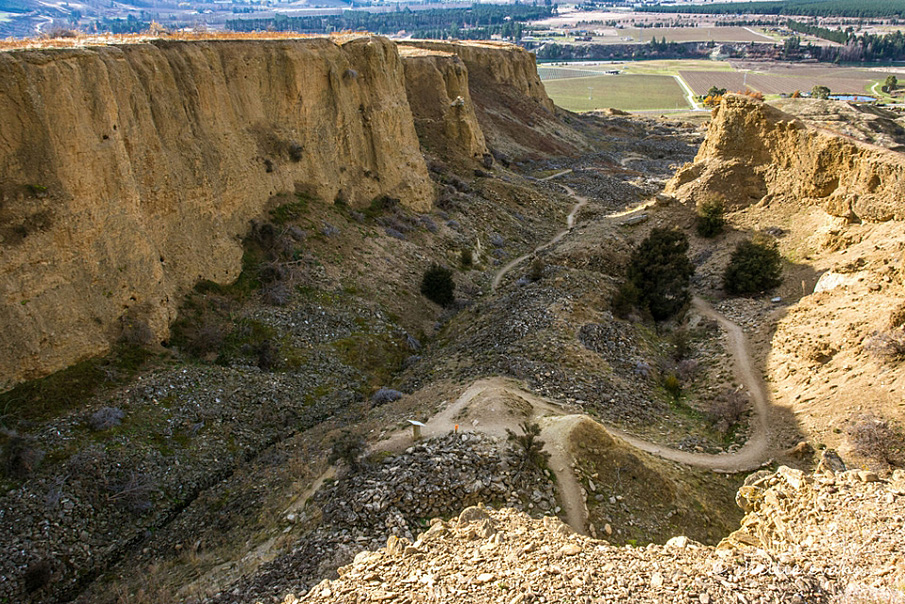
Stewart Town sits on a terrace close to Menzies Dam and overlooks the spectacular sluicing faces of Pipe Clay Gully. The land on the south bank of the Kawarau River, stretching up to the Carrick Range, was subject to extensive mining, particularly hydraulic sluicing (Bannockburn Sluicings, List Entry No. 5612). Stewart Town was not a town rather a cluster of buildings, that existed because of the residents’ control and sale of water to miners. It is named for miner and entrepreneur David Stewart who secured the water right from Long Gully, cut a race and built a dam to store water, which he sold to miners. Access to water allowed previously unworkable areas to be mined.

Stone mason David Stewart, and miner John Downie Menzies lived in a stone building close to their reservoir (Menzies Dam, List Entry No. 5611). Menzies died in 1894 and his house, race, claims and effects were sold. Stewart Town was occupied from about 1865 until the early twentieth century. Menzies and Stewart were in Bannockburn by the mid-1860s and there is a record of an application for a residence area in both their names in 1873. David Stewart died in 1883. William Roy mined with David Stewart and John Menzies from the 1870s. In 1913, Roy’s residence area was located next to the orchard section. William Roy died in 1923. As mining declined, the land around Stewart Town became part of the landscape of small holdings and allotments characteristic of the subdivisions between Bannockburn and the Kawarau River.

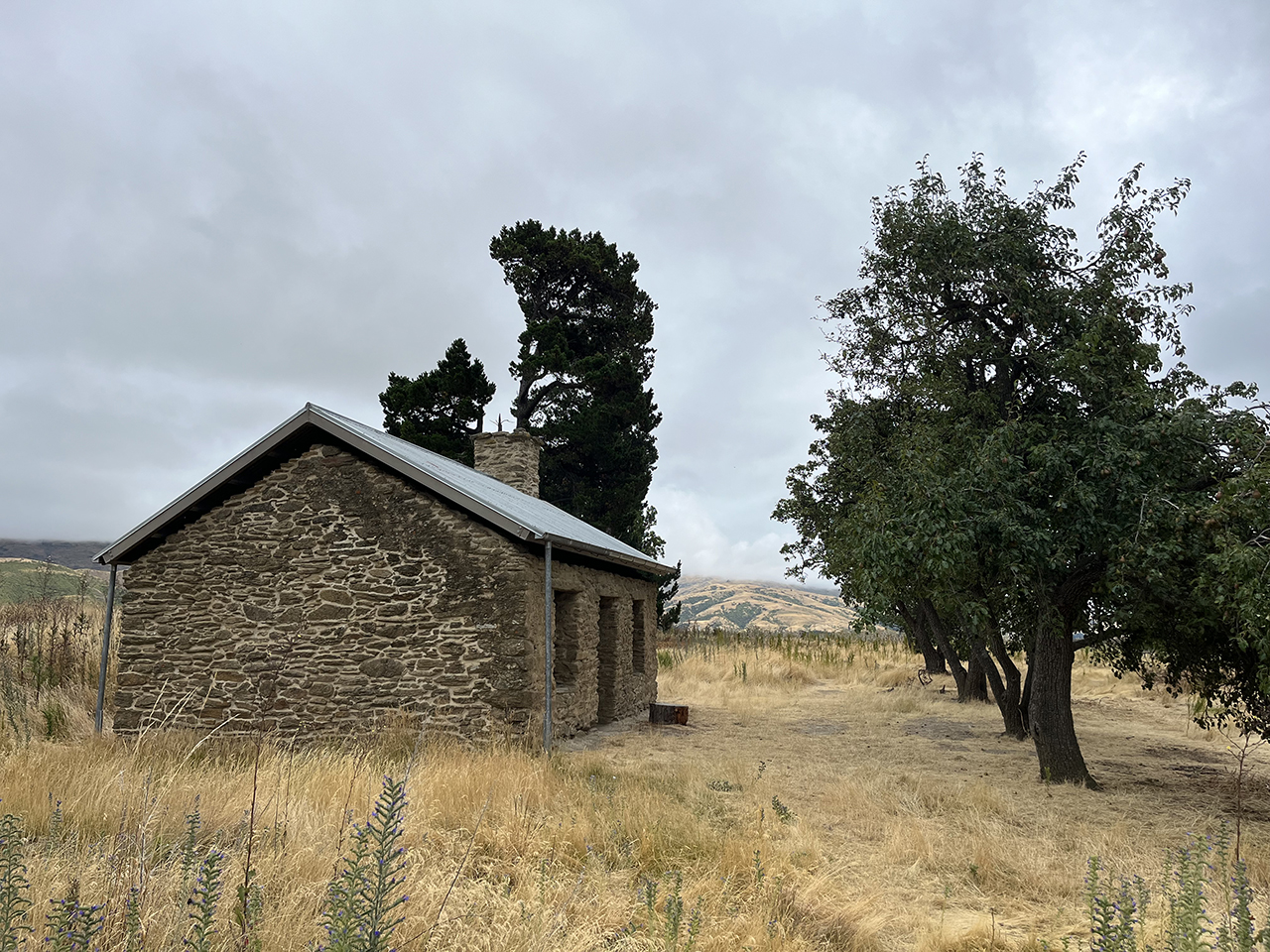
Stewart Town is a collection of nine earth and stone structures centred around one stone house (the Lind house). The stone house is constructed of split schist with mud mortar, with a mud brick extension at the north end. There are traces of cement plaster on the inside. The doors, windows and fireplace have large schist slabs over them. There is a small mud-walled area adjacent to the extension that was reportedly a dairy. There appear to have been at least two compounds surrounded with mud brick walls, a small section of which remains. A race runs through the back compound, and then to a dam. In front of the Lind House is an orchard containing fruiting apple, pear and apricot trees.

The land on which Stewart Town stands was included in the Bannockburn Sluicings Historic Reserve gazetted in 2000. In 2014, Stewart Town remains part of the Bannockburn Sluicings Historic Reserve.
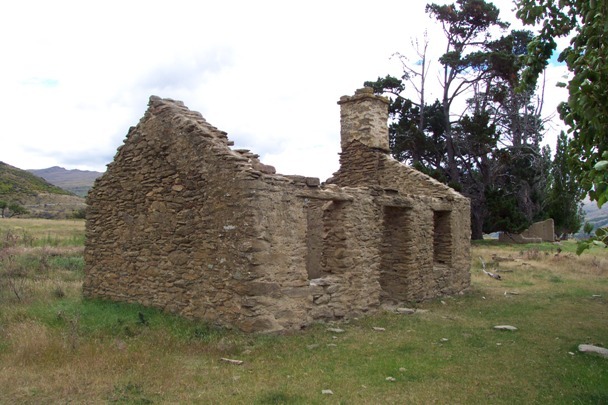
Stewart Town, Bannockburn | S Gallagher | 19/01/2024 | Heritage New Zealand Pouhere Taonga

List Entry Information

Overview

Status
Listed

List Entry Status
Historic Place Category 2

Access
Able to Visit

List Number
5610

Date Entered
10th April 1985

Date of Effect
10th April 1985

City/District Council
Central Otago District

Region
Otago Region

Extent of List Entry

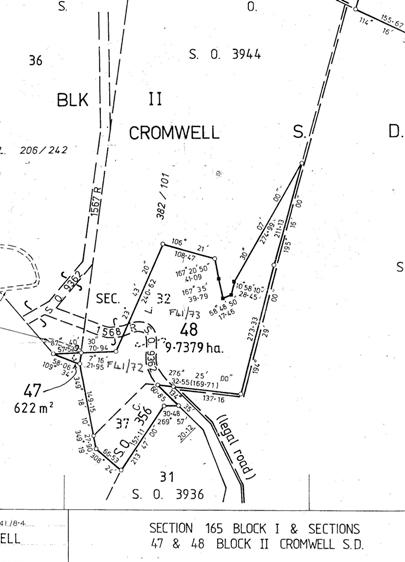
Extent includes part of the land described as Pt Lot 1 DP 26776 (RT OT18D/464), Otago Land District, and the archaeological sites associated with Stewart Town. Refer to the extent map tabled at the Heritage New Zealand Board meeting on 30 April 2015.

Legal description

Pt Lot 1 DP 26776 (OT18D/464), Otago Land District

Detailed List Entry

Construction Details

Start Year

1865

Type

Original Construction

Reference

Public NZAA Number

F41/72

Completion Date

11th February 2015

Report Written By

Heather Bauchop

Information Sources

Otago Goldfields, n.d.

Otago Goldfields Park pamphlet

Stephenson, 2004

Janet Stephenson, Heather Bauchop and Peter Petchey, 'Bannockburn Heritage Landscape Study', Department of Conservation, Science and Research Unit, Wellington 2004

Report Written By

This place was identified as significant under previous legislation with different information requirements. It remains significant under the current legislation. There is opportunity under our legislation and policies to add to this information. Further information about this place may be available from the Otago/Southland Office of Heritage New Zealand Pouhere Taonga. Please note that entry on the New Zealand Heritage List/Rarangi Korero identifies only the heritage values of the property concerned, and should not be construed as advice on the state of the property, or as a comment of its soundness or safety, including in regard to earthquake risk, safety in the event of fire, or insanitary conditions. A fully referenced upgrade report is available on request from Otago-Southland Office of Heritage New Zealand

Further Information

Current Usages

Uses: Civic Facilities

Specific Usage: Historic or recreation reserve

Uses: Cultural Landscape

Specific Usage: Historic Landscape

Former Usages

General Usage:: Accommodation

Specific Usage: House

General Usage:: Agriculture

Specific Usage: Orchard

General Usage:: Mining

Specific Usage: Mine Water Race/ Water Race cuttings/tunnels etc

Themes

Web Links

Overview

Status

Listed

List Entry Status

Historic Place Category 2

Access

Able to Visit

List Number

5610

Date Entered

10th April 1985

Date of Effect

10th April 1985

City/District Council

Central Otago District

Region

Otago Region

Extent of List Entry

Extent includes part of the land described as Pt Lot 1 DP 26776 (RT OT18D/464), Otago Land District, and the archaeological sites associated with Stewart Town. Refer to the extent map tabled at the Heritage New Zealand Board meeting on 30 April 2015.

Legal description

Pt Lot 1 DP 26776 (OT18D/464), Otago Land District

Status

Listed

List Entry Status

Historic Place Category 2

Access

Able to Visit

List Number

5610

Date Entered

10th April 1985

Date of Effect

10th April 1985

City/District Council

Central Otago District

Region

Otago Region

Extent of List Entry

Extent includes part of the land described as Pt Lot 1 DP 26776 (RT OT18D/464), Otago Land District, and the archaeological sites associated with Stewart Town. Refer to the extent map tabled at the Heritage New Zealand Board meeting on 30 April 2015.

Legal description

Pt Lot 1 DP 26776 (OT18D/464), Otago Land District

Construction Information

Construction Details

Start Year

1865

startYearCirca

Type

Original Construction

Construction Details

Start Year

1865

startYearCirca

Type

Original Construction

Reference

Historical and Associated Iwi / Hapū / Whānau

Public NZAA Number

F41/72

Completion Date

11th February 2015

Report Written By

Heather Bauchop

Information Sources

Otago Goldfields, n.d.

Otago Goldfields Park pamphlet

Stephenson, 2004

Janet Stephenson, Heather Bauchop and Peter Petchey, 'Bannockburn Heritage Landscape Study', Department of Conservation, Science and Research Unit, Wellington 2004

Other Information

This place was identified as significant under previous legislation with different information requirements. It remains significant under the current legislation. There is opportunity under our legislation and policies to add to this information. Further information about this place may be available from the Otago/Southland Office of Heritage New Zealand Pouhere Taonga. Please note that entry on the New Zealand Heritage List/Rarangi Korero identifies only the heritage values of the property concerned, and should not be construed as advice on the state of the property, or as a comment of its soundness or safety, including in regard to earthquake risk, safety in the event of fire, or insanitary conditions. A fully referenced upgrade report is available on request from Otago-Southland Office of Heritage New Zealand

Historical and Associated Iwi / Hapū / Whānau

Public NZAA Number

F41/72

Completion Date

11th February 2015

Report Written By

Heather Bauchop

Information Sources

Otago Goldfields, n.d.

Otago Goldfields Park pamphlet

Stephenson, 2004

Janet Stephenson, Heather Bauchop and Peter Petchey, 'Bannockburn Heritage Landscape Study', Department of Conservation, Science and Research Unit, Wellington 2004

Other Information

This place was identified as significant under previous legislation with different information requirements. It remains significant under the current legislation. There is opportunity under our legislation and policies to add to this information. Further information about this place may be available from the Otago/Southland Office of Heritage New Zealand Pouhere Taonga. Please note that entry on the New Zealand Heritage List/Rarangi Korero identifies only the heritage values of the property concerned, and should not be construed as advice on the state of the property, or as a comment of its soundness or safety, including in regard to earthquake risk, safety in the event of fire, or insanitary conditions. A fully referenced upgrade report is available on request from Otago-Southland Office of Heritage New Zealand

Further Information

Current Usages

Uses: Civic Facilities

Specific Usage: Historic or recreation reserve

Uses: Cultural Landscape

Specific Usage: Historic Landscape

Former Usages

General Usage: Accommodation

Specific Usage: House

General Usage: Agriculture

Specific Usage: Orchard

General Usage: Mining

Specific Usage: Mine Water Race/ Water Race cuttings/tunnels etc

Current Usages

Uses: Civic Facilities

Specific Usage: Historic or recreation reserve

Uses: Cultural Landscape

Specific Usage: Historic Landscape

Former Usages

General Usage: Accommodation

Specific Usage: House

General Usage: Agriculture

Specific Usage: Orchard

General Usage: Mining

Specific Usage: Mine Water Race/ Water Race cuttings/tunnels etc

Location

Loading
Related listings
Bannockburn Sluicings, Central Otago. CC BY-NC-ND 2.0 Image courtesy of www.flickr.com
Bannockburn Sluicings
Menzies Dam, Bannockburn, Central Otago
Menzies Dam
Menzies Dam, Bannockburn, Central Otago
Menzies Dam
Bannockburn Sluicings, Central Otago. CC BY-NC-ND 2.0 Image courtesy of www.flickr.com
Bannockburn Sluicings
Stay up to date with Heritage this month