Early history of the site
Waitangi was a coastal settlement before the arrival of European peoples. Situated at the mouth of the Waitangi River in Pēwhairangi / Bay of Islands, it had direct access to marine resources and good-quality horticultural soils. Archaeological observations record the presence of shell middens and related features at Waitangi, including within the current Treaty Grounds. The settlement is likely to have been particularly important for its position beside a notable transportation route connecting Pēwhairangi with fertile lands in the interior.
Traditional Ngāpuhi accounts refer to the site being occupied by Maikuku, a daughter of Uenuku and Kareariki, inhabitants of Pouerua pa - a large inland centre. As a woman of high birth, Maikuku moved to Waitangi after becoming tapu at adulthood and initially lived in a cave known as Te Ana o Maikuku, believed to extend underground from the shoreline to the vicinity of the current flagstaff. Maikuku was sought out by Hua from Taratara pā at Whangaroa, who discovered the cave due to the wailing of a taniwha. Subsequent to their union, Maikuku and Hua occupied a house, Ruarangi, above the cave. A stone feature overlooking the approach to this site from the sea is traditionally known as Maikuku’s seat - he tūru o Maikuku. Maikuku and Hua left Waitangi following the birth of their first child, Te Rā, and eventually returned to Pouerua.
Maikuku is significant as a granddaughter of Rāhiri, the founding ancestor of Ngāpuhi. Ngāpuhi came to form a major force in the northern part of the North Island prior to European arrival, and remains New Zealand’s largest tribal group. The offspring of Maikuku and Hua are notable for founding several hapū of what later became the influential Ngāpuhi northern alliance. Te Rā became the leading rangatira of Pouerua - subsequently one of the main settlements of the northern alliance - and the founder of Ngāti Rāhiri. As Ngāti Rāhiri’s lands lay predominantly inland, Waitangi formed the hapū’s main and perhaps only coastal settlement. It is said to have been occupied seasonally, with people gathering from inland to fish and collect shellfish for three months each year.
Early Māori-Pākehā interaction at Waitangi
In the early 1800s, land at Waitangi was held by Waraki, a Ngāti Rāhiri rangatira. By this time the Bay of Islands had become a major port for ships from Britain and North America that were engaged primarily in whaling. The area also became a focus for New Zealand’s earliest European missionary activity, including that undertaken by the London-based Church Missionary Society (CMS). In May 1815, Waraki provided 50 acres of land at Waitangi to two early CMS missionaries, Thomas Kendall and William Hall, in return for five axes. Waraki was the father-in-law of Ruatara, a notable leader in the Pēwhairangi region who had been instrumental in establishing New Zealand’s first mission station beside Rangihoua pā a few months previously.
Hall and Kendall were interested in Waitangi because of its potential for accessing timber resources, undertaking cultivation and raising cattle. Their agreement with Waraki reflected early divisions within the missionary community and a desire by some members to become more self-sufficient – including through private enterprise. The compact can be considered one of the first recorded land accommodations between Māori and Pākehā in New Zealand. During the negotiations, Waraki expressed his concerns that Māori would soon struggle to retain their lands.
Hall and Kendall’s 50 acres was on the north side of the Waitangi River. Two CMS sawyers, Conroy and Campbell, constructed a saw pit and dwellings for themselves, possibly on the beach at Te Ana o Maikuku, in the southeastern part of the current treaty grounds. They also helped erect a substantial timber house for Hall and his family. By January 1816, Hall had planted wheat, created a vegetable garden and cleared about two further acres, assisted by local Māori. This enterprise can be considered one of the first European-style farms in New Zealand. Hall also took steps to teach Māori workmen how to saw timber using European equipment. Both this and agricultural training were in line with early CMS policy to provide Māori with new skills.
Local Māori engaged with the CMS party according to their own needs and cultural framework. Following both the death of Waraki in June 1815 and a transgression of wāhi tapu by Waraki’s followers, taua muru parties from elsewhere in Pēwhairangi visited members of the CMS party to exact ritual payment or utu. First the sawyers, and then the Hall family returned to Rangihoua. Although Hall dismantled his house, he continued to crop wheat and barley at Waitangi until shortly before his departure from New Zealand in 1825. By this time, the CMS had established other stations at Kerikeri (1819) and Paihia (1823), the latter lying to the south of the Waitangi River mouth and forming the headquarters of the CMS.
Ngāti Rāhiri rangatira in the 1820s and 1830s were prominent in inter-Māori conflicts of this period - the so-called ‘Musket Wars’. Waitangi was subject to several taua or taua muru expeditions, some large and destructive. By the late 1820s, the settlement’s proximity to Paihia led increasingly to visits from CMS missionaries, who by now had a greater focus on religious conversion. Recorded Māori cultivations in the Waitangi area include those of early Christian converts, such as Rangi - the first male convert in 1824 - and in 1828, Rāwiri Taiwhanga, a skilled horticulturalist who experimented with European crops and farming techniques at an early stage, and whose acceptance of Christianity in 1830 became ‘the first conversion of note’.
Māori, James Busby and the site of the British Residency
From the mid-1820s, overseas commercial activity in New Zealand, and particularly the North, diversified to involve a wider range of resources and commodities. Economic engagement between Māori and Britain, including shipping operating from Australian ports, increased with benefits perceived by both parties. The CMS encouraged Māori to consider that the Crown had a paternal interest in their welfare, and facilitated a visit to England by the powerful Ngāpuhi leaders Hongi Hika and Waikato in 1820, during which Hongi gained an audience with King George IV. This meeting was seen by Northern Māori as reflecting a special bond, and it was to George’s brother King William IV that thirteen leaders appealed to by letter in 1831, requesting the latter to become ‘a friend and guardian of these islands’. This occurred in the light of concerns about the misconduct of visiting British subjects and rumours of French territorial ambitions. Many Pākehā settlers also sought British intervention.
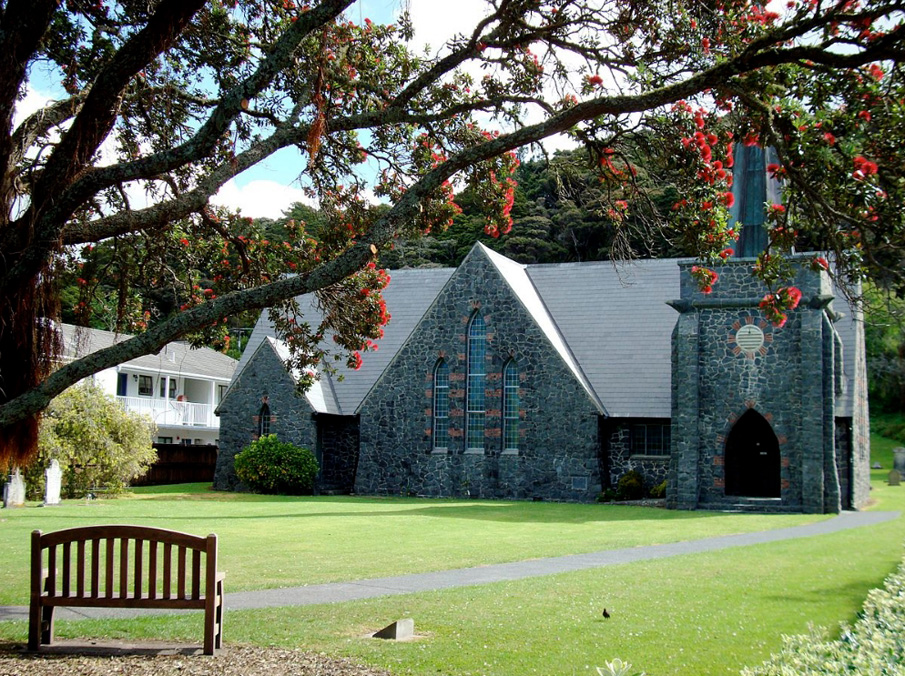
Anxious to protect its trading interests, the British government appointed a British Resident in 1832 to act as an intermediary or kaiwhakarite between Māori and Pākehā in New Zealand. The chosen individual was James Busby (1802-71), a native of Edinburgh who had emigrated to New South Wales in 1824. Busby had experimented with vine-growing on a 2000-acre (809 hectare) grant of land in the Hunter River district before impressing the colonial authorities with reports on subjects that included viticulture and New Zealand. Busby first set foot in this country in May 1833, at the CMS headquarters at Paihia.
Busby’s instructions as British Resident were to protect ‘well disposed settlers and traders’, prevent offences by Europeans against Māori, and apprehend escaped convicts. His duties also included assisting ‘the commercial relations of Great Britain and her colonies with New Zealand’. On 20 May 1833, at a ceremony in Paihia churchyard (List No. 3824; Category 1 historic place), Busby read out the ‘King’s letter’ - presented to a large gathering of Māori, including 22 rangatira, as a response to the 1831 petition. As historian Claudia Orange has noted, Busby ‘pointed out that the King was honouring them (whakarangatiratanga - literally, increasing their chiefly mana) by his appointment, just as similar appointments were made to European states and to America. There was more than a suggestion of ambassadorial representation to an independent country.’
In accordance with official instructions, Busby immediately discussed the location for a place of residence with the assembled chiefs. According to Busby, they suggested that Waitangi was the most suitable site because of its connections with the interior. Busby appears not to have mentioned that prior to leaving Australia, he had obtained the deed to Hall’s ‘Farm at Wythangee’, providing him with the potential, at least, to evict European settlers. Recent occupants had included an elderly physician, Dr Adolphus James Ross and his wife, from Port Jackson (Sydney), who had built a house on the land in early 1833, subsequently abandoned. In addition to Ngāti Rāhiri, hapū associated with Waitangi at this time included Ngāti Kawa and Te Matarahurahu.
Construction of the British Residency (1833-4)
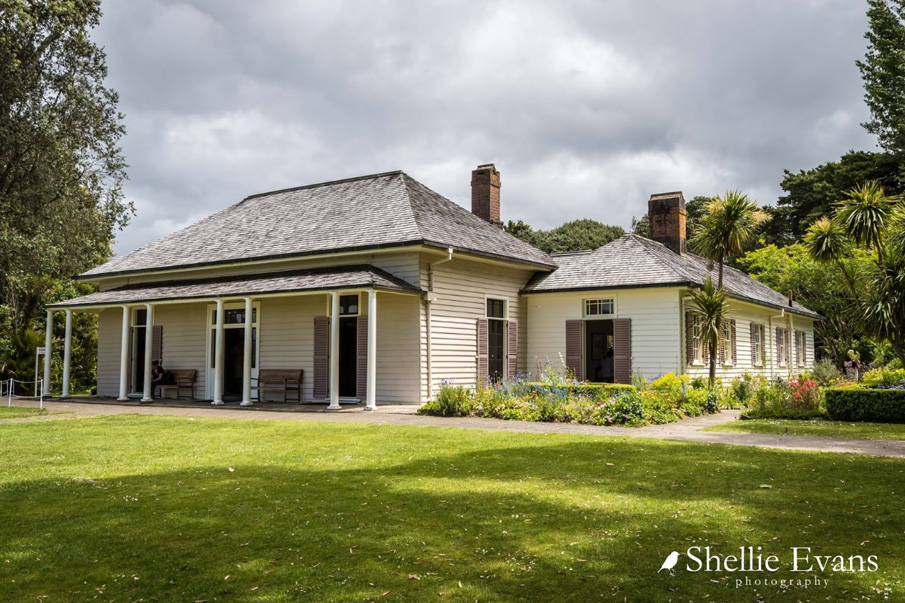
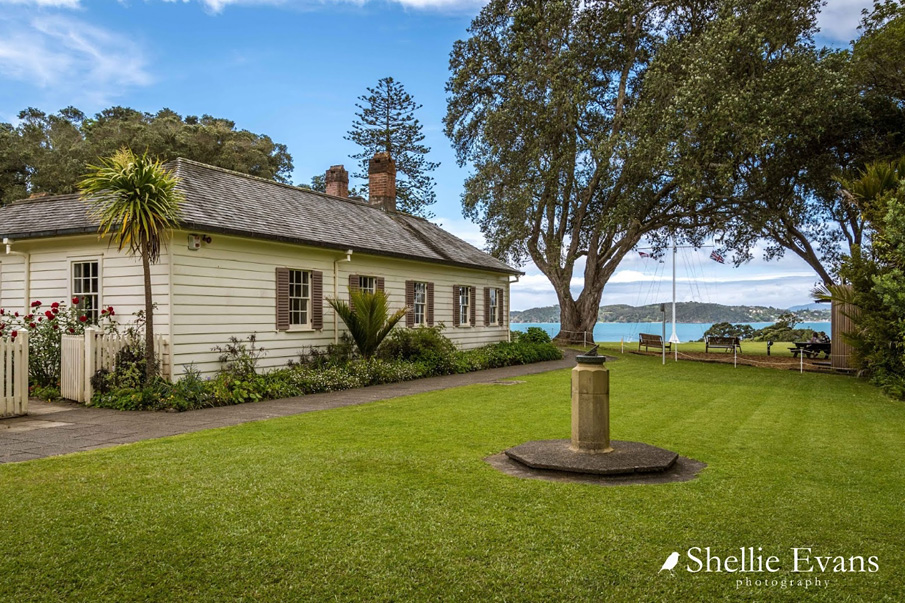
Busby’s new residence was erected over several months in 1833-4. It occupied an elevated position from which trade and other activity in the Bay could be surveyed. The residence consisted of two main structures: the first was a largely prefabricated, rectangular house of symmetrical Georgian design. The second was a detached outbuilding to the rear, constructed of local materials.
The single-storey timber house was designed by the Colonial Architect of New South Wales, Ambrose Hallen (?-1845), who modified plans for a more ambitious structure commissioned by Busby from the fashionable Sydney architect, John Verge (1782-1861). Made largely from Australian hardwoods, the structure’s main components were prefabricated in Sydney by both ‘free’ and convict labour. The weatherboard house was rectangular in plan, containing two moderate-sized rooms, a smaller central room, and a wide central hall, all under a hipped roof. At the front it also encompassed a projecting verandah.
Prefabrication provided Busby with greater certainty about his accommodation, but was also a means of transporting familiar ideas about ‘home’, social and cultural background and status. Within a British colonial context, the main building’s symmetrical appearance symbolised order and reason, in common with other Georgian-style architecture, which was influenced by Enlightenment ideas. Class, gender and other social relations were embodied in the incorporation of a detached block to the rear containing a kitchen and servants' room, which was constructed of native timber and other local materials. Although Busby considered the overall residence to be small for someone of his station, it was of significantly better quality than most other Pākehā dwellings in the region.
Construction of the residence involved both Māori and Pākehā communities. After being initially shipped to Paihia, most components of the main house were transported by waka to Waitangi in June 1833. Both Māori and Pākehā workmen appear to have been employed in preparing the ground and subsequent carpentry work. Busby also purchased locally-made shingles, laths and shell for lime from communities at Te Puke and Waimate, as well as additional timber from Pākehā merchants. Gardens were simultaneously prepared, which included the planting of vines. James Busby and his wife Agnes moved into the new premises in late January 1834.
New Zealand’s first national flag and He Whakaputanga o te Rangatiratanga o Nu Tirene / The Declaration of the Independence of New Zealand (1834-5)
Between 1834 and 1840, the Residency and its immediate surroundings formed a landscape in which major political developments affecting New Zealand’s future occurred. Both Māori and Pākehā took part in a decision-making, although not necessarily in mutual understanding. While the Residency symbolised the British Crown’s formal presence in New Zealand, land immediately in front of the building ‘became a space that was used like a marae or a paepae, a space where issues were debated within Ngāpuhi and between Māori and Pākehā’. Initially, the residence was viewed by at least some Māori as a tapu, or sacred place because of its links with the King’s representative.
Busby appears to have wanted Māori leaders to form a collective, decision-making assembly or legislature as a prelude to a British dependency or protectorate being established. Māori rangatira, however, were more focussed on upholding the mana and wellbeing of their people. As part of Busby’s first diplomatic initiative, in March 1834, 25 or more Northern rangatira gathered in a tent erected on the lawn in front of the Residence to choose a national flag. Intended to identify New Zealand ships, including those owned by Māori who were by now engaged in overseas trade, this move had been immediately prompted by concerns that such ships were being turned away at foreign ports. The rangatira voted for a white flag with the red cross of St George, and a blue field in the top left corner containing another red cross and four white stars. As historian Claudia Orange has noted of this emblem, known as Te Kara:
'…its long-term significance lay in Maori understanding of the event: the belief that the mana of New Zealand, closely associated with the mana of chiefs, had been recognised by the British Crown…The flag identified New Zealand as a separate country, yet associated it with Britain, known by Maori to be the world’s most powerful nation. Northern Maori absorbed the flag into their oral tradition, possibly regarding it as a special rahui or protection of their identity.'
In October 1835, Busby called another hui at the Residence in response to a perceived threat of French intervention. A gathering of 34 rangatira discussed and signed a document in te reo Māori known as He Whakaputanga o te Rangatiratanga o Nu Tirene - translated by Busby as the Declaration of the Independence of New Zealand. The signatories requested that King William IV remain their matua (guardian or protector) against threats to their authority and mana, as part of a reciprocal arrangement in which they would protect British subjects in their territory. They also agreed to meet annually at Waitangi, and make decisions about trade, peace and wrong-doing. The Colonial Office responded with reassurances that the King would offer support and protection as long as this was consistent with ‘the just rights of others and to the interests of His Majesty’s subjects’. There is evidence that Northern Māori subsequently met at Waitangi and elsewhere, although on their own terms rather than in a timber Parliament House planned by Busby. Busby continued to gather signatures for He Whakaputanga until 1839, including that of the notable Waikato leader, Te Wherowhero.
During this period, Busby may have developed the grounds further. Additional vines were planted in 1836. More substantial cultivation may have occurred after 1837, when Busby requested a ‘Scotch plough’ that would allow him to bring new land into use. A Norfolk Island pine is said to have been given by the immediate family of Gilbert Mair, an early Scottish trader who was involved in representations to the British government to have New Zealand declared a British colony. As well as promoting the use of imported plants, Busby also kept a nursery of native trees, which he evidently hoped to export to Britain for substantial profit: two rows of surviving cabbage trees to the northwest of the house may reflect a horseshoe arrangement around the garden, shown in 1840. Much of the activity on the gardens and cultivations was carried out through the efforts of Māori workmen. Notable visitors included the naturalist, Charles Darwin (1809-1882) in December 1835.
With a growing family, Busby also erected additional rooms in a rear skillion to the main house, possibly in the second half of 1839.
Te Tiriti o Waitangi / The Treaty of Waitangi (1840)
In 1836, a dispute between two rangatira, Waikato and Noa, over the sale of land to a European purchaser had resulted in several people being killed on the Residency grounds, diminishing the tapu nature of the building. Further tensions in the region led to a serious outbreak of conflict in 1837. Over 200 British nationals signed a petition for Crown intervention. Pressure was also coming to bear on Crown authorities by private colonising groups in Britain, such as the Wakefield settlers, to allow planned settlement. The authorities shifted from supporting a position whereby accommodation had to be found for British settlers in a Māori New Zealand to one where a place had to be found for Māori in a settler colony.
In 1839, the British appointed Captain William Hobson (1792-1842) as consul to New Zealand. His task was to secure sovereignty for the British Crown peacefully, preferably by treaty. After arriving in Kororāreka in January 1840, he announced himself Lieutenant Governor and proclaimed land restrictions as issued in New South Wales. Having asserted authority over British subjects, he requested Busby - who had now been relieved of his position - to organise a formal assembly or hui of rangatira at the former Residency due to its associations with earlier discussions between Māori leaders and the British government.
In preparation for the event, a treaty document was drafted. In part, this took place at the former Residency. A te reo Māori translation was subsequently prepared, involving the CMS missionary leader Henry Williams. The contents of the treaty in English guaranteed rights for both Māori and Pākehā in return for British ‘sovereignty’; the te reo version used different terminology that would have been understood within its own cultural framework. A large tent was erected on the lawn in front of Busby’s house, in which discussions would take place.
On 5 February, a substantial number of people, both Māori and Pākehā arrived at the former Residency grounds. They included many of the rangatira from the region, as well as missionaries, dignitaries and local settlers. After the contents of the treaty had been delivered in English, the te reo Māori version was read out for the benefit of the rangatira. In ensuing speeches, many of them including the tohunga and rangatira of Waitangi, Te Kēmara, spoke out against the treaty. Others, notably Tāmati Waka Nene, spoke in favour. After many hours, the rangatira retired to Te Tou Rangatira at Te Tii, on the south side of the Waitangi River, where they engaged in further debate into the night.
The following morning, a second gathering took place at the former Residency. This resulted in up to 46 rangatira signing a te reo Māori parchment version of the treaty inside the marquee. The first signatory was Hōne Heke. The signatory on behalf of the Crown was Hobson. Shaking everyone who had signed by the hand, Hobson declared ‘He iwi tahi tatou’ (We are now one people).
The treaty was envisaged as being a founding document ‘under which an indigenous people and settlers from a vastly different culture were intended to live together peaceably in the same country’. Its three articles collectively provided for an extension of Crown control; a guarantee of rights for rangatira; and a guarantee of the rights and privileges of British subjects for all Māori. However, Te Tiriti o Waitangi in te reo Māori, which the rangatira at Waitangi had signed, held different meanings to the English-language Treaty of Waitangi. As Claudia Orange has noted, ‘Māori and Europeans therefore had different expectations of the treaty’s terms.’ In particular, while Māori considered the treaty to guarantee a sharing of control, British authorities and most Pākehā settlers saw it as representing a straightforward transfer of sovereignty to the Crown. Resolution of such differences has since provided New Zealand with challenges.
After the first signing at Waitangi, Hobson organised for the treaty to be sent to other parts of the region and then further afield to gather additional signatures. As at Waitangi, not all Māori rangatira were prepared to sign. Significant leaders such as Mananui Te Heuheu of Ngāti Tūwharetoa, and others, declined. Nevertheless, in May 1840 Hobson declared British sovereignty, back-dating it to 6 February. This made New Zealand the first island-group in the Pacific to come under formal European control, a significant step in the process of globalisation in the region.
Victoria, the Northern War and Busby’s Estate (1840-82)
Prior to Hobson’s arrival in January 1840, Busby had recognised that his role as British Resident was coming to an end. Initially, he sought to maintain his future by promoting Waitangi as the site of a township and future capital of New Zealand. A proposed settlement, called Victoria, was surveyed between Busby’s house and the Waitangi River, with the first lots being sold in Sydney in November 1839. As Governor Hobson’s temporary residence, Busby’s dwelling was referred to immediately after the treaty as ‘Government House’. However, Government officials soon recognised that the location lacked the necessary requirements for a substantial town. After a temporary capital was created elsewhere in the Bay of Islands at Okiato in May 1840, a permanent centre of administration was established some 200 kilometres to the south, at Auckland. More generally, Busby’s land also became subject to a protracted dispute with the Crown after the latter proclaimed that it would investigate all land purchases made before January 1840.
During the early 1840s, Busby initially concentrated on converting his large landholding into a country estate and working farm, commensurate with his position as a founding citizen of the colony and gentleman farmer. The former Residency was enlarged with projecting rear wings, probably in 1841-2, creating a more substantial dwelling of Palladian design. In 1844, the visiting American consul, J. B. Williams, described the house as a ‘pretty neat, and hospitable Mansion’.
The shift of power to Auckland resulted in a reduction in the importance of Ngāpuhi in relation to commercial activity and interaction with the Crown. Frustrations led to open conflict - the Northern War of 1845-5 - between parts of Ngāpuhi, led by Hōne Heke, and British and other forces. At this time, the house was evidently subjected to taua muru by Kawiti’s people, Norfolk Island pines were cut down, and the lawns damaged by animals. British forces were also quartered at the residence and its surrounds in January-July 1846. Reflecting an ongoing military presence in the region, James Busby proposed to sell the house and land to the government for a military station. Later in 1848, the estate was offered to let, ‘to supply the troops stationed at the Bay, or to engage in fattening cattle and for persons wanting to fatten cattle and sheep for the Auckland market.’
For most of his remaining life, Busby fought the government to retain the Waitangi estate and other lands obtained, an issue that was finally settled in 1868. He took an active role in public life, including as a representative for the Bay of Islands in the Auckland Provincial Council (1853-5 and 1857-63), and as editor of the Aucklander (1861-3), a newspaper that was created partly to oppose the government on land claim issues. Both he and Agnes Busby shared their time between Auckland and their country estate. Improvements to the house included reshingling, possible extension of the south wing, and the addition of a glasshouse.
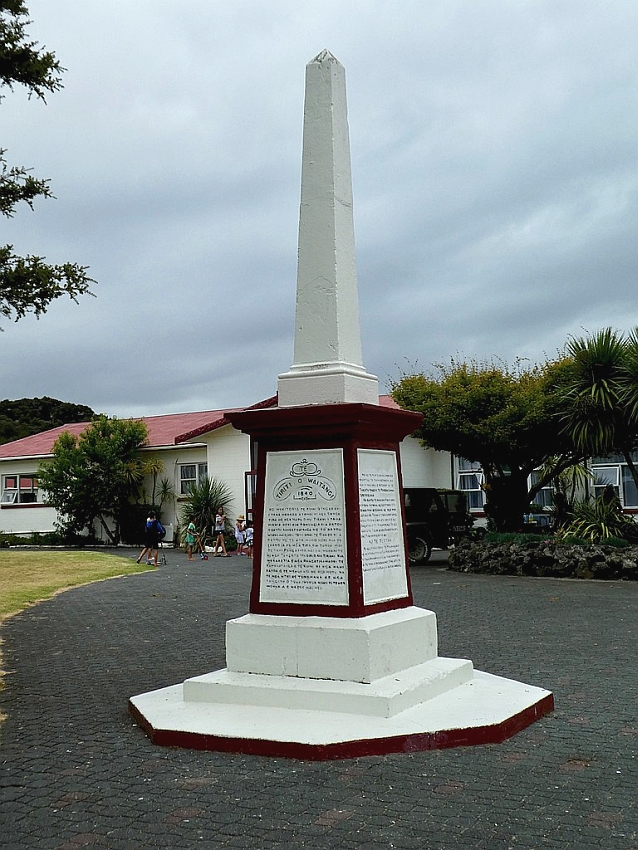
After James Busby’s death in 1871, the estate was occupied by Agnes with sons John and William Busby. At the dissolution of John and William Busby’s partnership in 1879, the estate was offered for sale. At this time, the house was described as ‘a comfortable Cottage of 22 rooms, with Out-offices…adjoining it there is about 6 acres [2.4 hectares] of Shrubbery and Orchard, the latter full of choice Fruit-trees’. Consciousness about the Treaty had receded among the settler community, and although it was noted that the estate might be suitable for purchase by the ‘sentimentally-disposed’, no bids were received. From the 1870s, it was largely left to Māori to keep the connections between Waitangi and the Treaty alive. In 1876 when the colonial governor, the Marquess of Normanby visited, the main Māori place of assembly was at Te Tii. A year before the Busby estate was finally sold in 1882, Agnes Busby and many other dignitaries attended the opening of the new Te Tiriti o Waitangi meeting house on the south side of the river. In addition to the meeting house, a monument to commemorate the treaty was also erected (List No. 71, Category 1 historic place).
Emergence as a National Monument (1883-1932)
In 1886, when the Waitangi estate was offered for sale again, no mention was made of its historic connections. In 1892, the house was noted as ‘once occupied by Mr. Busby, the British Resident’ and was said to be ‘still standing in decent preservation’. However, it became increasingly run-down. With its associated land being managed as a sheep run, the house is said to have been unoccupied, with its front rooms used as a shearing-shed and nightly sheep-shelter.
Following the 50th anniversary of New Zealand’s creation as a British colony and related jubilee celebrations in the 1890s, a keenness developed among the settler community to acknowledge people and places linked particularly with the European pioneering past. When offered for sale again in 1900, the land was referred to as the ‘historic Waitangi estate’. After purchase by farmer, E. G. Hewin, the house was renovated for occupation. Work at this time included demolishing the north wing and glasshouse, and rebuilding the front verandah.
In the early 1900s, lawyer and local politician Vernon Reed became interested in the historic associations of the house, notably its direct links with the Treaty of Waitangi, which he saw as ‘the instrument which brought about the entry of New Zealand into the British Empire’. In 1908, the year after New Zealand’s colonial status formally ended with the country’s transformation into a British Dominion, Reed was elected to represent the Bay of Islands in Parliament and approached the Liberal Government about preserving the Waitangi estate as a national memorial. The Government authorised negotiations to occur, but Reed was unable to secure a satisfactory agreement that encompassed an area beyond the house and its immediate grounds.
A subsequent owner, F. W. F. Fagan of Russell, sought to take advantage of the estate’s historic associations: in 1910, he emulated Busby’s attempts to create a new township, offering 200 quarter acre sections at Ruarangi, Waitangi, to include Busby’s house. The latter was described as ‘the greatest “antiquity” connected with the British occupation of the Dominion…[which] must be memorable as a country’s birthplace, tinged with all the intense romance of a Shakespeare’s Stratford-on-Avon’. A number of sections were purchased, but others remained unsold.
In the 1930s, the approaching centennial of European colonisation further increased interest in New Zealand’s history and heritage. Notions of nation-building also held a high profile as the country experienced the difficulties of the Great Depression. There had additionally been a recent strengthening of Māori interest in the treaty, partly stimulated by the construction of a new meeting hall at Te Tii. When the Waitangi property encompassing the house was offered for sale in 1931, Vernon Reed took the Governor-General, Charles Baron (later Viscount) Bledisloe, and his wife Lady Elaine to view the site. The couple immediately decided to purchase and gift the property to the nation.
A former Conservative politician in Britain, Lord Bledisloe considered the site to be ‘New Zealand’s most historic spot’. In his view, the Treaty of Waitangi not only ‘established British Sovereignty in this Dominion and laid the foundation of its peaceable and ordered Government, but also safe-guarded for all time the rights and privileges of the Native Race’. It was his view that ‘the site…cannot fail to be an object of considerable interest both to New Zealanders and British visitors in days to come. If this is so, its preservation as a National Monument would appear to be desirable’. Bledisloe’s awareness of history and landscape may have been influenced by his own country estate, Lydney Park in Gloucestershire, England, which contained remnants of an Iron Age hillfort, Roman temple and medieval castle close to the main residence. In 1928-9, Bledisloe had allowed the eminent British archaeologist, Sir Mortimer Wheeler, to excavate the temple and other remains, generating popular interest.
The Waitangi house and its associated garden formed the earliest substantial national purchase of a place for cultural heritage purposes, and the country’s ‘first monument of state’.
The ‘Treaty House’ and its grounds (1933-1970)
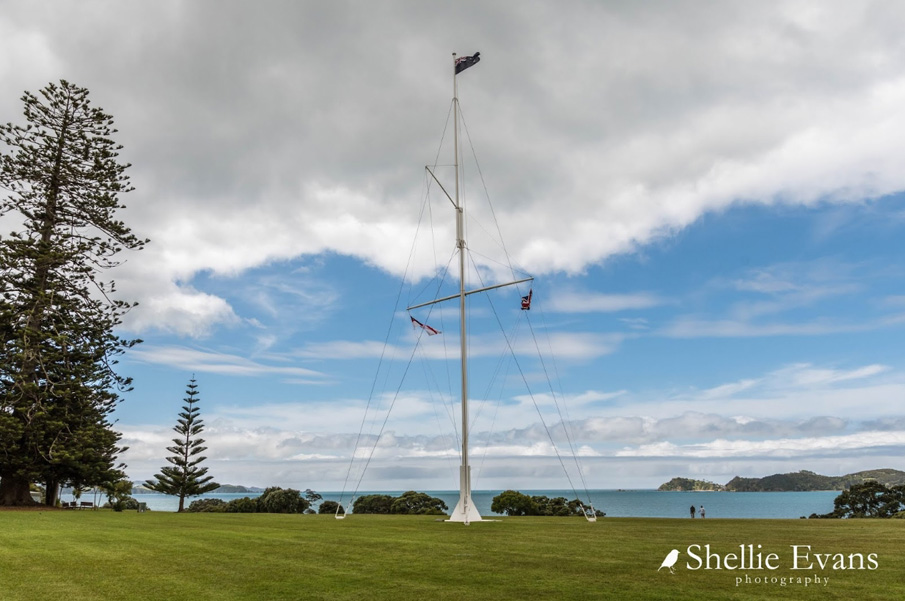
The Bledisloes’ gift of some 1,000 acres (405 hectares) in May 1932 was followed by a further 1,300 (526 hectares) a few months later. The couple also donated £500 towards the restoration of the former British Residency, which was in future to be known as the Treaty House. The government entrusted restoration to two well-known architects, W. H. Gummer of Auckland and William Page of Wellington. Gummer, in particular, was one of the country’s leading practitioners. With instructions to return the building as near as possible to its character, structure and appearance in 1840, they oversaw a dramatic modification of the residence, including the construction of a new concrete north wing and replacement of the rear skillion and south wing. Wall framing of the 1833-4 house was retained. A new flagstaff and commemorative plaque was also erected in front of the house, marking the approximate position where the treaty was signed. Lord Bledisloe considered the spot where the treaty was signed to be the most important part of the gift.
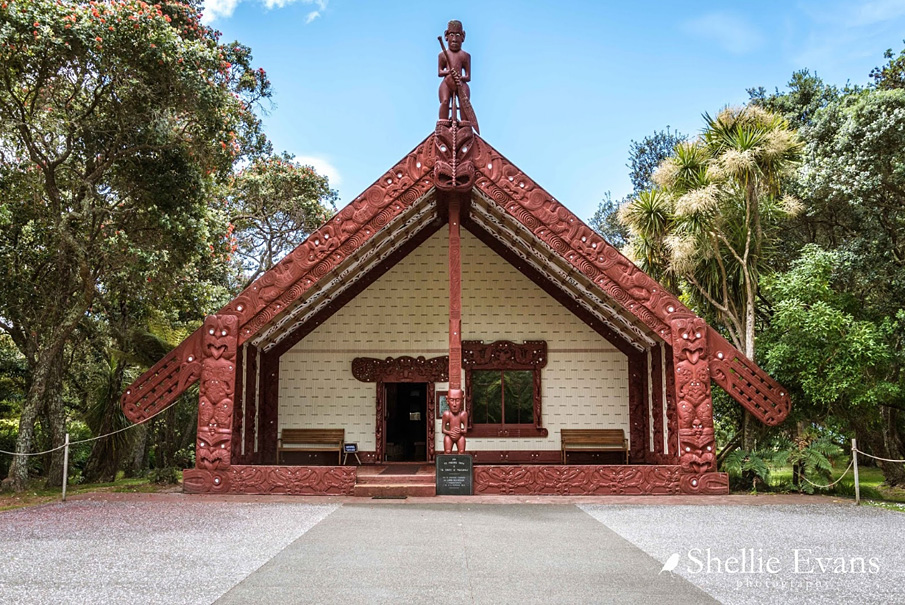
According to one authority, the gifting and restoration work ‘more than any other single factor…contributed to a renewal of Pākehā interest in Waitangi and the events of 1840’. The gift also encouraged greater awareness of the Treaty among Māori: Māori representatives were appointed to the body created to look after the estate - the Waitangi National Trust Board. Māori also began projects to commemorate the gift, including the construction of a whare rūnanga close to the house. Initiated by Ngāpuhi, the concept was embraced by other iwi and the structure became a national memorial to the relationship established at Waitangi in 1840. Its foundation stone, inscribed ‘Te Paepae Tapu O Te Tiritiri o Waitangi’ (The sacred threshold of the Treaty of Waitangi), was laid at a large hui held on 6 February 1934 - 96 years after the first signing. The year held particular resonance for Māori as the centennial of the first national flag, Te Kara.
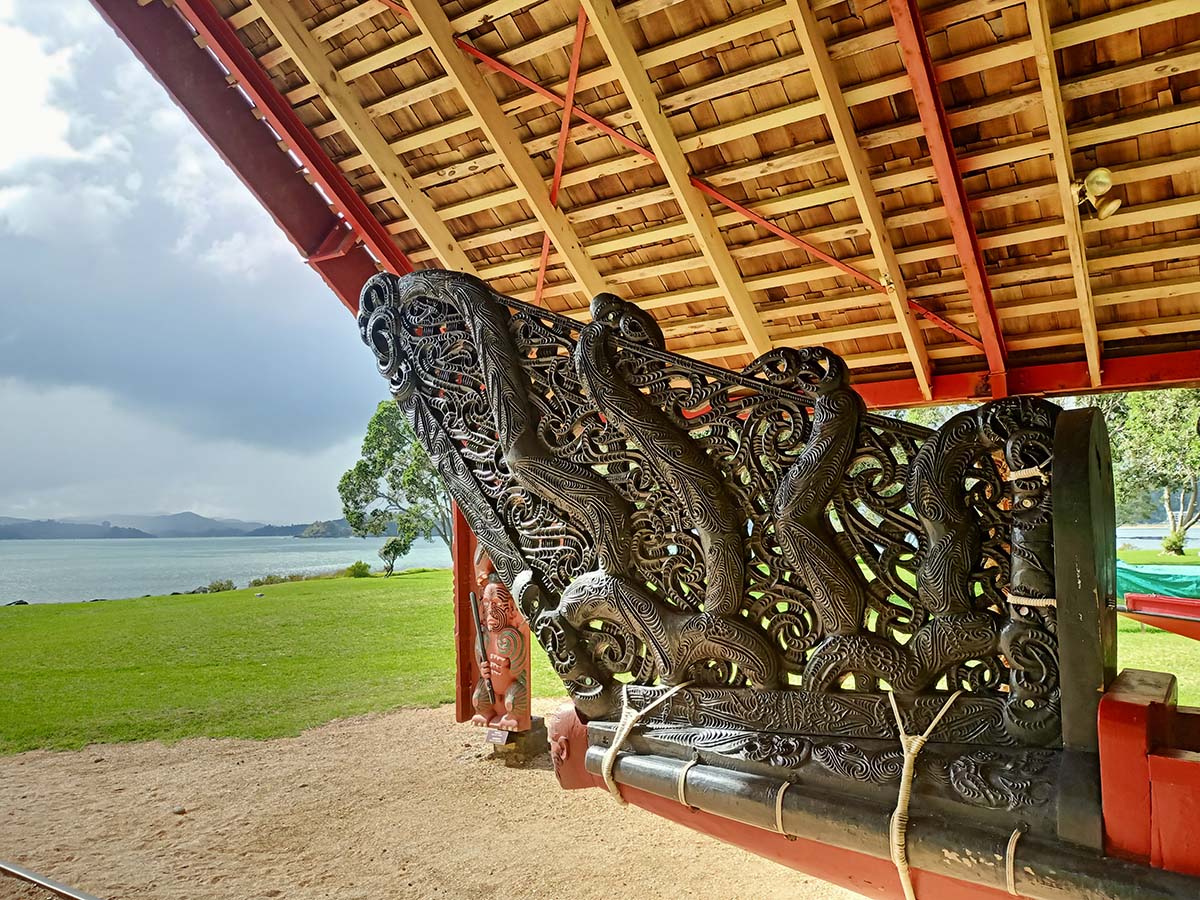
Cementing Waitangi’s role as a national symbol, substantial commemorations took place as part of the 1940 centennial of the first signing. Celebrations were consciously planned as a demonstration of national pride that had been heightened by the outbreak of the Second World War in 1939. As part of these events, the Treaty documents were temporarily housed in the former Residency - the first occasion that these were officially regarded as historically significant. A large re-enactment of the Treaty signing was held. A 117-foot waka, Ngātokimatawhaorua, was also created. The principal builder was Pita Heperi. More than 10,000 people were in attendance.
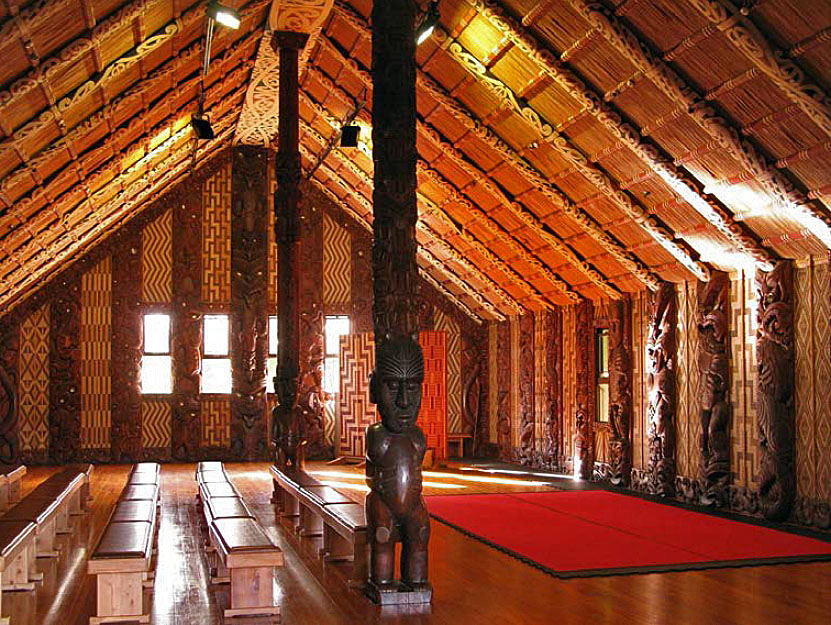
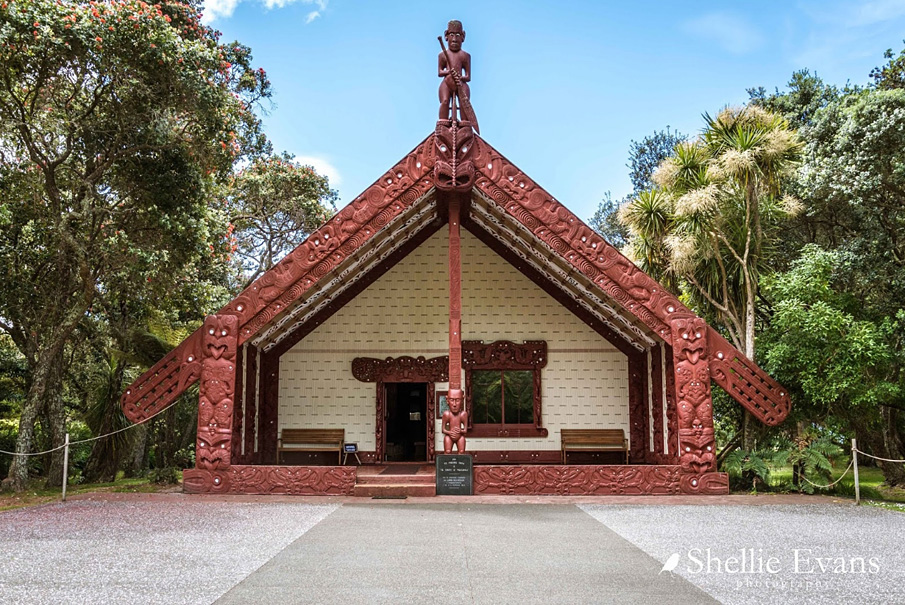
Te Whare Rūnanga was opened at the celebrations. The structure is notable as a showcase of pan-Māori identity, and the first marae on a national scale intended for all iwi and Pākehā. It features carvings representing eleven iwi groups, as well as incorporating tukutuku panels; and tukituki or kowhaiwhai patterns on its rafters. The work was initially supervised by Harold Hamilton and then Pineamine Taiapa (1901-72). Pineamine’s brother, Hone Te Kauru Taiapa (1911-79), and other noted carvers such as Eramiha Te Kapua (1867-1875?-1955) similarly worked on the building. At the opening, the haka was led by the prominent Ngāti Porou leader and land reformer, Sir Apirana Ngata (1874-1950), who had also been involved in organising its construction. The first person to cross the threshold, performing the ruahine role, was the noted land rights campaigner Whina Cooper (née Te Wake, 1895-1994). A contingent of the newly-formed Māori Battalion was welcomed outside Te Whare Rūnanga, shortly before the Battalion went overseas to fight in war.
At the same commemorations, the Hobson Memorial was also unveiled by the Deputy Prime Minister, and future premier, Peter Fraser (1884-1950). Designed by the Treaty House restorer, William Page, the monument was erected a short distance to the west of the residence, as part of a formal landward approach by road. It was built of local basalt quarried from cliffs near the Treaty House, and commemorated the British government official who initiated the first signing, Governor William Hobson. Commemorative plaques to James Busby and the rangatira that had signed the Treaty were unveiled inside the Treaty House. To further assist in approaches to encourage New Zealanders to study Waitangi and its historical associations, five self-contained cottages at the south end of Hobson Bay, erected for the use of officials during the centennial commemorations, were retained for the use of visitors.
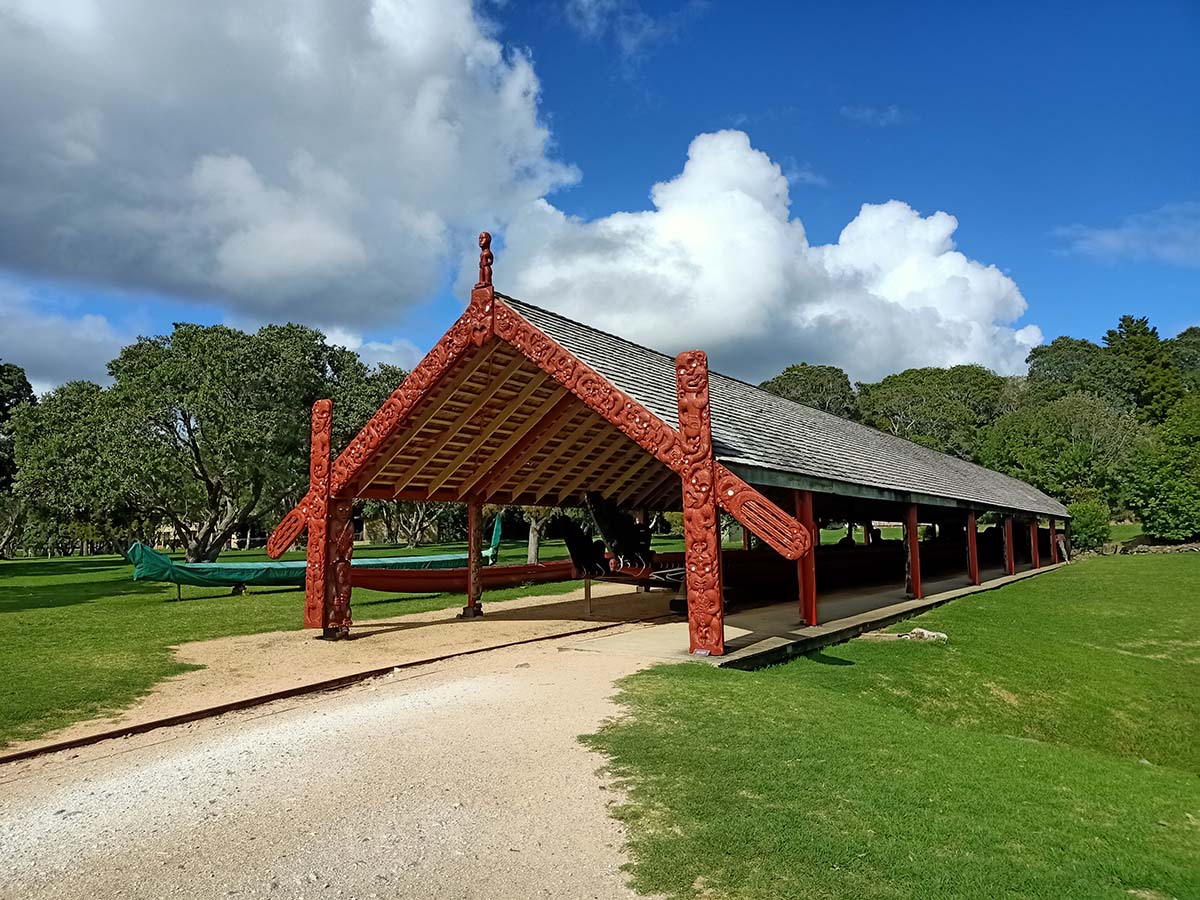
During the war, the New Zealand Army used the property, digging trenches and pits for defence purposes. In 1942, a whare waka to shelter Ngātokimatawhaorua was erected beside Te Whare Rūnanga, again designed by William Page. From 1947, in the aftermath of military victory, commemorations at Waitangi became an annual event. For many years military personnel, and the navy in particular, played a central role. In 1946-7, a new flagstaff - said to have been the tallest in the Southern Hemisphere - was erected by the Royal New Zealand Navy to replace the 1933 version. It could be seen by all ships entering the Bay of Islands.
By 1950, a ha-ha or sunken fence was dug between the Treaty House and flagstaff to fill the pits and trenches created by the army. By this time, a Māori Battalion mobile canteen and a shed housing a whale boat had also been placed or erected close to Te Whare Rūnanga. In 1953, following pressure on the government from both northern Māori and possibly Lord Bledisloe, Queen Elizabeth II visited Waitangi during her coronation tour of New Zealand - an important symbolic event marking the first time that a reigning British monarch had visited the site. From then onwards, the Governor-General and government members, as well as the armed forces, attended annual commemorations on 6 February. Royal visitors also frequently called in. A sundial, designed by W. H. Gummer, was erected near the house in 1958 to commemorate the Queen’s visit. Further commemorative features included rear access gates to the house in memory of James and Agnes Busby in 1960. Staff housing was erected on sloping ground to the south of the main residence. In 1963, the ha-ha was infilled, and the whole area in front of the Treaty House became a single grassed expanse.
Subsequent developments
Public interest in Waitangi continued to increase during the 1960s and 1970s: annual Waitangi Day commemorations were televised to the nation. In 1973, a Labour government introduced New Zealand Day on 6 February as a public holiday, which was called Waitangi Day from 1976. Māori and Pakeha perspectives on both the treaty and annual commemoration, however, did not always coincide. From the late 1960s onwards, Waitangi became a focus for popular protest as Māori disaffection with government attitudes to land and related issues intensified. In 1969, the flagstaff was repaired and re-erected after being damaged by activists using explosives. Initially, protests called for a greater Pākehā awareness of Māori culture and identity, but expanded to include acknowledgement of Māori as tangata whenua – the people of the land. The Treaty of Waitangi Act 1975 led to the legal investigation of a considerable number of treaty-related issues. In 1985, the Treaty of Waitangi Amendment Act enabled the examination of claims extending back to the first signing in 1840.
Māori cultural resurgence was reflected in other ways at Waitangi. In 1976, a new whare waka, Te Korowai o Maikuku, was built beside the beach at Te Ana o Maikuku (also formerly known as Hobson’s Beach) to house Ngātokimatawhaorua. Positioned on the site of cottages erected in 1940, this replaced the earlier whare waka near Te Whare Rūnanga, which was dismantled. Plans for a new visitors’ centre in the grounds were also proposed in the mid-1970s. Designed by the renowned Māori architect, John Scott (1924-92), this building was promoted as having the potential to strengthen multi-cultural ties and create new opportunities for broader Māori involvement at Waitangi. It was built in 1982, and opened by the Prince and Princess of Wales in April 1983.
Greater academic interest in events surrounding the treaty gained traction in the lead up to the 150th anniversary of the treaty signings in 1990. Historical and archaeological research on the Treaty House and Grounds was carried out, and attempts were made to reinterpret the Treaty House in a way that was more informative about its history - this included exposing much of the pre-cut frame remnants of the 1830s structure during a major conservation project in 1989-90.
Along with Te Tii Marae, the Waitangi Treaty Grounds continue to be a major focus for annual commemorations of Waitangi Day. It remains symbolically valuable to both Māori and Pākehā for its links with the aims and aspirations of Te Tiriti o Waitangi / The Treaty of Waitangi. The site receives a large number of visitors from New Zealand and overseas throughout the year, visitors who wish to gain more knowledge about Te Tiriti o Waitangi / The Treaty of Waitangi, or the place where it was first signed, or to utilise the site for other reasons, including to debate or protest related or other matters of current interest. The place is still held in trust by the Waitangi National Trust Board ‘as a place of historic interest, recreation, enjoyment, and benefit for the people…of New Zealand’.