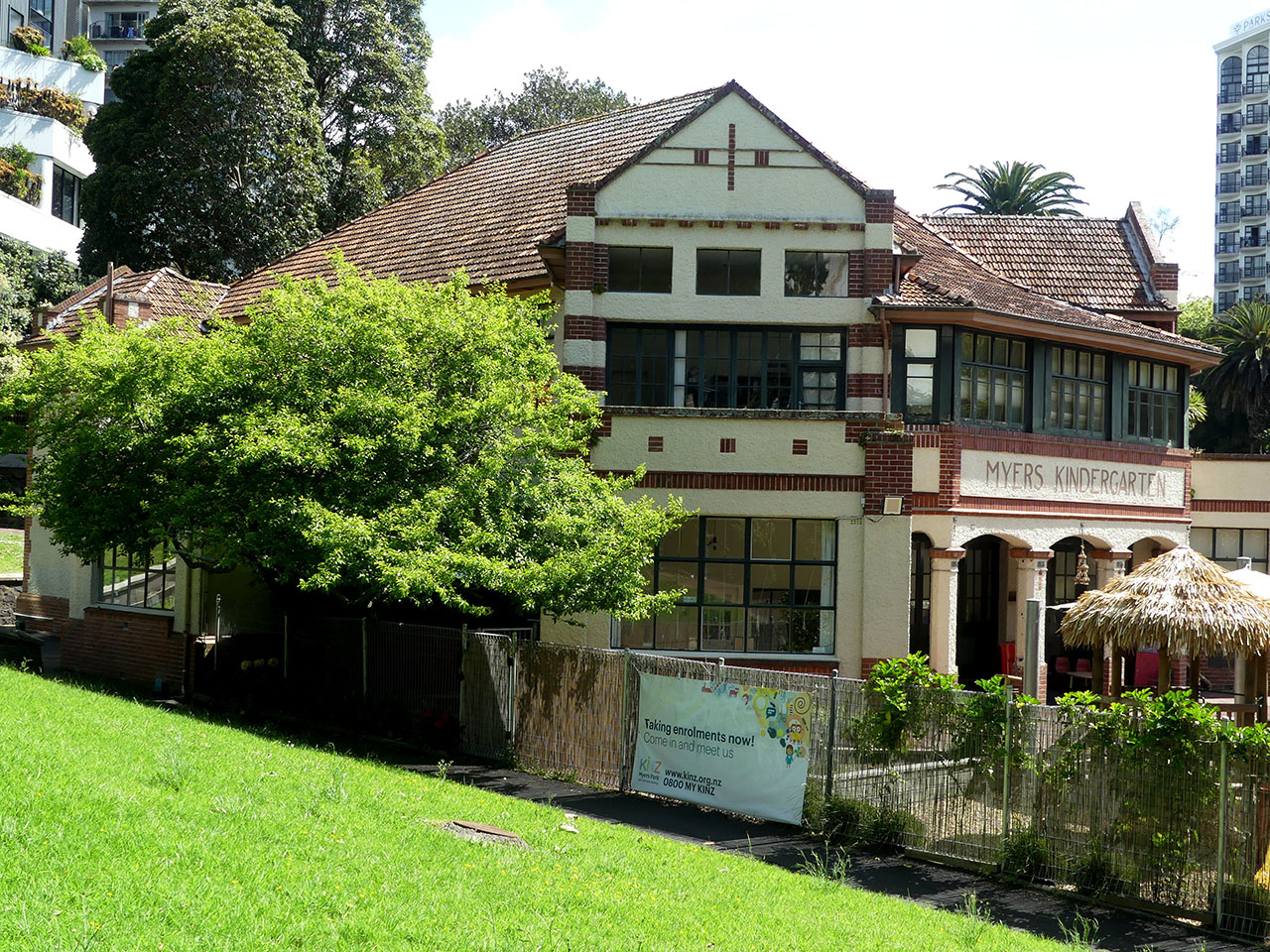
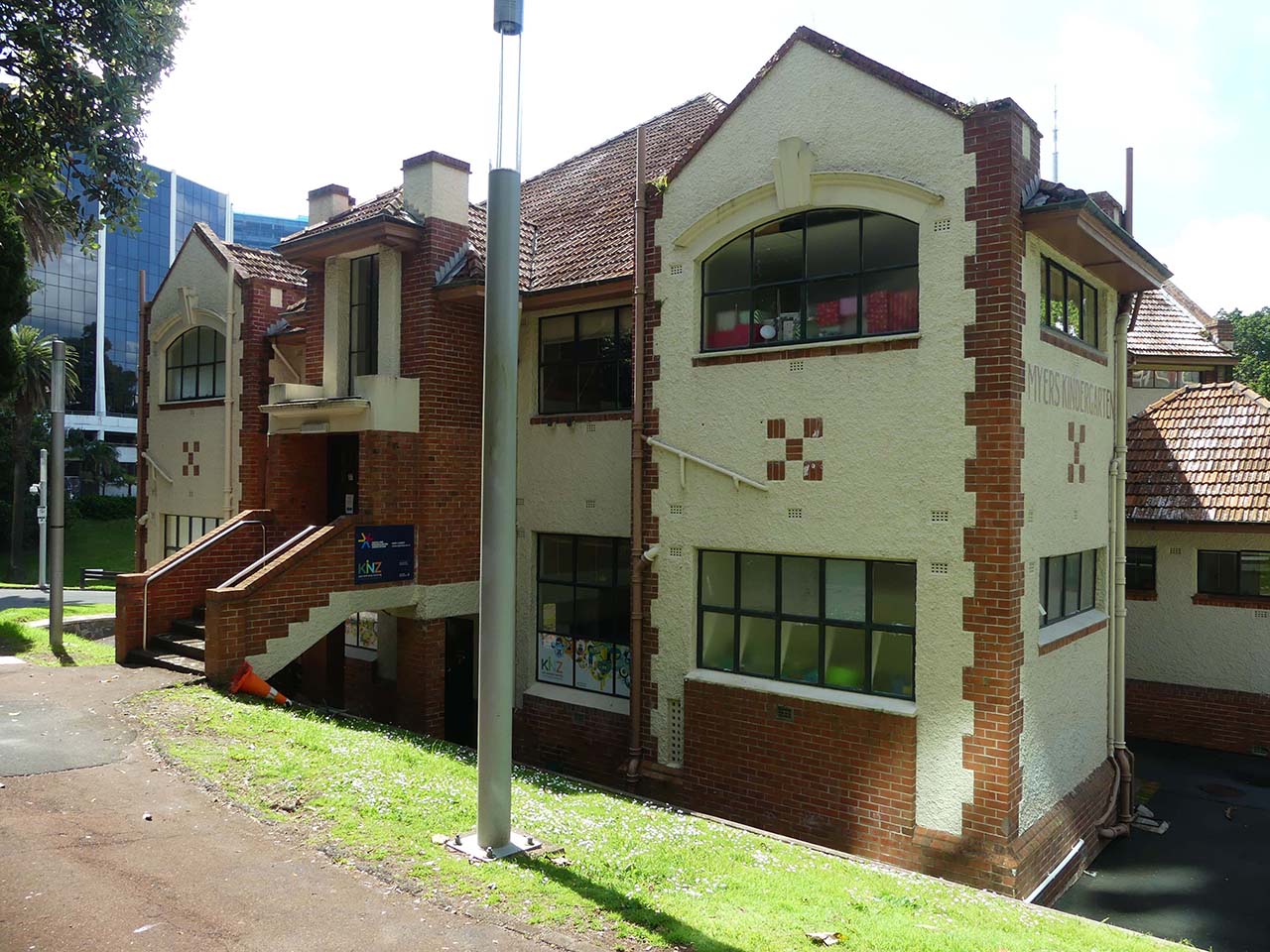
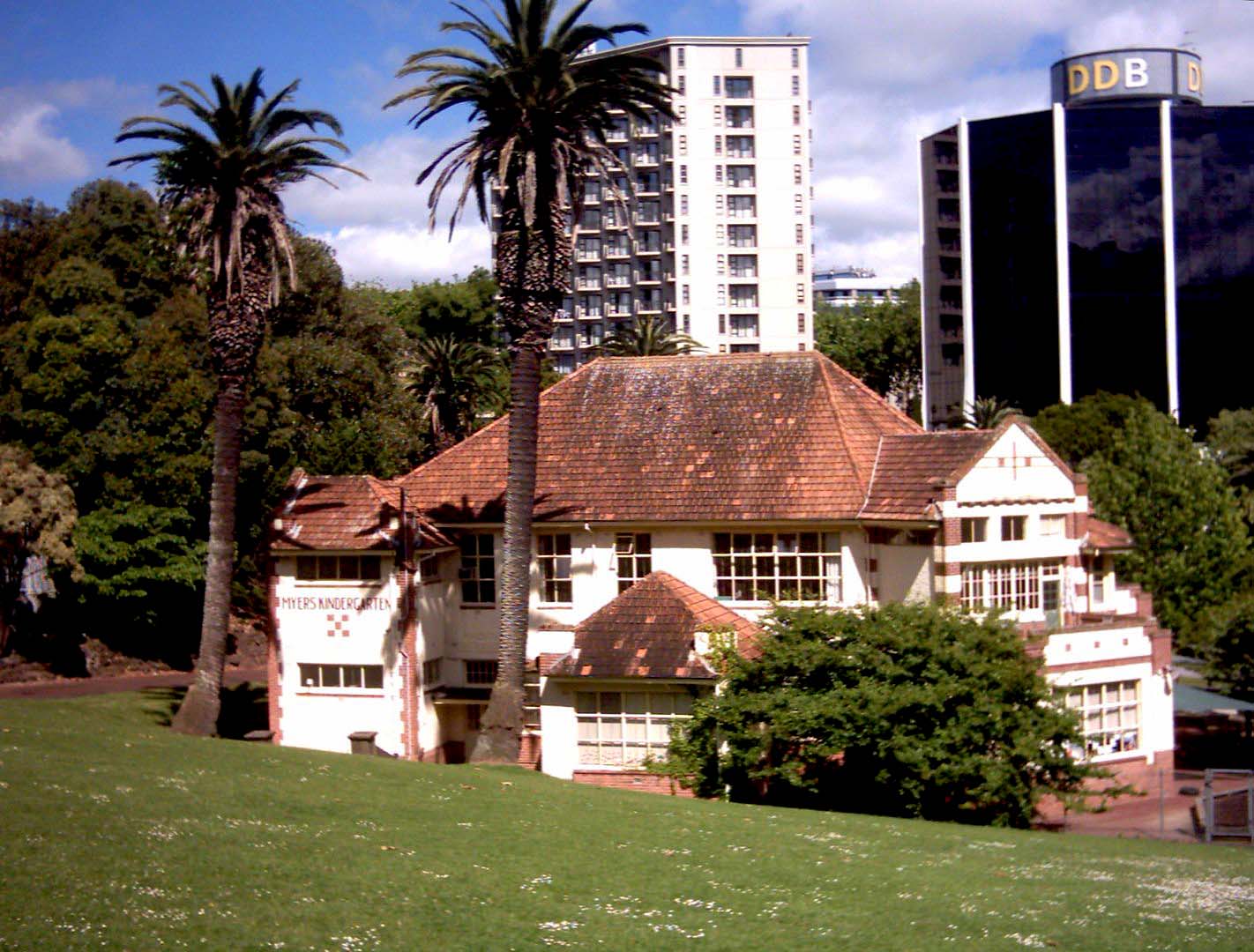
Constructed in Myers Park in 1915-16, Myers Kindergarten is one of central Auckland’s earliest surviving kindergarten building, and the oldest purpose-built example in New Zealand still in use for this purpose. Through its park setting, Arts and Crafts style and interior layout, the well-preserved brick structure directly reflects the principles of the kindergarten movement - an internationally significant educational development of the late nineteenth and early twentieth centuries. As well as long and enduring connections with children’s pre-school education, Myers Kindergarten has strong connections with women’s history and social attitudes towards supporting disadvantaged communities. It is additionally linked with philanthropic approaches adopted by Auckland’s Jewish community, notably the Liberal MP and businessman Sir Arthur Myers.
Myers Park lies near the south end of the Waihorotiu valley, which is closely associated with the shapeshifter Horotiu, kaitiaki (guardian) of Te Wai o Horotiu or the Horotiu creek. Māori settlement beside this watercourse included occupation on the site of the current Auckland Town Hall and adjoining Aotea Square. Also in the vicinity was a kāinga for female hawini (attendants) and kaimahi (helpers) who cared for Horotiu. The gully occupied by the present park formed a taniwha mahinga kai or taniwha feeding/grazing area. In 1840, Ngāti Whātua provided land for Auckland to be established as a colonial city. By the mid-1860s working-class housing developed in and around the gully. In 1913, at a time of heightened class tensions, Arthur Myers (1867-1926) gifted the city council £9000 to fund acquisition of the gully for a children’s park including a playground, which would remove some pre-existing dwellings. At the park opening in January 1915, Myers announced a further donation of £4000 for a free kindergarten for educating pre-school age children, notably of low-income artisan families in the immediate area.
Auckland’s Jewish community, including Myers and his family, strongly supported kindergarten education - an international movement that focused particularly on the education of pre-school children through action and play - and made it a philanthropic priority. In 1908, Myers’ American sister-in-law Martha Washington Myers (1867-1945) had helped found the Auckland Kindergarten Association (AKA), which aimed to provide free kindergartens in particularly disadvantaged areas and relied on voluntary work to become established. As well as promoting children’s mental and physical health through education, the movement ‘played a significant role in providing further education and employment for women, support mothers and raising awareness of issues to do with motherhood, child rearing and education’.
Opened in November 1916, Myers Kindergarten was the second purpose-built kindergarten in Auckland and considered by the AKA to be a model of its type. A notable early design by architectural partnership Chilwell and Trevithick, the two-storey Arts and Crafts style building was regarded as having great aesthetic appeal, incorporating elements derived from kindergarten educational principles including being designed to seamlessly integrate into the park grounds. This holistic design reflected both kindergarten movement and Arts and Crafts thinking. The ground floor layout incorporated a central ‘circle room’ that could be flexibly subdivided with accordion partitions. Outside it were classrooms containing large windows, bi-fold doors and natural colour schemes that physically and conceptually connected these spaces with the wider park - promoting the perceived health benefits of open air environments. The upper level held a school for children with special needs, who had not been well supported at nearby facilities. From 1921, this floor was shared with a school for deaf and hard of hearing children. The new building also formed a training school for kindergarten teachers, a central function of the AKA. Initial education at the kindergarten included lessons about the building and surrounding gardens themselves, imparting knowledge considered appropriate for working-class children about carpentry, bricklaying and gardening.
Myers Kindergarten has played an important role in the community beyond its educational role. During the 1918 influenza epidemic, it was converted into a temporary children’s hospital and has also been used as a food kitchen at times of need. In 1943-58, the upper floor was used exclusively for kindergarten teacher training until larger premises were required. Since 1948, the AKA has had sole and exclusive use of the place for use as a kindergarten with free rental from Auckland Council. Some alterations have occurred to improve the facilities and safety of the building, including enclosing balconies and fencing the ground floor exterior play area. Remaining in use for kindergarten purposes into the twenty-first century and retaining its original park setting, it is rare as a New Zealand kindergarten that has seen over a century of continuous use.
Myers Park lies near the south end of the Waihorotiu valley, which is closely associated with the shapeshifter Horotiu, kaitiaki (guardian) of Te Wai o Horotiu or the Horotiu creek. Māori settlement beside this watercourse included occupation on the site of the current Auckland Town Hall and adjoining Aotea Square. Also in the vicinity was a kāinga for female hawini (attendants) and kaimahi (helpers) who cared for Horotiu. The gully occupied by the present park formed a taniwha mahinga kai or taniwha feeding/grazing area. In 1840, Ngāti Whātua provided land for Auckland to be established as a colonial city. By the mid-1860s working-class housing developed in and around the gully. In 1913, at a time of heightened class tensions, Arthur Myers (1867-1926) gifted the city council £9000 to fund acquisition of the gully for a children’s park including a playground, which would remove some pre-existing dwellings. At the park opening in January 1915, Myers announced a further donation of £4000 for a free kindergarten for educating pre-school age children, notably of low-income artisan families in the immediate area.
Auckland’s Jewish community, including Myers and his family, strongly supported kindergarten education - an international movement that focused particularly on the education of pre-school children through action and play - and made it a philanthropic priority. In 1908, Myers’ American sister-in-law Martha Washington Myers (1867-1945) had helped found the Auckland Kindergarten Association (AKA), which aimed to provide free kindergartens in particularly disadvantaged areas and relied on voluntary work to become established. As well as promoting children’s mental and physical health through education, the movement ‘played a significant role in providing further education and employment for women, support mothers and raising awareness of issues to do with motherhood, child rearing and education’.
Opened in November 1916, Myers Kindergarten was the second purpose-built kindergarten in Auckland and considered by the AKA to be a model of its type. A notable early design by architectural partnership Chilwell and Trevithick, the two-storey Arts and Crafts style building was regarded as having great aesthetic appeal, incorporating elements derived from kindergarten educational principles including being designed to seamlessly integrate into the park grounds. This holistic design reflected both kindergarten movement and Arts and Crafts thinking. The ground floor layout incorporated a central ‘circle room’ that could be flexibly subdivided with accordion partitions. Outside it were classrooms containing large windows, bi-fold doors and natural colour schemes that physically and conceptually connected these spaces with the wider park - promoting the perceived health benefits of open air environments. The upper level held a school for children with special needs, who had not been well supported at nearby facilities. From 1921, this floor was shared with a school for deaf and hard of hearing children. The new building also formed a training school for kindergarten teachers, a central function of the AKA. Initial education at the kindergarten included lessons about the building and surrounding gardens themselves, imparting knowledge considered appropriate for working-class children about carpentry, bricklaying and gardening.
Myers Kindergarten has played an important role in the community beyond its educational role. During the 1918 influenza epidemic, it was converted into a temporary children’s hospital and has also been used as a food kitchen at times of need. In 1943-58, the upper floor was used exclusively for kindergarten teacher training until larger premises were required. Since 1948, the AKA has had sole and exclusive use of the place for use as a kindergarten with free rental from Auckland Council. Some alterations have occurred to improve the facilities and safety of the building, including enclosing balconies and fencing the ground floor exterior play area. Remaining in use for kindergarten purposes into the twenty-first century and retaining its original park setting, it is rare as a New Zealand kindergarten that has seen over a century of continuous use.