List Entry Information
Status
Listed
List Entry Status
Historic Place Category 1
Access
Private/No Public Access
List Number
642
Date Entered
21st September 1989
Date of Effect
21st September 1989
City/District Council
Auckland Council
Region
Auckland Council
Legal description
Pt Allots 10-14 Sec 45 City of Auckland
Status
Listed
List Entry Status
Historic Place Category 1
Access
Private/No Public Access
List Number
642
Date Entered
21st September 1989
Date of Effect
21st September 1989
City/District Council
Auckland Council
Region
Auckland Council
Legal description
Pt Allots 10-14 Sec 45 City of Auckland
Why is this place significant?
Historic Significance
Historical Significance or Value This historic place was registered under the Historic Places Act 1980. This report includes the text from the original Building Classification Committee report considered by the NZHPT Board at the time of registration. In 1852 a group of Aucklanders met to decide to form a congregational church in their city. Thomas Hamer was the first pastor, serving the church in various ways for 47 years. The church's first premises were in Shamrock Cottage on the corner of Albert and Victoria Streets. Over the years alterations were made to accommodate the expanding church but by 1872 the church had definitely outgrown that site. The section on Beresford Street was bought for a cost of 870 pounds sterling. The estimated cost of the church was 4,000 pounds sterling, the amount being raised by the congregations weekly offering. Inaugral services were held on the 20 February 1876. The opening of the church is described in the 'Southern Cross', 19 March 1876. Three hundred people attended the ceremony led by Sir George Grey and the pastor, the Rev J W Davies. People associated with the church, particularly its establishment, included: The Rev Thomas Hamer, who led a successful revolt against the proposal in the Provincial Council that the salary of Bishop Selwyn should be paid out of public funds. Captain W C Daldy, who worked on the Auckland Harbour Board and was involved in the formation of the South British Insurance Company. J C Firth a prominent settler and flour miller, later a member of the Provincial Council. Both Firth and Daldy were Directors on the Board of the Bank of NZ and Trustees of the Auckland Savings Bank. Other leading figures were; George Fowlds, Minister of Education; J Berry, Editor of the NZ Herald; H N Warner, Commissioner of Crown Lands for Auckland; C E Burton, Judge of the Supreme Court. In September 1964 the St James Presbyterian and the Beresford Street Congregational Church united. This was the first time in New Zealand that churches of two different denominations united. The old St James Church in Wellington Street was demolished and the Beresford Street Church became the new St James.
Physical Significance
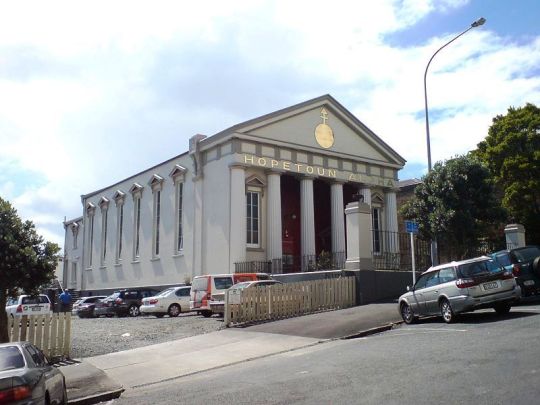
This historic place was registered under the Historic Places Act 1980. This report includes the text from the original Building Classification Committee report considered by the NZHPT Board at the time of registration. ARCHITECTURAL SIGNIFICANCE: St James Church dates from 1876 and is one of the oldest buildings remaining in Auckland. It is the first major example of poured concrete construction. Few examples of the work of Philip Herapath are left in Auckland. The church is intricately designed with delicate detailing in the gallery. With its temple front, the St James Church is one of the very few neoclassical buildings in Auckland. TOWNSCAPE/LANDMARK SIGNIFICANCE: St James Church sits on a slight rise above the motorway and its temple form is a prominent part of the townscape as one approaches the city along Hopetown Street. It forms part of a group of very distinctive Auckland buildings with the other concrete church hall building on one side and the old Auckland Fire Station (now St Johns Ambulance Station) on the other.
Why is this place significant?
Historic Significance
Historical Significance or Value This historic place was registered under the Historic Places Act 1980. This report includes the text from the original Building Classification Committee report considered by the NZHPT Board at the time of registration. In 1852 a group of Aucklanders met to decide to form a congregational church in their city. Thomas Hamer was the first pastor, serving the church in various ways for 47 years. The church's first premises were in Shamrock Cottage on the corner of Albert and Victoria Streets. Over the years alterations were made to accommodate the expanding church but by 1872 the church had definitely outgrown that site. The section on Beresford Street was bought for a cost of 870 pounds sterling. The estimated cost of the church was 4,000 pounds sterling, the amount being raised by the congregations weekly offering. Inaugral services were held on the 20 February 1876. The opening of the church is described in the 'Southern Cross', 19 March 1876. Three hundred people attended the ceremony led by Sir George Grey and the pastor, the Rev J W Davies. People associated with the church, particularly its establishment, included: The Rev Thomas Hamer, who led a successful revolt against the proposal in the Provincial Council that the salary of Bishop Selwyn should be paid out of public funds. Captain W C Daldy, who worked on the Auckland Harbour Board and was involved in the formation of the South British Insurance Company. J C Firth a prominent settler and flour miller, later a member of the Provincial Council. Both Firth and Daldy were Directors on the Board of the Bank of NZ and Trustees of the Auckland Savings Bank. Other leading figures were; George Fowlds, Minister of Education; J Berry, Editor of the NZ Herald; H N Warner, Commissioner of Crown Lands for Auckland; C E Burton, Judge of the Supreme Court. In September 1964 the St James Presbyterian and the Beresford Street Congregational Church united. This was the first time in New Zealand that churches of two different denominations united. The old St James Church in Wellington Street was demolished and the Beresford Street Church became the new St James.
Physical Significance
This historic place was registered under the Historic Places Act 1980. This report includes the text from the original Building Classification Committee report considered by the NZHPT Board at the time of registration. ARCHITECTURAL SIGNIFICANCE: St James Church dates from 1876 and is one of the oldest buildings remaining in Auckland. It is the first major example of poured concrete construction. Few examples of the work of Philip Herapath are left in Auckland. The church is intricately designed with delicate detailing in the gallery. With its temple front, the St James Church is one of the very few neoclassical buildings in Auckland. TOWNSCAPE/LANDMARK SIGNIFICANCE: St James Church sits on a slight rise above the motorway and its temple form is a prominent part of the townscape as one approaches the city along Hopetown Street. It forms part of a group of very distinctive Auckland buildings with the other concrete church hall building on one side and the old Auckland Fire Station (now St Johns Ambulance Station) on the other.
Construction Professional
Name
Herapath, Philip
Type
Architect
Biography
Herapath became a member of the Auckland Institute of Architects in 1885. His designs included institutional and ecclesiastical buildings, such as the main block of Auckland Hospital (1875, demolished 1964) and Wesleyan churches in Pitt St (1865), Onehunga (1877), Pukekohe and Pokeno (1878). The most important remaining example of his work is the Beresford Street Congregational Church (1875), now St James's Presbyterian Church. This was a pioneer design in concrete.
Construction Details
Start Year
1876
Type
Original Construction
Start Year
1898
Type
Modification
Description
building was cleaned and renovated and at this stage received its first coat of paint.
Construction Materials
The St James Church is the earliest example of a poured concrete public building in Auckland, and it consisted of a framed structure infilled with concrete. The recommendation for the use of this new technique as was used in the dwelling houses of Dr J L Campbell and that of Mr Firth came from Mr Firth and he and Captain Daldy supervised the construction. The foundations are of solid masonry and the erection of the walls was carefully superintended so as to render the experiment as successful as possible. The wall from the foundations to the top of the floor joists are two feet thick and above sixteen inches thick. The same material was used for the massive fluted columns supporting the portico at the front of the building and also for lintels and other members where stone would have traditionally been used.
Notable Features
The classical design and use of concrete construction are special features of the building.
Construction Professional
Name
Herapath, Philip
Type
Architect
Biography
Herapath became a member of the Auckland Institute of Architects in 1885. His designs included institutional and ecclesiastical buildings, such as the main block of Auckland Hospital (1875, demolished 1964) and Wesleyan churches in Pitt St (1865), Onehunga (1877), Pukekohe and Pokeno (1878). The most important remaining example of his work is the Beresford Street Congregational Church (1875), now St James's Presbyterian Church. This was a pioneer design in concrete.
Construction Details
Start Year
1876
Type
Original Construction
Start Year
1898
Type
Modification
Description
building was cleaned and renovated and at this stage received its first coat of paint.
Construction Materials
The St James Church is the earliest example of a poured concrete public building in Auckland, and it consisted of a framed structure infilled with concrete. The recommendation for the use of this new technique as was used in the dwelling houses of Dr J L Campbell and that of Mr Firth came from Mr Firth and he and Captain Daldy supervised the construction. The foundations are of solid masonry and the erection of the walls was carefully superintended so as to render the experiment as successful as possible. The wall from the foundations to the top of the floor joists are two feet thick and above sixteen inches thick. The same material was used for the massive fluted columns supporting the portico at the front of the building and also for lintels and other members where stone would have traditionally been used.
Notable Features
The classical design and use of concrete construction are special features of the building.
This historic place was registered under the Historic Places Act 1980. This report includes the text from the original Building Classification Committee report considered by the NZHPT Board at the time of registration. ARCHITECTURAL DESCRIPTION (STYLE): The neo-classical church is a single storeyed building in Grecian Doric style. Six massive fluted columns support the portico at the front of the building. The entrances are at either side of this portico. The church has a large hall and gallery with six large windows down each site. It is designed to seat 420 people. MODIFICATIONS: It has had some partitions added within the main hall just inside the entry, and behind the altar a concrete grill has been erected closing off the choir stalls. Otherwise is it largely in original condition.
This historic place was registered under the Historic Places Act 1980. This report includes the text from the original Building Classification Committee report considered by the NZHPT Board at the time of registration. ARCHITECTURAL DESCRIPTION (STYLE): The neo-classical church is a single storeyed building in Grecian Doric style. Six massive fluted columns support the portico at the front of the building. The entrances are at either side of this portico. The church has a large hall and gallery with six large windows down each site. It is designed to seat 420 people. MODIFICATIONS: It has had some partitions added within the main hall just inside the entry, and behind the altar a concrete grill has been erected closing off the choir stalls. Otherwise is it largely in original condition.
Historical and Associated Iwi / Hapū / Whānau
Completion Date
23rd March 1988
Report Written By
Jane Couch, Mary Cooper, Noni Boyd
Information Sources
Auckland Star
Auckland Star
Daily Southern Cross
Daily Southern Cross
New Zealand Herald
New Zealand Herald, 12 July 1932, p. 6; 28 September 1933, p. 6.
Ennor, 1952
G. Ennor, Three Hundred Years: A short history of the Beresford Street Congregational Church Auckland 1852-1952, Auckland, 1952
Onward
Onward, A religious monthly in connection with the Beresford Street Congregational Church
Other Information
A copy of this report is available from the NZHPT Northern Region office Please note that entry on the New Zealand Heritage List/Rarangi Korero identifies only the heritage values of the property concerned, and should not be construed as advice on the state of the property, or as a comment of its soundness or safety, including in regard to earthquake risk, safety in the event of fire, or insanitary conditions.
Historical and Associated Iwi / Hapū / Whānau
Completion Date
23rd March 1988
Report Written By
Jane Couch, Mary Cooper, Noni Boyd
Information Sources
Auckland Star
Auckland Star
Daily Southern Cross
Daily Southern Cross
New Zealand Herald
New Zealand Herald, 12 July 1932, p. 6; 28 September 1933, p. 6.
Ennor, 1952
G. Ennor, Three Hundred Years: A short history of the Beresford Street Congregational Church Auckland 1852-1952, Auckland, 1952
Onward
Onward, A religious monthly in connection with the Beresford Street Congregational Church
Other Information
A copy of this report is available from the NZHPT Northern Region office Please note that entry on the New Zealand Heritage List/Rarangi Korero identifies only the heritage values of the property concerned, and should not be construed as advice on the state of the property, or as a comment of its soundness or safety, including in regard to earthquake risk, safety in the event of fire, or insanitary conditions.
Current Usages
Uses: Civic Facilities
Specific Usage: Conference centre
Former Usages
General Usage: Religion
Specific Usage: Church
Current Usages
Uses: Civic Facilities
Specific Usage: Conference centre
Former Usages
General Usage: Religion
Specific Usage: Church