DonateMembershipVisit Heritage
  • Tūrangawaewae
    Places
  • Tira Māori
    Māori Heritage
  • Poutairangahia
    Archaeology
  • Rauemi
    Resources
  • Mō Tātou
    About Us
  • New Zealand Heritage List
  • Nominate and submit
  • Explore the List
  • National Historic Landmarks
  • Plaques
  • Rainbow List Project
  • Lost heritage
  • Visit Heritage
  • Our properties
  • Turnbull House Project
  • Collections
  • Shop
  • Tohu Whenua
  • Tira Māori
  • Conserving Māori heritage
  • Marae built heritage
  • Māori heritage on the List
  • Hinemihi—Te Hokinga Mai
  • What is archaeology?
  • Is there a site on my property?
  • What are my legal requirements?
  • Affecting an archaeological site
  • Declaring an archaeological site
  • Archaeology FAQs
  • Archaeology Digital Library
  • Archaeology guidelines and templates
  • Resources
  • Funding
  • Publications
  • Sustainable management guides
  • Disaster recovery
  • Podcasts & digital resources
  • Education Hub
  • Conservation plans
  • About
  • Board
  • Māori Heritage Council
  • Senior Staff
  • Offices
  • Contact us
  • Careers
  • Covenants
  • Fast-track
  • Corporate documents
  • Currently consulting on
  • Our submissions
  • News
  • Covid-19 response
Quick links
Rārangi Kōrero | The List
Explore the List
National Historic Landmarks
Ngā Manawhenua o Aotearoa me ōna Kōrero Tūturu
Quick links
Tapuwae
A Vision for Places of Māori Heritage
Funding for Māori Heritage
Resources
Quick links
Archaeological Authority Portal
Applying for an archaeological authority
Archaeology FAQs
Browse the most frequently asked questions about archaeological authorities and the archaeological process.
Quick links
Quick links
News
News Keep up to date with Heritage New Zealand Pouhere Taonga
Membership
Membership Find out more and sign up today
DonateMembershipVisit Heritage
  • Tūrangawaewae
    Places
  • Tira Māori
    Māori Heritage
  • Poutairangahia
    Archaeology
  • Rauemi
    Resources
  • Mō Tātou
    About Us
  • New Zealand Heritage List
  • Nominate and submit
  • Explore the List
  • National Historic Landmarks
  • Plaques
  • Rainbow List Project
  • Lost heritage
  • Visit Heritage
  • Our properties
  • Turnbull House Project
  • Collections
  • Shop
  • Tohu Whenua
  • Tira Māori
  • Conserving Māori heritage
  • Marae built heritage
  • Māori heritage on the List
  • Hinemihi—Te Hokinga Mai
  • What is archaeology?
  • Is there a site on my property?
  • What are my legal requirements?
  • Affecting an archaeological site
  • Declaring an archaeological site
  • Archaeology FAQs
  • Archaeology Digital Library
  • Archaeology guidelines and templates
  • Resources
  • Funding
  • Publications
  • Sustainable management guides
  • Disaster recovery
  • Podcasts & digital resources
  • Education Hub
  • Conservation plans
  • About
  • Board
  • Māori Heritage Council
  • Senior Staff
  • Offices
  • Contact us
  • Careers
  • Covenants
  • Fast-track
  • Corporate documents
  • Currently consulting on
  • Our submissions
  • News
  • Covid-19 response
Quick links
Rārangi Kōrero | The List
Explore the List
National Historic Landmarks
Ngā Manawhenua o Aotearoa me ōna Kōrero Tūturu
Quick links
Tapuwae
A Vision for Places of Māori Heritage
Funding for Māori Heritage
Resources
Quick links
Archaeological Authority Portal
Applying for an archaeological authority
Archaeology FAQs
Browse the most frequently asked questions about archaeological authorities and the archaeological process.
Quick links
Quick links
News
News Keep up to date with Heritage New Zealand Pouhere Taonga
Membership
Membership Find out more and sign up today
  • Places
  • Nominate and submit
  • National Historic Landmarks
  • Places
  • Nominate and submit
  • National Historic Landmarks
  • Tira Māori
  • Conserving Māori heritage
  • Marae built heritage
  • Tira Māori
  • Conserving Māori heritage
  • Marae built heritage
  • Archaeological authorities
  • Archaeology Digital Library
  • Archaeological authorities
  • Archaeology Digital Library
  • All resources
  • Publications
  • Funding
  • All resources
  • Publications
  • Funding
  • FAQs
  • FAQs
Follow us on:
Places
  • Places
  • Nominate and submit
  • National Historic Landmarks
Tira Māori
  • Tira Māori
  • Conserving Māori heritage
  • Marae built heritage
Archaeology
  • Archaeological authorities
  • Archaeology Digital Library
Resources
  • All resources
  • Publications
  • Funding
FAQs
  • FAQs
Follow us on
HomePrivacyTerms and conditionsAbout this site
© Heritage New Zealand Pouhere Taonga 2026.
 
Public Shelters (Former)

Quay Street, AUCKLAND

Private

Historic Place Category 2

List No. 670

Quick links:
List GalleryLocationDetails
Situated on the waterfront in central Auckland since the early 1900s, the Public Shelters have formed an important aspect in the provision of public access to the city harbour for more than a century. Consisting of two buildings of ornate Arts and Crafts design, they were originally erected in 1915 to provide shelter for owners and passengers of the many small launches that sailed around the Hauraki Gulf in the early twentieth century. Their value to Aucklanders was confirmed when they were relocated a short distance to their current positions in 1922-3 for the same use. In both their initial and secondary locations, they are associated with widespread improvements to the city waterfront undertaken in 1903-24 to the designs of W.H. Hamer, Chief Engineer of the Auckland Harbour Board. They remain important components of a wider historic landscape linked with Auckland’s evolution as a notable national and international port.

The Public Shelters are situated in an area known to Māori as One-Panea, part of the wider Waitematā harbour. The Waitematā forms the ancestral waters of numerous iwi including Ngāti Whātua Ōrakei, with many kāinga and pā occupying its shoreline and headlands. One-Panea was a source of kaimoana, and also used for the arrival and departure of waka. After Auckland was established as a colonial city in 1840, the area - renamed Commercial Bay - became the main landing site for settlers and goods, including produce brought from afield by Māori. Under the Auckland Harbour Board (AHB), established in 1871, successive reclamations improved port facilities as the town’s economy developed. By the end of the century, Auckland was one of New Zealand’s busiest ports. In the early 1900s, a growing fleet of small private launches operating in the Hauraki Gulf used waterfront steps and landings for arrival and departure, often illegally. From 1903, the AHB employed notable engineer, W.H. Hamer (1869-1940) to improve and expand the port facilities through major works. In 1915, his Quay Street West extension scheme to the west of Queen’s Wharf (1907-13) sought to regularise launch operations by creating purpose-built launch landings and associated public shelters in association with reclamation and a new harbour wall.

Hamer’s scheme established five multi-level, reinforced-concrete launch landings close to the intersection of Beatty and Quay Streets. Two public shelters of handsome appearance were added overlooking the landings in late 1915.

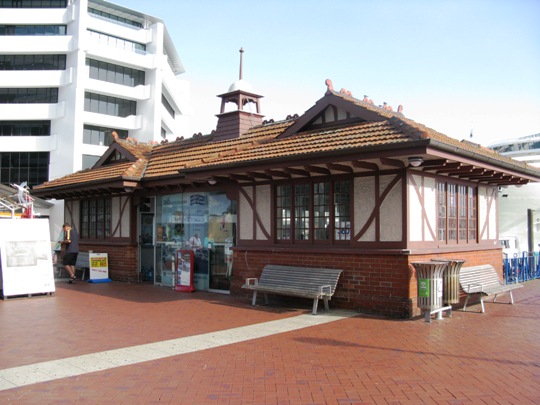
Of identical design, each contained two open waiting rooms with large multi-pane windows offering views in all directions. Externally, the structures had a brick base, lath and plaster walls with applied half-timbering details, and a hipped Marseilles tile roof topped by a decorative roof rotunda. In their Arts and Crafts-influenced style, they can be seen to have embodied aspects of ‘Englishness’ at a time when New Zealand troops were fighting for the British Empire during the First World War (1914-18). Newspapers lauded both the shelters and landings for their design and as a public amenity.

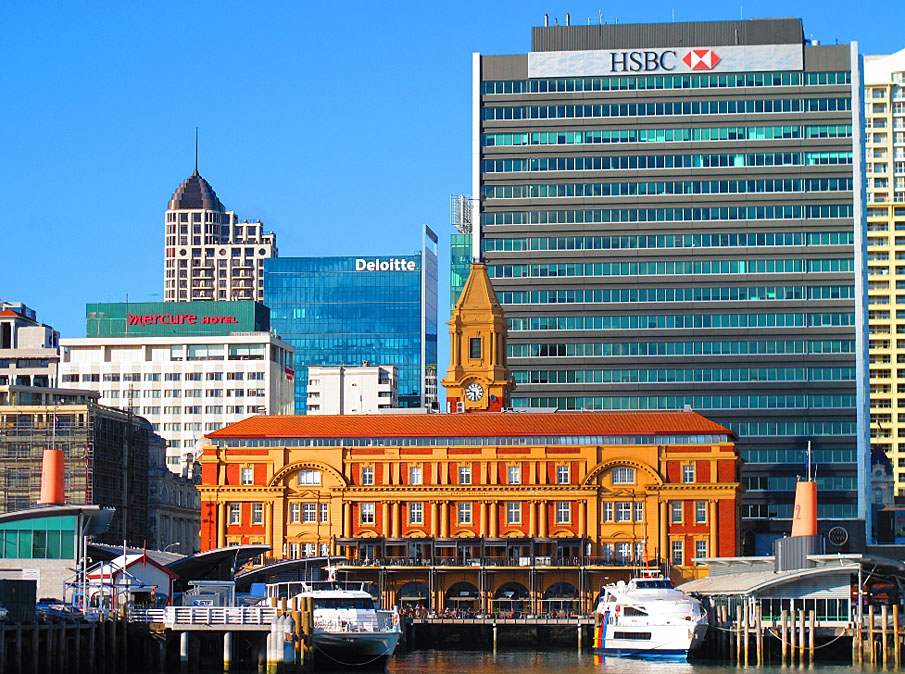
Less than a decade later, plans for further port expansion necessitated relocation of the launch landings and shelters to a new harbourfront a short distance to the north. The structures were moved by crane, with one shelter being repositioned immediately west of the landmark Ferry Building (built 1909-12) in mid-1922, and the other on a jettied platform connected to the under-construction Princes Wharf in early 1923. They were respectively placed beside harbour steps to the water and three of the similarly relocated launch landings. The latter were subsequently reserved for licensed, commercial launches, which remained popular in competition with larger ferries and commercial shipping businesses through the early decades of the twentieth century.

The shelters remained in use for much of the remaining century as public spaces with interior seating. By the 1980s, external glass doors had been added to both structures. At this time, the eastern shelter was converted into a food kiosk, involving some internal alteration. In 1998, it was further converted into a ticket kiosk and returned to use as a passenger waiting area, specifically for ferry passengers. Both shelters were incorporated in a wider redevelopment of the waterfront space for public use in 2021-2. In 2023 the western shelter was repurposed as a cultural and marine education space by Ngāti Whātua Ōrākei. Both shelters, along with their associated launch landings and harbour steps, remain notable parts of a wider historic area linked with Auckland’s maritime development, which also includes the nearby Ferry Building, Queen’s Wharf and First World War Memorial Beacon - all similarly of early twentieth-century date.
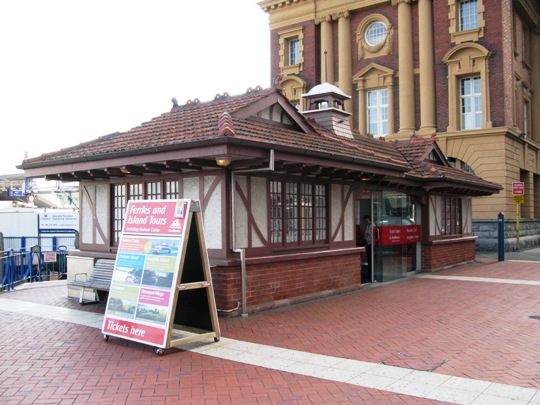
Wharf Pavilions (Two Buildings) | Martin Jones | 24/11/2009 | NZ Historic Places Trust
null | Martin Jones | 24/11/2009 | NZ Historic Places Trust
Wharf Pavilions (Two Buildings) | Martin Jones | 24/11/2009 | NZ Historic Places Trust
null | Martin Jones | 24/11/2009 | NZ Historic Places Trust

List Entry Information

Overview

Status
Listed

List Entry Status
Historic Place Category 2

Access
Private/No Public Access

List Number
670

Date Entered
26th November 1981

Date of Effect
26th November 1981

City/District Council
Auckland Council

Region
Auckland Council

Legal description

Lot 15 DP 131565(RT NA77A/383), Pt Lot 37 DP 131586, Lot 3 DP 179758 (RT NA110D/518) and Legal Road, North Auckland Land District

Detailed List Entry

Construction Professional

Name

Hamer, W.H

Type

Engineer

Biography

W.H. Hamer (c.1869-1940) was educated at Rugby, England, and in the mechanical workshops at King’s College. He was subsequently articled to E.G. Mawbey, the waterworks engineer at King’s Lynn, Norfolk, who was also President of the County Engineers and Surveyors’ Association. By the early 1900s, Hamer occupied the post of Resident Engineer of the Victoria and Albert Docks in London, said at the time to be ‘unsurpassed in the completeness of its arrangements by any other docks in the world.’ Employed by the London and India Dock Company during this period, Hamer worked in a department with an expenditure of more than £200,000 and was in charge of over a thousand workmen. In January 1903, Hamer was appointed Engineer to the Auckland Harbour Board and arrived in New Zealand a few months later. In July 1904, he produced his blueprint for the modernisation of Auckland’s port facilities, involving a radical reorganisation of the waterfront using innovative aspects such as ferro-concrete wharves. Work was undertaken on the Railway (later Kings) Wharf extension in 1904-8, the Ferry Jetty in 1907, and the Queens Wharf in 1907-13, although it was not until the 1920s that some elements of his scheme such as the Princes Wharf (1921-4) were completed. Hamer is said to have overseen construction of parts of the Queens Wharf himself. Hamer’s opinion was evidently sought for other harbour-related projects including at Thames and Whakatane. In 1907, he also produced a set of plans for a canal between the Waitemata and Manukau harbours, although this was never built. Keeping up-to-date with methods of wharf construction and new machinery, he undertook tours of inquiry to Australia (1914), Canada and the United States (1918), and the ports of Great Britain (1920). Hamer resigned from his post with the Auckland Harbour Board in December 1924. Source: Registration Report for First World War Memorial (Register No. 9652), May 2014

Construction Details

Start Year

1915

Type

Original Construction

Description

Shelter sheds and launch landings

Start Year

1923

Type

Relocation

Description

Removal of second shelter to position beside Princes Wharf and launch landings

Start Year

1922

Type

Relocation

Description

Removal of first shelter to position beside Ferry Building and harbour steps

Start Year

1980

Type

Modification

Description

Installation of glass doors to both shelters

Period

Pre

Start Year

1980

Type

Modification

Description

First (east) shelter adapted for a food kiosk

Period

1980s

Start Year

1998

Type

Modification

Description

First (east) shelter altered to a ticket kiosk

Start Year

2023

Type

Modification

Description

Second (west) shelter modified to create a cultural and marine education space

Construction Materials

Single storey brick base foundation walls, half timbered, marseilles tile roof.

Reference

Completion Date

15th May 2024

Report Written By

Alexandra Foster

Information Sources

Auckland Star

Auckland Star

Northern Advocate

Northern Advocate

New Zealand Herald

New Zealand Herald, ‘Historic Hut is Preserved’, 25 March 1961

Report Written By

This place was identified as significant under previous legislation with different information requirements. It remains significant under the current legislation. There is opportunity under our legislation and policies to add to this information. Further information about this place may be available from the Northern Regional Office of Heritage New Zealand Pouhere Taonga. A fully referenced copy of the Upgrade Report is available upon request from the Northern Regional Office of Heritage New Zealand Pouhere Taonga Please note that entry on the New Zealand Heritage List/Rarangi Korero identifies only the heritage values of the property concerned, and should not be construed as advice on the state of the property, or as a comment of its soundness or safety, including in regard to earthquake risk, safety in the event of fire, or insanitary conditions.

Further Information

Current Usages

Uses: Civic Facilities

Specific Usage: Shelter

Former Usages

General Usage:: Transport

Specific Usage: Bus Station/Depot/station/shelter

General Usage:: Transport

Specific Usage: Water - transport - other

Themes

Web Links

Overview

Status

Listed

List Entry Status

Historic Place Category 2

Access

Private/No Public Access

List Number

670

Date Entered

26th November 1981

Date of Effect

26th November 1981

City/District Council

Auckland Council

Region

Auckland Council

Legal description

Lot 15 DP 131565(RT NA77A/383), Pt Lot 37 DP 131586, Lot 3 DP 179758 (RT NA110D/518) and Legal Road, North Auckland Land District

Status

Listed

List Entry Status

Historic Place Category 2

Access

Private/No Public Access

List Number

670

Date Entered

26th November 1981

Date of Effect

26th November 1981

City/District Council

Auckland Council

Region

Auckland Council

Legal description

Lot 15 DP 131565(RT NA77A/383), Pt Lot 37 DP 131586, Lot 3 DP 179758 (RT NA110D/518) and Legal Road, North Auckland Land District

Construction Information

Construction Professional

Name

Hamer, W.H

Type

Engineer

Biography

W.H. Hamer (c.1869-1940) was educated at Rugby, England, and in the mechanical workshops at King’s College. He was subsequently articled to E.G. Mawbey, the waterworks engineer at King’s Lynn, Norfolk, who was also President of the County Engineers and Surveyors’ Association. By the early 1900s, Hamer occupied the post of Resident Engineer of the Victoria and Albert Docks in London, said at the time to be ‘unsurpassed in the completeness of its arrangements by any other docks in the world.’ Employed by the London and India Dock Company during this period, Hamer worked in a department with an expenditure of more than £200,000 and was in charge of over a thousand workmen. In January 1903, Hamer was appointed Engineer to the Auckland Harbour Board and arrived in New Zealand a few months later. In July 1904, he produced his blueprint for the modernisation of Auckland’s port facilities, involving a radical reorganisation of the waterfront using innovative aspects such as ferro-concrete wharves. Work was undertaken on the Railway (later Kings) Wharf extension in 1904-8, the Ferry Jetty in 1907, and the Queens Wharf in 1907-13, although it was not until the 1920s that some elements of his scheme such as the Princes Wharf (1921-4) were completed. Hamer is said to have overseen construction of parts of the Queens Wharf himself. Hamer’s opinion was evidently sought for other harbour-related projects including at Thames and Whakatane. In 1907, he also produced a set of plans for a canal between the Waitemata and Manukau harbours, although this was never built. Keeping up-to-date with methods of wharf construction and new machinery, he undertook tours of inquiry to Australia (1914), Canada and the United States (1918), and the ports of Great Britain (1920). Hamer resigned from his post with the Auckland Harbour Board in December 1924. Source: Registration Report for First World War Memorial (Register No. 9652), May 2014

Construction Details

Start Year

1915

Type

Original Construction

Description

Shelter sheds and launch landings

Start Year

1923

Type

Relocation

Description

Removal of second shelter to position beside Princes Wharf and launch landings

Start Year

1922

Type

Relocation

Description

Removal of first shelter to position beside Ferry Building and harbour steps

Start Year

1980

Type

Modification

Description

Installation of glass doors to both shelters

Period

Pre

Start Year

1980

startYearCirca

Type

Modification

Description

First (east) shelter adapted for a food kiosk

Period

1980s

Start Year

1998

Type

Modification

Description

First (east) shelter altered to a ticket kiosk

Start Year

2023

Type

Modification

Description

Second (west) shelter modified to create a cultural and marine education space

Construction Materials

Single storey brick base foundation walls, half timbered, marseilles tile roof.

Construction Professional

Name

Hamer, W.H

Type

Engineer

Biography

W.H. Hamer (c.1869-1940) was educated at Rugby, England, and in the mechanical workshops at King’s College. He was subsequently articled to E.G. Mawbey, the waterworks engineer at King’s Lynn, Norfolk, who was also President of the County Engineers and Surveyors’ Association. By the early 1900s, Hamer occupied the post of Resident Engineer of the Victoria and Albert Docks in London, said at the time to be ‘unsurpassed in the completeness of its arrangements by any other docks in the world.’ Employed by the London and India Dock Company during this period, Hamer worked in a department with an expenditure of more than £200,000 and was in charge of over a thousand workmen. In January 1903, Hamer was appointed Engineer to the Auckland Harbour Board and arrived in New Zealand a few months later. In July 1904, he produced his blueprint for the modernisation of Auckland’s port facilities, involving a radical reorganisation of the waterfront using innovative aspects such as ferro-concrete wharves. Work was undertaken on the Railway (later Kings) Wharf extension in 1904-8, the Ferry Jetty in 1907, and the Queens Wharf in 1907-13, although it was not until the 1920s that some elements of his scheme such as the Princes Wharf (1921-4) were completed. Hamer is said to have overseen construction of parts of the Queens Wharf himself. Hamer’s opinion was evidently sought for other harbour-related projects including at Thames and Whakatane. In 1907, he also produced a set of plans for a canal between the Waitemata and Manukau harbours, although this was never built. Keeping up-to-date with methods of wharf construction and new machinery, he undertook tours of inquiry to Australia (1914), Canada and the United States (1918), and the ports of Great Britain (1920). Hamer resigned from his post with the Auckland Harbour Board in December 1924. Source: Registration Report for First World War Memorial (Register No. 9652), May 2014

Construction Details

Start Year

1915

Type

Original Construction

Description

Shelter sheds and launch landings

Start Year

1923

Type

Relocation

Description

Removal of second shelter to position beside Princes Wharf and launch landings

Start Year

1922

Type

Relocation

Description

Removal of first shelter to position beside Ferry Building and harbour steps

Start Year

1980

Type

Modification

Description

Installation of glass doors to both shelters

Period

Pre

Start Year

1980

startYearCirca

Type

Modification

Description

First (east) shelter adapted for a food kiosk

Period

1980s

Start Year

1998

Type

Modification

Description

First (east) shelter altered to a ticket kiosk

Start Year

2023

Type

Modification

Description

Second (west) shelter modified to create a cultural and marine education space

Construction Materials

Single storey brick base foundation walls, half timbered, marseilles tile roof.

Reference

Historical and Associated Iwi / Hapū / Whānau

Completion Date

15th May 2024

Report Written By

Alexandra Foster

Information Sources

Auckland Star

Auckland Star

Northern Advocate

Northern Advocate

New Zealand Herald

New Zealand Herald, ‘Historic Hut is Preserved’, 25 March 1961

Other Information

This place was identified as significant under previous legislation with different information requirements. It remains significant under the current legislation. There is opportunity under our legislation and policies to add to this information. Further information about this place may be available from the Northern Regional Office of Heritage New Zealand Pouhere Taonga. A fully referenced copy of the Upgrade Report is available upon request from the Northern Regional Office of Heritage New Zealand Pouhere Taonga Please note that entry on the New Zealand Heritage List/Rarangi Korero identifies only the heritage values of the property concerned, and should not be construed as advice on the state of the property, or as a comment of its soundness or safety, including in regard to earthquake risk, safety in the event of fire, or insanitary conditions.

Historical and Associated Iwi / Hapū / Whānau

Completion Date

15th May 2024

Report Written By

Alexandra Foster

Information Sources

Auckland Star

Auckland Star

Northern Advocate

Northern Advocate

New Zealand Herald

New Zealand Herald, ‘Historic Hut is Preserved’, 25 March 1961

Other Information

This place was identified as significant under previous legislation with different information requirements. It remains significant under the current legislation. There is opportunity under our legislation and policies to add to this information. Further information about this place may be available from the Northern Regional Office of Heritage New Zealand Pouhere Taonga. A fully referenced copy of the Upgrade Report is available upon request from the Northern Regional Office of Heritage New Zealand Pouhere Taonga Please note that entry on the New Zealand Heritage List/Rarangi Korero identifies only the heritage values of the property concerned, and should not be construed as advice on the state of the property, or as a comment of its soundness or safety, including in regard to earthquake risk, safety in the event of fire, or insanitary conditions.

Further Information

Current Usages

Uses: Civic Facilities

Specific Usage: Shelter

Former Usages

General Usage: Transport

Specific Usage: Bus Station/Depot/station/shelter

General Usage: Transport

Specific Usage: Water - transport - other

Current Usages

Uses: Civic Facilities

Specific Usage: Shelter

Former Usages

General Usage: Transport

Specific Usage: Bus Station/Depot/station/shelter

General Usage: Transport

Specific Usage: Water - transport - other

Location

Loading
Related listings
Harbour Historic Area. Ferry Building July 2015. Image courtesy of www.jontynz.com
Harbour Historic Area
Harbour Historic Area. Ferry Building July 2015. Image courtesy of www.jontynz.com
Harbour Historic Area
Stay up to date with Heritage this month