Early history of the site:
Hundreds of years before the arrival of the first Europeans, Te Arawa people spread inland from Maketu into the area they named Te Rotorua-nui-a-kahu, making good use of the many springs and thermal pools they found. Though later described by Europeans as having been a scrub covered wasteland, a ‘sulphuretted swamp’ and a ‘howling wilderness,’ to tangata whenua the area originally known in part as Paepaehakumanu, and in part as Motutara, now occupied by the Rotorua Government Gardens, was a rich resource. An area valued for its medicinal benefits; as a food source; for fibre dying and for sharpening weapons and tools. Rongoa or medicinal plants could be gathered here and steeped in the hot pools to extract the resins for treating ailments, and the thermally heated margins of the Lake were enjoyed for both bathing and the therapeutic value of soaking ones body in the water. The area provided a wide range of water and swamp birdlife including karoro, tarapunga, pukeko, kuaka and parera. Paepaehakumanu refers to the beams or perches set up for snaring birds. Plant resources such as harakeke and kanuka, used in the making and dying of garments were, and are still, gathered here. Hoanga still in existence near the lake edge and beside the thermal pools, indicate that the silica rocks around the edges of the pools were used for sharpening weapons and tools while bathing.
The geothermal features of Paepaehakumanu Motutara were created according to ancient Maori teachings, by Ngatoroirangi, the tohunga (priest) who guided Te Arawa canoe to Aotearoa. Rotorua was the location of several battles and traditional history relates that Te Tawharakurupeti battle between Te Arawa and Ngati Tuwharetoa was fought in and around the Rotorua Government Gardens area, including near the Oruawhata pool. Koiwi from some Te Arawa killed in the battle were deposited in the pool to prevent desecration.
Early European arrivals to the area included missionaries and magistrates, and relations with local Maori seemed free of the confrontations experienced elsewhere.
Emergence of Government Spa Town 1840 to 1880:
The first European travellers to the district quickly became aware of the many thermal pools that dotted the landscape, including at Paepaehakumanu Motutara, and of the healing properties long recognised and utilised by Maori. The medicinal value of the waters had been documented as early as 1849 by G. Butler Earp, who promoted the health benefits of the area in his Handbook for Intending Emigrants enthusing that there was not a spa or mineral water in England or Europe, whose virtues were half as efficacious as the Rotorua springs. Similar opinions were expressed by (Sir) George Grey in 1849, Premier (Sir) George Bowen in 1872, Hon. William Fox in 1874 and Josiah Firth in 1875, all of whom recognised the value of the area as a landscape of natural geothermal wonders with potential to become an economic asset to the Government by utilising the natural hot springs and other cultural attractions. In 1865 a Roman Catholic Priest from Tauranga named Father Mahoney, made his way to the healing waters of Te Pupunitanga in order to help his crippling rheumatism. For three months he bathed daily in the water and was completely cured. Thereafter the spring was known as the Priests Bath. In 1870, a visit by Prince Alfred, the Duke of Edinburgh (followed by the world’s press) created a major stimulus for tourism growth.
The difficult access and lack of bathing facilities were no deterrent as increasing numbers of invalids visited in search of a health cure at a time when, ‘taking the waters’ often consisted of pitching a tent and bathing directly in the spring. Even prominent members of the scientific community would visit and document their research. These included Professor Berggen of Denmark in 1874, Dr Max Buchner of Germany in 1877, (Sir) James Hector in 1881, and a number of members of the New Zealand Institute (Royal Society). From 1873 to 1877 the operation of the Native Land Court was suspended by Government because a number of iwi/hapu from the Lakes District were in open opposition to some of its rulings.
At the end of 1879, Arawa leaders formed Komitinui o Rotorua (Great Committee) to discuss all land issues and decided to lay out a township at Rotorua. Government agents had been discussing possible deals for some time and had some areas ‘under negotiation’ to preclude private sales in the interim. Acquiring land in Rotorua was clearly a government objective and ‘on 22 November Francis Dart Fenton, Chief Justice of the Maori Land Court met with the assembled leaders of Ngati Whakaue, Uenukukopako and Rangiteaorere, at the meeting house of Tamatekapua. He submitted a lengthy proposal, supporting the creation of a township, and the setting aside of the thermal springs.’ On 25 November 1880:
‘...an agreement was reached and signed by F.D. Fenton for the government, and 47 Maori representatives. The land to be included in the new township was said to run from ‘the west end of Te Pukeroa to Puarenga Stream, and from Lake Rotorua up to the mountains, excluding the Native Village of Ohinemutu.’
Contained within the same agreement with Ngati Whakaue was a clause setting aside 50 acres containing many medicinal thermal springs, 'Hei oranga mo nga iwi katoa o te Ao' (for the benefit of the people of the world). At that time known as the Sanatorium Reserve (now the Rotorua Government Gardens), it reflects the generous intentions and foresight of the original Maori landowners.
‘Fenton invited the tribal leaders to nominate representatives to assist planning for the establishment of the town. Four were chosen from Ngati Whakaue, and one came from each of the other two tribes. From this meeting emerged the historic ‘Agreement for a Township at Ohinemutu Between Francis Dart Fenton for the Government of New Zealand and the Chiefs of Ngati Whakaue, Ngati Rangiwewehi and Ngati Uenukukopako the Supposed Owners of the Soil.’ ‘It was drafted by the six Te Arawa kaumatua, as well as Fenton, who forwarded it to Rotohiko Haupapa, Chief Administrative Officer of the Komiti Nui o Rotorua.’ The Fenton Agreement was legalised by the Thermal Springs District Act 1881 and the same year the Morrow plan of ‘Rotorua Town’ was presented. The antipodean ‘South Seas Spa Town’ was born. The Fenton Agreement was followed in 1883 by one known as the Clarke Agreement signed by Government representative Henry Tacy Clarke and Ngati Whakaue, on 26 February of that year. That Agreement led to divisions of titles within the township block and the belief by the local owners, that they would receive handsome returns for the lease of their land by the Crown and its agencies.
As observed by Ben Te Amohanga Manley, ‘...put simply, Ngati Whakaue’s view is that those reserves which were embodied in the Fenton Agreement were gifted to the Crown for the township, and as such what was gifted to the Crown could never be sold. This view has been contrasted over the years with a swing from acceptance to denial and to the eventual dismissal of those claims by the Crown in the mid twentieth century.’ Investigations over the years have been instigated by Ngati Whakaue via official petitions to Government, in 1930, 1948 and 1953. The lands had become vested in the Waiariki Maori Land Board in 1924, and in 1952 that Board transferred the administration of the blocks to the Maori Trustee. It was not until 15 December 1980 that the Maori Land Court transferred ownership of the block to the descendants of the underlying owners, represented by 10 formally nominated Trustees (Te Pukeroa Oruawhata Trust).
The Development of the Health Spa Attraction 1880 to 1901:
Rotorua is unique in New Zealand’s political history as having been controlled by central government. Although a town board was created in 1883, its authority was for only minor administration. The township, including the Sanatorium Reserve, was essentially Crown controlled for over a century from 1880 to 1983. It was to be this strong central government involvement and associated financial commitment to the development of Rotorua as a tourist town, that ultimately saw it eclipse both Te Aroha Hot Springs Reserve and Hanmer in attracting tourists to ‘take the waters’.
The preliminary town plan was referred by the Minister of Lands, William Rolleston, to head of the Geological Survey and Director of the Colonial Museum and Botanic Gardens, James Hector, for his recommendations as to the best location for the Sanatorium building and facilities. Hector visited Rotorua in November 1881 and, in conjunction with Judge J.D. Fenton, Judge H.C. Munro, Mr S. Percy Smith (District Surveyor) and Mr W. H. Hales (District Engineer) determined the size of the Sanatorium Reserve and the 'character' and location of the buildings, including the hospital and bath keeper’s cottage. The group also directed that the town, which had been commonly known as Ohinemutu, should be called Rotorua. On December 24, 1881, Rolleston issued an announcement noting, ‘a pavilion is to be erected in the vicinity of the most highly esteemed springs which is to be filled up with baths...The layout of the recreation reserve, the planting of shrub avenues and other improvements of a similar nature are to be at once commenced.’ The first recorded works to contour the land and create the reserve began in 1882, when topsoil was brought in to begin the transformation and taming of the Reserve’s thermal landscape. Early ground work concentrated on the practical, with establishment of a vegetable garden, the cultivation of fruit trees and the construction of fowl enclosures etc to ensure food for convalescing patients. A system of walks was formed to link the Sanatorium building with the Madame Rachel Bath (Whangapipiro) and the Priest’s Bath and Springs (Te Pupunitanga).
In 1882, blue gums were planted on either side of the entrance and a nursery was established to cultivate pine and Californian conifer tree seed, the first of several dispatches by the Colonial Botanic Gardens, Wellington. This distribution was part of James Hector and the Colonial Botanic Garden’s national dispersion programme that saw tree seeds and plants of potential economic merit tested in a range of different environments throughout the country. As well as being a site of early ecosystem trialling, the plantings of pine and conifer species reflected an established landscape model for Sanatoria and Spa resorts which were traditionally set among pine woods and eucalyptus groves. This association between vegetation and health establishments was driven by period environmental theory which held that particular plants were regarded as curative agents, purifying and medicating the air.
The earliest buildings erected in the Rotorua Government Gardens were in the central area in the early 1880s, but were short lived in the harsh and unforgiving environment. New Zealand’s first Government bathhouse was built in Rotorua’s Sanatorium Reserve, this was the Pavilion Bath (Priest’s Pavilion) built in 1882 on the site of the ‘Priest’s Pool’. Within two years this building suffered such extensive corrosion of its nails that the roof collapsed, and there were other disasters with people being ‘overcome by fumes’.
In late 1883 the Government began building the Government Sanatorium complex (originally called Rotorua Hospital) in an area of six acres within the Reserve. It consisted of the Sanatorium Hospital, the Blue Baths and its Pavilion and the medical superintendent and bath keeper’s respective residences. Resident Medical Officer Dr Alfred Ginders was appointed to oversee treatments. The government and its employee’s enthusiasm verged on the euphoric, with the waters on the Reserve touted as being a cure for everything from, ‘plethora and corpulency’ and ‘congestions of the viscera’, to ‘sexual impotence’ and even for reducing cravings for alcohol.
By 1884 the first lawn tennis courts had been formed and six years later bowling greens appeared as another of the Sanatorium’s attractions.
In 1885 the original Blue Baths were opened by visiting English journalist George Augustus Sala. Designed by Tauranga architect, Arthur Burrows, this plain wooden bath building was situated beside the Sanatorium, being supplied by the Oruawhata Spring, and was originally used mainly by Sanatorium patients. Although its primary purpose was as a revenue earning health spa rather than as a hospital, the Sanatorium was required to treat sick Maori under a clause of the 1880 agreement for the gifting of the land, ‘...Maori sick are to be admitted to the hospital without payment...’. It was also used for treating victims of the Tarawera eruption in 1886.
Camille Malfroy, a French geothermal engineer was appointed to Rotorua in 1886 as Overseer of Works. He laid out the streets and paths for the town and had also, a major impact on the development of the Sanatorium Reserve, encouraging the conversion of the hazardous tracks and scrub to gardens, paths, pools and lawns. He was also responsible for installing an ingenious system of irrigation to combat the drying effects of the thermal soil; described as a grand idea for watering the round lawns in front of the Sanatorium, his scheme harnessed water from the fountain pipe and revolved using hydraulic pressure.
Malfroy was tireless, also, in overseeing alterations and improvements to the baths and tapping in to various springs for their medicinal and recuperative values. He built a new bathhouse (almost entirely without nails) over the Priest Pool, and developed an ingenious version of a water operated clock. Made of wood it was corrosion resistant and struck a warning bell every five minutes so that bathers could regulate their treatment. This stood near the entrance to the Priest’s Bath but has not survived. In 1887 the Blue Baths facility, in addition to the swimming pool, had two other treatment mechanisms installed; the Electro Galvanic Bath and the Sulphur Vapour Bath.
Over the next five years further ground development focused on the creation of additional walks and tracks so that by 1893 a network of wide, hard surfaced walks and secondary paths bisected the grounds, spreading south and east from the original cluster of buildings and baths near the corner of Hinemoa and Hinemaru Streets. Each landscape element was carefully considered and taking its cue from pleasure grounds of the period. These included walks, gardens, turf ribbon borders, shrubberies, plantations of forest trees including blue gums, pines and various species of conifers, shady groves of ornamental trees (usually deciduous), small clumps of pine or other evergreen tree species, water features and garden ornamentation. By 1897 the grounds and its pine plantation, were praised as being one of the attractions.
Maori were involved in providing tourism experiences from the earliest arrival of tourists to Rotorua, over time this involvement has narrowed with two aspects remaining solely with Te Arawa; artisanship and entertainment aspects that draw on a cultural base that can only come from within Maori entrepreneurship. One of the great early influences came from Tene Waitere, an important and influential Maori carver of the colonial period. He acquired his skills in a customary manner and had profound knowledge of carving traditions, but worked in a new world. He was the first Ngati Tarawhai artist to produce a major corpus of material for European clients.
The 1886 eruption of Mount Tarawera had a disastrous affect on the iwi/hapu of Te Arawa. Some lessees defaulted and non payments led to the outright sale of some of the shares in Te Pukeroa Oruawhata by some of its owners. In 1889 Ngati Whakaue elders negotiated a prerequisite that a total of 20 acres encompassing some 48 township lots, were to be reserved and these lands finally became the core for what is known today as Te Pukeroa Oruawhata Trust.
Destroyed by fire in 1888, the Sanatorium Hospital was replaced with a larger building in 1891. These earliest sanatorium buildings and the first Blue Baths have not survived, however the Medical Superintendent’s house may have, albeit it altered in 1907, to provide a larger house for Dr Wohlmann.
Malfroy's genius continued with the construction of the Malfroy geysers. Recognised as a significant engineering feat, detail of their construction was published in the Transactions and Proceedings of the Royal Society of New Zealand, local newspapers and the Brisbane Courier, In 1896 Malfroy added a women’s swimming bath to the Blue Baths. Structures in the Reserve were gradually becoming more substantial and a cohesion of linking gardens and thermal features was emerging.
The infrastructure the Government was developing at Rotorua did not occur to the same level in Te Aroha where although the actual spa complex was controlled by central government as part of its tourism development policy, the actual town was not. When the Auckland to Te Aroha rail line opened in 1886 it increased visitor numbers markedly, thereby hastening government plans to complete such a link to Rotorua. It was a costly and complex engineering feat over difficult terrain, and it is unlikely, without the strong conviction by Prime Minister Sir Joseph Ward as to the tourism potential of health resorts, that construction would have been achieved at that time. The first train from Auckland arrived in Rotorua in December 1894 and Rotorua’s visitor numbers grew as anticipated, the town rapidly overtaking Te Aroha as the pre eminent Spa. Ongoing optimism for the success of rail and the tourism growth of Rotorua, was signalled in 1930 when a deluxe Auckland to Rotorua Express was inaugurated.
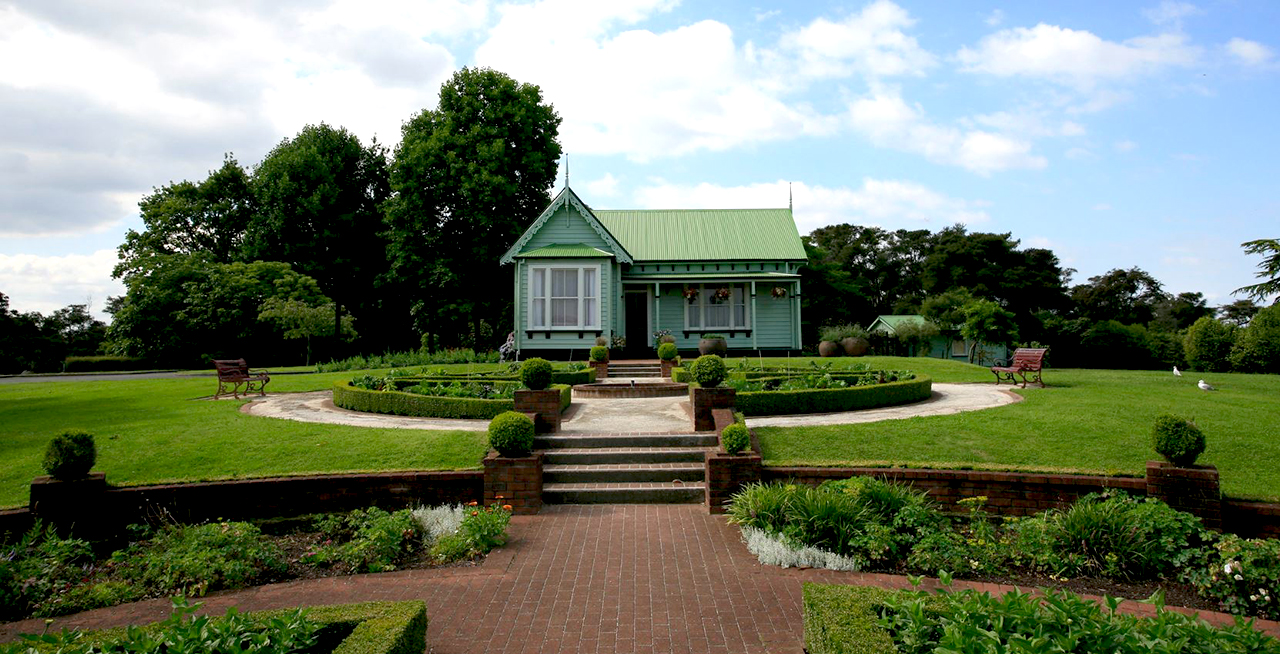
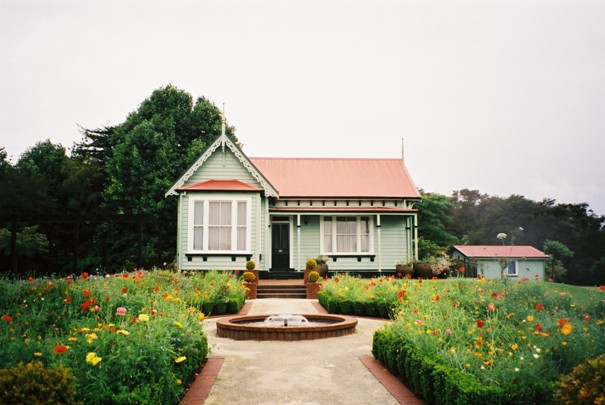
By 1898 reserves in the Thermal Springs districts were under the control of the newly formed Forest and Agricultural Branch of the Crown Lands Department and the Sanatorium grounds were under the superintendency of John Barrett, (Rotorua forest nurseryman) considered to be one of the leading horticulturalists in New Zealand at this time. The Government Inquiry Office was built in 1898, (later renamed Government Works Office). Later that year Thomas Pearson was appointed landscape gardener of Government Reserves in the Rotorua District. Formerly employed by the Tasmanian Government, Pearson appears to have taken over from Barrett and was reportedly engaged in major landscape works by 1900. The cottage for the Head Gardener was built in the Sanatorium Garden in 1899. From the late 1890s the gardens began featuring on postcards and in pictorial records. Including by such iconic photographers and postcard manufacturers as Muir and Moody, Sidney Charles Smith, Frederick Radcliffe, William Beattie and the ubiquitous Burton Brothers.
The Edwardian Pleasure Garden 1901 - 1910:
In 1901 control of the Sanatorium grounds moved from the Department of Crown Lands to the newly created Department of Tourist and Health Resorts under the management of Thomas Donne. Six years later Donne’s Department was to assume control of the entire town and its costly and ambitious creation as a tourist and health centre.
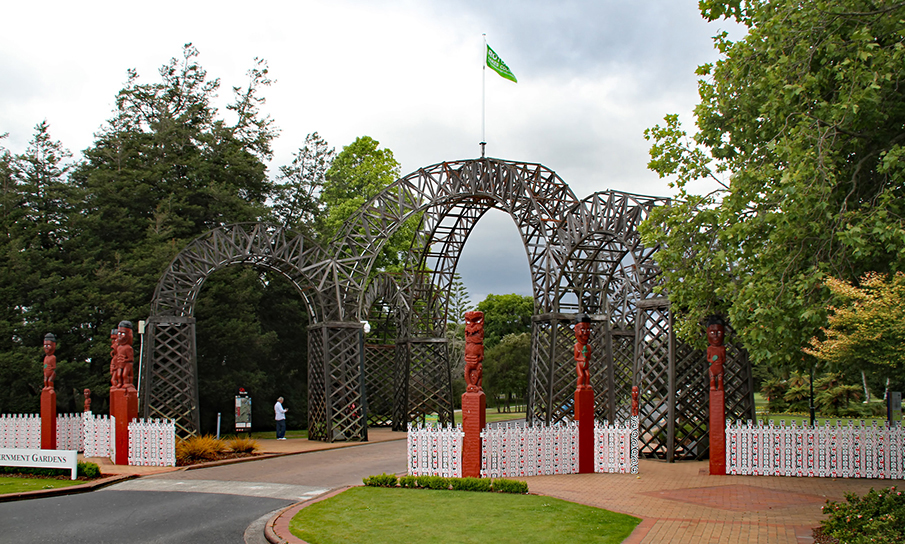
The then Duke and Duchess of York (later King George V and Queen Mary) stayed in Rotorua for three days in June 1901. A new bath next to the Pavilion Bath was opened by the Duchess and named in honour of her visit, the Duchess Bath. This was on the site of the current Polynesian Spa. Also in their honour, a special latticework arch was designed and erected at the intersection of Fenton and Hinemoa Streets; the arch was designed to represent the crown. Consisting of totara latticework, it was decorated with greenery and illuminated with the newly supplied electric light. The arch was moved to its present Hinemaru Street entranceway site shortly after the royal visit.
By 1902 the Resident Medical Officer position was redesignated with a wider role as Government Balneologist (an expert on medicinal springs) for all of New Zealand’s hot springs, but resident in Rotorua, a position that continued until 1951.
The first Balneologist was Dr Arthur Stanley Wohlmann, an English doctor, and a specialist in the subject. He had worked at the Royal Hospital at Bath and after touring the spas of Europe arrived in Rotorua in 1902. The existing medical accommodation was insufficient for his needs and a large two storey home (Wohlmann House) was designed for his use on the then boundary of the Sanatorium reserve in Hinemoa Street.
In 1899/1900 the first Bowling Green was under construction to augment the croquet and tennis facilities. Fashion and medical dictates were changing and the offering of complimentary recreational attractions to augment ‘taking the waters’ was gaining credence and began to appear in the Rotorua Government Gardens around 1900, including a band rotunda, tearoom and a small zoo and aviary.
Located at the ‘bathgate’ entrance, in 1903 the new tourist bureau building replaced the Inquiry Office which in the same year became the Government Works Office. The building has not survived and its exact location is not known.
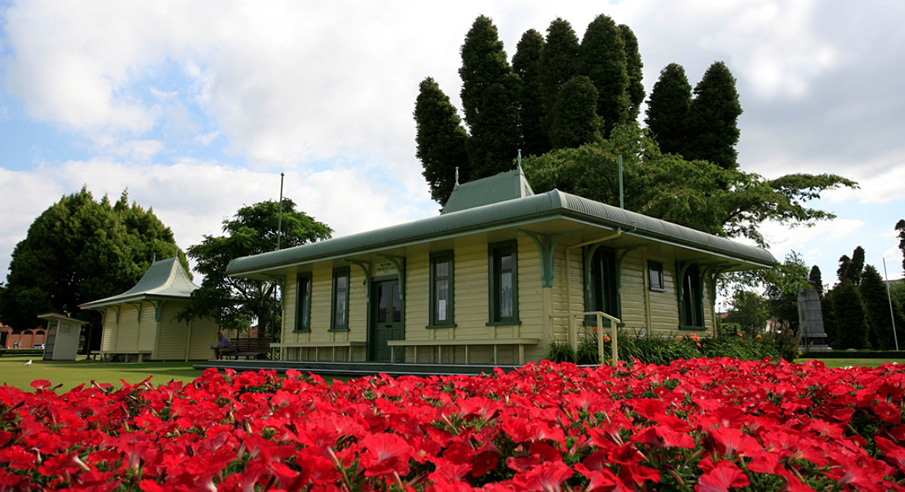
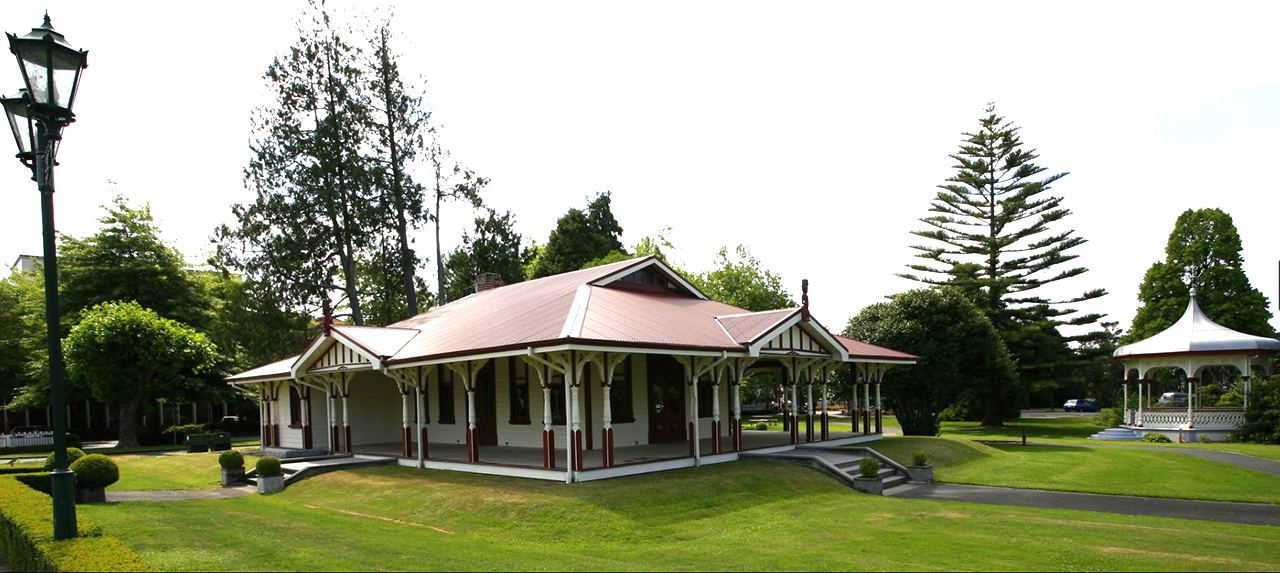
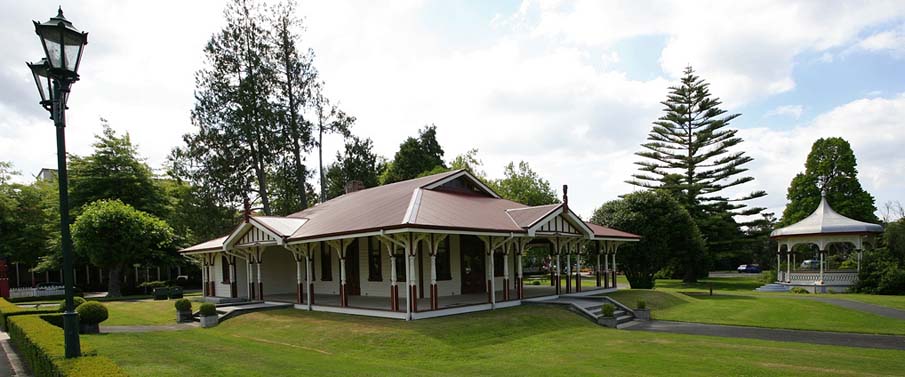
Opened in 1903 by Prime Minister Sir Joseph Ward, Te Runanga (the meeting place) was originally built as a tea kiosk/pavilion run by the Department of Tourist and Health Resorts. It stands near the western border of the Rotorua Government Gardens, close to Hinemaru Street. It had a verandah around three sides and had electric lighting both inside and out. The kiosk catered to a variety of clientele, becoming popular with both tourists and local residents, including the players from the croquet, bowls and tennis clubs. In 1904 a terrace around the tea house and an ornamental pond in front of it, were added. As with the Sanatorium, the teahouse was supplied with fruit and vegetable from the kitchen garden.
The development of the grounds in the first decade of the 1900s was on an impressive scale. Henry Matthews, appointed by Donne in 1903 to supervise the laying out of all of the department's Reserves, and landscape gardener Thomas Pearson, were responsible for the design of new garden areas and walks to compliment the new buildings which appeared across the site. Huge quantities of petrified rock were removed from the grounds and equally large volumes of soil and pumice were added to modify the topography and improve drainage. In the case of the new Bath House (1908) a new roadway had to be formed to enable invalid access to the building and primary walks configured to connect the building to the other sanatorium structures. In the fashion of a botanic garden, trees and plants (particularly those in the shrubberies bordering the main drive and primary walks) were clearly labelled for the edification of visitors.
In 1904 the monument in memory of Fred Wylie, who died in the South African War, was unveiled. At least four ornamental lakelets were designed and constructed between 1904 and 1908. The earliest of these was the work of Thomas Pearson and are similar to ponds he constructed in the Auckland Domain, Te Aroha Hot Springs Domain and the Fernery at the Christchurch Exhibition. Two later ponds were designed by Pearson’s replacement, Mr Hall and the Engineer in Charge, Mr Birk.
Donne and Wohlmann shared a common vision to transform the Sanatorium into a modern scientific health spa. Under their administration the simple immersion baths of the 1880s and 1890s were replaced with a range of massage, douche and spray techniques, and infrastructure and buildings were carefully designed to reflect the culture of a European spa. The landscape that supported this development was similarly well considered and was designed to ensure that it could fulfil a number of functions within the new resort style Sanatorium.
These four functions were as: a treatment modality and therapeutic instrument; a landscape of botanical education; a landscape of indigenous culture; a landscape of entertainment and amenity and a landscape of specialised production. Wohlmann believed that beautiful scenery and rational amusements were absolutely essential in every health resort. As part of this holistic regime, he successfully made a case for daily music performances in the Gardens to avoid patient boredom. This led to two brass bands, one Maori and the other European, playing every day from 1903.
Appreciation of indigenous New Zealand was not limited to ‘native’ vegetation and Donne, who considered the Maori presence at Rotorua to be one of the Spa’s chief draw cards, attempted to incorporate Maori culture and arts and crafts into the Sanatorium grounds in a number of ways. An aviary was established, described in 1902 as ‘one of the most perfect in the colony’ with ‘native’ water fowl and land birds including kiwi, weka, pukeko, kea, kakapo and kaka. An additional attraction was a small zoological collection alongside the aviary. Its residents included a pen of Indian Axis deer, guinea pigs, and raccoons gifted from the Washington National Zoological Park, who escaped not long after their arrival. A ‘small educated monkey’ was added in 1906. An owl house was also a feature in 1909. Its residents, like the raccoons, a gift from the Washington National Zoological Park. Black and white swans, peacocks and peahens were added to the aviary and, by 1909, large quantities of ducks and geese were confined within the grounds. Donated goldfish decorated one of the ornamental lakelets fronting the tea pavilion and brown and rainbow trout, were a feature of another pool.
In the tea pavilion patrons were served refreshments as one visitor reported, ‘by obliging Maori girls with Maori mats dangling from their waists’. A series of carved gateway posts and a paling fence decorated with kowhaiwhai pattern signalled the formal Queens Drive entrance to the grounds. Completed in 1907, this boundary treatment replaced an earlier timber, rail and wire fence with a triple gate system.
A camera obscura was added in 1909, mounted on top of the Ticket Office. Made popular by the 1906/07 Christchurch Exhibition, the camera obscura was said to 'appeal to the lovers of beauty as well as the curious'. Nothing of these structures survives.
The floral displays planned by Pearson around this time were described as being on a magnificent scale and were considered by Donne to be ‘the best of their kind in Australasia and to vie even with those of the famous spa of Europe’.
In terms of medical management, Wohlmann was a Fellow of the British Balneological and Climatological Society and his approach appears to have followed that group's theories around hydrotherapeutics, exercise and food. To enable individual dietary regimes using fresh produce, Wohlmann directed that land be set aside for an orchard, sizable kitchen garden and glasshouses for winter supplies. Vegetable beds were formed to the rear of both the Sanatorium and Medical Officers house and the orchard was planted where today's nursery is located.
By 1907, both grass and asphalt courts were available for tennis, a croquet lawn was developed and other building continued apace, including in 1906 an office which sold tickets for the various facilities. The second Blue Baths was built overlooking the bowling green.
The Antipodean Spa Finally Realised, the Rotorua Bath House 1908:
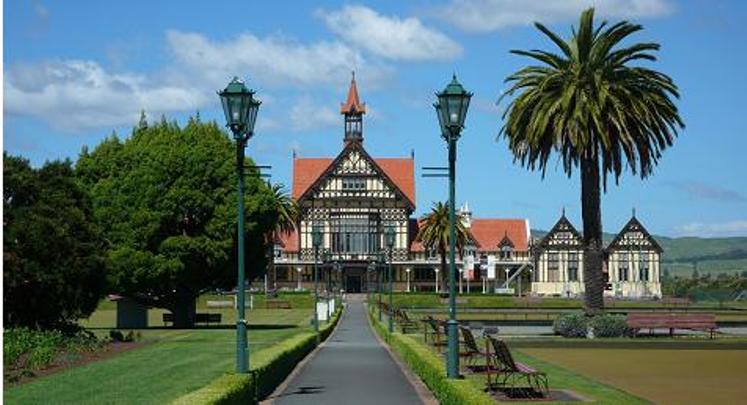
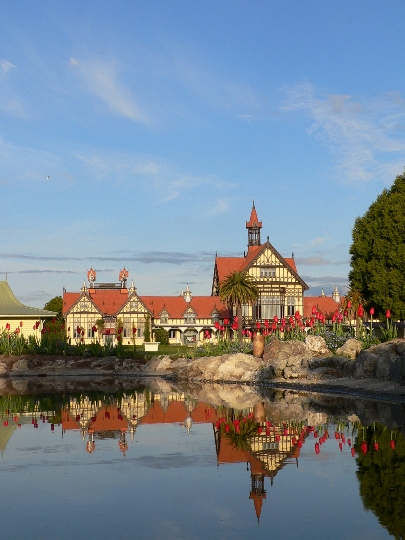
Dr Wohlmann made the construction of a new bathhouse one his first priorities, but although planning began in 1903 it was not opened until 1908.This impressive structure was the Elizabethan Revival style Rotorua Baths, also known as the Bath House or Tudor Towers. The hot water from Madame Rachel’s Spring was tapped to supply it. This building was an ambitious undertaking designed to compete with the popular European spas. Although not an architect, Wohlmann was responsible for the building concept. The half timbered Elizabethan revival style, modified to meet contemporary colonial requirements, was the preferred approach. Wohlmann considered the timber bath house buildings of Nauheim near Frankfurt to offer a greater impression of comfort, rather than the marble buildings of many other European spas. There was no suitable building stone available close to Rotorua and Wohlmann thought it better not to try to make timber look like stone in a classical style.
The exterior was built using pumice concrete between rimu timbers. Rather than excavated foundations, a series of concrete arches supported the building, also providing access for pipe work. This basement was concealed behind an earth terrace. For financial reasons a substantially reduced portion of the original plan was erected; the extreme northern wing and most of the southern wing were not completed.
The building contained fourteen deep baths, 42 shallow baths, twelve mud baths, four electrical baths, eight massage douche baths as well as four local vapour baths and Wohlmann estimated it could accommodate 1,000 bathers per day. Under Dr Wohlmann’s guidance Rotorua was at the centre of the practice and study of balneology in New Zealand. He had the baths reticulated so as to offer different ’waters’ believed to be beneficial to particular medical conditions. He piped in the alkaline water containing sulphur, from the Rachel spring to manage rheumatic diseases that required ’softening effect’; with the waters considered to be soothing and sedative in effect and effective in reducing pain and swelling in joints and tissues. The water from the Priest pool on the other hand were most valuable in the treatment of arthritis, rheumatism and ‘cases of nervous debility’ as they contained free sulphuric acid considered to have a ‘stimulating and tonic’ reaction. Wohlmann’s theory being, ‘...we find a strongly alkaline sulphurous water arising alongside of a still stronger acid, and it is to the close juxtaposition of these essentially antagonistic waters that the baths of Rotorua owe their fame.’
Optimism abounded, with T. E. Donne, Superintendent, Department of Tourist and Health Resorts, Rotorua reporting in 1908, ‘The stream of travellers has certainly set towards New Zealand and the establishment of up to date Government baths will no doubt make Rotorua world famous and be the means of attracting many thousands more visitors yearly.’ Despite Dr Wohlmann’s grand plans and the support of Prime Minister Sir Joseph Ward, the design failed to cope with the effects that soon undermined all the efforts and aspirations. Water vapour and steam from the mineral baths condensed on the walls and ceilings causing the plaster to soon begin to fall away, and the framing to rot. The waters even began to react with and break down the foundations. The ongoing maintenance issues became a costly issue and one that slowed later discussions on hand over of the building to the District Council.
The second Balneologist, Dr J.C. Duncan noted in his report of 1921, ‘Hydrotherapy has become an exact science capable of effecting cures that were previously considered impossible.’ Tourists were drawn to Rotorua by the thermal wonders and the medicinal value of the baths and pools. The Department of Tourist and Health Resorts had responded by creating an area entirely devoted to leisure in a grand style, including an orchestra and brass bands playing in the grounds and upstairs in the Bath House.
People could walk in the gardens, view the birds in the aviary, experience the camera obscura and take tea at Te Runanga. There were bowling greens, tennis courts, croquet lawns; with regattas and aquatic carnivals held on the nearby lake. This was the golden age of the Edwardian spa.
A Changing Focus from Health to Pleasure, Development 1920s to 1940s:
By the mid 1920s there were more sightseers and pleasure seekers visiting the Rotorua Government Gardens than those seeking health relief, and the emphasis began to gradually shift from a curative landscape to one more focused on general amenity. Correspondingly, official reports and letters reflected this change and the grounds are referred to as the Government Gardens rather than the Sanatorium Grounds in Tourist Department files from this time. Changing fashions in recreation and increasing visitor numbers prompted a rationalisation of some of the spaces within the grounds. New landscape and commemorative features were added during this period, including the First World War cenotaph 1923, and Arawa Monument in 1927. Some areas that had previously been used for passive amenity and ornamental effect were turned over to active recreation areas. By 1925 there were three bowling greens and five tennis courts in front of the Bath House. Rhododendron and azalea seeds sent by Professor Wright Smith of the Edinburgh Botanic Gardens, were successfully raised. Fourteen lawn tennis courts behind the Bath House had overwritten the path system with its border gardens and willow trees and an additional six asphalt courts were sited across the road. In what was a rare move for a public garden of this period, motor vehicles were allowed and subsequent public pressure saw the Queens and Hinemoa Drives sealed in 1931. The zoological attractions were removed from the grounds along with parts of the original Blue Baths, the latter in 1932. A vast rockery was created near the trout pond; much of this garden was stocked with alpine and rockery species from the New Zealand Alpine and Rock Garden Society that provided Mr Hesketh with a significant amount of free seed.
Sir Joseph Ward had became premier for a second time in 1929 and plans were drawn up for two new bath houses. In 1931 the Pavilion bathhouse was replaced with a new building named the Ward Baths, and, soon after the new Blue Baths opened .
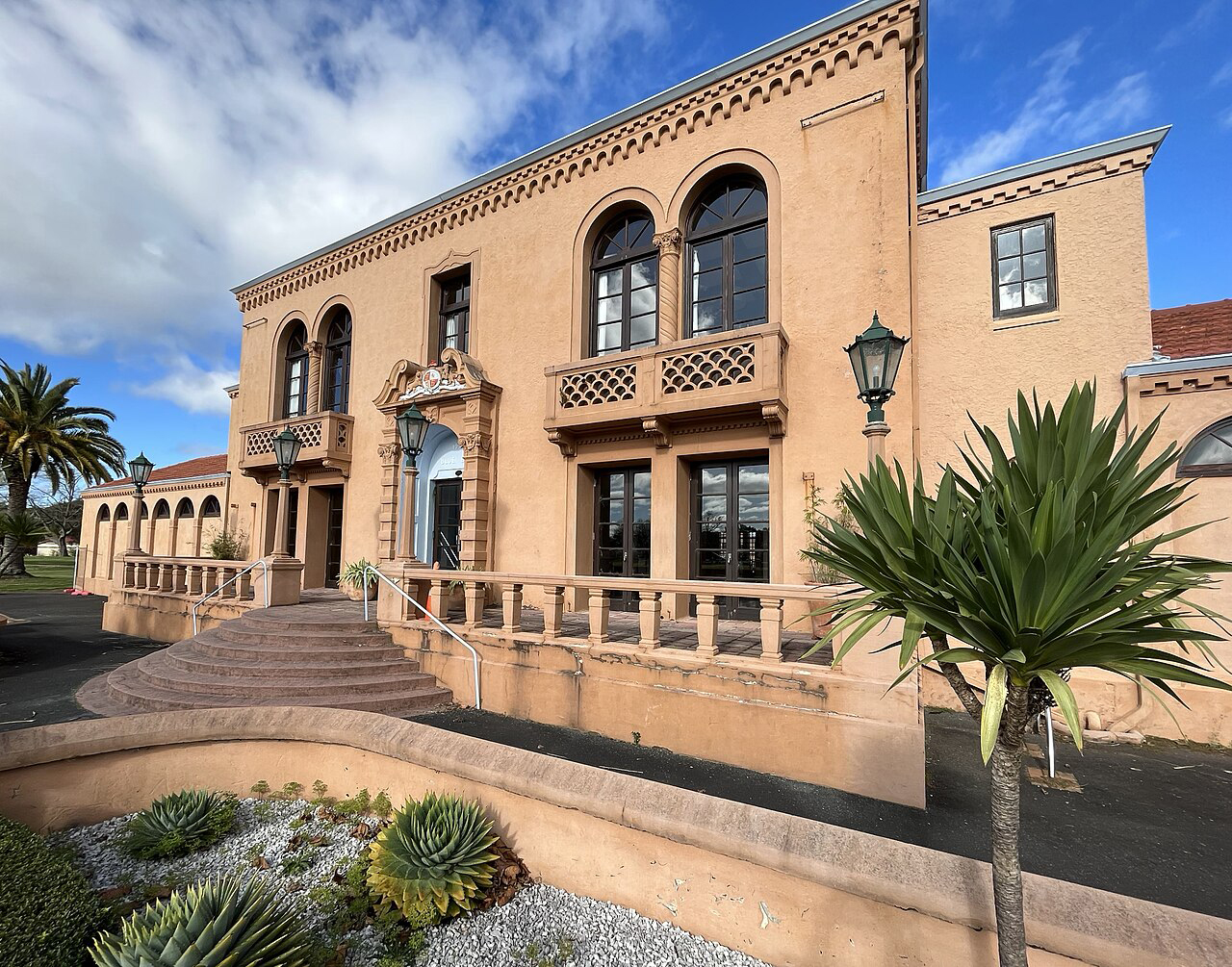
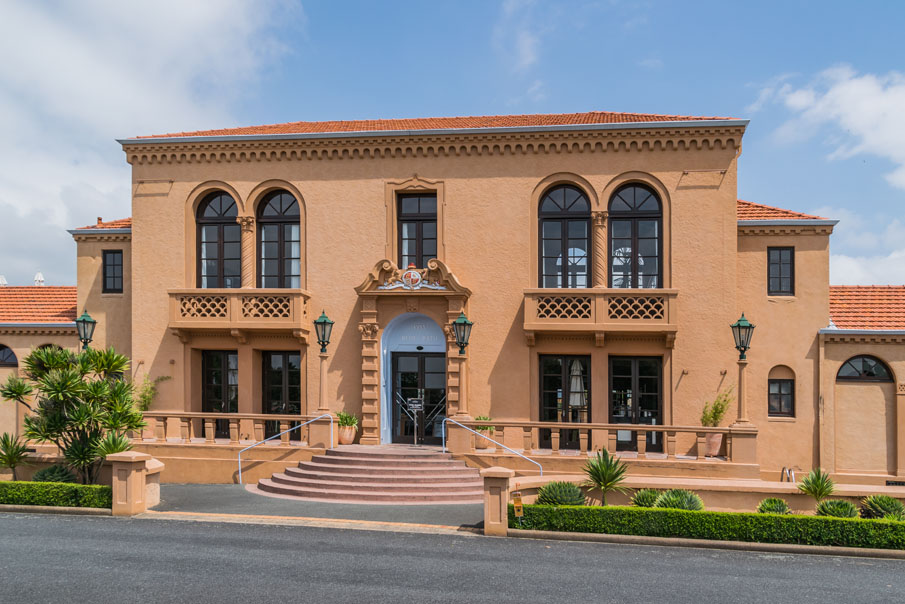
‘Fully opened in 1933, the Blue Baths building is a rare example of a Spanish Mission style bath house, which manifests important changes in attitudes towards health and recreation in the early twentieth century... In the political context, it was constructed after the election of Joseph Ward (1856-1930) as Prime Minister in 1928...In contrast to the segregated bathing that had occurred previously, they allowed mixed swimming...With family activity encouraged, the baths saw a number of social and sporting events, including Christmas carnivals and swimming championships. Local schools frequently used the facilities...’
The tea rooms at the Blue Baths took over in popularity from the now dated Te Runanga tea room and in 1934 the Te Runanga building became a pavilion for the bowling club who later glassed in the verandahs (since reversed) to enlarge the facility.
In 1936 a growing concern over the loss of New Zealand's native flora prompted the NZ Native Plant Protection Society and the Institute of Horticulture to approach the Tourist and Health Resorts Department requesting them to include ‘a well constructed garden suited to the cultivation of a representative collection of the indigenous flora of the district’ at each of their major tourist resorts. A remit greeted enthusiastically by then head gardener, Arthur Hesketh, who noted he had about half an acre of native plants growing in the grounds, all propagated from nearby bush. In 1945, Mr M Boothby took over from Hesketh and during his time, assisted by 18 gardening staff, made many changes to the organization of the landscaped areas and in removing high maintenance plants. Several well respected horticultural experts and enthusiasts visited the gardens, some writing favourably about the experience or exchanging plants, these included New Zealand horticultural enthusiasts; William Guilfoyle (Director of Melbourne Botanical Garden), Bernard Aston (Government Chemist), C.H. Treadwell (New Zealand Native Plants Protection Society), Victor Davies (Duncan and Davies) and Barbara Mathews (horticultural journalist).
During the time between World Wars One and Two, the spa was promoted as Rotorua’s main attraction, however the overall use declined, and particularly of the baths for medical purposes. The existing sanatorium was leased to the Waikato Hospital Board, and after renovations, in 1948 was reopened as ‘Gardenholm’, an old men’s home.
Foundations for a new sanatorium were laid in 1939, sited close to the main baths. Plans were delayed by the outbreak of the Second World War and eventually abandoned. Upon his death in 1942, Duncan’s replacement would be the third and last Government Balneologist. Appointed in Jan 1943, this was Dr A. T. M. Blair who retired in 1957. Other specialist staff providing relief to patients included physiotherapists, Arthur White and James Meek with each capable of between 3 to 4,000 treatments a year.
Even prior to completion of the expensive Ward and Blue Baths the Tourism Department began to change its attitude toward spas and reported concerns about the costs associated with its involvement in so many spas.
Mid to Late Twentieth Century Use and Development:
The first known local example of a public campaign relating to the gardens occurred in January 1947. The local paper ran a successful petition in order to save the lily pond near the Princes Gate, Further campaigns for retaining other garden features would have varied success later in the century.
Following World War Two, rehabilitation at the nearby Queen Elizabeth Hospital utilised the Rotorua Government Gardens as a restorative environment. In 1947 the Health Department took over control of the Bath House and Sanatorium and its 1949 report expressed the view that the waters as a miraculous cure could no longer be supported. This further influenced a change in the Government’s view. This change is expressed by Dr Lennane, Director of Physical Medicine, in 1951:
‘It is not considered that any mineral waters applied externally or taken internally have a specific action on arthritis...benefit gained...is now considered to be due merely to heat and moisture, and with some waters, to a counter irritant effect.’
Interestingly, the mud and waters are today used for relaxing and healing by a local rehabilitation service.
The Government’s tourism venture to create a great Southern Hemisphere spa was in ruin and in 1966 the Rotorua Bath House ceased operation as a spa. A number of factors were at play including changing medical philosophy, distance from European spa, lack of population nearby and the high cost of maintenance.
For several years talks between the Government and District Council took place regarding the council takeover of the Gardens. The idea was first considered in the early 1950s, but remained unresolved. In 1956 cabinet considered that the Bath House building be closed and demolished, however concerned citizens rallied to the cause and the Bath House was saved from destruction. In the 1960s the main impediments to an agreement were the operational losses incurred by both the Ward and Blue Baths and the financial compensation the Council wanted to offset this. In 1963, the Government transferred the Bath House and two and a half acres of land to the Rotorua City Council, together with a grant of 60,000 pounds towards the cost of the Bath House restoration.
In 1965, ‘Tudor Towers’ restaurant took up a lease of the upstairs area of the Bath House. It was last used as a bath house in 1965 and was vacated by the Health Department in 1966; all treatments were transferred to nearby Queen Elizabeth Hospital. In 1969 the Rotorua Art and History Museum opened in the south wing. The city council made substantial additions, alterations and restoration to the Bathhouse in 1977, 1979 and 1982. These involved converting the southern wing into a museum; the northern wing into an art gallery; two licensed restaurants; a night club and at the rear a covered walkway was built attaching the building to the indoor sportsdrome, built on vacant land behind the Bath House. The nightclub lease at the Bath House expired in 1990 and in 1993 a conservation plan for the building was commissioned.
A petition was presented to parliament in November 1970 in order to curb any council decision to take over the Rotorua Government Gardens before a ratepayer’s poll was taken and little more was heard on the subject for the rest of the decade.
In 1965 the Ward Baths were extended with the Aix wing. In 1971 the government granted a lease on the Ward Baths facility to a Wellington company named Polynesian Pools who redeveloped the pool complex.
In 1972 the old Government Enquiry Office and the Duchess Baths were demolished early one morning.
In March 1974 the then Minister of Tourism Mrs Tirikatene-Sullivan announced the department’s intention to demolish the Prince’s Gate archway at the Queens Drive entrance on Hinemaru Street, describing the structure as hazardous and a danger to the public. The people of Rotorua once again rallied successfully to protect their Rotorua Government Gardens. Repairs were carried out in October 1974 with costs shared between Council and government.
The Sanatorium building was demolished in 1975 and the district council negotiated a 33 year lease of the land for an orchid display centre with a company who then became the first group to receive a lease of Sanatorium Reserve land. When finished this development was known as the Fleur International Orchid Gardens. The complex is now leased as part of the Tamaki Tours operation.
Ownership Changes Hands, 1960s to Present:
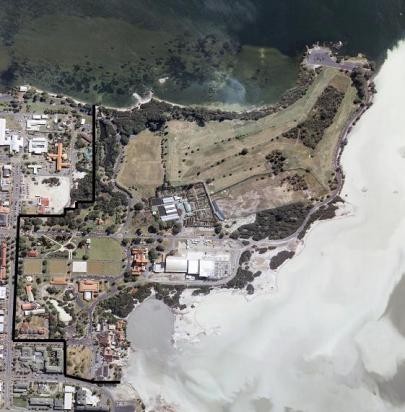
An agreement for the transfer of the Rotorua Government Gardens from the Tourist and Publicity Department to the Rotorua City Council was formulated in 1963. Involving 117 acres of gardens and playing areas, the transfer was progressive and began with the area containing the Bath House and the land to the east extending to the lakeshore and the main access roads. Administrative control of the Government Grounds was officially transferred from the Tourist and Publicity Department to the Rotorua District Council in June 1983. However, the Department continued to be responsible for their maintenance until April 1986. As part of this agreement safeguards were formalised to ensure that the Gardens were developed and maintained to a high standard and their tourist value retained. This was documented in the Management Plan for the site approved by Council in August 1986.
During this period new buildings were erected and some parts of the gardens redeveloped. This included the establishment of a camellia garden near the Gardeners Cottage, the camellias having been donated by Col. Tom Durrant, an internationally regarded Camellia expert. It is believed that remnants of this planting survive in the current ‘avenue’ of camellias. In 1986 Bob Burstall of the Forest Research Institute had visited the Gardens to investigate trees for inclusion in his historic and notable tree study, and eight specimens were included. One of the oldest ornamental garden structures remaining from the 19th Century was demolished sometime in the mid 1980s. This was a live arbour, planted with wisteria which enclosed the walk leading towards the Princes Gate on the northern side of the Te Runanga Kiosk.
The once popular Blue Baths had been in a steady decline since 1955 and were closed from 1982 until 1999 when they were reopened after substantial adaptation.
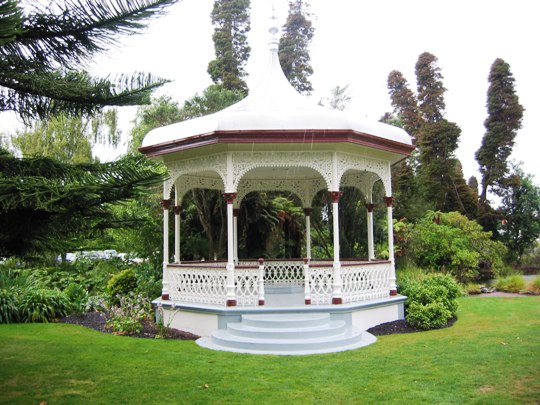
The Rotunda was moved north about 200 metres from its original site in 1991 to make way for the new bowling pavilion. In recent years the Rotunda has become a place for weddings ceremonies and is featured in a Rotorua District Council brochure ‘Where to Wed’.
In 1992 the men's and women's bowling clubs built a joint clubroom in the Gardens and Rotorua District Council decided to demolish Te Runanga. Yet again the community rallied and the decision was overturned. The Rotorua Heritage and Civic Trust coordinated a restoration project and the building is now used as a function room.
The latest sport to be accommodated in the Rotorua Government Gardens is petanque, and a court is sited to the right of the existing bowling greens. A lack of demand for lawn bowls means that Rotorua District Council is considering converting one of the greens in to a general recreational green space for visitors to enjoy and use for picnics.
A Millennium statue (Y2K) was installed in the gardens in 2001.
Tourism and particularly international visitors, continues to be a very strong economic driver for Rotorua District, and as a high profile park with cultural and thermal attractions within, the Rotorua Government Gardens remain an integral attraction. No figures are specifically collected; it is estimated that one in five visitors to Rotorua visit the Gardens (a conservative figure of around 400,000 people per year). The grounds have been used as a location for films. Timed to coincide with the centennial of the building, in 2006 a project was initiated to complete the Bath House building to its original plan. The fundraising efforts for the project are being driven by the Rotorua Museum Centennial Trust. Stage one of the three stage project, the Viewing Platform, was completed in March 2006 and offers expansive views of the gardens and lake area. The second stage, the North Wing extension, was completed in November 2008. The south wing extension, which began in 2009, will house two new galleries, one named in commemoration of historian, Don Stafford.