

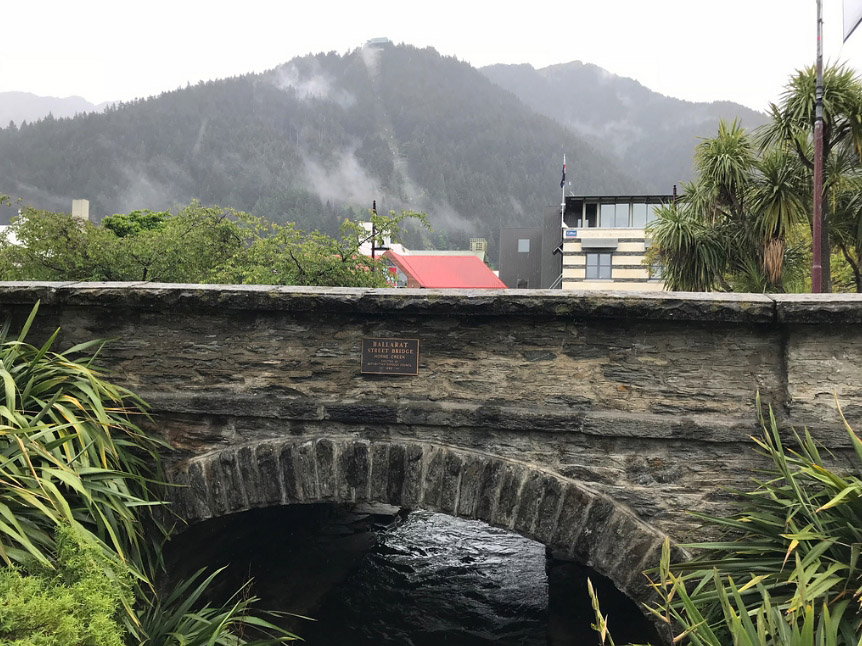
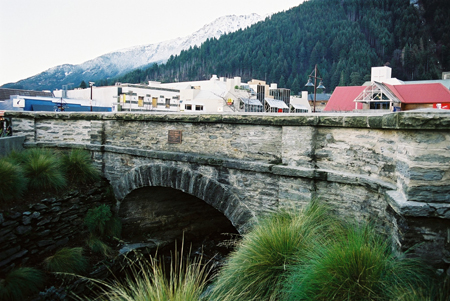
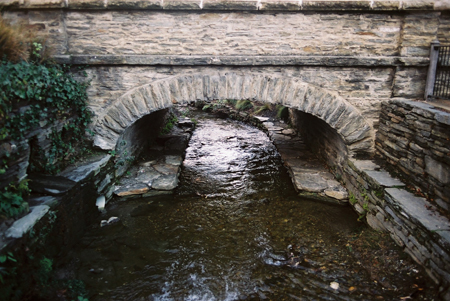
The bridge consists of a single arch, constructed from the local schist, topped with a stone parapet. The bridges which were first constructed in Queenstown in the early 1860s tended to be of wood and generally needed to be replaced after 20-odd years. Controversy surrounded the building of the Ballarat Street Bridge; the council argued over which should be built first, it or the bridge in Shotover Street. The design was also contentious; the local paper questioned whether the low arch would be strong enough for the traffic. During construction the building inspector complained about the size of stone being used (his report was eventually over-ridden), about the length of time it was taking to construct the bridge, and about the steep approaches to it. While the council agreed with the inspector's last comment, they decided that the contractor had complied with the plans provided to him and therefore the council should spend an extra £20 on building up the road. The bridge was mostly complete by 6 June 1882, with only the pointing and coping to do. It was not entirely finished because of the 'loss of the stonemason' who appeared to have disappeared. The whole was finally complete on 7 July 1882.
Stone arch bridges are relatively unusual in New Zealand and the Ballarat Street Bridge is unusual within that small group because it is constructed from coursed rubble schist rather than from the more common ashlar blocks of limestone. Schist was a common building material in Central Otago due to its availability and the relative lack of timber in the area. The Ballarat Street Bridge is a picturesque element of the Queenstown streetscape and a reminder of Queenstown's early days.
List Entry Information
Status
Listed
List Entry Status
Historic Place Category 1
Access
Able to Visit
List Number
7097
Date Entered
17th December 1993
Date of Effect
17th December 1993
City/District Council
Queenstown-Lakes District
Region
Otago Region
Legal description
Adjacent to Lot 1 DP 20875 Blk V and Lot 1 DP 20964 Blk XXX Town of Queenstown.
Status
Listed
List Entry Status
Historic Place Category 1
Access
Able to Visit
List Number
7097
Date Entered
17th December 1993
Date of Effect
17th December 1993
City/District Council
Queenstown-Lakes District
Region
Otago Region
Legal description
Adjacent to Lot 1 DP 20875 Blk V and Lot 1 DP 20964 Blk XXX Town of Queenstown.
Why is this place significant?
Historic Significance
Historical Significance or Value This historic place was registered under the Historic Places Act 1980. This report includes the text from the original Proposal for Classification report considered by the NZHPT Board at the time of registration. The Ballarat Street bridge serves as a visible reminder of the town's long history as a gold mining service centre and more recently as a major tourist attraction.
Physical Significance
This historic place was registered under the Historic Places Act 1980. This report includes the text from the original Proposal for Classification report considered by the NZHPT Board at the time of registration. ARCHITECTURAL QUALITY: In comparison with other forms of bridge construction used in New Zealand during the nineteenth century, arch bridges built entirely from stone are rare. The Ballarat Street bridge in Queenstown is even more uncommon because it is built from coursed rubbe schist masonry rather than the more usual ashlar blocks of limestone (G.G. Thornton, October 1990). The scarcity of timber, the abundant supply of schist and the ease with which it could be extracted encouraged the stone's use for a wide range of building types and structures in Central Otago last century. TOWNSCAPE/LANDMARK VALUE: Standing on one of Queenstown's principal thoroughfares, the bridge is a picturesque element within the streetscape of one of New Zealand's leading tourist resorts and therefore complements the more conspicuous and much admired former courthouse, library and Lake County Council buildings nearby.
Why is this place significant?
Historic Significance
Historical Significance or Value This historic place was registered under the Historic Places Act 1980. This report includes the text from the original Proposal for Classification report considered by the NZHPT Board at the time of registration. The Ballarat Street bridge serves as a visible reminder of the town's long history as a gold mining service centre and more recently as a major tourist attraction.
Physical Significance
This historic place was registered under the Historic Places Act 1980. This report includes the text from the original Proposal for Classification report considered by the NZHPT Board at the time of registration. ARCHITECTURAL QUALITY: In comparison with other forms of bridge construction used in New Zealand during the nineteenth century, arch bridges built entirely from stone are rare. The Ballarat Street bridge in Queenstown is even more uncommon because it is built from coursed rubbe schist masonry rather than the more usual ashlar blocks of limestone (G.G. Thornton, October 1990). The scarcity of timber, the abundant supply of schist and the ease with which it could be extracted encouraged the stone's use for a wide range of building types and structures in Central Otago last century. TOWNSCAPE/LANDMARK VALUE: Standing on one of Queenstown's principal thoroughfares, the bridge is a picturesque element within the streetscape of one of New Zealand's leading tourist resorts and therefore complements the more conspicuous and much admired former courthouse, library and Lake County Council buildings nearby.
Construction Professional
Name
McNeil, James
Type
Sculptor
Biography
Stonemason. The text below is from the original Proposal for Classification report considered by the NZHPT Board at the time of registration. James McNeil was a local stonemason, who also built the Lake County offices and a cottage for himself in Church Street which is still extant. He was a Master of the local Masonic Lodge on a number of occasions and lived in Queenstown from around 1882 until his death in 1920.
Construction Details
Start Year
1882
Type
Original Construction
Construction Materials
Central Otago schist with a mud mortar infill.
Notable Features
The bridge's construction is its most notable feature.
Construction Professional
Name
McNeil, James
Type
Sculptor
Biography
Stonemason. The text below is from the original Proposal for Classification report considered by the NZHPT Board at the time of registration. James McNeil was a local stonemason, who also built the Lake County offices and a cottage for himself in Church Street which is still extant. He was a Master of the local Masonic Lodge on a number of occasions and lived in Queenstown from around 1882 until his death in 1920.
Construction Details
Start Year
1882
Type
Original Construction
Construction Materials
Central Otago schist with a mud mortar infill.
Notable Features
The bridge's construction is its most notable feature.
This historic place was registered under the Historic Places Act 1980. This report includes the text from the original Proposal for Classification report considered by the NZHPT Board at the time of registration. DESCRIPTION: The bridge was built for the Queenstown Borough Council in 1882.
This historic place was registered under the Historic Places Act 1980. This report includes the text from the original Proposal for Classification report considered by the NZHPT Board at the time of registration. DESCRIPTION: The bridge was built for the Queenstown Borough Council in 1882.
This historic place was registered under the Historic Places Act 1980. This report includes the text from the original Proposal for Classification report considered by the NZHPT Board at the time of registration. ARCHITECTURAL DESCRIPTION: Built of coursed rubble masonry construction, the Ballarat Street bridge spans the Horne Creek just north of Queenstown's commercial centre. Running north-south between Camp and Stanley Streets the bridge provides motor vehicle access across the creek. Between the abutments a single broad arch with voussoirs is terminated by a solid stone parapet with a string course close to crown and a coping of a harder stone. The approach walls of the bridge, which is slightly elevated above normal street level, are curved and a plaque attached to the east side reads "Ballarat Street Bridge - Horne Creek - Erected by Queenstown Borough Council - 1882 - ". MODIFICATIONS: None.
This historic place was registered under the Historic Places Act 1980. This report includes the text from the original Proposal for Classification report considered by the NZHPT Board at the time of registration. ARCHITECTURAL DESCRIPTION: Built of coursed rubble masonry construction, the Ballarat Street bridge spans the Horne Creek just north of Queenstown's commercial centre. Running north-south between Camp and Stanley Streets the bridge provides motor vehicle access across the creek. Between the abutments a single broad arch with voussoirs is terminated by a solid stone parapet with a string course close to crown and a coping of a harder stone. The approach walls of the bridge, which is slightly elevated above normal street level, are curved and a plaque attached to the east side reads "Ballarat Street Bridge - Horne Creek - Erected by Queenstown Borough Council - 1882 - ". MODIFICATIONS: None.
Historical and Associated Iwi / Hapū / Whānau
Completion Date
3rd July 2002
Report Written By
Melanie Lovell-Smith
Information Sources
Borrell, 1973
Marion Borrell, 'Old Buildings of the Lakes District', Dunedin, 1973
Cyclopedia of New Zealand, 1905
Cyclopedia Company, Industrial, descriptive, historical, biographical facts, figures, illustrations, Wellington, N.Z, 1897-1908, Vol. 4 Otago and Southland, Cyclopedia Company, Christchurch, 1905
Hayward, 1987
Bruce W. Hayward, 'Granite and Marble: a guide to building stones in New Zealand', Geological Society of New Zealand Guidebook, No.8
Clifford, 1989
R.D. Clifford, The Historic of Lake Lodge of Ophir No.85 - 1864-1989, Lake Lodge of Ophir, Queenstown, 1989.
Queenstown Courier
Queenstown Courier
Other Information
This historic place was registered under the Historic Places Act 1980. This report includes the text from the original Proposal for Classification report considered by the NZHPT Board at the time of registration. Please note that entry on the New Zealand Heritage List/Rarangi Korero identifies only the heritage values of the property concerned, and should not be construed as advice on the state of the property, or as a comment of its soundness or safety, including in regard to earthquake risk, safety in the event of fire, or insanitary conditions.
Historical and Associated Iwi / Hapū / Whānau
Completion Date
3rd July 2002
Report Written By
Melanie Lovell-Smith
Information Sources
Borrell, 1973
Marion Borrell, 'Old Buildings of the Lakes District', Dunedin, 1973
Cyclopedia of New Zealand, 1905
Cyclopedia Company, Industrial, descriptive, historical, biographical facts, figures, illustrations, Wellington, N.Z, 1897-1908, Vol. 4 Otago and Southland, Cyclopedia Company, Christchurch, 1905
Hayward, 1987
Bruce W. Hayward, 'Granite and Marble: a guide to building stones in New Zealand', Geological Society of New Zealand Guidebook, No.8
Clifford, 1989
R.D. Clifford, The Historic of Lake Lodge of Ophir No.85 - 1864-1989, Lake Lodge of Ophir, Queenstown, 1989.
Queenstown Courier
Queenstown Courier
Other Information
This historic place was registered under the Historic Places Act 1980. This report includes the text from the original Proposal for Classification report considered by the NZHPT Board at the time of registration. Please note that entry on the New Zealand Heritage List/Rarangi Korero identifies only the heritage values of the property concerned, and should not be construed as advice on the state of the property, or as a comment of its soundness or safety, including in regard to earthquake risk, safety in the event of fire, or insanitary conditions.
Current Usages
Uses: Transport
Specific Usage: Bridge/ Viaduct
Former Usages
General Usage: Transport
Specific Usage: Bridge/ Viaduct
Current Usages
Uses: Transport
Specific Usage: Bridge/ Viaduct
Former Usages
General Usage: Transport
Specific Usage: Bridge/ Viaduct
Location
Sign up to hear more
Get the latest heritage news, features and events delivered
straight to your inbox.
