List Entry Information
Status
Listed
List Entry Status
Historic Place Category 2
Access
Private/No Public Access
List Number
7291
Date Entered
14th December 1995
Date of Effect
14th December 1995
City/District Council
Auckland Council
Region
Auckland Council
Extent of List Entry
Extent includes part of the land described as Lot 1 DP 361575 (RT 250578), North Auckland Land District, and the building known as Barrington Building thereon, and its fittings and fixtures.
Legal description
Lot 1 DP 361575 (RT 250578), North Auckland Land District
Status
Listed
List Entry Status
Historic Place Category 2
Access
Private/No Public Access
List Number
7291
Date Entered
14th December 1995
Date of Effect
14th December 1995
City/District Council
Auckland Council
Region
Auckland Council
Extent of List Entry
Extent includes part of the land described as Lot 1 DP 361575 (RT 250578), North Auckland Land District, and the building known as Barrington Building thereon, and its fittings and fixtures.
Legal description
Lot 1 DP 361575 (RT 250578), North Auckland Land District
Why is this place significant?
Cultural Significance
This historic place was registered under the Historic Places Act 1993. The following text is from the original Recommendation for Registration considered by the NZHPT Board at the time of registration. Cultural: In the 1970s the former warehouse served as an art gallery, the "Barrington Gallery". It retains the name today.
Historic Significance
Historical Significance or Value This historic place was registered under the Historic Places Act 1993. The following text is from the original Recommendation for Registration considered by the NZHPT Board at the time of registration. Historical: The Barrington Building was designed as a warehouse for island trader Gustav Kronfeld, who owned it between 1904 and 1936 when it became the premises of John Bates & Co., glass and china importers. The present name refers to its mid/late 1970s role as a venue for Barrington Gallery. Gustav Kronfield owned the Barrington Building between 1904 & 1917. It became the premises of John Bates & Co , glass and china importers, which operated there from the mid 1930s until at least the mid 1960s. The early merchandising-shipping links remained until at least the 1970s with tenancies for companies such as Kempthorne Prosser, Chemical Fertiliser Works, American Airlines and Holm Shipping Co.
Physical Significance
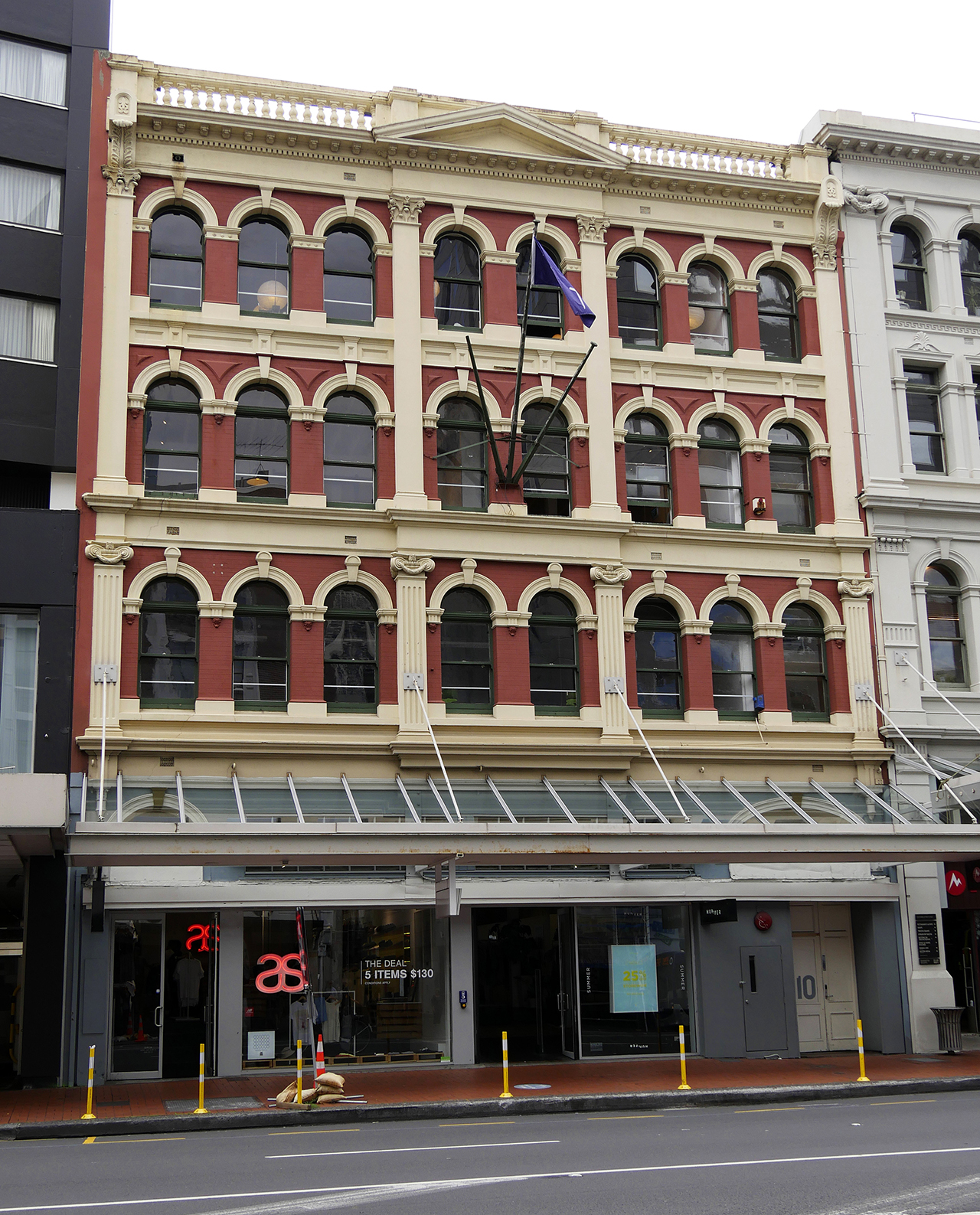
This historic place was registered under the Historic Places Act 1993. The following text is from the original Recommendation for Registration considered by the NZHPT Board at the time of registration. Architectural: The Barrington Building (1904) was designed by architect John Currie. The design of the building is eclectic Romanesque/Italianate. It has an exceptionally detailed and rich facade which is out of the ordinary for Edwardian warehouse facades. The original post and beam construction (timber post and beam) and brick walls are still in place with service facilities (present day) built around them as required. Present day plaster board wall linings are in evidence placed over the brick walls. Window frames are a mixture of square-headed and segmental and appear to be original. They are all predominantly sash windows contemporary with the date of the building. Some division of rooms appears to have taken place both in the past and in the present but the partitions appear to be reversible. Stairwells appear to have been refurbished in Art Modern style probably in the 1940s or early 1950s with smooth plastered surfaces replacing balusters, they can be considered a legitimate part of the architectural history, of the place. Doorway architraves and doors have been replaced in some parts with functional fittings dating c 1960s - 1980s. A lift door appears to be contemporary with the 1920s when electric lifts became more prevalent and when electric lifts were probably installed in this building. Archaeological: Parts of this area have archaeological potential.
Why is this place Category 1 / Category 2?
Detail Of Assessed Criteria
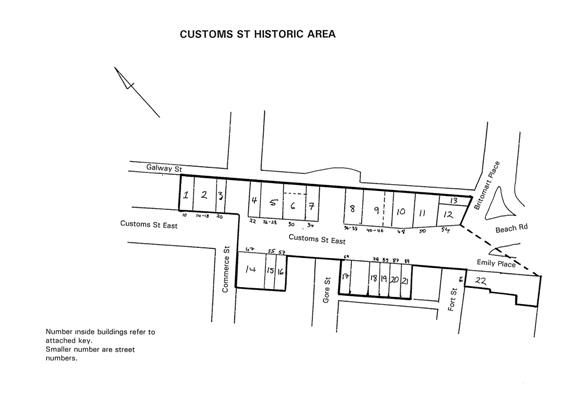
This historic place was registered under the Historic Places Act 1993. The following text is from the original Recommendation for Registration considered by the NZHPT Board at the time of registration. The following comments are made in relation to the criteria identified under S.23(2) of the Historic Places Act 1993. a) The extent to which the place reflects important and representative aspects of New Zealand history. b) The association of the place with events, persons or ideas of importance in New Zealand history. The Barrington Building reflects the importance of merchandising warehouses to New Zealand cities. In a colony which lacked substantial manufacturing industries, importing was an important business activity. These merchandising warehouses were usually clustered around the interface between the waterfront and the central business district. The building has had a long association with local arts and crafts, first though the Bates connection which was involved in all three New Zealand international exhibitions as well as retailing and importing and then with the Barrington dealer gallery, which showcased local and international artists of renown. c) the potential of the place to provide knowledge of New Zealand history. The Customs St East buildings all stand on land reclaimed between 1879 and 1886 and therefore have archaeological significance. Reclamation of the seabed commenced in 1859. The outer edge of the northern side of Customs St was initially bounded by a muddy embankment and on the seaward side of the reclamation were massive stone retaining walls. Customs St provided access to a number of wharves constructed out across the mudflats of Commercial Bay to deeper water. Between 1879 and 1886 the reclamation continued in a northerly and easterly direction forming the land between Customs and Quay St. This is the land on which the warehouses now stand. It is probable that a large quantity of material will have been deposited on the sea bed from the wharves which is likely to include artefacts of historical and archaeological interest. g) The technical accomplishment or value, or design of the place. The design of the Barrington Building is eclectic Romanesque/Italianate. The facade emphasises rectangularity through the treatment of the parapet which has a triangular pediment visually supported on three storeys by Classical pilasters. These pilasters are strongly emphasised, in keeping with the style, forming a Classical frame at the edges of the facade. The arrangement of the facade by these means is divided into three bays or spandrels recessed behind the plane of the pilasters. The fact that this building functioned as a warehouse in 1904, but was richly designed in the style of a retail store, indicates the wealth of the merchants of Princess Street who built these warehouses. k) The extent to which the place forms part of a wider historical and cultural complex or historical and cultural landscape. This warehouse is one of several Merchants' warehouses on the northern side of Customs St East. This impressive group of nineteenth and early twentieth century commercial buildings once formed the city's point of commercial contact with the rest of the colony and the world. Conclusion: The Barrington Building, 10 Customs St East, Auckland, is recommended for registration as a Category II as a place of historical and cultural heritage significance and value. The Barrington Building is one of a group of turn of the century merchandising warehouses built on Auckland's busy waterfront. The building has an exceptionally detailed and rich facade not common in Edwardian warehouses.
Why is this place significant?
Cultural Significance
This historic place was registered under the Historic Places Act 1993. The following text is from the original Recommendation for Registration considered by the NZHPT Board at the time of registration. Cultural: In the 1970s the former warehouse served as an art gallery, the "Barrington Gallery". It retains the name today.
Historic Significance
Historical Significance or Value This historic place was registered under the Historic Places Act 1993. The following text is from the original Recommendation for Registration considered by the NZHPT Board at the time of registration. Historical: The Barrington Building was designed as a warehouse for island trader Gustav Kronfeld, who owned it between 1904 and 1936 when it became the premises of John Bates & Co., glass and china importers. The present name refers to its mid/late 1970s role as a venue for Barrington Gallery. Gustav Kronfield owned the Barrington Building between 1904 & 1917. It became the premises of John Bates & Co , glass and china importers, which operated there from the mid 1930s until at least the mid 1960s. The early merchandising-shipping links remained until at least the 1970s with tenancies for companies such as Kempthorne Prosser, Chemical Fertiliser Works, American Airlines and Holm Shipping Co.
Physical Significance
This historic place was registered under the Historic Places Act 1993. The following text is from the original Recommendation for Registration considered by the NZHPT Board at the time of registration. Architectural: The Barrington Building (1904) was designed by architect John Currie. The design of the building is eclectic Romanesque/Italianate. It has an exceptionally detailed and rich facade which is out of the ordinary for Edwardian warehouse facades. The original post and beam construction (timber post and beam) and brick walls are still in place with service facilities (present day) built around them as required. Present day plaster board wall linings are in evidence placed over the brick walls. Window frames are a mixture of square-headed and segmental and appear to be original. They are all predominantly sash windows contemporary with the date of the building. Some division of rooms appears to have taken place both in the past and in the present but the partitions appear to be reversible. Stairwells appear to have been refurbished in Art Modern style probably in the 1940s or early 1950s with smooth plastered surfaces replacing balusters, they can be considered a legitimate part of the architectural history, of the place. Doorway architraves and doors have been replaced in some parts with functional fittings dating c 1960s - 1980s. A lift door appears to be contemporary with the 1920s when electric lifts became more prevalent and when electric lifts were probably installed in this building. Archaeological: Parts of this area have archaeological potential.
Why is this place Category 1 / Category 2?
Detail Of Assessed Criteria
This historic place was registered under the Historic Places Act 1993. The following text is from the original Recommendation for Registration considered by the NZHPT Board at the time of registration. The following comments are made in relation to the criteria identified under S.23(2) of the Historic Places Act 1993. a) The extent to which the place reflects important and representative aspects of New Zealand history. b) The association of the place with events, persons or ideas of importance in New Zealand history. The Barrington Building reflects the importance of merchandising warehouses to New Zealand cities. In a colony which lacked substantial manufacturing industries, importing was an important business activity. These merchandising warehouses were usually clustered around the interface between the waterfront and the central business district. The building has had a long association with local arts and crafts, first though the Bates connection which was involved in all three New Zealand international exhibitions as well as retailing and importing and then with the Barrington dealer gallery, which showcased local and international artists of renown. c) the potential of the place to provide knowledge of New Zealand history. The Customs St East buildings all stand on land reclaimed between 1879 and 1886 and therefore have archaeological significance. Reclamation of the seabed commenced in 1859. The outer edge of the northern side of Customs St was initially bounded by a muddy embankment and on the seaward side of the reclamation were massive stone retaining walls. Customs St provided access to a number of wharves constructed out across the mudflats of Commercial Bay to deeper water. Between 1879 and 1886 the reclamation continued in a northerly and easterly direction forming the land between Customs and Quay St. This is the land on which the warehouses now stand. It is probable that a large quantity of material will have been deposited on the sea bed from the wharves which is likely to include artefacts of historical and archaeological interest. g) The technical accomplishment or value, or design of the place. The design of the Barrington Building is eclectic Romanesque/Italianate. The facade emphasises rectangularity through the treatment of the parapet which has a triangular pediment visually supported on three storeys by Classical pilasters. These pilasters are strongly emphasised, in keeping with the style, forming a Classical frame at the edges of the facade. The arrangement of the facade by these means is divided into three bays or spandrels recessed behind the plane of the pilasters. The fact that this building functioned as a warehouse in 1904, but was richly designed in the style of a retail store, indicates the wealth of the merchants of Princess Street who built these warehouses. k) The extent to which the place forms part of a wider historical and cultural complex or historical and cultural landscape. This warehouse is one of several Merchants' warehouses on the northern side of Customs St East. This impressive group of nineteenth and early twentieth century commercial buildings once formed the city's point of commercial contact with the rest of the colony and the world. Conclusion: The Barrington Building, 10 Customs St East, Auckland, is recommended for registration as a Category II as a place of historical and cultural heritage significance and value. The Barrington Building is one of a group of turn of the century merchandising warehouses built on Auckland's busy waterfront. The building has an exceptionally detailed and rich facade not common in Edwardian warehouses.
Construction Professional
Name
Currie, John
Type
Architect
Biography
John Currie (c.1859-1921) was born in Ireland. He immigrated to New Zealand in 1874 and practised architecture in Auckland on his own account. In 1879 the firm of L.D. Nathan became a major client. Accordingly much of Currie's work was in the designing of commercial and warehouse buildings. Few of these survive with the exception of L.D. Nathan & Co. Bond Store (now Archilles House, 1902) and P. Hayman's Warehouse (now Sofrana House, 1899-1900). Currie also designed buildings for Moss Davis, the Auckland brewer. The two best known works from this association were the Rob Roy Tavern, Freeman's Bay (1884), and the restoration of the interior of the Grand Hotel in Princes Street after fire in 1901. The latter building was designed by H.D. Skinner in 1879, although is sometimes erroneously attributed to Currie. In addition to hotels and commercial work, Currie also undertook residential commissions. The best known of these is "Wickford" in Princes Street. Originally the home of Mr N.A. Nathan, it now accommodates the Registry Office of the University of Auckland. Currie was one of the original members of the New Zealand Institute of Architects formed in 1905. Currie died in Ponsonby in 1921 aged 70.
Construction Details
Start Year
1904
startYearCirca
Type
Original Construction
Construction Professional
Name
Currie, John
Type
Architect
Biography
John Currie (c.1859-1921) was born in Ireland. He immigrated to New Zealand in 1874 and practised architecture in Auckland on his own account. In 1879 the firm of L.D. Nathan became a major client. Accordingly much of Currie's work was in the designing of commercial and warehouse buildings. Few of these survive with the exception of L.D. Nathan & Co. Bond Store (now Archilles House, 1902) and P. Hayman's Warehouse (now Sofrana House, 1899-1900). Currie also designed buildings for Moss Davis, the Auckland brewer. The two best known works from this association were the Rob Roy Tavern, Freeman's Bay (1884), and the restoration of the interior of the Grand Hotel in Princes Street after fire in 1901. The latter building was designed by H.D. Skinner in 1879, although is sometimes erroneously attributed to Currie. In addition to hotels and commercial work, Currie also undertook residential commissions. The best known of these is "Wickford" in Princes Street. Originally the home of Mr N.A. Nathan, it now accommodates the Registry Office of the University of Auckland. Currie was one of the original members of the New Zealand Institute of Architects formed in 1905. Currie died in Ponsonby in 1921 aged 70.
Construction Details
Start Year
1904
startYearCirca
Type
Original Construction
This place is part of an historic area that was registered under the Historic Places Act 1993. The following text is from the original Recommendation for Registration considered by the NZHPT Board at the time of registration of the historic area. Balustrade parapet, central pediment supported by pilasters, continuous arched windows, four storey, brick. Formerly "John Bates Building" built c1904 for Gustav Kronfeld, General Merchant whose trade centred on the Pacific Islands. Architect: J. Currie.
This place is part of an historic area that was registered under the Historic Places Act 1993. The following text is from the original Recommendation for Registration considered by the NZHPT Board at the time of registration of the historic area. Balustrade parapet, central pediment supported by pilasters, continuous arched windows, four storey, brick. Formerly "John Bates Building" built c1904 for Gustav Kronfeld, General Merchant whose trade centred on the Pacific Islands. Architect: J. Currie.
Historical and Associated Iwi / Hapū / Whānau
Information Sources
Auckland Public Libraries
Auckland Public Libraries
Auckland Weekly News
Auckland Weekly News
New Zealand Herald
New Zealand Herald, 12 July 1932, p. 6; 28 September 1933, p. 6.
New Zealand Graphic
New Zealand Graphic
Other Information
Copies of the original registration reports are available from the NZHPT Northern Region office Please note that entry on the New Zealand Heritage List/Rarangi Korero identifies only the heritage values of the property concerned, and should not be construed as advice on the state of the property, or as a comment of its soundness or safety, including in regard to earthquake risk, safety in the event of fire, or insanitary conditions.
Historical and Associated Iwi / Hapū / Whānau
Information Sources
Auckland Public Libraries
Auckland Public Libraries
Auckland Weekly News
Auckland Weekly News
New Zealand Herald
New Zealand Herald, 12 July 1932, p. 6; 28 September 1933, p. 6.
New Zealand Graphic
New Zealand Graphic
Other Information
Copies of the original registration reports are available from the NZHPT Northern Region office Please note that entry on the New Zealand Heritage List/Rarangi Korero identifies only the heritage values of the property concerned, and should not be construed as advice on the state of the property, or as a comment of its soundness or safety, including in regard to earthquake risk, safety in the event of fire, or insanitary conditions.
Former Usages
General Usage: Trade
Specific Usage: Warehouse/storage area
Former Usages
General Usage: Trade
Specific Usage: Warehouse/storage area