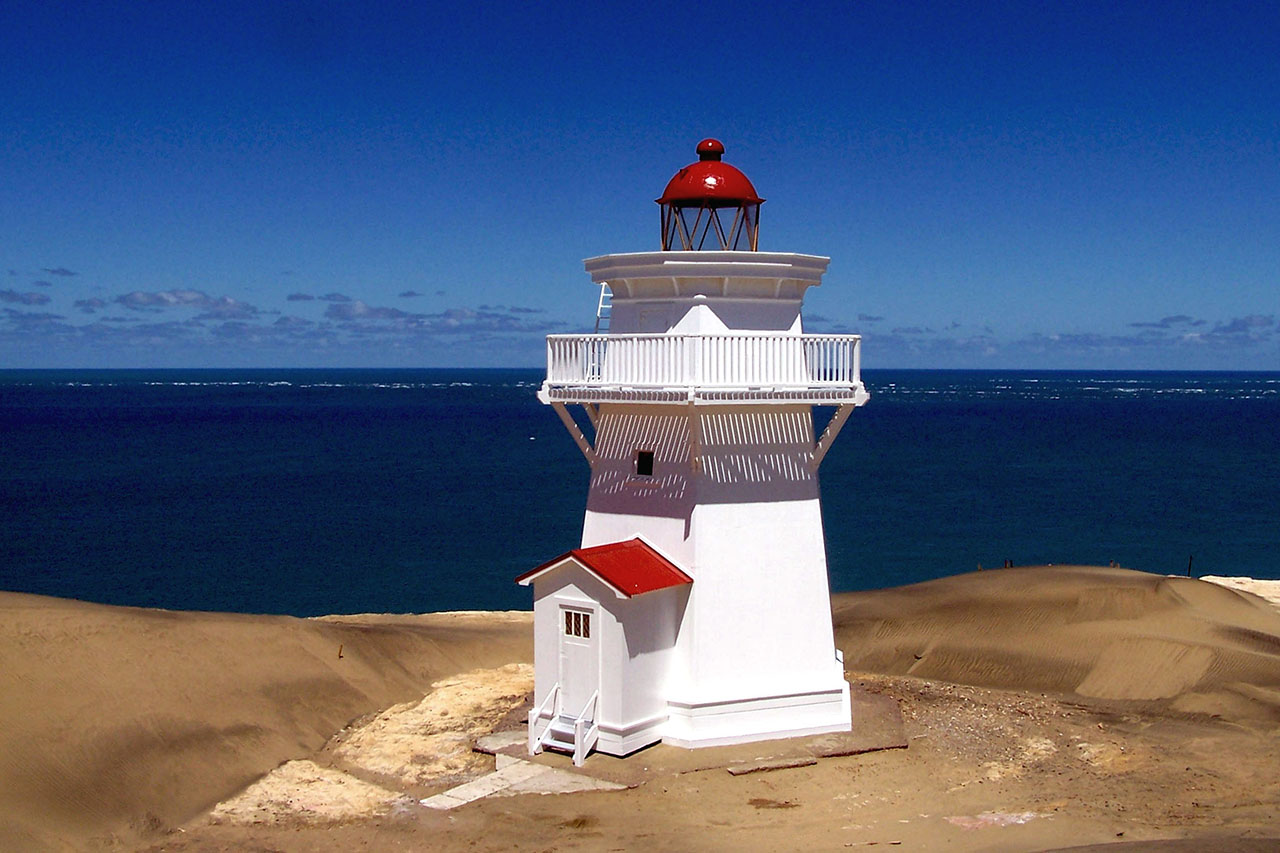
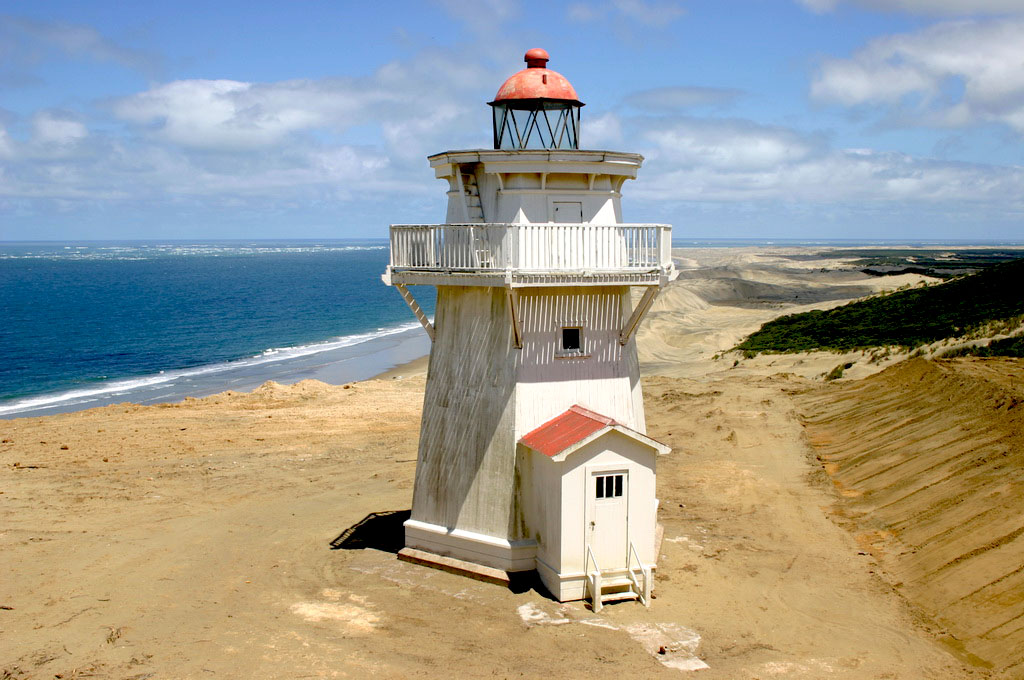
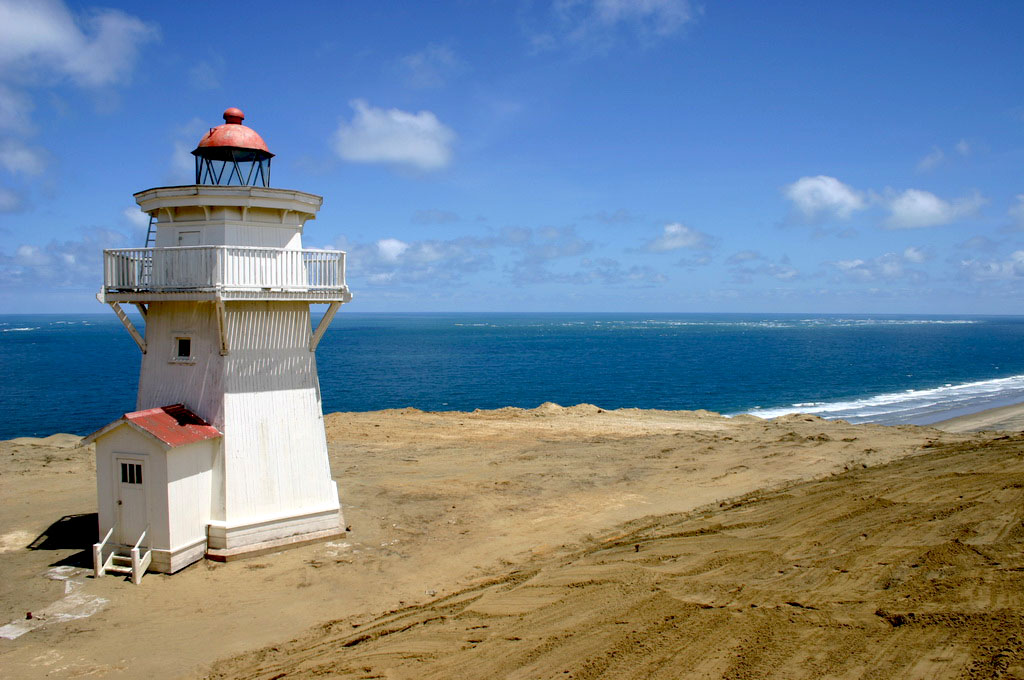
The Kaipara North Head Lighthouse is one of only a small number of remaining timber lighthouses in New Zealand. Constructed in 1883-84, it was erected to guide shipping across the treacherous Kaipara bar. The Kaipara, on the west coast of Northland, is New Zealand's largest natural harbour and became the focus for the widespread exploitation of kauri timber around its shores in the late nineteenth and early twentieth centuries. Such timber was a major construction material, exported throughout New Zealand and overseas. Erected on a sandstone outcrop, the structure lay some 8 km from the nearest settlement at Pouto, in an area dominated by large drifting sand dunes. It was part of a larger complex, which included residences for the two permanent lighthouse keepers and their families, as well as a signal station and other ancillary buildings. Earlier Maori occupation had occurred in the immediate vicinity, reflecting an ongoing relationship between human settlement and the maritime environment.
The lighthouse was originally 13.4m tall, with a tapering six-sided tower, three storeys high. It was topped by a large lantern, and erected with a small basement in its concrete footings to allow a weight mechanism for the clockwork light to be used. Unlike other similar towers, prefabricated and imported from Britain, the structure was constructed of local materials. Most notably, the walls of the tower were designed with an external and internal skin of local kauri, while the core was erected of basalt rubble from Mt Eden, Auckland. This has enabled the building to withstand extreme winds. The structure was designed by John Blackett (1818-1893), an important individual in New Zealand's nineteenth-century engineering history, possibly assisted by Captain Robert Johnson. Johnson had put forward the earliest scheme for national lighthouse coverage of New Zealand's shores in the 1860s, stimulating a major programme of lighthouse construction by the colonial government that lasted into the 1880s. Timber structures allowed such work to be carried out at a lesser cost, and the Kaipara light proved to be the last of the coastal lighthouses erected during this period. The lighthouse and its auxiliary buildings were built at a cost of £5,571.
The light in the lantern was imported from Britain, and was first exhibited in December 1884. The cramped interior of the lighthouse was mostly used for storage and also contained trap doors in its centre to accommodate the weights associated with the operation of the light. Although the light was visible for up to 37 km in good conditions, crossing the bar remained treacherous, and within a few months of it starting operation the lighthouse keepers played host to shipwreck victims from three vessels: the Anabell, Mary Annison and Mathieu. Extreme conditions were suffered at the station as well as at sea, with shifting sands and erosion being a major problem. This eventually led to the keepers and their families moving to nearby Pouto from the early 1900s, with an extra keeper being taken on to allow two keepers to remain at the station on rotation. Many of the station buildings succumbed to the wind or were relocated at this time.
At the outbreak of the Second World War (1939-1945), the light - which was by then of gas automatic type - was extinguished, and in 1944 the original lantern was removed and eventually set up at Cape Saunders, where it remains. A smaller lantern from Cape Foulwind was subsequently installed on the top of the tower, incorporating a new automatic light. The light was relit on the same day in November 1947 that the Kaipara was formally closed as a port of entry, although the harbour still remained open for local traffic. The lighthouse was finally closed in 1955 or early 1956, after which it became derelict. A preservation society was formed in the early 1970s to restore the building, supported by the local community at Pouto. The building and the associated station site were subsequently placed under the management of the New Zealand Historic Places Trust, who still operate the place as a historic property. The lighthouse remains popular, with an estimated 35,000 tourists visiting the site annually in the late 1990s, in spite of its remote location.
The Kaipara North Head Lighthouse is historically significant as a prominent reminder of the role that shipping and coastal transport has played in the social and economic development of New Zealand. It has archaeological value as the site of an associated lighthouse station. The place has considerable architectural significance as one of few remaining timber lighthouses in New Zealand, as the only 1880s example believed to be constructed locally of New Zealand materials, and for its association with John Blackett - an important nineteenth-century engineer. The Kaipara North Head Lighthouse has cultural significance for its close connections with the local community at Pouto.
The lighthouse was originally 13.4m tall, with a tapering six-sided tower, three storeys high. It was topped by a large lantern, and erected with a small basement in its concrete footings to allow a weight mechanism for the clockwork light to be used. Unlike other similar towers, prefabricated and imported from Britain, the structure was constructed of local materials. Most notably, the walls of the tower were designed with an external and internal skin of local kauri, while the core was erected of basalt rubble from Mt Eden, Auckland. This has enabled the building to withstand extreme winds. The structure was designed by John Blackett (1818-1893), an important individual in New Zealand's nineteenth-century engineering history, possibly assisted by Captain Robert Johnson. Johnson had put forward the earliest scheme for national lighthouse coverage of New Zealand's shores in the 1860s, stimulating a major programme of lighthouse construction by the colonial government that lasted into the 1880s. Timber structures allowed such work to be carried out at a lesser cost, and the Kaipara light proved to be the last of the coastal lighthouses erected during this period. The lighthouse and its auxiliary buildings were built at a cost of £5,571.
The light in the lantern was imported from Britain, and was first exhibited in December 1884. The cramped interior of the lighthouse was mostly used for storage and also contained trap doors in its centre to accommodate the weights associated with the operation of the light. Although the light was visible for up to 37 km in good conditions, crossing the bar remained treacherous, and within a few months of it starting operation the lighthouse keepers played host to shipwreck victims from three vessels: the Anabell, Mary Annison and Mathieu. Extreme conditions were suffered at the station as well as at sea, with shifting sands and erosion being a major problem. This eventually led to the keepers and their families moving to nearby Pouto from the early 1900s, with an extra keeper being taken on to allow two keepers to remain at the station on rotation. Many of the station buildings succumbed to the wind or were relocated at this time.
At the outbreak of the Second World War (1939-1945), the light - which was by then of gas automatic type - was extinguished, and in 1944 the original lantern was removed and eventually set up at Cape Saunders, where it remains. A smaller lantern from Cape Foulwind was subsequently installed on the top of the tower, incorporating a new automatic light. The light was relit on the same day in November 1947 that the Kaipara was formally closed as a port of entry, although the harbour still remained open for local traffic. The lighthouse was finally closed in 1955 or early 1956, after which it became derelict. A preservation society was formed in the early 1970s to restore the building, supported by the local community at Pouto. The building and the associated station site were subsequently placed under the management of the New Zealand Historic Places Trust, who still operate the place as a historic property. The lighthouse remains popular, with an estimated 35,000 tourists visiting the site annually in the late 1990s, in spite of its remote location.
The Kaipara North Head Lighthouse is historically significant as a prominent reminder of the role that shipping and coastal transport has played in the social and economic development of New Zealand. It has archaeological value as the site of an associated lighthouse station. The place has considerable architectural significance as one of few remaining timber lighthouses in New Zealand, as the only 1880s example believed to be constructed locally of New Zealand materials, and for its association with John Blackett - an important nineteenth-century engineer. The Kaipara North Head Lighthouse has cultural significance for its close connections with the local community at Pouto.