Designer:
Cape Brett Lighthouse was designed by David Scott, the Marine Department's Lighthouse Artificer. Scott was involved in the design and construction of a number of New Zealand lighthouses for the Marine Department. Cape Brett was his final design before his retirement.
Builders:
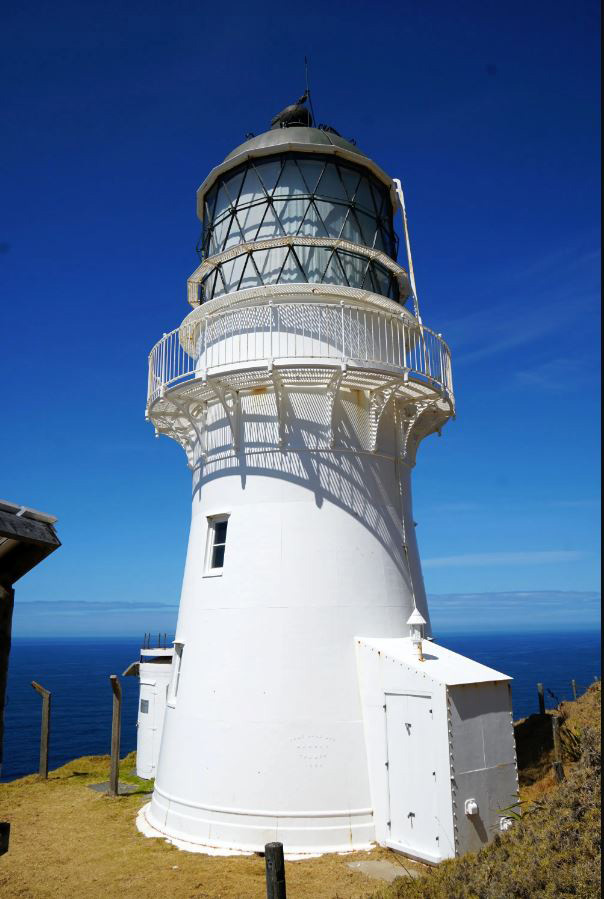
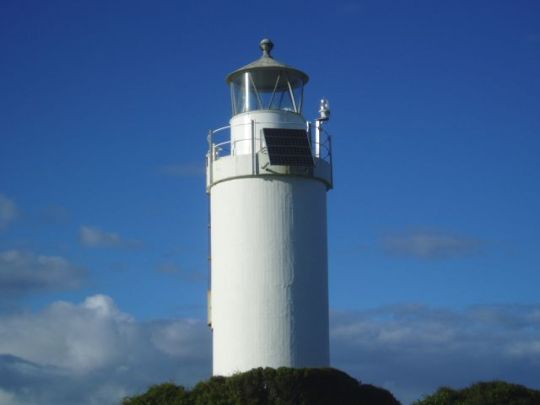
The iron tower of the Cape Brett Lighthouse was constructed at the Thames Iron Works of Charles Judd; the contract was signed by Charles Judd's sons James Charles Judd and William Henry Judd. Charles Judd came to New Zealand in 1859, and worked originally in Auckland. In 1869 he established the Thames Iron Works on what became a substantial site in the centre of Thames. He smelted the first iron on the Thames Goldfield. The foundry catered for the mining and sawmilling industries, eventually supplying equipment to all parts of New Zealand but especially the Auckland Province. Judd's made fire plug boxes, sewerage manhole covers, cesspit grates, iron pipes and gas lamp posts. The Thames Iron Works made the cast iron towers for the lighthouses at Kahurangi Point (1903), Cape Campbell (1905), East Island (1906) and Cape Brett (1910).
Equipment Manufacturers:
The light was designed and part fabricated by Messrs Stevenson, Civil Engineers of Edinburgh. The optics were made by Chance Brothers and Co. Ltd, Birmingham, and the lantern, parapet, carriage and mercury trough and clockwork rotating mechanism by James Milne and Sons Ltd, Edinburgh .
Stevensons:
Robert Stevenson (1772 - 1850) was a Scottish engineer and lighthouse designer, responsible for building fifteen lighthouses between 1811 and 1833. Through his sons Alan (1807 - 1865), David (1815 - 1886), and Thomas (1818 - 1887) and grandsons David A (1854 - 1938) and Charles Stevenson (1855 - 1950), he established a dynasty of lighthouse engineers. The novelist and poet Robert Louis Stevenson was a grandson who did not follow the family profession.
Chance Brothers:
Robert Lucas Chance bought the blown window glass works of the British Crown Glass Company in Spon Lane, Birmingham in 1824. The company's future was guaranteed in 1832 by investment from William and George Chance who were successful Birmingham iron merchants. They became partners in the business, now called Chance Brothers and Company. In 1832, Chance Brothers became the first British glassworks to adopt the cylinder method to produce sheet glass, and overtook all rivals to become the largest British manufacturer of window and plate glass, and optical glasses.
Chance Brothers also became a major lighthouse engineering company, producing optical components, machinery, and other equipment for lighthouses around the world. James Timmins Chance pioneered placing lighthouse lamps inside a cage surrounded by Fresnel lenses so as to increase the available light output; these optics revolutionised lighthouse design. Another important innovation from Chance Brothers was the introduction of rotating optics, allowing adjacent lighthouses to be distinguished from each other by the number of times per revolution that the light flashes.
Chance Brothers' other projects included the glazing of the Crystal Palace and the Houses of Parliament, including the opal glass for the four faces of the Westminster Clock Tower which houses Big Ben. The ornamental windows for the United States White House were also made there. Other products included stained glass windows, ornamental lamp shades, microscope glass slides, painted glassware, glass tubing and specialist types of glass.
Pilkington acquired a 50% shareholding in Chance in 1945, then assumed full control of Chance Brothers by the end of 1952. The production of flat glass ceased at Smethwick in 1976. The remainder of the works closed in 1981, ending over 150 years of glass production at Smethwick.
James Milne:
Milne was an Edinburgh brass founder who commenced business in 1824. By 1894, the Company was James Milne and Sons Ltd., and it was under that name it provided equipment for Cape Brett, as well as many other lighthouses worldwide. For example at Copinsay Lighthouse built in the Orkneys in 1915, Milne and Sons built the lantern, parapet, revolving machine, carriage and mercury trough. It seems likely they were responsible for the same elements at Cape Brett.
Cape Brett Lighthouse:
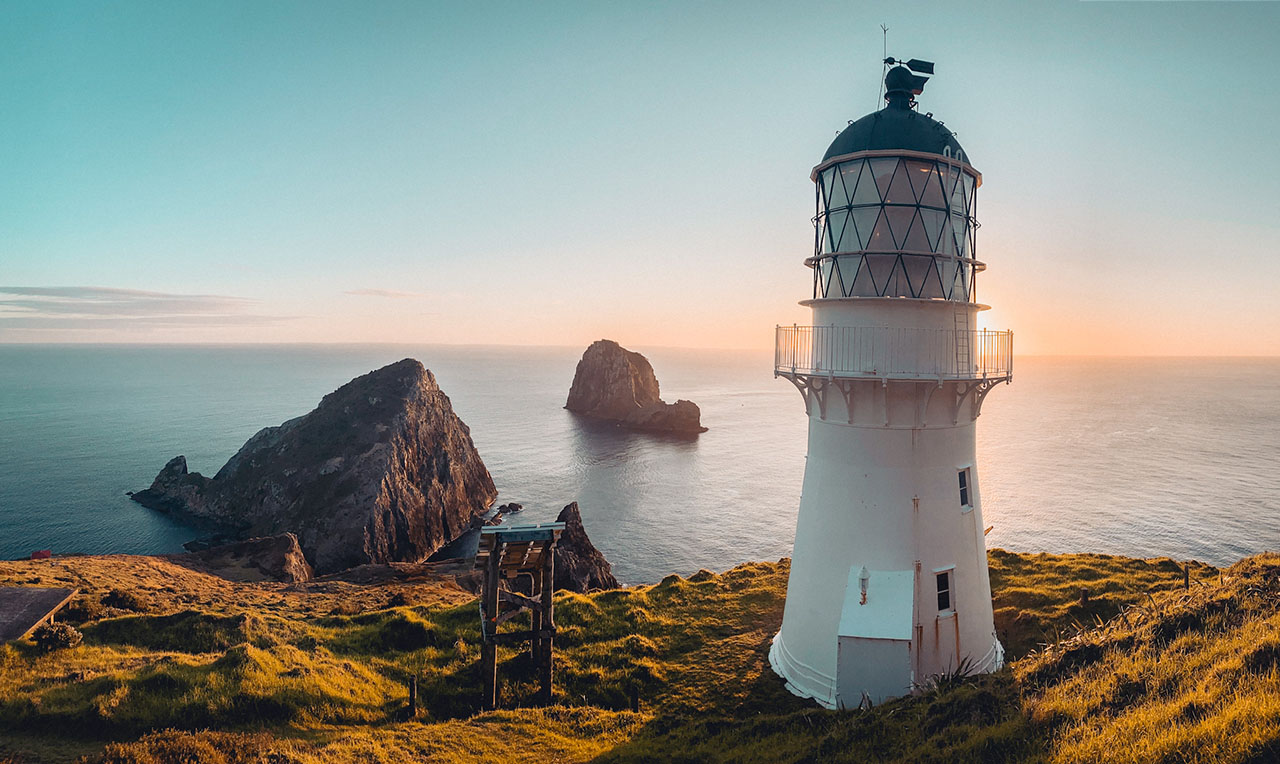
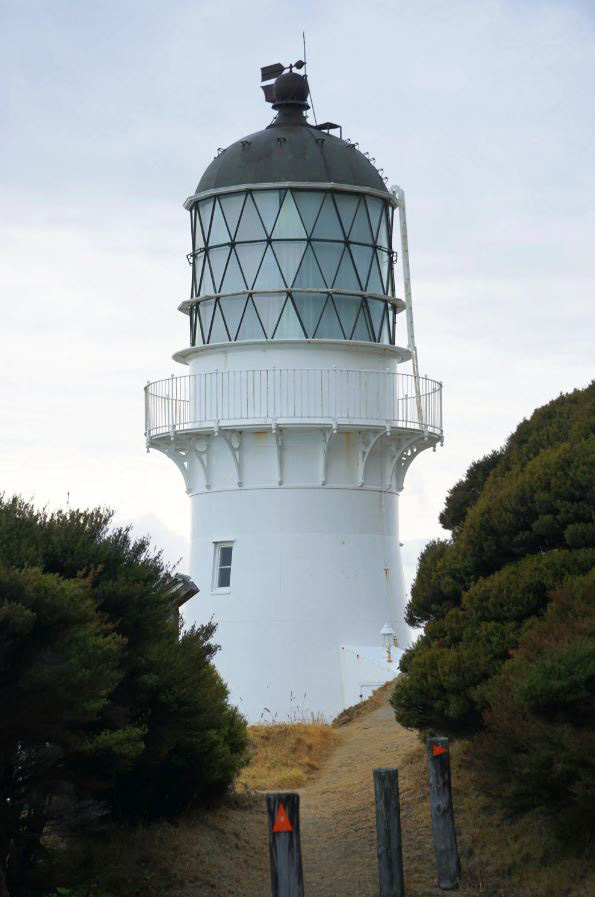
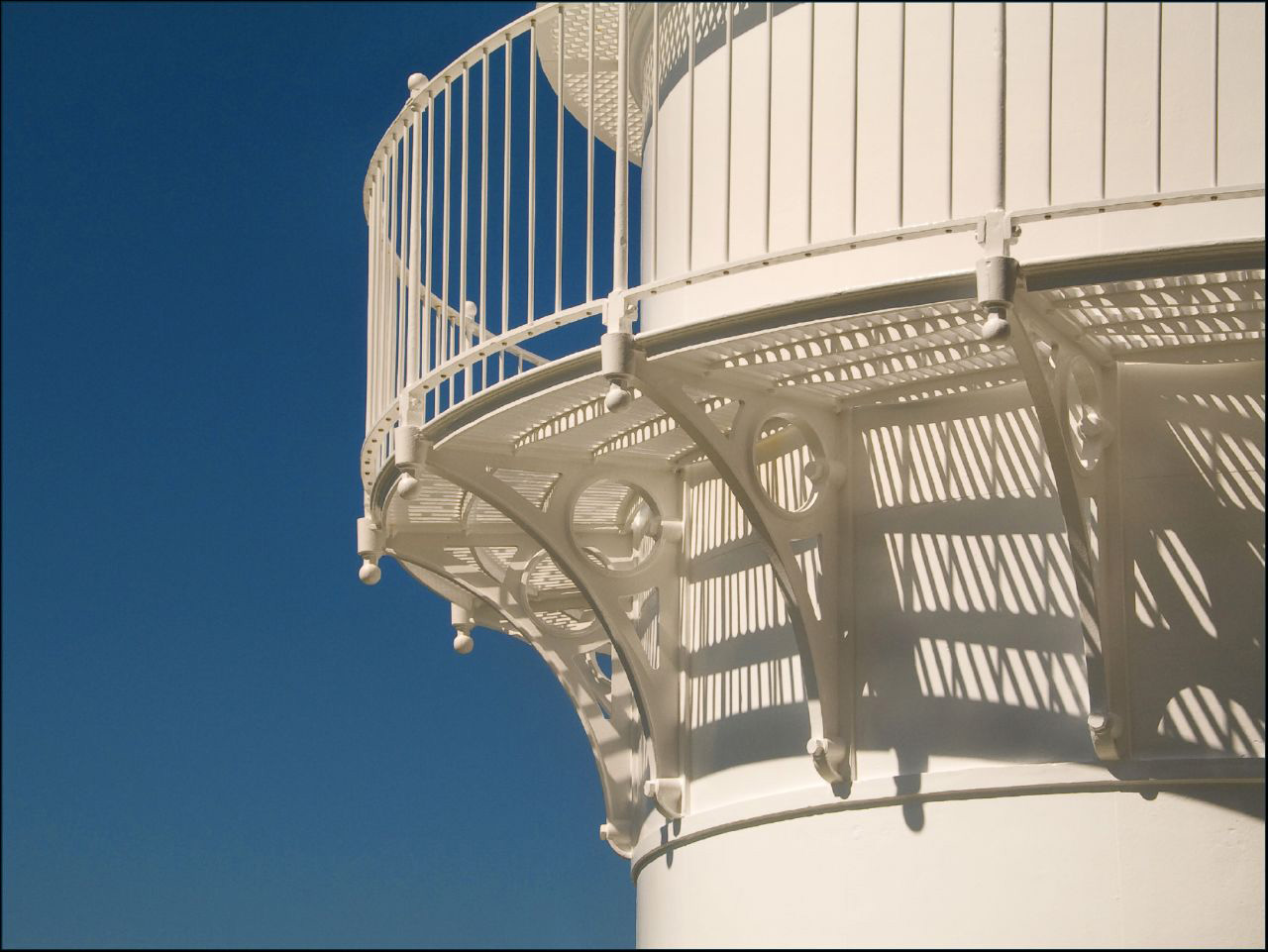
The Cape Brett Lighthouse has a 15.3 metre high cast iron tower, constructed in five tiers with the lantern and dome above. A small square entrance room outside the tower gives entry into the circular ground floor room, with a curving iron ladder giving access to the floor above. The first floor also has a similar ladder giving access to the light room, in which is housed the machinery to rotate the light and the mercury bath supporting the light itself, which projects up into the lantern with its windows to the sea. An iron ladder from the first floor room gives access via an exterior door to the gallery that runs around the tower. From the gallery, external vertical ladders give access to the exterior of the lantern, to the copper dome and ultimately to the spherical vent with its lightning rod.
The ground and first floor rooms have a square open hatch in the centre, guarded by a wooden rail, to allow the weights driving the clockwork rotational mechanism to descend, at their fullest extent into the cavity below the ground floor.
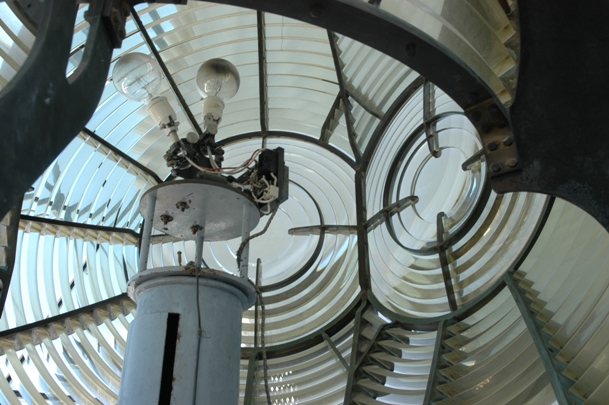
The lantern contains a first order light with a Fresnel lens containing two 'bulls-eyes' to create the two flashes. The light source is enclosed within the revolving bronze frame that holds the glass bulls-eyes and other lens elements. First order lenses were the largest type, designed for important coastal sites. Lenses ranged down in size to the sixth order, the smallest, which was designed for small harbours and rivers. Because the two bulls-eyes revolved around the light source (kerosene and later electric lamps), the light emitted a flashing white light, 2 flashes in quick succession every 30 seconds. Situated 155 metres above sea level, it could be seen for 49 kilometres.
Fresnel lens:
In 1819, the French Government commissioned physicist Augustin Fresnel to develop an improved lighting system for French lighthouses. Fresnel explored ways that glass lenses could be used to concentrate the light source. Since a single lens of sufficient strength would be too large to be practical, Fresnel used multiple prismatic lenses surrounding the light source to capture the light rays emitted from a single light source and direct them into a narrow horizontal beam.
In its simplest form, Fresnel's design was a barrel-shaped array of lenses encircling the light source. In the area immediately horizontal to the light source, dioptric lenses magnified and concentrated the visible light as it passed directly though them. At the same time, above and below the light source, multiple catadioptric prisms mounted around the periphery of the barrel each collected and intensified the light and redirected it in the same plane as the dioptric lenses. Light output was increased dramatically from the old reflector systems, with as much as eighty percent of the light transmitted over thirty kilometres out to sea.
In the centre of many Fresnel lenses there are circular 'bulls-eye' panels, which bend the light into a circular beam. By rotating the optic array, different flash patterns could be obtained by placing one or more 'bulls-eye' panels around the circumference of the array, and varying the speed of the rotation. This provided each lighthouse with its own signature flash rate.
Because Fresnel's design involved modular construction, a Fresnel lens could be built in one location, disassembled and easily shipped in multiple small sections, making transportation and re-assembly in the tight confines of a lantern room significantly easier than would have been the case with an optic made up of a few large glass elements.
Fresnel's design was so revolutionary that it was immediately adopted world-wide as the standard lighthouse lens, a pre-eminence that it maintained well into the twentieth century. This type of optic array became known as the 'Fresnel' lens. Before his death in 1828, Fresnel began to collaborate with the Scottish engineering firm of D and T Stevenson, who took the basic Fresnel concept and further developed it, working in collaboration with Chance Brothers of Birmingham. As noted above, Stevensons designed the light for Cape Brett and Chance Brothers built the optics, with James Milne and Son of Birmingham constructing the clockwork winding gear that supports it, the lantern, parapet, revolving machine, carriage and mercury trough.
Light Orders:
Fresnel's lighthouse lenses are divided into six orders based on their focal length. The order of a Fresnel lens is approximately the Dioptre or optical power of the lens, which is the reciprocal of the focal length of the lens in metres. A Fresnel lens with a focal length of 50 centimetres or 0.5 metres is classified as a second order lens. The largest (first order) lens has a focal length of 920 millimetres and an optical area 2590 millimetres high. The complete assembly of a first order lens is about 3.7 metres tall and 1.8 metres wide.
Cape Brett is a first order light, the only first order light to have been installed in the twentieth century in New Zealand. New Zealand Lighthouses that had first order lights were Dog Island (1865), Nugget Point (1870), Centre Island (1878), Cape Reinga (originally at Cape Maria Van Diemen 1879), Puysegur (1879), Mokohinau (1883), Cuvier (1889), Stephens Island (1894) and Cape Brett (1910). With the exception of Nugget Point and Cape Brett, these optics have been removed; at Nugget Point the optic is stored in the lighthouse tower. Puysegur was destroyed in a fire in the 1940s.
Mercury float:
Cape Brett Lighthouse was the first in New Zealand to have a mercury float or mercury bath installed to support the Fresnel lens. Earlier methods had involved rollers and ball bearings.
To rotate a very heavy glass optic apparatus, a mechanism was needed that offered the smallest resistance while taking the least amount of space. A circular trough forms a container into which is fitted the frame of the optical apparatus. The optic carrying vessel is shaped like a hollow cylinder which fits inside the slightly larger circular trough. With no liquid, the optic would just sit on the bottom of the bath, and its rotation would be impossible.
When the trough is flooded with liquid the liquid starts to buoy the vessel. The requirement is to place the right amount of liquid in the trough to give it enough buoyancy to float the vessel. This critical volume could be quite large depending on the liquid medium.
A first order lens with its support and other associated parts weighs over 4300 kilograms. If water was used, the volume of the basin required to float the apparatus would require a circular trough 3.3 metres deep. Not only is such a deep float hard to accommodate in a confined space of a lighthouse, but from an engineering point of view, such a mechanism would be impossible to manage because of the instability of the water surface.
Despite its poisonous nature, mercury was found to be the best medium. Not only is it not corrosive to cast iron, it is also non-flammable, being almost inert to any chemical reaction at normal temperature. Since mercury is 13.6 times heavier than water, the same 4.3 tonne optic requires a trough only 25 centimetres deep. The density of the mercury creates a very stable surface for the optic to float on.
The mercury bath provided an elegant solution to the problem of rotating heavy optics quickly without expending energy on overcoming the friction. The whole mechanism could be easily turned with a gentle push. The mercury float provided increased rotational speed of the mechanism, near-frictionless rotation, was able to take more weight than the roller and ball bearing method, and offered less wear and tear, giving a longer lifespan. At the levels of exposure they would have experienced, it is unlikely that the keepers suffered any mercury poisoning.
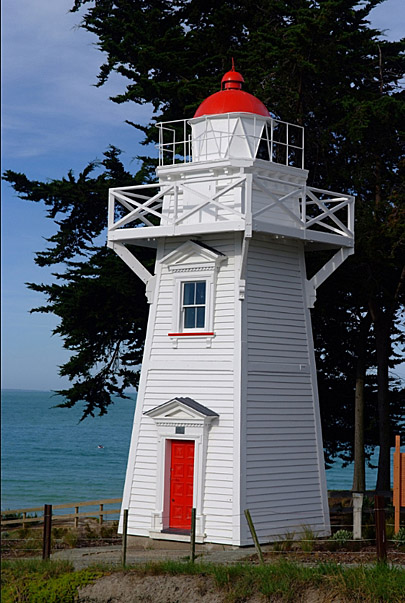
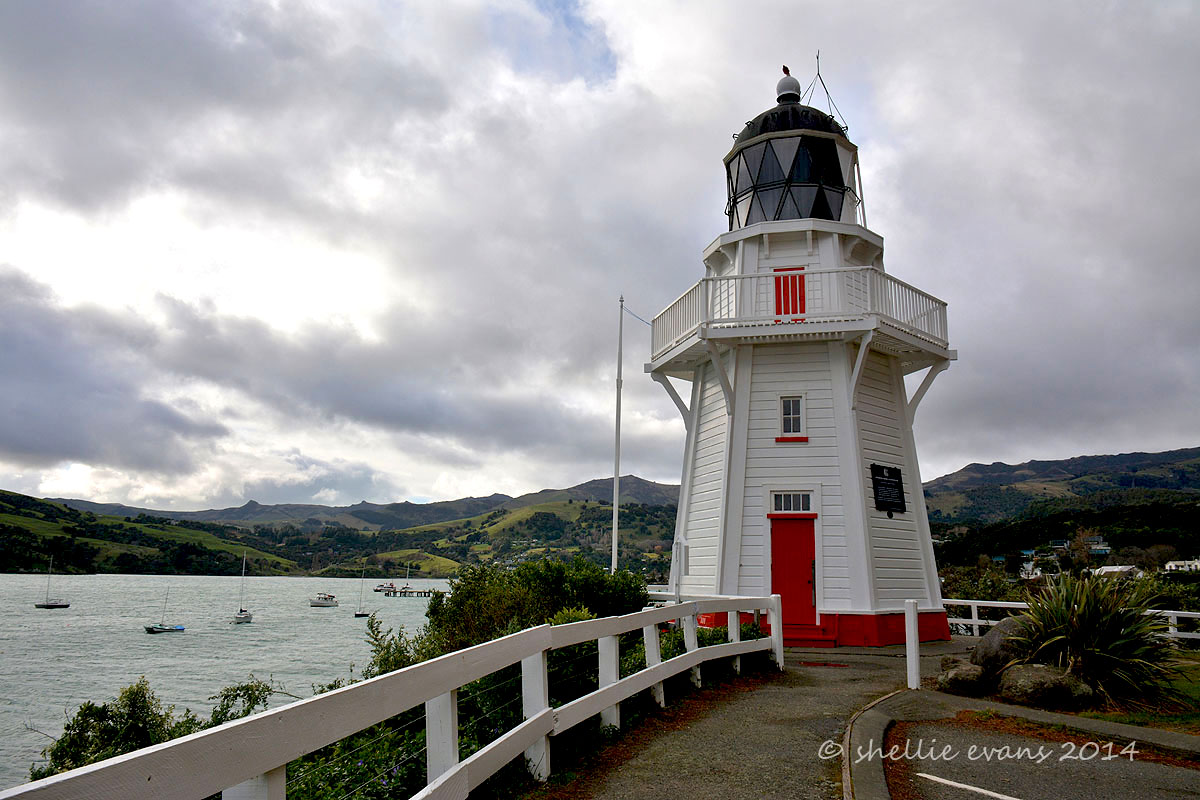
Cape Brett was the first lighthouse in New Zealand to use a mercury bath. Several other existing lights, such as Dog Island (first order, built 1865) and Castle Point (second order, built 1913) were converted to use a mercury bath, although these were later re-converted to a slew ring in the 1970s when mercury became recognised as a hazard. Cape Brett is now the only lighthouse in New Zealand with a complete, operational mercury bath. The one at Dog Island is still intact but the mercury has been removed. Akaroa Lighthouse is another relatively intact lighthouse, with its second order Fresnel lens and roller mounted rotational equipment intact. However, while its operation is capable of being demonstrated to visitors, its relocation to its inner harbour site has completely removed it from its historic context.
Other lighthouse station buildings:
Cape Brett Lighthouse Station was staffed by a Principal Keeper and two assistant keepers. A number of buildings and facilities were erected on the site to support the lighthouse keepers and their families, and to provide infrastructural support to the operation of the lighthouse station. Most of these do not survive as intact structures, but all of them are represented on site by remnants in the ground, so that the layout and purposes of the lighthouse station are able to be interpreted to visitors. The Assistant Keeper's house does survive, and has been adapted for use as a Department of Conservation hut for overnight visitors. It is also the location of interpretative material used to describe the history of the lighthouse station and the life of its former residents. This interpretation happens both physically and virtually through a website.
These former buildings or their sites, which are included in the registration, include the sites of the houses of the Principal Keeper, the Assistant Keeper and the Second Assistant Keeper, the landing and gantry, crane, tramway, whim and engine shed, vegetable garden, schoolhouse, signal hut, power house, kerosene store, boat shed, stores shed, engine shed, water tank, workshop and forge, pump house, fowl houses and cow bails.
Lighthouse keepers and their families represent a distinct community within New Zealand society. Keepers moved from one location to another, but also developed quite intense and not always easy relationships with other personnel at the lighthouse where they were based. From the many primary resources, both official and private, it has been possible to develop a detailed picture of the way of life of the keepers at Cape Brett and their families, and this material is used by the Department of Conservation to interpret the history of the site to visitors, both physically and virtually through a website. Because so much physical evidence of the lighthouse settlement remains, it is possible for visitors to gain a good appreciation of what life was like, so that the buildings and other physical remains can be brought to life though the stories of the people who once lived and worked there.