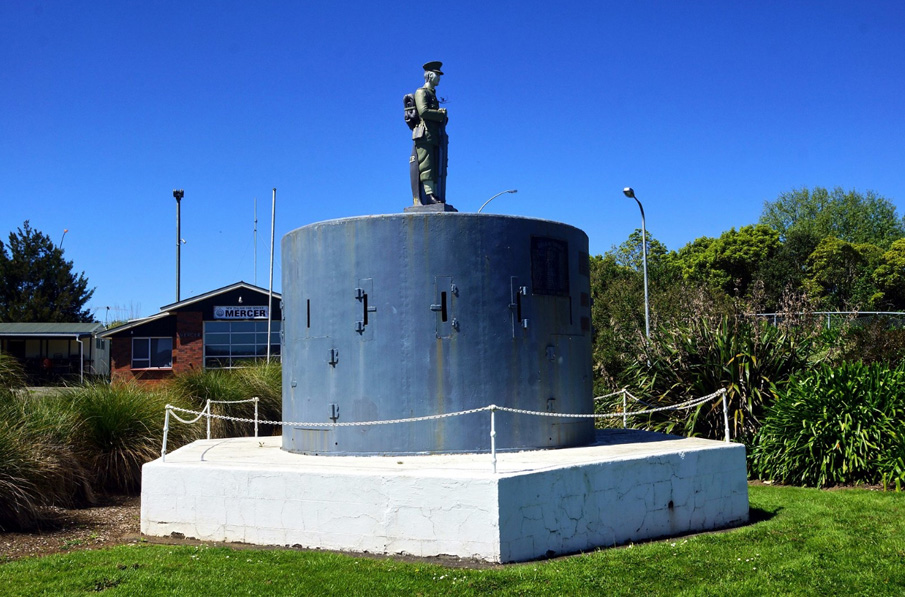
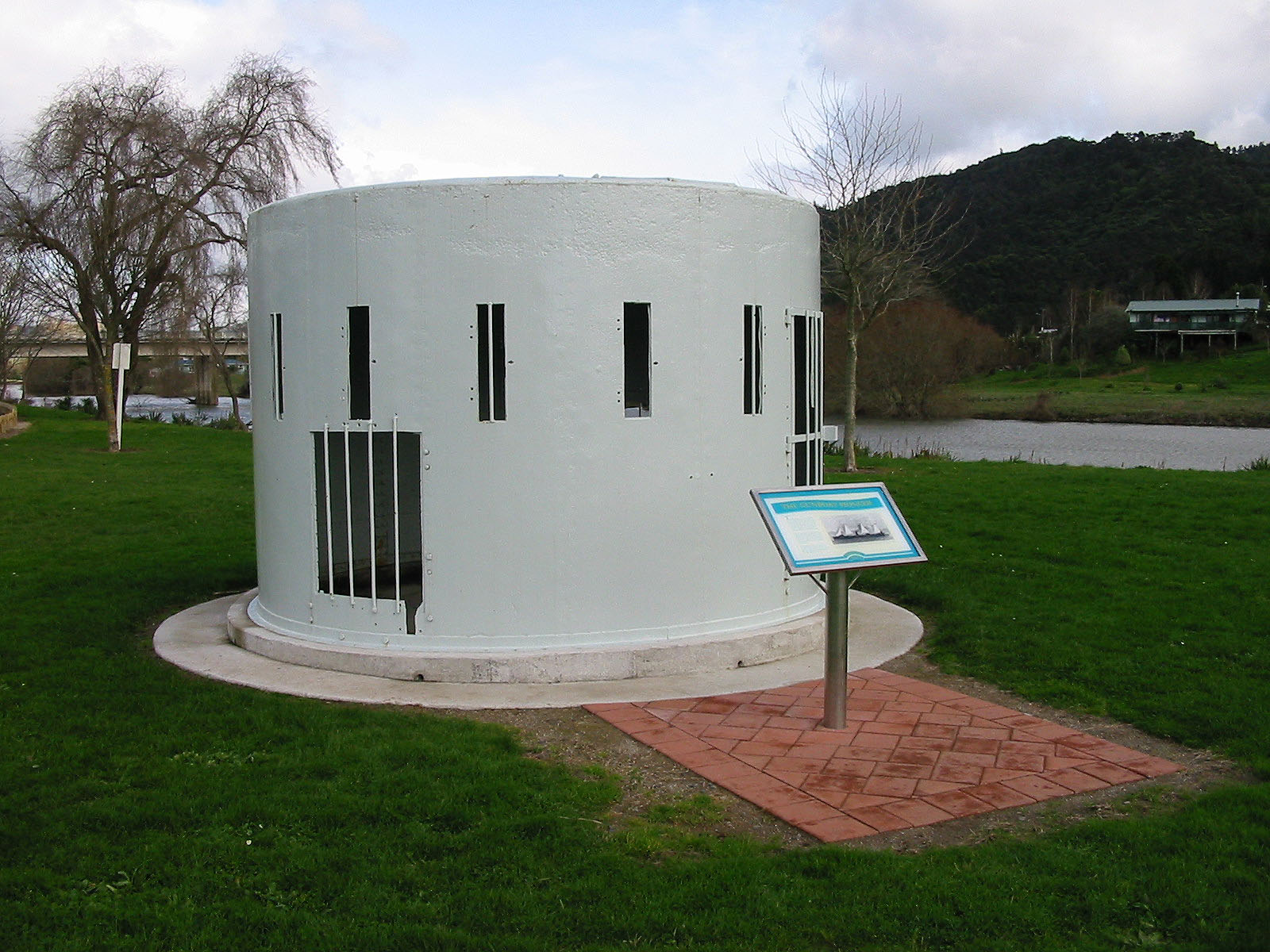
The Pioneer Gun Turret and War Memorial is internationally significant as one of the earliest surviving examples of revolving gun turrets in the world, and - along with its sister turret in Ngaruawahia - also the first to have been produced in the Southern Hemisphere. Located on the banks of the Waikato River in Mercer, the circular iron turret forms a major part of a memorial unveiled in 1922, to commemorate local soldiers who fell in the First World War (1914-18). The turret originally formed part of the colonial gunship Pioneer, an iron-clad sternwheel paddle steamer, built by the Sydney-based Australasian Steamship Company in 1863 for military operations in the Waikato. It was the first purpose-built warship commissioned by the colonial authorities in New Zealand, following a decision by the British naval authorities to transfer most of their New Zealand-based fleet to Sydney. The vessel is said to have been designed in Auckland, and saw important service during the Waikato - or third New Zealand - War (1863-64). This included transporting troops and supplies to the battlefields, reconnoitring enemy positions, and shelling defended pas, including during the battles of Meremere and Rangariri.
The Pioneer incorporated two revolving gun cupolas, based on a design by Captain Cowper Coles (1819-1870). Coles was a British naval officer, who is considered to have invented the spindle-less revolving gun turret in 1859. The cupola represented a major innovation in naval military technology, allowing gunships to fire in several directions without having to manoeuvre into a broadside position. The earliest vessel to use any form of revolving turret was the Monitor, used by the Union forces in the American Civil War in 1862. Coles' design was considered to be superior to that of the Monitor, and was first adopted by the Rolf Krake for the Danish Navy, followed by the Wivern for the American Confederate forces. These ships were respectively launched in Britain on 6 May and 4 July 1863, just before the Pioneer was completed in Sydney on 16 July. Other vessels were later launched for the British, Prussian and Peruvian navies, with Coles' design ultimately being superceded by those of his rival in the British admiralty, Edward Reed. Reed's designs were incorporated in the Destruction (1871), considered to be the first battleship of the modern era.
The Mercer gun turret was designed to include a 24-pound rotating artillery gun within a circular cupola measuring 3.6 m. in diameter and 2.4 m. high. Constructed of riveted iron plates, the cupola incorporated four artillery ports at regular intervals around its circumference, through which the gun could be fired. The turret also included 15 gunslits for rifle fire, believed to be a unique feature of the Pioneer. In late 1863 or early 1864, the turrets were removed from the vessel, probably to lighten its load, with that at Mercer said to have been used to incarcerate local drunks as the settlement developed into an important transport hub during the 1870s. The Pioneer itself sank on the Manukau Bar in 1866. In the early 1920s, the Mercer turret was converted into a memorial to local men who served in the First World War, and was unveiled by Lord Jellicoe on the first officially commemorated Anzac Day, in 1922. It is one of a small group of monuments created by local communities in the 1920s to also remember the New Zealand Wars. Surmounted by the figure of a soldier and placed on a concrete plinth, the memorial continued to be used for Anzac Day commemorations until the 1990s. It now incorporates a plaque remembering all those who died so that Mercer can be a place of peace.
The Pioneer Gun Turret and War Memorial is technologically important as one of the earliest surviving international examples of Cowper Coles' revolving gun cupolas, and as part of the earliest purpose-built gunboat designed for New Zealand conditions. It is the best-preserved of the two surviving turrets from the Pioneer, with the other being located at nearby Ngaruawahia. The turret is historically significant for its association with the British military conquest of the Waikato in 1863-64, and the development of the colonial New Zealand navy. The memorial has spiritual and social significance for commemorating those who served and died in the First World War and other conflicts, and as a place of annual gathering on Anzac Day for over three quarters of a century. The memorial is part of broader historical and cultural landscape that includes the Waikato River and the former military Great South Road.