

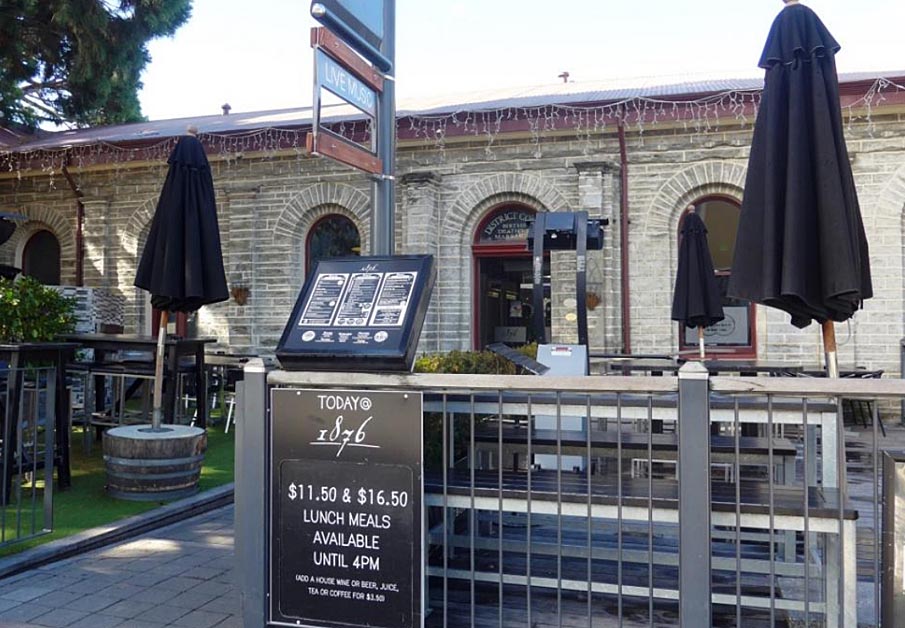
The first representatives of law and order in the Queenstown area were the wardens of the goldfields, appointed for their knowledge of the Mining Act. By April of 1863 the two wardens appointed to Arrowtown and Queenstown were asking that public offices and quarters be erected for their use. At that time they were working out of two tents which functioned as the gold receiver's office, sleeping quarters and courthouse. These tents were becoming dilapidated and because of the severe winters, both wardens strongly suggested a tender for the construction of the buildings be accepted 'at once'. Fortunately tenders were called for a wooden courthouse in July 1863. By 1874 it was decided to replace this with a substantial stone courthouse and athenaeum, and tenders were called for its construction in June 1875. The courthouse building was erected between November 1875 and September 1876. It varies from the standard nineteenth century pattern of such buildings in New Zealand and Australia, with its courtroom situated at the southern end of the building and the offices between it and the library to the north, rather than having the courtroom in the centre, surrounded by offices on two or three sides.
The courthouse continues to serve as the local seat of justice. While the offices have been rearranged over the years, the basic layout of the courthouse remains unchanged.
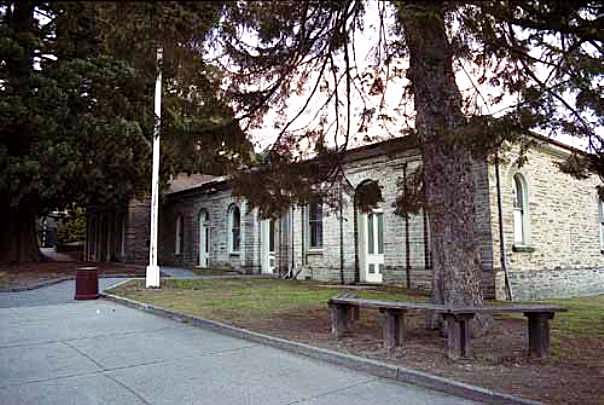
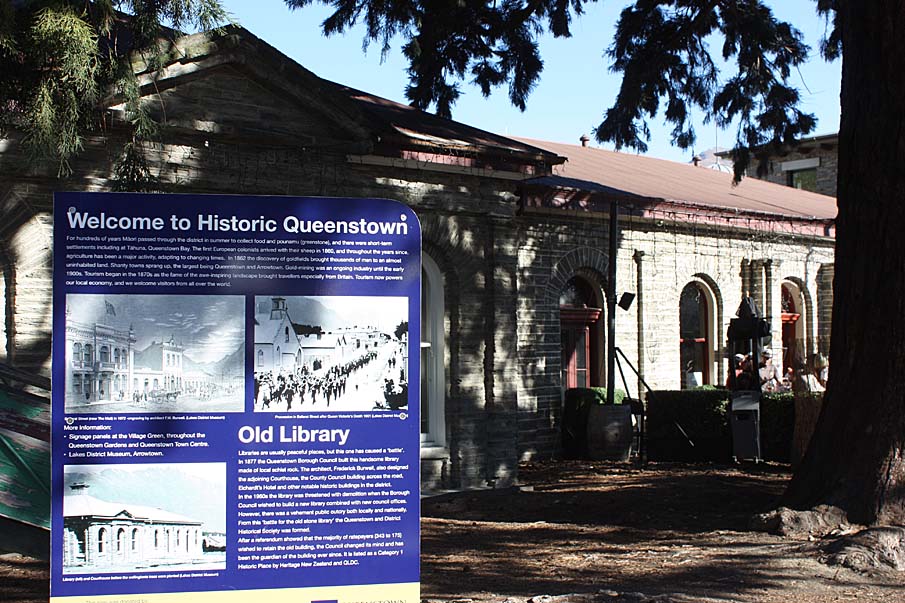
Calls for a library and athenaeum for Queenstown had begun as early as 1873. It appears that building of the library began later than the courthouse. It was underway by the middle of 1876 and was finished by early 1877. The library formally opened with a concert on 17 March 1877 and was described at the Library Committee's Annual General Meeting in July as a 'handsome and commodious building'. At the time of opening it had two main rooms and a small central store room. These two rooms alternated functions over the years, used as either the reading room or the lending library. The building was threatened with demolition in the 1960s when the Borough Council wished to build a new library combined with new council offices. However, there was a vehement public outcry, both locally and nationally and eventually, after holding a referendum in 1967, which showed the majority of ratepayers wished to retain the old building, the council changed its mind and constructed a new library adjacent to the old. Water was laid on to the old building for the first time in its history, a storeroom was created and access to the new library provided by a doorway cut in the end wall. The old library building is currently occupied by the Citizens' Advice Bureau.
The Courthouse and Library are two of the few structures that survive from Queenstown's early goldmining days. They are fine examples of stone construction using the local schist. Together they create a distinctive entrance into the central business district of Queenstown and are much loved by the locals, as was evidenced in the struggle to save the library building in the 1960s and more recent concerns over a planned development next to the courthouse.
List Entry Information
Status
Listed
List Entry Status
Historic Place Category 1
Access
Private/No Public Access
List Number
7655
Date Entered
26th November 1981
Date of Effect
26th November 1981
City/District Council
Queenstown-Lakes District
Region
Otago Region
Legal description
Lot 3 DP 20964 (RT OT13B/227), Otago Land District
Status
Listed
List Entry Status
Historic Place Category 1
Access
Private/No Public Access
List Number
7655
Date Entered
26th November 1981
Date of Effect
26th November 1981
City/District Council
Queenstown-Lakes District
Region
Otago Region
Legal description
Lot 3 DP 20964 (RT OT13B/227), Otago Land District
Construction Professional
Name
Burwell, F. W.
Type
Architect
Biography
F.W. Burwell (1846-1915) is noted for designing many buildings in Invercargill, transforming the centre of the town between 1874 and the mid-1880s. Born in Scotland, Burwell served his articles with the architect John Matthews and immigrated to New Zealand in the late 1860s. By 1873, he had established his practice in Queenstown. He moved to Invercargill the following year. Once established there, he began designing elegant two and three-storey buildings in the Renaissance style. He designed almost all the buildings in Dee Street, including the hospital. 'The Crescent' was another notable Invercargill streetscape created by Burwell. In recognition of his work, he was elected a Fellow of the Royal Institute of British Architects in 1880. The depression in the 1880s saw his commissions decline and he moved to Australia in 1887 where he practised in Melbourne, Perth and then Fremantle. He was particularly successful in the last, as Western Australia was in the middle of a building boom, and a number of his commercial buildings in central Fremantle are now classified by the Australian Heritage Commission. Burwell returned to Melbourne in 1910, and died there five years later. (Jonathan Mane-Wheoki, 'Burwell, Frederick William (1846-1915)' in Jane Thomson (ed.), Southern People: a dictionary of Otago Southland biography, Dunedin, 1998, p. 74.)
Construction Details
Start Year
1875
Finish Year
1876
Type
Original Construction
Start Year
2007
Type
Modification
Description
Renovations
Construction Professional
Name
Burwell, F. W.
Type
Architect
Biography
F.W. Burwell (1846-1915) is noted for designing many buildings in Invercargill, transforming the centre of the town between 1874 and the mid-1880s. Born in Scotland, Burwell served his articles with the architect John Matthews and immigrated to New Zealand in the late 1860s. By 1873, he had established his practice in Queenstown. He moved to Invercargill the following year. Once established there, he began designing elegant two and three-storey buildings in the Renaissance style. He designed almost all the buildings in Dee Street, including the hospital. 'The Crescent' was another notable Invercargill streetscape created by Burwell. In recognition of his work, he was elected a Fellow of the Royal Institute of British Architects in 1880. The depression in the 1880s saw his commissions decline and he moved to Australia in 1887 where he practised in Melbourne, Perth and then Fremantle. He was particularly successful in the last, as Western Australia was in the middle of a building boom, and a number of his commercial buildings in central Fremantle are now classified by the Australian Heritage Commission. Burwell returned to Melbourne in 1910, and died there five years later. (Jonathan Mane-Wheoki, 'Burwell, Frederick William (1846-1915)' in Jane Thomson (ed.), Southern People: a dictionary of Otago Southland biography, Dunedin, 1998, p. 74.)
Construction Details
Start Year
1875
Finish Year
1876
Type
Original Construction
Start Year
2007
Type
Modification
Description
Renovations
Historical and Associated Iwi / Hapū / Whānau
Completion Date
3rd June 2003
Report Written By
Melanie Lovell-Smith
Information Sources
Adams, 1970
P Adams, 'Queenstown Library: Research Report for the New Zealand Historic Places Trust', HP 26/1970, 29 April 1970, on file 12007-018
Hillier Nurseries, 1991
The Hillier Manual of Trees & Shrubs, 6th edn, Newton Abbot, Devon, 1991
Miller, 1973
F.W.G Miller, Golden Days of Lake County, 5th edn, Christchurch, 1973
Southland Daily News
Southland Daily News
Other Information
This place was identified as significant under previous legislation with different information requirements. It remains significant under the current legislation. There is opportunity under our legislation and policies to add to this information. Further information about this place may be available from the Otago/Southland Office of Heritage New Zealand Pouhere Taonga. Please note that entry on the New Zealand Heritage List/Rarangi Korero identifies only the heritage values of the property concerned, and should not be construed as advice on the state of the property, or as a comment of its soundness or safety, including in regard to earthquake risk, safety in the event of fire, or insanitary conditions.
Historical and Associated Iwi / Hapū / Whānau
Completion Date
3rd June 2003
Report Written By
Melanie Lovell-Smith
Information Sources
Adams, 1970
P Adams, 'Queenstown Library: Research Report for the New Zealand Historic Places Trust', HP 26/1970, 29 April 1970, on file 12007-018
Hillier Nurseries, 1991
The Hillier Manual of Trees & Shrubs, 6th edn, Newton Abbot, Devon, 1991
Miller, 1973
F.W.G Miller, Golden Days of Lake County, 5th edn, Christchurch, 1973
Southland Daily News
Southland Daily News
Other Information
This place was identified as significant under previous legislation with different information requirements. It remains significant under the current legislation. There is opportunity under our legislation and policies to add to this information. Further information about this place may be available from the Otago/Southland Office of Heritage New Zealand Pouhere Taonga. Please note that entry on the New Zealand Heritage List/Rarangi Korero identifies only the heritage values of the property concerned, and should not be construed as advice on the state of the property, or as a comment of its soundness or safety, including in regard to earthquake risk, safety in the event of fire, or insanitary conditions.
Current Usages
Uses: Law Enforcement
Specific Usage: Courthouse
Former Usages
General Usage: Law Enforcement
Specific Usage: Courthouse
Current Usages
Uses: Law Enforcement
Specific Usage: Courthouse
Former Usages
General Usage: Law Enforcement
Specific Usage: Courthouse
Location
Sign up to hear more
Get the latest heritage news, features and events delivered
straight to your inbox.
