Traditional History
The earliest traditions associated with human occupation of the South Island refer to Rakaihautu, the captain of the Uruao waka, which brought the Waitaha tribe to New Zealand. Rakaihautu beached his waka at Whakatu (Nelson) and divided the new arrivals into two groups, with his son Rakihouia taking one party south along the coastline and Rakaihautu taking another south by an inland route. On his inland journey, Rakaihautu used his ko (a digging implement) named Tuhiraki, to carve out the major lakes and subsequent waterways of Te Wai Pounamu . The earliest people of the South Island are most commonly known as Waitaha. There are also important tribal histories and traditions relating to the Kahui-tipua, Hawea and Rapuwai peoples that are closely connected with the South Canterbury region. As described in WAI 27 The Ngai Tahu Report;
Waitaha were both a people and a collection of peoples. The name refers to all those who were there prior to the Ngati Mamoe and Ngai Tahu migrations. Known by European scholars as Moa Hunters, the culture associated with the hunting of the moa had already gone with the passing of these flightless birds when Ngai Tahu first crossed Cook Strait.
The next wave of migration was undertaken by the descendants of Whatu-Mamoe, who came down from the North Island's east coast (Te Tai Rawhiti) to settle in the south. These descendants came to be known as Ngati Mamoe and through inter-marriage and conquest they merged with the resident Waitaha.
The origins of Ngai Tahu also have genesis from Te Tairawhiti. Tahu Potiki, the eponymous ancestor of Ngai Tahu, descended from the Ngati Porou tupuna, Paikea. The descendants of Tahu Potiki formed Ngai Tuhaitara and Ngati Kuri, and moved south to Wellington. They then continued their migration to Te Wai Pounamu. Warfare as well as political and personal alliances saw Ngai Tahu interests fused with Ngati Mamoe and Waitaha. Today, Ngai Tahu manawhenua is recognised over a large part of the South Island. Huirapa, one of Tuhaitara and Marukore’s children, had been killed at Hataitai and his ure (descendants) called themselves Kati Huirapa when they migrated down to Waipounamu. Kati Huirapa intermarried with Hawea, Rapuwai, Waitaha and Kati Mamoe creating Waiteruaiti then Arowhenua as their main kaika.
Both iwi history and archaeological evidence show Maori occupation in the South Canterbury region over an extended period, with the inhabitants utilising a wide variety of natural resources from the diverse environment. The date of earliest settlement of the area is generally thought to be the 12th century. There was extensive human settlement throughout the South Canterbury region when moa still existed, as shown in the widespread archaeological remains of moa bones in cultural contexts. With respect to the Pouakai, the only Eagle known to have been in New Zealand; tribal korero relates how the Pouakai was so big and strong that it could pick up a small child and carry them off and that it hunted the Moa or Whero nu Moa into the swamps or attacked them as they foraged for food. This korero would indicate the Pouakai was also present when settlement occurred.
Although a specific date cannot be given for the art at Te Manunui, archaeologists have suggested that rock art sites such as this and others in the South Canterbury and North Otago regions date from the first 500 years of human occupation in New Zealand. Some rock shelters with rock art have been shown through archaeological methods to be occupied by Maori who lived while moa still existed in the region.
Descriptions of rock art were amongst the earliest published records of an archaeological nature in New Zealand. The surveyor W. B. Mantell first recorded sketches of rock art in his notebooks in 1852. In 1868 Mantell delivered an address on moa to the Royal Society of New Zealand in which he asserted that Maori must have lived contemporaneously with moa due to depictions seen in the rock art of the Canterbury and Otago regions.
In Julius Von Haast’s first address as president of the Philosophical Institute of Canterbury on the 5th of April, 1877, he chose to discuss the topic of rock art in the Canterbury region,
The paintings are done with a bold hand; they are well finished, and show clearly that they are the work of an artist of times long gone by, who was no novice in his profession. The paint consists of kokowai (red oxide of iron), of which the present aborigines of New Zealand make still extensive use, and of some fatty substance, such as fish oil, or perhaps some oily bird-fat. It has been well fixed upon the some-what porous rock, and no amount of rubbing will bring it off. It is evident, however, that the existing paintings, which are already partly destroyed by the scaling off of the rock through the influence of frost and other physical agencies causing weathering, are not the first which were delineated on this rock, because in many spots, and sometimes below the paintings under consideration, faint traces of still older ones are visible.
Von Haast regarded the rock art executed in black as belonging to an earlier time than the art in red, describing the rock art executed in black as ‘…of a more primitive nature, and seem to have been done by a different race of men’.
The Rev. J. W. Stack presented his “Sketch of the Traditional History of the South Island Maoris” to the Philosophical Institute of Canterbury at that same meeting, which was published in the Transactions and Proceedings of the Royal Society of New Zealand. He noted that much of his information came from Peta Te Hone of Kaiapoi and other kaumatua of note from areas including Moeraki and Arowhenua.
Stack’s sources attributed rock art to Ngati Mamoe, who ‘…are said to have lived in caves, where traces of their occupation are shown in the rude drawings overlying those of a more ancient date’.
James Herries Beattie published details in the Journal of Polynesian Society of his conversations with respected Maori elder Taare Te Maiharoa, who spoke of the history of rock art. Beattie noted that,
‘It was the people who came with Rakaihautu and their descendants who executed on sheltered cliff-faces the paintings, around the origin of which so much surmise has centred. My informant reckoned that the ancestors of these people had once had a system of writing very unlike English writing or printing, and that they lost much of the knowledge in coming from land to land, but still retained memories of it. These paintings represented their writing after they came to New Zealand, and preserved to them incidents of their history. Only the designs done in black are Waitaha work, and the method of making the paint has been traditionally handed down. There is a tree called monoao, which my informant had seen growing at Benmore (near Lake Hawea), and describes as like a macrocarpa, with branches that may grow many feet long and with leaves like matai (black pine). Probably no other kind of tree in New Zealand contains so much gum or resin (called ware in south, pia in north), and it will burn readily when green. The branches of this tree when burnt, give off a smoke, said my informant, that would speedily turn white clothes black with soot. Screens were erected to direct the smokes against a tipaki (flax mat), and the soot was subsequently scraped into an ipu (carved wooden basin). Tarata trees would be chipped and the gum collected, and rautawhiri berries gathered. These berries or seeds were smashed and tightly squeezed into a whitau (flax bag) and hung by the fire, when the oil from them would drip into the ipu. The oil of the weka (woodhen) was also an ingredient, and these four items were mixed in certain proportions, “not too thick nor too thin,” and the result, said my informant, was “an ink that would stand for ever.
The claim that the paint so obtained was indelible is substantiated by the state of preservation of the work, as some of the black paintings are probably over 1,000 years old. The red paintings, continued my informant, were done many generations later than the black, and were the work of Kati-Mamoe, who simply copied the Waitaha figures.’
Beattie reported that another well-known rakatira Henare Te Maire, agreed with that korero.
Historical Accounts and Recording of the Site
Formal recording of Te Manunui Rock Art Site began in the twentieth century. Local enthusiasts Hugh McCully and G.A Hornsy were among the first to record rock art in the south Canterbury area, leaving significant collections of tracings. Duplicates of McCully’s works were gifted to the Otago and Dominion Museums, whilst Hornsy’s remained in his personal possession. Both collections contain tracings of the Te Manunui Rock Art Site.
Roger Duff carried out a survey of rock art sites for the South Canterbury Historical Society from 1945 to 1946, at which time he made scale drawings of the art at Frenchman’s Gully. In 1946 the Department of Internal Affairs commissioned Theo Schoon to make ‘artists oil copies’ of the rock art sites. As a result of this commission Schoon doubled the number of recorded rock art sites, but unfortunately, he was also responsible for ‘retouching’ a large number of drawings with grease crayon. Te Manunui is one of the sites where Schoon’s retouching is evident. Schoon’s collection of rock art paintings, including two that depict figures at the Te Manunui site, is now held in the Canterbury Museum.
The artist Tony Fomison carried out the third major rock art survey in the south Canterbury area from 1959 to 1960, during which time he created a large collection of sketches and tracings of the rock art figures as well as recording information on the condition of the sites. Fomison made numerous recommendations relating to their long-term preservation. At the Te Manunui site he identified vandalism, flaking and stock as major threats to the art. Fomison’s recommendations included fencing, improved site access and the use of interpretive signage to draw attention to the drawings as a public education tool.
By August 1961 a series of protection/enhancement works had been completed by a committed band of heritage enthusiasts, Department of Works and Labour, and Department of Lands and Survey staff.
The rock art site was declared a Private Historic Reserve by the Minister of Lands on the 6th of June 1962 under the then Reserves and Domains Act of 1953. The National Historic Trust (New Zealand Historic Places Trust) was named as the administering body responsible for managing the site.
Te Manunui was first entered in the New Zealand Archaeological Association Site Recording Scheme in 1965, with details included from Tony Fomison’s site visit of 1959 (recorded as site J39/17).
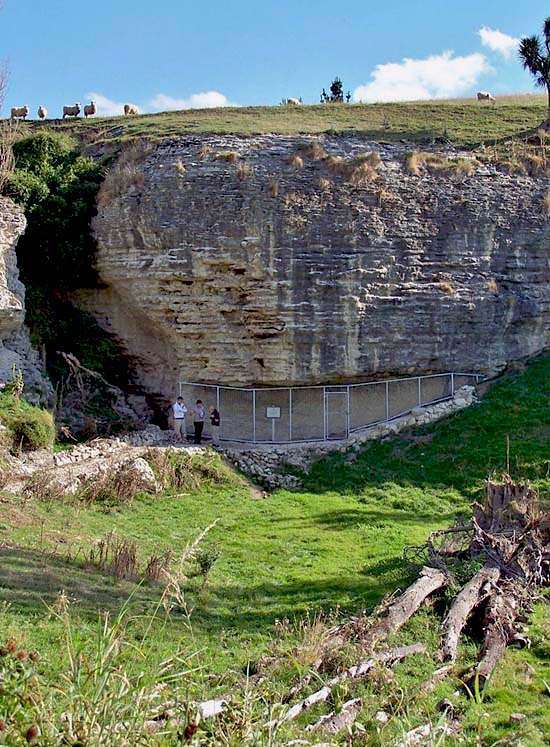
The most recent recordings of the Te Manunui site were made in 1995 by Brian Allingham as part of the survey and recording work of the Ngai Tahu Maori Rock Art Trust South Island Maori Rock Art Project (SIMRAP). There are more than 80 individual figures identified at this site. These recordings are held by the Ngai Tahu Maori Rock Art Trust (NTRAT) on behalf of the kaitiaki runaka and Ngai Tahu whanui. Allingham notes that the Te Manunui art is unique in that the site was not a permanent occupation shelter and he offers the suggestion that the proliferation of art at the site may be due to the wai puna (freshwater spring) at the eastern edge of the site. The proximity of fresh running water may have provided both sustenance and cultural inspiration for the early artists.
As a 50 year anniversary project in 2006, the Historic Places South Canterbury Branch elected to significantly upgrade the Frenchmans Gully rock art site in conjunction with the Waimate and Timaru District Councils, Department of Conservation, the newly established Ngai Tahu Maori Rock Art Trust, NZHPT and the current landowners.
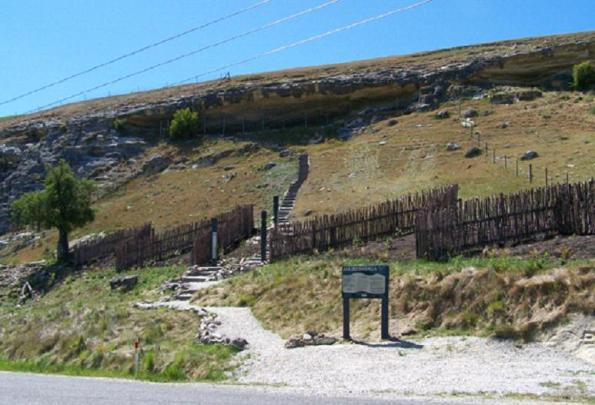
Works were undertaken to install a culvert close to the rock shelter and to construct an interpretation shelter and gate at the roadside entrance to the site. A number of bones were found during these works and specialists from the Otago Museum confirmed two of them as moa. The bones were identified as belonging to the stout-legged moa Euryapteryx geranoides (renamed Euryapteryx gravis, but now known as Euryapteryx curtus) and the heavy-footed moa Pachyornis elephantopus. However, the bones do not show any signs of human interaction, so these finds do not contribute to dating of the art.
The newly upgraded site was officially opened on the 20 June 2006 at which time the name “Te Manunui” was formally gifted to the site by tangata whenua. The opening was planned to coincide with the 31st UNESCO World Heritage Committee annual conference being held in New Zealand for the first time and was attended by UNESCO Youth Forum delegates as well as local dignitaries.
Ngai Tahu Maori Rock Art Trust representative Sue Eddington noted at that time that “it was important to remember it was not just Maori rock art but national history and was there for everyone to take pride in and enjoy”.
Rock Art and New Zealand Art
Maori rock art is often regarded as the earliest New Zealand artwork, and the rock art sites of South Canterbury and North Otago have been described as “New Zealand’s oldest art galleries”. The Ngai Tahu Artist Ross Hemera, has commented on the importance of rock art in informing his work, stating, “These drawings, for me, are manifestations of our tipuna. So when I go back to the rock shelters, when I’m visiting, these are the occasions when I feel closest to the spirit of my ancestors”. Another Ngai Tahu artist, Simon Kaan, described his connection to rock art as, “We talk about filling up our kete as artists and this is where our whakapapa is, you know, from an artistic perspective.” Francese Home has deep feelings for the art maintaining that, “Rock art is part of our whakapapa, it is the direct link with our early tupuna who walked this land centuries ago acquainting themselves with a new life and new land. For a while we lost the connection through colonisation (other iwi as well as Anglo/Saxon) however we never lost the connection to this ancient art and our sense of belonging to this whenua.”
New Zealanders have long been influenced by their experience with Maori rock art. Theo Schoon’s employment by the Department of Internal Affairs in 1947 to document rock art was formative in the development of his own art. New Zealand artist Gordon Walters accompanied Schoon on visits to rock art sites and Tony Fomison was involved in the recording of many sites and extensively sketched the art at various sites.
Comparisons with Other Sites
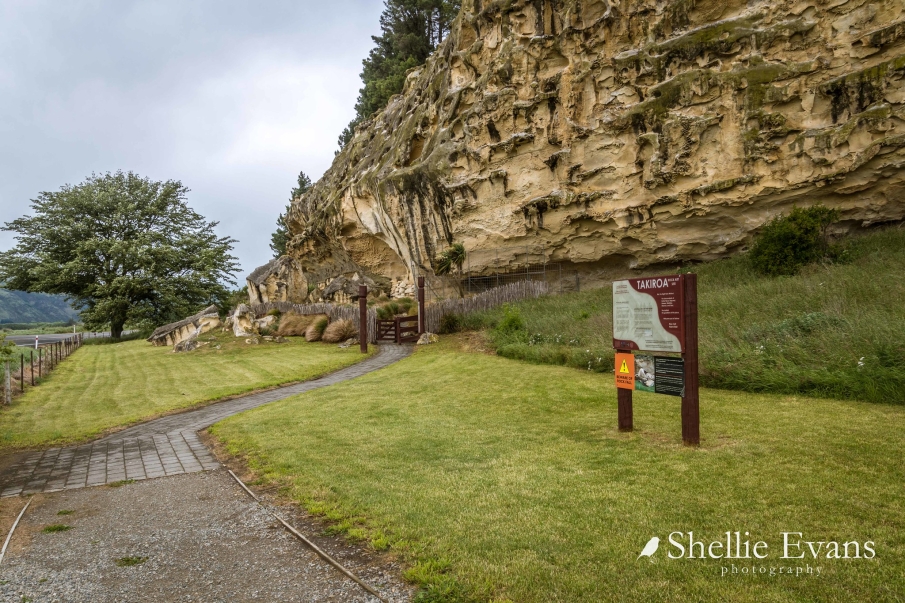
Rock art in the north Otago and south Canterbury regions is commonly found in a similar context to that of Te Manunui Rock Art Site. The art is often applied to the walls or accessible roof area of a limestone outcrop, where rain contact will be minimal. Limestone surfaces under overhangs such as Te Manunui are found at rock art sites like the nearby Craigmore sites, Takiroa (NZHPT Register No. 7769), Maerewhenua (NZHPT Register No 7770) and Raincliff rock art site (not registered; NZAA Site Record J38/56).
The distinctive bird figure has special significance due to its rarity. The rest of the art depicted within the shelter is not uncommon. The depiction of birds, marine animals, and human type forms are all common in rock art of the area and similarities can be found with other sites in the North Otago and South Canterbury regions. The blank central portion that features in the abstract human-like figures is also a motif seen in art at other sites.
Trotter and McCulloch identified seven other examples of giant bird type depictions in the South Island. Some of these figures have been referred to as ‘bird-men’ or ‘bird-men type figures’. A North Otago site is also shown to depict small birds along its wingspan as seen in one of the figures at Te Manunui Rock Art Site. None of the 80 or so naturistic and stylistic art figures represented at the site depict post-European contact objects.
The depiction of birds such as Moa and Pouakai that have been extinct for more than 500 years suggests that rock art is at least that old.