The Taranaki region is thought to have been settled by Maori at least 700 years ago. Archaeological evidence suggests that pa were being built in the area, which surrounds Mount Taranaki, as early as the fifteenth century. A number of iwi hold mana whenua in the west coast of the region, including Ngati Tama and Ngati Mutunga, Te Atiawa and Taranaki.
In the early eighteenth century, the area which would become New Plymouth was a frontier between the Taranaki and Te Atiawa tribes. Around 1720-1730 the Taranaki hapu Nga-potiki-taua built a fortified stronghold called Pukaka on a hill in a central location. Pukaka Pa was abandoned around 1760 when the area was taken by Te Atiawa, who affiliate with the waka Tokomaru and are said to descend from the semi-divine origins of ancestor Awanuiarangi, whose people moved south from Northland to the Bay of Plenty and Taranaki.
European whalers initially arrived along the Taranaki coast in the first half of the nineteenth century, and generally integrated themselves relatively harmoniously with the local Maori communities. By the early 1840s a Te Atiawa pa of the Ngati Te Whiti hapu at Ngamotu, called Otaka Pa, was still populated but many other Maori strongholds in the region had been abandoned following attacks by taua from the Waikato a decade earlier, which had prompted a major migration of the remnant Te Atiawa population to Otaki, Wellington and Marlborough.
Organised colonial settlement at Taranaki was first instituted by the Plymouth Company in 1839-1840, who arranged to purchase land from the New Zealand Company for the settlement of immigrants from Devon and Cornwall, although this purchase would be much disputed in the future. The site of the township was chosen and laid out by Chief Surveyor Frederic Carrington in February 1841, and settler ships arrived from England from March 1841 onwards. By this time the Plymouth Company had fallen into financial difficulties, and was formally merged with the New Zealand Company in May 1841. Settler ships continued to arrive, but disputes around the Crown’s role in transferring land out of Maori ownership, and between tangata whenua over who had the authority to transfer land, were already evident, affecting all involved.
Nga Pakanga Whenua O Mua: wars fought over land
An enquiry by Commissioner William Spain (1803–1876) in 1844 upheld the initial European purchase of 60,000 acres, but this was re-investigated by Governor Robert FitzRoy (1804-1865) and reduced to 3,500 acres. Over the next 15 years large blocks of land were purchased by the Governor on either side of New Plymouth, but tensions (both inter-tribal and between Maori and Pakeha) continued to escalate, erupting into hostilities in 1854 with a skirmish between hapu at Bell Block, and the first Maori-European battle in Taranaki in 1860.
The series of prolonged conflicts during the 1860s and early 1870s are now most commonly known as the New Zealand Wars, waged between the Crown and Maori in response to Maori efforts to retain their land. Major military actions in Taranaki occurred around Waitara (notably at Mahoetahi and Sentry Hill), southwest of New Plymouth at Waireka and Tataramaika, and in South Taranaki at Otapawa, Turuturumokai and Te-Ngutu-o-te-Manu. Battles were waged over these same issues not only around Taranaki, but also in the regions of Waikato, Whanganui, Bay of Plenty, and the East Coast of the North Island, continuing from conflicts over land since the early colonial period.
These wars caused widespread deprivation, suffering and loss of life and land for iwi, resulting in the heavy confiscation of tribal land taken by the Crown under the Land Settlement Act of 1863, which stripped Maori not only of their homes and wahi tapu, but also their ability to provide for themselves and their iwi, earn a fair income in the new colonial society, and retain the right of self-determination (tino rangatiratanga) and cultural autonomy. The devastating effects of these actions have since been acknowledged by the Crown through formal apologies and efforts of redress by settlement negotiations under the ongoing Waitangi Tribunal process, which, due to complexity of the situation in Taranaki, is not yet resolved for that region. The Waitangi Tribunal’s Taranaki Report: Kaupapa Tuatahi states that as the region where the wars started first and continued the longest, compounded by continuing expropriation of land through legislative means, the Taranaki claims are the result of distinctive circumstances where ‘in no other part of New Zealand did a contest of that nature continue for so long or Maori suffer so much the deprivations of strife after British sovereignty was proclaimed.’
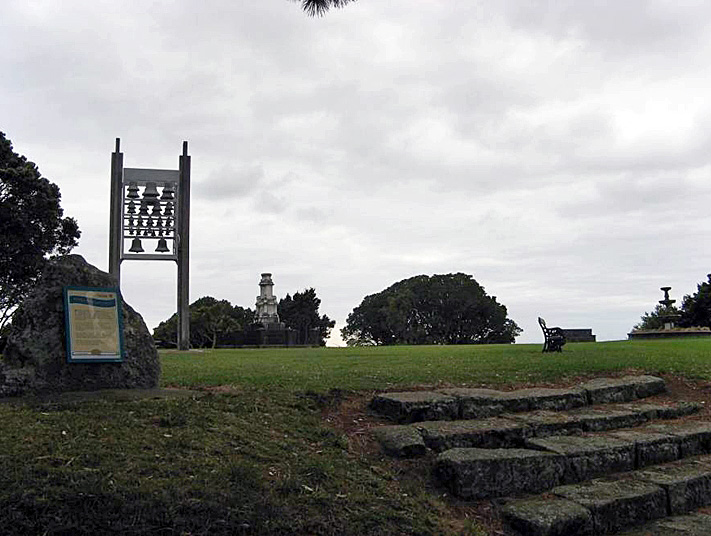
The conflicts in Taranaki also affected the fledgling European settler communities, with many residents of outlying areas abandoning their homes and taking refuge in the urban centre of New Plymouth town, or leaving the region altogether for a time. Complaints from anxious European settlers resulted in the Government stationing a garrison at New Plymouth, and the site of the former Pukaka pa (which had been renamed Marsland Hill by the colonists in 1841) was transformed into a military stockade and barracks for Imperial troops in 1855. The Marsland Hill stockade also acted as a place of refuge for the town’s residents when threatened by the conflicts. Local residents had also been formed into a militia since the Militia Act of 1858.
As the frequency of battles decreased the British troops were gradually withdrawn, until the last detachment left New Plymouth in 1870; however further military actions occurred in South Taranaki and in 1880-1881 following the peaceful Maori protests at Parihaka. The former barracks on Marsland Hill/Pukaka were next used to house new immigrants from Poland, Scandinavia and Britain from 1874-1880, before being dismantled and removed from the site in 1891. A portion of the barracks has survived in the form of the Camp House building (Register no. 7233, Category 1) on the slopes of Mt Taranaki.
Memorial to the conflicts
New Zealand inherited the tradition of war memorials as part of an international trend that spread from Europe. They provide a focal point for the grief of those who lost loved ones but may have no grave to mourn at, as well as a way to honour the collective and individual sacrifice of those involved in the horrors of war. However, few monuments to the New Zealand Wars were constructed in the immediate aftermath of the hostilities. Historians Chris Maclean and Jock Phillips propose that this was because the idea of a memorial to commemorate the ordinary soldier was a relatively new concept at the time, and also suggest that the Pakeha community harboured painful, often embarrassing memories of frustrating conflicts ‘with few clear-cut victories, and those were often the results of the efforts of imperial soldiers rather than locals’, that did not bear much celebration. Sensitivity to the fragility of peace may have also been a factor. However, as the years passed and the veterans of the battles neared the ends of their lives, the urge to pay tribute to those who fought began to grow.
Land on Marsland Hill/Pukaka had been gazetted by the Government in 1863 for a suitable memorial ‘to be erected in memory of certain officers and soldiers of Her Late Majesty’s Forces’, but no monument was constructed until the early years of the twentieth century, when this original reserved land was enlarged for the same purpose. The renewed impetus for the tribute was led by New Zealand Cross recipient Captain F.J. Mace, and other esteemed Taranaki veterans, however there were a great many members of the public who were more than keen to contribute, as well as Government subsidies now available.
Attitudes towards memorialisation had by this time changed. A renewed interest in the history of New Zealand’s pioneers (perhaps reflecting a desire to create roots and legitimise Pakeha presence, as well as celebrate that aging generation) dovetailed with a general Victorian/Edwardian enthusiasm for monument-building. Memorials to New Zealand’s fallen in the recent (1899-1902) South African (Boer) War were being completed just six months after the end of that war. Maclean and Phillips state that ‘the desire to teach the younger generation that men had died before them in the service of Empire was the main impulse behind the renewed building of memorials to the dead of the New Zealand Wars.’
The New Plymouth memorial on Marsland Hill/Pukaka is one of the earliest examples from this new wave of monuments of a memorial initiated by veterans themselves. The Marsland Hill Memorial Committee was formed in 1905 after a few years of advocacy by Captain Mace NZC, and public subscription was sought from the end of 1906. Subscribers included members of the local community, as well as a number of prominent public figures including the Governor General Lord William Plunket, Dr Frederic Truby King, and veteran Colonel Walter Gudgeon, who was by that time New Zealand’s Resident Commissioner in the Cook Islands. International contributions also came from veterans and other British regiments. The Government offered a pound-for-pound subsidy of up to £300.
Prominent local architect Frank Messenger won the design competition for the monument. During his career Messenger designed approximately 315 buildings and monuments around Taranaki, including New Plymouth’s Cenotaph (Register no. 885, Category 2), Devonport Flats (Register no. 890, Category 2), St Aubyn Chambers (Register no. 7451, Category 2) and the distinctive balconies around the White Hart Hotel (Register no. 149, Category 1); and St Andrew’s Church (Register no. 875, Category 2) and the Town Hall (Register no. 877, Category 2) in Inglewood.
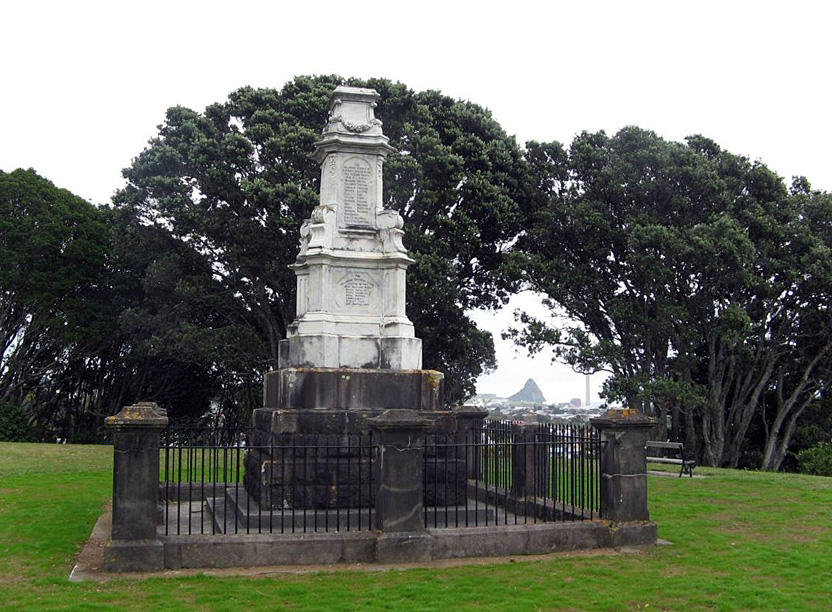
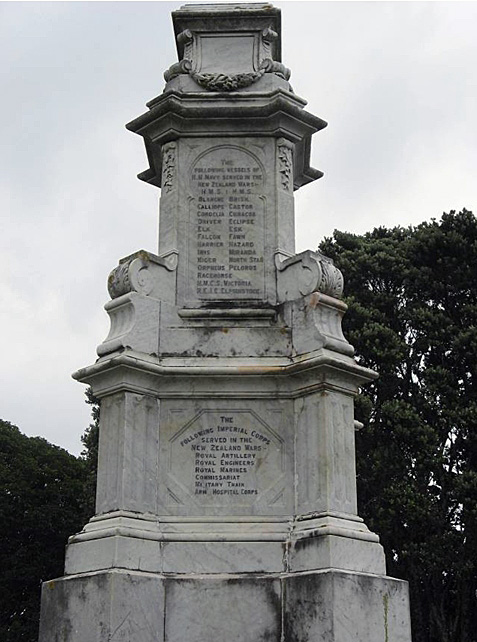
Auckland masonry firm W. Parkinson & Co constructed the monument’s carved marble pedestal, and the plinth was of local andesite and New Zealand granite on a base of concrete. The pedestal was topped by a carved marble statue of a trooper in military uniform, modelled for by South African War veteran George Messenger (brother of Frank) and sculpted at the Carrara quarries in Italy. The total cost came to around £800. The inscription dedicated the memorial not only to those who fought in the Taranaki conflicts, but ‘to the honoured memory of the officers and men of H.M. Naval, Military and Colonial Forces and Loyal Maoris[sic] who fell in action or died during the Maori Wars 1845-47:1860-70’, giving it a national scope.
The memorial was unveiled with great ceremony, including a parade of troops, by the Governor General Lord Plunket on 7 May 1909. The Premier, Sir Joseph Ward, sent an apology of sincere regret that he could not attend. In his speech, S. Percy Smith, Chairman of the Committee, expressed his pride at the ‘uniqueness’ of the monument: ‘There was none in the Dominion so comprehensive. There were monuments erected to regiments and individuals, but this one commemorated the deeds of the naval and imperial military forces, the militia and the loyal Maoris.’ Lord Plunket’s words unwittingly convey the purely colonial perspective of the sentiment behind the memorial: ‘I am very glad as representative of the King to pay honour to the band of veterans present here to-day, who helped make and keep this portion of his Empire, and add my tribute to the memory of those who, throughout New Zealand died in the service of their Sovereign and their country…for whilst the greatest monument of those white men and loyal Natives who kept New Zealand for the Empire is that prosperous Dominion itself to-day, it is well that on this historic spot a fitting monument to their honour should keep their memories green.’
Soon after the unveiling, the decision was made to erect a permanent railing around the structure.
Site of protest
The New Zealand Wars Memorial on Marsland Hill/Pukaka continues to be a focus for the strong emotions evoked by the conflicts and their aftermath. While intended as a way to honour the fallen, the monument also memorialises the perceived ‘victory’ of one group over another, without acknowledging the very great sacrifices made on both sides. The inscription and Lord Plunket’s speech encapsulate the attitudes of its time of construction, and the monument can easily be viewed as a reminder of the negative – and devastating – effects of the colonisation of New Zealand on the Maori population. Minor vandalism of the monument has occurred since its unveiling; however during the 1990s two incidents on separate Waitangi Days seriously affected the structure and signify its significance as a site representative of the serious and ongoing consequences of the conflicts.
Late on the night of 5 February 1991, the marble statue of the soldier was toppled from its pedestal and attacked, being broken into eight large pieces and hundreds of smaller chips. In place of the statue a large sign was left on the pedestal, which read ‘In remembrance of the Maori people who suffered in the military campaigns – honour the Treaty of Waitangi.’ The damage was considered to be so bad that the statue was deemed to be beyond repair, and the face and rifle were missing entirely from the fragments. The statue was not replaced on the pedestal and it remains empty. Responsibility for the action was claimed by the Waitangi Action Alliance of Taranaki, who stated that the oppressive symbolism of the monument was a glorification of dishonesty, greed and murder, which immortalised the people and means ‘by which illegal land occupations were enforced and Maori civilian communities attacked and destroyed.’ Members of the community, including the Returned Services Association, expressed their anger at the vandalism of ‘part of the community’s heritage’, while the New Plymouth police said that the damage to the statue ‘would receive more attention than that given to other wilful damage cases.’
A subsequent Treaty protest action occurred in February 1995, when three of the now statue-less pedestal’s supporting columns were removed and the monument covered in graffiti. The messages called for awareness (‘Ma mauranga’), ‘Tino Rangatiratanga’, ‘Honour the Treaty’, and ‘Go home Imperial soldiers – Return to sender’ accompanied by a depiction of an envelope. Maori commentator Te Ururoa Flavell remarked at the time, ‘If this (the desecration) makes people sit up and consider the plight of Maoridom over the years then it will be justified.’
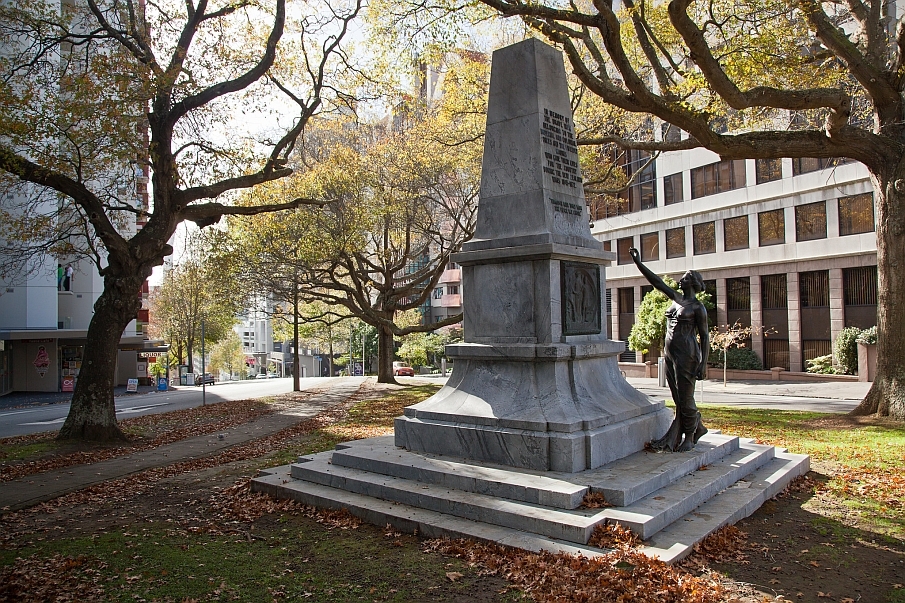
The Marsland Hill memorial is not the only New Zealand Wars memorial site that has been the focus of social protest action. The New Zealand Wars Memorial statue in Auckland’s Symonds Street Cemetery (Register no. 4493, Category 2) was tarred and feathered as a protest during the 1981 Springbok Tour, and the wreck of the Wars-era PS Rangiriri in Hamilton was also the subject of political vandalism during Waitangi Day protests in the mid 1990s.
International academics have termed sites like this as having significant ‘discord value’, for their ability to catalyse and encourage debate and discussion about difficult issues in a public forum. Maclean and Phillips have also shown that the study of war memorials can shed light on politics, the interplay between social groups, gender relationships, the power of ideology, and ethnic relationships in New Zealand: ‘War memorials did not emerge after each war as an automatic unthinking response, as a natural and time-honoured way of wrapping up each armed conflict. Rather, they were deliberate and often controversial acts of social control. Certain social groups were especially influential, and they acted with definite ideological purposes in mind.’
While the attitudes expressed in memorials such as that at Marsland Hill/Pukaka can appear to enshrine, and therefore celebrate, cultural and social perspectives that differ from those that the present society is working to redress, this is one of the qualities in which their heritage value lies. Today the New Zealand Wars Memorial can be read as a stark reminder of the formative events that shaped New Zealand, and as a symbol of their ongoing historical, cultural and social legacy.