DonateSupporterVisit Heritage
  • Tūrangawaewae
    Places
  • Tira Māori
    Māori Heritage
  • Poutairangahia
    Archaeology
  • Rauemi
    Resources
  • Mō Tātou
    About Us
  • New Zealand Heritage List
  • Nominate and submit
  • Explore the List
  • National Historic Landmarks
  • Plaques
  • Rainbow List Project
  • Lost heritage
  • Visit Heritage
  • Our properties
  • Turnbull House Project
  • Collections
  • Shop
  • Tohu Whenua
  • Tira Māori
  • Conserving Māori heritage
  • Marae built heritage
  • Māori heritage on the List
  • Hinemihi—Te Hokinga Mai
  • What is archaeology?
  • Is there a site on my property?
  • What are my legal requirements?
  • Affecting an archaeological site
  • Declaring an archaeological site
  • Archaeology FAQs
  • Archaeology Digital Library
  • Archaeology guidelines and templates
  • Resources
  • Funding
  • Publications
  • Sustainable management guides
  • Disaster recovery
  • Podcasts & digital resources
  • Education Hub
  • Conservation plans
  • About
  • Board
  • Māori Heritage Council
  • Senior Staff
  • Offices
  • Contact us
  • Careers
  • Covenants
  • Fast-track
  • Corporate documents
  • Currently consulting on
  • Our submissions
  • News
Quick links
Rārangi Kōrero | The List
Explore the List
National Historic Landmarks
Ngā Manawhenua o Aotearoa me ōna Kōrero Tūturu
Quick links
Tapuwae
A Vision for Places of Māori Heritage
Funding for Māori Heritage
Resources
Quick links
Archaeological Authority Portal
Applying for an archaeological authority
Archaeology FAQs
Browse the most frequently asked questions about archaeological authorities and the archaeological process.
Quick links
Quick links
Contact us
Offices
DonateSupporterVisit Heritage
  • Tūrangawaewae
    Places
  • Tira Māori
    Māori Heritage
  • Poutairangahia
    Archaeology
  • Rauemi
    Resources
  • Mō Tātou
    About Us
  • New Zealand Heritage List
  • Nominate and submit
  • Explore the List
  • National Historic Landmarks
  • Plaques
  • Rainbow List Project
  • Lost heritage
  • Visit Heritage
  • Our properties
  • Turnbull House Project
  • Collections
  • Shop
  • Tohu Whenua
  • Tira Māori
  • Conserving Māori heritage
  • Marae built heritage
  • Māori heritage on the List
  • Hinemihi—Te Hokinga Mai
  • What is archaeology?
  • Is there a site on my property?
  • What are my legal requirements?
  • Affecting an archaeological site
  • Declaring an archaeological site
  • Archaeology FAQs
  • Archaeology Digital Library
  • Archaeology guidelines and templates
  • Resources
  • Funding
  • Publications
  • Sustainable management guides
  • Disaster recovery
  • Podcasts & digital resources
  • Education Hub
  • Conservation plans
  • About
  • Board
  • Māori Heritage Council
  • Senior Staff
  • Offices
  • Contact us
  • Careers
  • Covenants
  • Fast-track
  • Corporate documents
  • Currently consulting on
  • Our submissions
  • News
Quick links
Rārangi Kōrero | The List
Explore the List
National Historic Landmarks
Ngā Manawhenua o Aotearoa me ōna Kōrero Tūturu
Quick links
Tapuwae
A Vision for Places of Māori Heritage
Funding for Māori Heritage
Resources
Quick links
Archaeological Authority Portal
Applying for an archaeological authority
Archaeology FAQs
Browse the most frequently asked questions about archaeological authorities and the archaeological process.
Quick links
Quick links
Contact us
Offices
  • Places
  • Nominate and submit
  • National Historic Landmarks
  • Places
  • Nominate and submit
  • National Historic Landmarks
  • Tira Māori
  • Conserving Māori heritage
  • Marae built heritage
  • Tira Māori
  • Conserving Māori heritage
  • Marae built heritage
  • Archaeological authorities
  • Archaeology Digital Library
  • Archaeological authorities
  • Archaeology Digital Library
  • All resources
  • Publications
  • Funding
  • All resources
  • Publications
  • Funding
  • FAQs
  • FAQs
Follow us on:
Places
  • Places
  • Nominate and submit
  • National Historic Landmarks
Tira Māori
  • Tira Māori
  • Conserving Māori heritage
  • Marae built heritage
Archaeology
  • Archaeological authorities
  • Archaeology Digital Library
Resources
  • All resources
  • Publications
  • Funding
FAQs
  • FAQs
Follow us on
HomePrivacyTerms and conditionsAbout this site
© Heritage New Zealand Pouhere Taonga 2026.
 
Callery's Battery

Golden Point Road, MACRAES, Otago

Public

Historic Place Category 1

List No. 9299

Quick links:
List GalleryLocationDetails
Callery’s Battery, located within Golden Point Historic Reserve near Macraes in the Waitaki District of Otago, is New Zealand’s best surviving example of a working stamper battery on its original site.

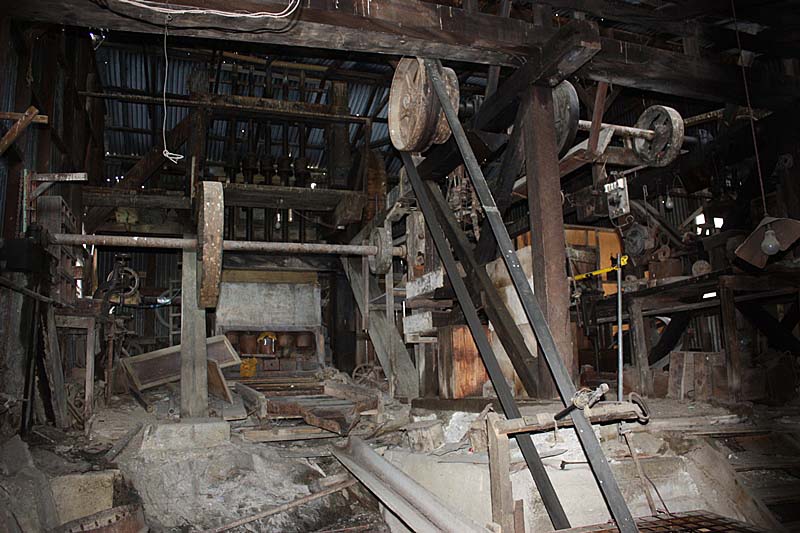
The battery processed both gold and scheelite from the early twentieth century and is an outstanding example of a small-scale stamp battery in original working condition, giving it aesthetic, and archaeological, historical and technological significance. The battery not only shows how a stamp battery was set up to run, with its stamps, drive train and power source all intact, but it also shows how all of the smaller elements in a battery, such as workshops, electrical plant and the forge, were arranged. Callery’s Battery, located within the Golden Point Historic Reserve and the Golden Point Historic Area (List No. 7211), forms an integral part of a complex and largely intact archaeological and historical landscape reflecting alluvial and hard rock mining associated with the Golden Point and Maritana Mines.

The first quartz mine worked in the Macraes area was at the Eclipse Reef in 1866. A stamper battery was built circa 1868, but had stopped working by 1872. Quartz mining then proceeded at a number of sites. The Maritana Reef was probably discovered in 1889, but, work did not commence until 1902. Around 1902, the Maritana Mine was opened by Charles McGill, who erected a 6 stamp battery powered by a 16 feet [4.8 metre] diameter water wheel to work the reef. The mine closed and was reopened 1911 when the Maritana Mining Company began operations on a different site.

In the meantime, the original Maritana Battery was still in existence on its original site, but in a much-modified form. The Callery brothers took over this battery, and continued to modify it until the present form took shape, probably with none of the original machinery remaining (although some original timbers may have been recycled in the structure). During the 1940s scheelite was in high demand because of the war effort, and Callery and party worked the separate Round Hill Mine, and transported the ore to the ‘Deep Dell Battery’ for treatment. The mine closed in 1954.

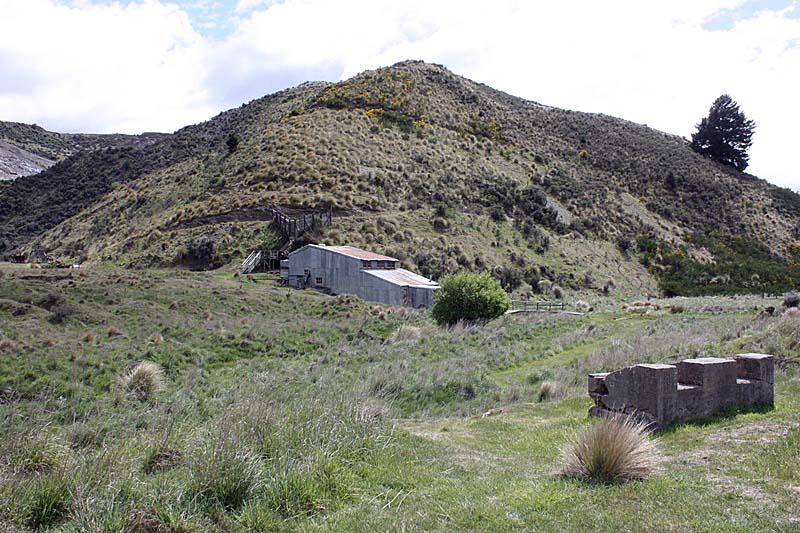
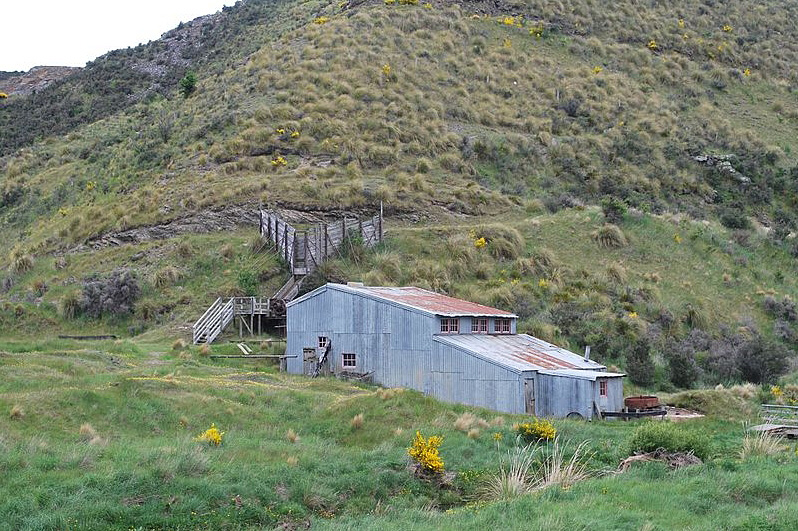
Callery’s Battery is set within the Golden Point Historic Reserve. The site provides the public with the opportunity to learn about mining technologies and the lives of miners in isolated goldfields. The area is scarred by mining – with evidence of alluvial, hard rock mining, as well as the dramatic modern mining. The juxtaposition of modern mining and the historic reserve adds an interesting dimension to the site, a reminder of how active this landscape was (and remains today). Golden Point is considered to be one of the two or three large underground gold mines in Otago. It was the largest in terms of the area worked; however the returns were not as great as Bendigo mine. Golden Point area is unusual in that all major forms of mining occurred there - alluvial mining and then quartz mining.

In 2019, Callery’s Battery remains an attraction for visitors to the Golden Point Historic Reserve.
Callery's Battery, Golden Point Road, Macraes | H Bauchop | 17/11/2015 | Heritage New Zealand Pouhere Taonga
Callery's Battery, Golden Point Road, Macraes. Interior looking toward the stamper | H Bauchop | 17/11/2015 | Heritage New Zealand Pouhere Taonga
Callery's Battery, Golden Point Road, Macraes | H Bauchop | 17/11/2015 | Heritage New Zealand Pouhere Taonga
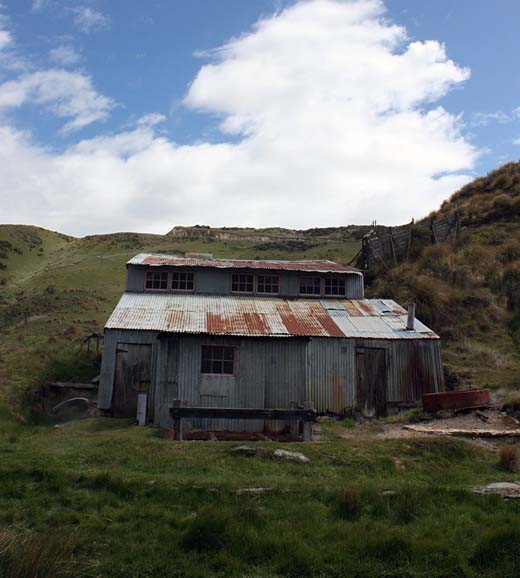
Callery's Battery, Golden Point Road, Macraes. Interior looking toward the stamper | H Bauchop | 17/11/2015 | Heritage New Zealand Pouhere Taonga

List Entry Information

Overview

Status
Listed

List Entry Status
Historic Place Category 1

Access
Able to Visit

List Number
9299

Date Entered
15th April 2020

Date of Effect
7th May 2020

City/District Council
Waitaki District

Region
Otago Region

Extent of List Entry

Extent includes part of the land described as Sec 4 Blk VIII Highlay SD (RT OT16B/853, NZ Gazette 1985 p.4297), Otago Land District and structures associated with Callery’s Battery thereon, comprising the battery house, ore bin, grizzly and rock breaker and and the following chattels in the battery house: battery, drives, Wilfley table, forge, work table, associated tools and mineral extraction equipment (Refer to map in Appendix 1 and Appendix 4 of the List entry report for further information, and site plan Figure 14).

Legal description

Sec 4 Blk VIII Highlay SD (RT OT16B/853, NZ Gazette 1985 p.4927), Otago Land District

Location Description

The Golden Point Historic Reserve lies 50 kilometres inland from Palmerston, off SH85 on the road from Dunback to Hyde. It is five kilometres from the village of Macraes, on Golden Point Road. The road traverses active mining operations, with mine staff patrolling the entrance to Golden Point Historic Reserve, which is crossed by a mining road. NZTM: E1398442/N4974893

Detailed List Entry
Significance

Cultural Significance

Technological Significance or Value As a working stamping battery, Callery’s battery has special technological significance. The battery not only shows how a stamp battery was set up to run, with its stamps, drive train and power source all intact, but it also shows how all of the smaller items in a battery, such as workshops, electrical plant and the forge, were arranged. It is considered the best surviving stamper battery in New Zealand.

Historic Significance

Historical Significance or Value Callery’s Battery has historical significance as it illustrates the history of one of Otago’s most significant hard rock and scheelite mines. Gold mining is one of the major themes in New Zealand’s history and has had a great impact on the New Zealand landscape. Otago was one of the principal areas of mining (along with the West Coast and the Coromandel). The story of scheelite is significant but less well known than that of gold mining, and Callery’s Battery tells the story of both.

Physical Significance

Aesthetic Significance or Value Callery’s Battery is located within a complex of gold mining sites and in proximity to modern mining. The battery in its context gives visitors a strong sense of what mining in this environment would have been like; the visual context provides a rustic aesthetic of significant value which is essential in contributing to understanding of this site. Although the battery is operated on an irregular basis, the opportunity to view a working stamper battery is rare and provides a powerful sensory experience of the noise and movement and the reality of miner’s working lives. The juxtaposition of modern mining is thought provoking, a reminder of the physical reality of mining – a noisy, exploitive undertaking, when many historic mining sites are divorced from the messy reality. Archaeological Significance or Value Callery’s Battery is the most significant surviving stamper battery in New Zealand. In addition, it is part of an entire mining system, which shows an intact nineteenth and early twentieth century industrial landscape. Ore which fed batteries was extracted from the pits and tunnel workings on the surrounding hillsides via tracks, tramway and aerial cableway. Water needed for powering crushing and extraction processes was taken from Deepdell Creek via a weir and race system and Battery Creek via a reservoir and race system. Two sources of energy used to drive the Callery battery are demonstrated by the remaining evidence of the original water wheel pit and by the present kerosene engine. The operational water right and associated water race supplying the Callery Battery ‘wilfley’ gold and scheelite recovery table is distinctive regionally and rare nationally. It is significant as one of the three major scheelite mines in New Zealand. It was approximately the largest in production and was certainly the largest in area explored and had very sustained sequences of operation from 1889 through until the 1970s when the facilities and land were gifted to Lands and Survey.

Detail Of Assessed Criteria

This place was assessed against all criteria, and found to qualify under the following: a, b, f, g, j and k. It is considered that this place qualifies as a Category 1 historic place. (a) The extent to which the place reflects important or representative aspects of New Zealand history Callery’s Battery represents the lives and work place of miners in the gold and scheelite mining industries. These industries are important in New Zealand’s history. Gold mining transformed Otago’s landscape and economy in the nineteenth century. The battery represents the hard rock gold mining in the twentieth century, and the growing importance of scheelite, particularly during The First World War and Second World War when increased demand for scheelite encouraged this industry. Its history also reflects the boom and bust nature of mining through its changing ownership and operation. (b) The association of the place with events, persons, or ideas of importance in New Zealand history Callery’s Battery is associated with the development of gold mining and scheelite mining in Otago in the late nineteenth and the twentieth centuries, both of which are events of importance in New Zealand history. As one of the most significant scheelite mines, and one of the most active quartz mines in Otago, it has a strong association. (f) The potential of the place for public education Callery’s Battery is set within the Golden Point Historic Reserve. The site provides the public with the opportunity to learn about mining technologies and the lives of miners in isolated goldfields. Interpretation panels provide background information about the sites within the reserve, including the battery, and together they have strong educative value. This is particularly so on days when the battery is operated. (g) The technical accomplishment, value, or design of the place Callery’s Battery is the best preserved and most authentic stamp battery to survive in New Zealand: overall Callery’s Battery is an outstanding example of a small-scale stamp battery in original working condition. It not only shows how a stamp battery was set up to run, with its stamps, drive train and power source all intact, but it also shows how all of the smaller items in a battery, such as workshops, electrical plant and the forge, were arranged. (j) The importance of identifying rare types of historic places Stamper batteries were once found at hundreds of quartz mines. Fewer than 20 still stand on their original sites. Callery’s Battery in Otago is one of three batteries in New Zealand to survive intact within their original buildings. The other two are located in the Coromandel, these being the Government Battery in Coromandel township and the Lillis battery nearby. This combined with the fact that Callery’s Battery is the best example of a working stamper battery on its original site, makes it a rare historic place. (k) The extent to which the place forms part of a wider historical and cultural area Callery’s Battery is located within the Golden Point Historic Reserve and the Golden Point Historic Area (List No. 7211), a complex and largely intact archaeological and historical landscape reflecting alluvial and hard rock mining associated with the Golden Point and Maritana Mines. It is part of a complex of surface and subsurface features and structures including mining shafts, tailings, benched tracks and roads, water races, and former miner’s residences. Summary of Significance or Values Callery’s Battery located within the Golden Point Historic Reserve and the Golden Point Historic Area (List No. 7211), forms an integral part of a complex and largely intact archaeological and historical landscape reflecting alluvial and hard rock mining associated with the Golden Point and Maritana Mines. Callery’s Battery is an outstanding example of a small-scale stamper battery and battery in original working condition. It not only shows how a stamp battery was set up to run, with its stamps, drive train and power source all intact, but it also shows how all of the smaller items in a battery, such as workshops, electrical plant and the forge, were arranged. It is the best surviving stamper battery in New Zealand.

Construction Details

Start Year

1902

Type

Original Construction

Description

Maritana Mine opened and six stamper battery erected

Start Year

1932

Type

Refurbishment/renovation

Description

Battery reconditioned and a 16 hp kerosene engine installed

Start Year

1934

Type

Addition

Description

Electric light and Wilfley table installed

Start Year

1954

Type

Other

Description

Mining ceased

Construction Materials

Corrugated iron, timber, steel, cast iron.

Historical Narrative

Early History Callery’s Battery sits in the hinterland of an area traditionally associated with the Kāhui-tipua, Te Aitanga-a-Rapuwai, Waitaha, Kāti Māmoe and latterly Kai Tahu iwi. Travelling routes along the Waihemo, Te Hakapupu (Pleasant River) and Waikouaiti awa enabled access into the interior for many generations of iwi. Key coastal settlements at Moeraki, Matakaea (Shag Point), Waikouaiti, and Huriawa (Karitane Peninsula) attest to the rich resources in the area supporting those vibrant communities for generations. For example, the Waihemo awa was recorded by local Ngāi Tahu kaumātua, Merekihereka Hape and Rāwiri Te Mamaru, as a kāinga mahinga kai (food-gathering place) where tuna (eel), īnaka (whitebait), pātiki (flounder), raupō, aruhe (bracken fernroot), and pipi were gathered. The mouth of the river was a shelter for waka, a place of sea and freshwater fishing, and a habitat for fur seals and moa. Inland and to the west, Pātearoa/ Rock and Pillar Range, was a place of mahinga kai particularly for weka and tikumu/mountain daisy. Stone resources, particularly silcrete, were mined at different inland quarry sites and transported as blade blanks for use at coastal sites such as Matakaea Mining history Mining is one of the major themes in New Zealand’s history and has a ‘great impact on New Zealand landscape.’ Otago was one of the principal areas of mining (along with the West Coast and the Coromandel). Gold mining took two forms – alluvial gravels and quartz bedrock mining. Scheelite was an important ore of tungsten used in the steel industry. It is sometimes found in association with gold bearing deposits, and was also mined in Otago – with the most significant scheelite deposits at Glenorchy and near Macraes, including an area known as Golden Point. One of the most important areas of quartz bedrock mining was at Macraes, inland from Palmerston in Otago, known to Māori as Ōtī and an area associated with seasonal food gathering. Quartz mining required money, men and equipment – the rock had to be mined, crushed, and treated to extract the gold. Such processing required large plant and buildings, as well as motive power such as water power or steam power using coal as fuel. Both alluvial mining and quartz bedrock mining left characteristic landscape effects: alluvial mining left its logical sequence of water races, reservoirs, sluicing faces, tailings and tail races, while quartz mining left shafts and adits, mullock heaps and battery sites. Quartz mining was capital intensive: quartz was blasted from the bedrock, tunnels dug, ore crushed and gold extracted with cyanide or mercury. Much gold was lost in this process. While gold was more easily extracted from the top oxidised layers of rock, returns dropped as mines went deeper, and the gold could not be chemically liberated as easily. The first quartz mine to be worked in the Macraes area was at the Eclipse Reef in 1866, which by 1868 had become known as the Duke of Edinburgh. A stamper battery was built in about 1868, but had stopped working by 1872. Local quartz mining then proceeded at a number of sites, including in the area of the present Golden Point Historic Reserve, where at least five different batteries have operated. Callery’s and its predecessor, McGill’s operated at the same location. Two main ore bodies bound this reserve, and were served by these batteries: the Maritana Reef and the Golden Point Reef. The Maritana Reef was probably discovered in 1889, but unless some small-scale work was carried out by the Donaldson brothers in association with the Golden Point Mine, work did not commence until 1902. The Charles Hay’s Maritana Quartz Mining Company was operating in the area in 1889, pegging out a claim on a reef, close to Golden Point – and perhaps giving the name to the reef. The Mount Ida Chronicle reported in September 1890 that a number of reefs had recently been discovered around the Macraes area – notably the Maritana, the Golden Point and the Orient, and had looked to be good prospects, with only a lack of capital preventing progress. Another mineral was found in association with the gold deposits and added to the history of mining near Macraes. Scheelite, the main ore of tungsten, was also mined and processed in the vicinity of Golden Point. Along with mines at Glenorchy, this was one of New Zealand’s most significant scheelite mines. Scheelite was found in quartz veins, often in association with gold. Scheelite mining began in New Zealand in the 1880s, with ore exported to Germany. The scheelite trade with Germany ended with the declaration of war in 1914, with Britain buying New Zealand’s scheelite. Scheelite was used in steel manufacture, and was used to strengthen steel and in weapons manufacture. It was difficult for miners to save both gold and scheelite from the ore, as they require different techniques. Scheelite is most efficiently saved as coarser grains (sand size), but that size of particle does not release much gold from sulphides, or even from quartz. Miners had to decide whether to save gold or scheelite, a decision usually reflecting the price of the ore. Callery’s Battery at Golden Point was used for processing both gold and scheelite. Around 1902, the Maritana Mine was opened by Charles McGill, and McGill erected a six stamp battery powered by a 16 feet diameter [4.8 metre] water wheel to work the reef. McGill had prior experience in South Africa. The reef was found to be gold bearing, but highly refractory (resistant to cyanide processing), and a small concentrating buddle (a shallow container in which ore is washed) was installed in 1903 to improve recovery. In 1905 a Frue vanner (a machine used to separate ore) was added again to improve the saving of concentrates, and a nine bhp oil engine was installed to provide motive power during dry weather. Despite this extensive development work, the 1906 Warden’s report commented that gold returns were small, and by 1907 work had ceased at the mine and battery. At this point the history of the Maritana Mine and its batteries becomes more complex. In December 1909 the Inspector of Mines reported that a Timaru syndicate was about to reopen the mine, but it was not until 1911 that the Maritana Mining Company was floated and began operations. The new company purchased a ten stamp battery from Barewood and re-erected it beside the mine to the east of the old battery, which was still standing. The new battery was linked to the mine workings by a tramway, these workings probably being further around the hillside to the north from the earlier mine of 1902-1907. In 1912, the West Coast Times reported that the Maritana Company was expected to begin crushing scheelite in three months, ‘an expensive and modern plant having been erected.’ In 1913 the company was working with a ten stamp battery and employed eleven men. By 1913 levels one and three in the mine were worked out. Prospecting in ground adjacent to the Deep Dell property came to nothing, and the mine closed down that year. In March 1914, the Mount Ida Chronicle reported that the Maritana mine was abandoned. In 1914 W.H. Bickerton and party purchased the old Maritana Mine machinery, including the battery, with the intention of relocating it to their workings at Nenthorn, where they had pumped out some of the old shafts, but there is no evidence that the machinery was ever re-erected there. In the meantime, the original Maritana Battery was still in existence on its original site, even if in a much-modified form. The Callery Brothers took over this battery, and continued to modify it until the present form took shape, probably with none of the original machinery remaining (although some original timbers may have been recycled in the structure). During the 1940s scheelite was in high demand because of the war effort. Callery and party worked the Round Hill Mine, and transported the ore to the Callery’s Battery, known at the time as the ‘Deep Dell Battery’ for treatment. Note that this battery is not the old Deep Dell Battery nearby at Horse Flat (site I42/13). Scheelite mining (at both the Round Hill and Golden Point Mines) and processing continued until at least 1951, with the occasional return to gold mining depending on the fluctuating prices of the two commodities. In 1980, the land was donated to the Department of Lands and Survey by members of the mining syndicate that still owned it. In 1985 the wider Golden Point area was gazetted as an historic reserve. In 2019, Callery’s Battery remains part of the Golden Point Historic Reserve and is accessible to the public, with interpretation panels explaining the site. The Battery is operated at irregular intervals.

Physical Description

Setting Golden Point Historic Reserve, in which Callery’s Battery sits, is located in a valley close to the Otago settlement of Macraes Flat, next to an area of active open cast mining. Golden Point is located in the gully formed by meandering Deepdell Creek. The area is scarred by mining – with evidence of alluvial, hard rock mining, as well as the dramatic modern mining. The juxtaposition of modern mining and the historic reserve adds an interesting dimension to the site, a reminder of how active this landscape was (and remains today). Callery’s Battery is part of a complex of mining sites in the wider Golden Point Historic Area (List No. 7211). These sites include mining shafts, tailings, benched tracks and roads, and water races, as well as former miner’s residences. The sites are associated with the Golden Point and Maritana mines, and include surface features, and sub-surface workings. The Maritana mine is much smaller than Golden Point, but it is unusual due to the presence of prospecting drives every six to eight metres. These were usually removed as the mine was worked. Several water races wind around the hillsides. The wooden house occupied by the Callery brothers is still in good order within the historic reserve, and there are two other mudbrick dwellings and their associated outhouses nearby, also located in the historic reserve. Current Description The battery house stands intact at the foot of the Maritana hillside, together with the associated ore bin, grizzly and rock breaker. The battery house is a corrugated-iron clad, timber framed building of a type that was once typical of stamper batteries, but has now virtually disappeared (the only other authentic examples are the Sawyer’s Battery in Thames and the Coromandel Government Battery). The ore bin, grizzly (a device for improving the screening of gravels) and rockbreaker are situated on the hillside behind the battery, and a short length of tramline allowed broken rock to be pushed by hand to the back of the stamp battery. The grizzly is set with a nominal gauge of 1 ½ inches (it actually varies between 1 ½ and 2 inches) [3.8-5 centimetres] and any larger lumps were fed through the Dodge Rockbreaker that was manufactured by Parke & Lacy of San Francisco. The existing stairs up to the rockbreaker are a modern addition for visitors. Inside, Callery’s Battery is intact and operational. The battery does not belong to any one period, and is the result of additions and modifications up to its operational retirement in the 1950s. The main operational plant consists of a five stamp stamper battery with automatic ore feeder and hopper. The battery frame has vertical timber battery posts with forward braces, with horizontal beams to support a camshaft level walkway to the front and the ore floor to the rear, although these do not appear to structurally support the battery itself. The mortar box is a heavy one-piece casting, with inclined slot screen mount. The cams are heavy duty items with webs on the leading faces, and are secured in place by conventional keys in a keyway. The stamps are fitted with gib tappets, and very heavy shoes (9 in. diameter and 10 in. long [2.9 centimetre diameter, 25.4 centimetres long]). The battery was used for both gold and scheelite recovery at different times, and so gravity separation was the principal treatment method used. There is a short copper-alloy table with eight steps in front of the stamps, and the pulp was then taken by a launder to a Wilfley table. This table is probably the only historic operational Wilfley table still in its last place of work in the country (the table at the Hauraki Prospectors’ Association in Thames has been relocated to the Coromandel Goldfield Centre museum). A Wilfley table is a large wooden table, on top of which are a series of parallel riffles. The table is set at an angle and the sludge is poured from the top corner. The heavier particles (gold) are held up along the riffles, while the lighter particles roll over the top. The whole table shakes, which works the gold down the riffles where they are removed. The paraffin engine is in a small room at the rear of the building and drove the stamper battery and other machinery via a flat belt to an intermediate shaft. The framework that supports this shaft is partially constructed from timbers that have been recycled from other machines, possibly even earlier incarnations of this battery. The building also contains a workshop/smithy area, with a forge and hand-operated blower, anvil, mercury retort, and assorted tools. Another work area with a workbench is on the upper level of the battery, beneath the intermediate shaft frame. Remaining from the Callery battery is the original well in which the waterwheel was located and some battery stampers which are possibly original. All the equipment associated with the mineral extraction process is now enclosed in the adjacent corrugated iron shed. A roadway leads up to a hopper and a collection of rusting metal equipment, including a Huntingdon battery from the Bonanza Mine. Callery's wooden house is still in good order; two mudbrick dwellings and their associated outhouses occupy terraces a short distance along the road, and the concrete foundations and fallen brick chimney of another building sit among the tailings on the valley floor. The other battery sites in the Golden Point Historic Reserve (but not included within the List entry) are foundations: • Donaldson’s Battery: NZAA Site No. I42/52. Constructed in 1889 as the first Golden Point Battery, and soon sold to the Donaldson brothers. Remodelled several times. Demolished in 1953. Site includes one set of timber mortar blocks and one concrete mortar block. • Site of the second Maritana Battery : NZAA Site No. I42/180. Constructed in 1911 when the old Barewood Gold-mining Company battery was purchased and moved to the Maritana ground (AJHR 1912 C2: 53). Site includes concrete mortar blocks for the 10 stamp battery. • Golden Point Battery: NZAA Site No. I42/18 (part of overall Golden Point Mine site). Constructed in 1930, and closed in 1944. Site consists of concrete battery foundations, presently off-limits due to nearby modern mining operations. • In addition, the Bonanza Mine Huntington Battery from Nenthorn has been relocated to the Golden Point Reserve, and has been re-erected at the foot of the Maritana Hill. Comparative Analysis Stamper batteries were once found at hundreds of quartz mines. Fewer than 20 still stand on their original sites. Only three batteries still survive intact within their original buildings, these being the Government Battery in Coromandel township, the Lillis battery nearby and Callery’s Battery. Another stamper battery is located on the site of the Caledonian-Golden Crown-Manukau claim in Thames. This is an assemblage of battery machinery reconstructed into a working battery. The five-stamp Golden Fleece Stamper Battery at Blacks Point Museum on the West Coast, is also in working order, but has been relocated from its original site. The 1899 Government Battery at the Coromandel Goldfield Centre is a Category 1 historic place (List Entry No. 130). The battery is powered by New Zealand's biggest working water wheel and was also one of the first stamper batteries in New Zealand to be started with a diesel motor running part of the plant. It is part of a working museum, demonstrating the process from crushing the rock ore form the mine to the final product - gold. The building is full of local history and relics from the past. According to the museum, this was the first diesel-powered gold processing plant in New Zealand and its last original stamper battery is the only working six-head stamper battery in the world. Petchey writes that the battery finally closed in about 1939, and then languished for many years with some parts removed and suffering from vandalism. The first curator of the Coromandel Museum, Gordon Allingham, and later R. Drinkwater, worked to preserve and restore the battery, which was operational again by the 1980s. The parts that were removed included the five-stamp mortar box, and the one presently in the battery was recovered from the Long Trail Mine at Colville. The present 3.5 h.p. single cylinder diesel engine and 25 feet [7.6 metre] diameter water wheel were installed at the same time. Another small stamper battery is operated at Mitchell’s Gully near Charleston on the West Coast, but this was built in 1977 on an old battery site using early battery parts. Callery’s Battery ‘is the best preserved and most authentic stamp battery to survive in New Zealand’: modified in the course of its operation, as would be expected of a working battery, ‘overall Callery’s Battery is an outstanding example of a small-scale stamp battery in original working condition. It not only shows how a stamp battery was set up to run, with its stamps, drive train and power source all intact, but it also shows how all of the smaller items in a battery, such as workshops, electrical plant and the forge, were arranged. It is the best surviving stamper battery in New Zealand.’ It is one of the most significant goldfields sites in the country.’

Reference

Public NZAA Number

I42/161

Completion Date

3rd February 2020

Report Written By

Heather Bauchop and Sarah Gallagher

Information Sources

Petchey, 2013

Petchey, P.G., ‘The Archaeology of the New Zealand Stamp Mill’, PhD Thesis, Department of Anthropology and Archaeology, University of Otago, 2013.

Smith, 1990

Paula J.M. Smith, Otago Goldfields Park Management Strategy 1990, Report prepared for the Department of Conservation, 1990.

Gray, 2003

John Gray, ‘Golden Point Battery, Macraes, Otago: Conservation Maintenance Report,’ Oakley Gray Architects for the Department of Conservation, Dunedin, 2003.

Report Written By

A fully referenced New Zealand Heritage List report is available on request from the Dunedin Office of Heritage New Zealand. Disclaimer Please note that entry on the New Zealand Heritage List/Rārangi Kōrero identifies only the heritage values of the property concerned, and should not be construed as advice on the state of the property, or as a comment of its soundness or safety, including in regard to earthquake risk, safety in the event of fire, or insanitary conditions. Archaeological sites are protected by the Heritage New Zealand Pouhere Taonga Act 2014, regardless of whether they are entered on the New Zealand Heritage List/Rārangi Kōrero or not. Archaeological sites include ‘places associated with pre-1900 human activity, where there may be evidence relating to the history of New Zealand’. This List entry report should not be read as a statement on whether or not the archaeological provisions of the Act apply to the property (s) concerned. Please contact your local Heritage New Zealand office for archaeological advice.

Further Information

Current Usages

Uses: Civic Facilities

Specific Usage: Historic or recreation reserve

Former Usages

General Usage:: Mining

Specific Usage: Battery/Crusher

Themes

Web Links

Overview

Status

Listed

List Entry Status

Historic Place Category 1

Access

Able to Visit

List Number

9299

Date Entered

15th April 2020

Date of Effect

7th May 2020

City/District Council

Waitaki District

Region

Otago Region

Extent of List Entry

Extent includes part of the land described as Sec 4 Blk VIII Highlay SD (RT OT16B/853, NZ Gazette 1985 p.4297), Otago Land District and structures associated with Callery’s Battery thereon, comprising the battery house, ore bin, grizzly and rock breaker and and the following chattels in the battery house: battery, drives, Wilfley table, forge, work table, associated tools and mineral extraction equipment (Refer to map in Appendix 1 and Appendix 4 of the List entry report for further information, and site plan Figure 14).

Legal description

Sec 4 Blk VIII Highlay SD (RT OT16B/853, NZ Gazette 1985 p.4927), Otago Land District

Location Description

The Golden Point Historic Reserve lies 50 kilometres inland from Palmerston, off SH85 on the road from Dunback to Hyde. It is five kilometres from the village of Macraes, on Golden Point Road. The road traverses active mining operations, with mine staff patrolling the entrance to Golden Point Historic Reserve, which is crossed by a mining road. NZTM: E1398442/N4974893

Status

Listed

List Entry Status

Historic Place Category 1

Access

Able to Visit

List Number

9299

Date Entered

15th April 2020

Date of Effect

7th May 2020

City/District Council

Waitaki District

Region

Otago Region

Extent of List Entry

Extent includes part of the land described as Sec 4 Blk VIII Highlay SD (RT OT16B/853, NZ Gazette 1985 p.4297), Otago Land District and structures associated with Callery’s Battery thereon, comprising the battery house, ore bin, grizzly and rock breaker and and the following chattels in the battery house: battery, drives, Wilfley table, forge, work table, associated tools and mineral extraction equipment (Refer to map in Appendix 1 and Appendix 4 of the List entry report for further information, and site plan Figure 14).

Legal description

Sec 4 Blk VIII Highlay SD (RT OT16B/853, NZ Gazette 1985 p.4927), Otago Land District

Location Description

The Golden Point Historic Reserve lies 50 kilometres inland from Palmerston, off SH85 on the road from Dunback to Hyde. It is five kilometres from the village of Macraes, on Golden Point Road. The road traverses active mining operations, with mine staff patrolling the entrance to Golden Point Historic Reserve, which is crossed by a mining road. NZTM: E1398442/N4974893

Significance

Why is this place significant?

Cultural Significance

Technological Significance or Value As a working stamping battery, Callery’s battery has special technological significance. The battery not only shows how a stamp battery was set up to run, with its stamps, drive train and power source all intact, but it also shows how all of the smaller items in a battery, such as workshops, electrical plant and the forge, were arranged. It is considered the best surviving stamper battery in New Zealand.

Historic Significance

Historical Significance or Value Callery’s Battery has historical significance as it illustrates the history of one of Otago’s most significant hard rock and scheelite mines. Gold mining is one of the major themes in New Zealand’s history and has had a great impact on the New Zealand landscape. Otago was one of the principal areas of mining (along with the West Coast and the Coromandel). The story of scheelite is significant but less well known than that of gold mining, and Callery’s Battery tells the story of both.

Physical Significance

Aesthetic Significance or Value Callery’s Battery is located within a complex of gold mining sites and in proximity to modern mining. The battery in its context gives visitors a strong sense of what mining in this environment would have been like; the visual context provides a rustic aesthetic of significant value which is essential in contributing to understanding of this site. Although the battery is operated on an irregular basis, the opportunity to view a working stamper battery is rare and provides a powerful sensory experience of the noise and movement and the reality of miner’s working lives. The juxtaposition of modern mining is thought provoking, a reminder of the physical reality of mining – a noisy, exploitive undertaking, when many historic mining sites are divorced from the messy reality. Archaeological Significance or Value Callery’s Battery is the most significant surviving stamper battery in New Zealand. In addition, it is part of an entire mining system, which shows an intact nineteenth and early twentieth century industrial landscape. Ore which fed batteries was extracted from the pits and tunnel workings on the surrounding hillsides via tracks, tramway and aerial cableway. Water needed for powering crushing and extraction processes was taken from Deepdell Creek via a weir and race system and Battery Creek via a reservoir and race system. Two sources of energy used to drive the Callery battery are demonstrated by the remaining evidence of the original water wheel pit and by the present kerosene engine. The operational water right and associated water race supplying the Callery Battery ‘wilfley’ gold and scheelite recovery table is distinctive regionally and rare nationally. It is significant as one of the three major scheelite mines in New Zealand. It was approximately the largest in production and was certainly the largest in area explored and had very sustained sequences of operation from 1889 through until the 1970s when the facilities and land were gifted to Lands and Survey.

Why is this place Category 1 / Category 2?

Detail Of Assessed Criteria

This place was assessed against all criteria, and found to qualify under the following: a, b, f, g, j and k. It is considered that this place qualifies as a Category 1 historic place. (a) The extent to which the place reflects important or representative aspects of New Zealand history Callery’s Battery represents the lives and work place of miners in the gold and scheelite mining industries. These industries are important in New Zealand’s history. Gold mining transformed Otago’s landscape and economy in the nineteenth century. The battery represents the hard rock gold mining in the twentieth century, and the growing importance of scheelite, particularly during The First World War and Second World War when increased demand for scheelite encouraged this industry. Its history also reflects the boom and bust nature of mining through its changing ownership and operation. (b) The association of the place with events, persons, or ideas of importance in New Zealand history Callery’s Battery is associated with the development of gold mining and scheelite mining in Otago in the late nineteenth and the twentieth centuries, both of which are events of importance in New Zealand history. As one of the most significant scheelite mines, and one of the most active quartz mines in Otago, it has a strong association. (f) The potential of the place for public education Callery’s Battery is set within the Golden Point Historic Reserve. The site provides the public with the opportunity to learn about mining technologies and the lives of miners in isolated goldfields. Interpretation panels provide background information about the sites within the reserve, including the battery, and together they have strong educative value. This is particularly so on days when the battery is operated. (g) The technical accomplishment, value, or design of the place Callery’s Battery is the best preserved and most authentic stamp battery to survive in New Zealand: overall Callery’s Battery is an outstanding example of a small-scale stamp battery in original working condition. It not only shows how a stamp battery was set up to run, with its stamps, drive train and power source all intact, but it also shows how all of the smaller items in a battery, such as workshops, electrical plant and the forge, were arranged. (j) The importance of identifying rare types of historic places Stamper batteries were once found at hundreds of quartz mines. Fewer than 20 still stand on their original sites. Callery’s Battery in Otago is one of three batteries in New Zealand to survive intact within their original buildings. The other two are located in the Coromandel, these being the Government Battery in Coromandel township and the Lillis battery nearby. This combined with the fact that Callery’s Battery is the best example of a working stamper battery on its original site, makes it a rare historic place. (k) The extent to which the place forms part of a wider historical and cultural area Callery’s Battery is located within the Golden Point Historic Reserve and the Golden Point Historic Area (List No. 7211), a complex and largely intact archaeological and historical landscape reflecting alluvial and hard rock mining associated with the Golden Point and Maritana Mines. It is part of a complex of surface and subsurface features and structures including mining shafts, tailings, benched tracks and roads, water races, and former miner’s residences. Summary of Significance or Values Callery’s Battery located within the Golden Point Historic Reserve and the Golden Point Historic Area (List No. 7211), forms an integral part of a complex and largely intact archaeological and historical landscape reflecting alluvial and hard rock mining associated with the Golden Point and Maritana Mines. Callery’s Battery is an outstanding example of a small-scale stamper battery and battery in original working condition. It not only shows how a stamp battery was set up to run, with its stamps, drive train and power source all intact, but it also shows how all of the smaller items in a battery, such as workshops, electrical plant and the forge, were arranged. It is the best surviving stamper battery in New Zealand.

Why is this place significant?

Cultural Significance

Technological Significance or Value As a working stamping battery, Callery’s battery has special technological significance. The battery not only shows how a stamp battery was set up to run, with its stamps, drive train and power source all intact, but it also shows how all of the smaller items in a battery, such as workshops, electrical plant and the forge, were arranged. It is considered the best surviving stamper battery in New Zealand.

Historic Significance

Historical Significance or Value Callery’s Battery has historical significance as it illustrates the history of one of Otago’s most significant hard rock and scheelite mines. Gold mining is one of the major themes in New Zealand’s history and has had a great impact on the New Zealand landscape. Otago was one of the principal areas of mining (along with the West Coast and the Coromandel). The story of scheelite is significant but less well known than that of gold mining, and Callery’s Battery tells the story of both.

Physical Significance

Aesthetic Significance or Value Callery’s Battery is located within a complex of gold mining sites and in proximity to modern mining. The battery in its context gives visitors a strong sense of what mining in this environment would have been like; the visual context provides a rustic aesthetic of significant value which is essential in contributing to understanding of this site. Although the battery is operated on an irregular basis, the opportunity to view a working stamper battery is rare and provides a powerful sensory experience of the noise and movement and the reality of miner’s working lives. The juxtaposition of modern mining is thought provoking, a reminder of the physical reality of mining – a noisy, exploitive undertaking, when many historic mining sites are divorced from the messy reality. Archaeological Significance or Value Callery’s Battery is the most significant surviving stamper battery in New Zealand. In addition, it is part of an entire mining system, which shows an intact nineteenth and early twentieth century industrial landscape. Ore which fed batteries was extracted from the pits and tunnel workings on the surrounding hillsides via tracks, tramway and aerial cableway. Water needed for powering crushing and extraction processes was taken from Deepdell Creek via a weir and race system and Battery Creek via a reservoir and race system. Two sources of energy used to drive the Callery battery are demonstrated by the remaining evidence of the original water wheel pit and by the present kerosene engine. The operational water right and associated water race supplying the Callery Battery ‘wilfley’ gold and scheelite recovery table is distinctive regionally and rare nationally. It is significant as one of the three major scheelite mines in New Zealand. It was approximately the largest in production and was certainly the largest in area explored and had very sustained sequences of operation from 1889 through until the 1970s when the facilities and land were gifted to Lands and Survey.

Why is this place Category 1 / Category 2?

Detail Of Assessed Criteria

This place was assessed against all criteria, and found to qualify under the following: a, b, f, g, j and k. It is considered that this place qualifies as a Category 1 historic place. (a) The extent to which the place reflects important or representative aspects of New Zealand history Callery’s Battery represents the lives and work place of miners in the gold and scheelite mining industries. These industries are important in New Zealand’s history. Gold mining transformed Otago’s landscape and economy in the nineteenth century. The battery represents the hard rock gold mining in the twentieth century, and the growing importance of scheelite, particularly during The First World War and Second World War when increased demand for scheelite encouraged this industry. Its history also reflects the boom and bust nature of mining through its changing ownership and operation. (b) The association of the place with events, persons, or ideas of importance in New Zealand history Callery’s Battery is associated with the development of gold mining and scheelite mining in Otago in the late nineteenth and the twentieth centuries, both of which are events of importance in New Zealand history. As one of the most significant scheelite mines, and one of the most active quartz mines in Otago, it has a strong association. (f) The potential of the place for public education Callery’s Battery is set within the Golden Point Historic Reserve. The site provides the public with the opportunity to learn about mining technologies and the lives of miners in isolated goldfields. Interpretation panels provide background information about the sites within the reserve, including the battery, and together they have strong educative value. This is particularly so on days when the battery is operated. (g) The technical accomplishment, value, or design of the place Callery’s Battery is the best preserved and most authentic stamp battery to survive in New Zealand: overall Callery’s Battery is an outstanding example of a small-scale stamp battery in original working condition. It not only shows how a stamp battery was set up to run, with its stamps, drive train and power source all intact, but it also shows how all of the smaller items in a battery, such as workshops, electrical plant and the forge, were arranged. (j) The importance of identifying rare types of historic places Stamper batteries were once found at hundreds of quartz mines. Fewer than 20 still stand on their original sites. Callery’s Battery in Otago is one of three batteries in New Zealand to survive intact within their original buildings. The other two are located in the Coromandel, these being the Government Battery in Coromandel township and the Lillis battery nearby. This combined with the fact that Callery’s Battery is the best example of a working stamper battery on its original site, makes it a rare historic place. (k) The extent to which the place forms part of a wider historical and cultural area Callery’s Battery is located within the Golden Point Historic Reserve and the Golden Point Historic Area (List No. 7211), a complex and largely intact archaeological and historical landscape reflecting alluvial and hard rock mining associated with the Golden Point and Maritana Mines. It is part of a complex of surface and subsurface features and structures including mining shafts, tailings, benched tracks and roads, water races, and former miner’s residences. Summary of Significance or Values Callery’s Battery located within the Golden Point Historic Reserve and the Golden Point Historic Area (List No. 7211), forms an integral part of a complex and largely intact archaeological and historical landscape reflecting alluvial and hard rock mining associated with the Golden Point and Maritana Mines. Callery’s Battery is an outstanding example of a small-scale stamper battery and battery in original working condition. It not only shows how a stamp battery was set up to run, with its stamps, drive train and power source all intact, but it also shows how all of the smaller items in a battery, such as workshops, electrical plant and the forge, were arranged. It is the best surviving stamper battery in New Zealand.

Construction Information

Construction Details

Start Year

1902

Type

Original Construction

Description

Maritana Mine opened and six stamper battery erected

Start Year

1932

Type

Refurbishment/renovation

Description

Battery reconditioned and a 16 hp kerosene engine installed

Start Year

1934

Type

Addition

Description

Electric light and Wilfley table installed

Start Year

1954

Type

Other

Description

Mining ceased

Construction Materials

Corrugated iron, timber, steel, cast iron.

Construction Details

Start Year

1902

Type

Original Construction

Description

Maritana Mine opened and six stamper battery erected

Start Year

1932

Type

Refurbishment/renovation

Description

Battery reconditioned and a 16 hp kerosene engine installed

Start Year

1934

Type

Addition

Description

Electric light and Wilfley table installed

Start Year

1954

Type

Other

Description

Mining ceased

Construction Materials

Corrugated iron, timber, steel, cast iron.

Historical Narrative

Early History Callery’s Battery sits in the hinterland of an area traditionally associated with the Kāhui-tipua, Te Aitanga-a-Rapuwai, Waitaha, Kāti Māmoe and latterly Kai Tahu iwi. Travelling routes along the Waihemo, Te Hakapupu (Pleasant River) and Waikouaiti awa enabled access into the interior for many generations of iwi. Key coastal settlements at Moeraki, Matakaea (Shag Point), Waikouaiti, and Huriawa (Karitane Peninsula) attest to the rich resources in the area supporting those vibrant communities for generations. For example, the Waihemo awa was recorded by local Ngāi Tahu kaumātua, Merekihereka Hape and Rāwiri Te Mamaru, as a kāinga mahinga kai (food-gathering place) where tuna (eel), īnaka (whitebait), pātiki (flounder), raupō, aruhe (bracken fernroot), and pipi were gathered. The mouth of the river was a shelter for waka, a place of sea and freshwater fishing, and a habitat for fur seals and moa. Inland and to the west, Pātearoa/ Rock and Pillar Range, was a place of mahinga kai particularly for weka and tikumu/mountain daisy. Stone resources, particularly silcrete, were mined at different inland quarry sites and transported as blade blanks for use at coastal sites such as Matakaea Mining history Mining is one of the major themes in New Zealand’s history and has a ‘great impact on New Zealand landscape.’ Otago was one of the principal areas of mining (along with the West Coast and the Coromandel). Gold mining took two forms – alluvial gravels and quartz bedrock mining. Scheelite was an important ore of tungsten used in the steel industry. It is sometimes found in association with gold bearing deposits, and was also mined in Otago – with the most significant scheelite deposits at Glenorchy and near Macraes, including an area known as Golden Point. One of the most important areas of quartz bedrock mining was at Macraes, inland from Palmerston in Otago, known to Māori as Ōtī and an area associated with seasonal food gathering. Quartz mining required money, men and equipment – the rock had to be mined, crushed, and treated to extract the gold. Such processing required large plant and buildings, as well as motive power such as water power or steam power using coal as fuel. Both alluvial mining and quartz bedrock mining left characteristic landscape effects: alluvial mining left its logical sequence of water races, reservoirs, sluicing faces, tailings and tail races, while quartz mining left shafts and adits, mullock heaps and battery sites. Quartz mining was capital intensive: quartz was blasted from the bedrock, tunnels dug, ore crushed and gold extracted with cyanide or mercury. Much gold was lost in this process. While gold was more easily extracted from the top oxidised layers of rock, returns dropped as mines went deeper, and the gold could not be chemically liberated as easily. The first quartz mine to be worked in the Macraes area was at the Eclipse Reef in 1866, which by 1868 had become known as the Duke of Edinburgh. A stamper battery was built in about 1868, but had stopped working by 1872. Local quartz mining then proceeded at a number of sites, including in the area of the present Golden Point Historic Reserve, where at least five different batteries have operated. Callery’s and its predecessor, McGill’s operated at the same location. Two main ore bodies bound this reserve, and were served by these batteries: the Maritana Reef and the Golden Point Reef. The Maritana Reef was probably discovered in 1889, but unless some small-scale work was carried out by the Donaldson brothers in association with the Golden Point Mine, work did not commence until 1902. The Charles Hay’s Maritana Quartz Mining Company was operating in the area in 1889, pegging out a claim on a reef, close to Golden Point – and perhaps giving the name to the reef. The Mount Ida Chronicle reported in September 1890 that a number of reefs had recently been discovered around the Macraes area – notably the Maritana, the Golden Point and the Orient, and had looked to be good prospects, with only a lack of capital preventing progress. Another mineral was found in association with the gold deposits and added to the history of mining near Macraes. Scheelite, the main ore of tungsten, was also mined and processed in the vicinity of Golden Point. Along with mines at Glenorchy, this was one of New Zealand’s most significant scheelite mines. Scheelite was found in quartz veins, often in association with gold. Scheelite mining began in New Zealand in the 1880s, with ore exported to Germany. The scheelite trade with Germany ended with the declaration of war in 1914, with Britain buying New Zealand’s scheelite. Scheelite was used in steel manufacture, and was used to strengthen steel and in weapons manufacture. It was difficult for miners to save both gold and scheelite from the ore, as they require different techniques. Scheelite is most efficiently saved as coarser grains (sand size), but that size of particle does not release much gold from sulphides, or even from quartz. Miners had to decide whether to save gold or scheelite, a decision usually reflecting the price of the ore. Callery’s Battery at Golden Point was used for processing both gold and scheelite. Around 1902, the Maritana Mine was opened by Charles McGill, and McGill erected a six stamp battery powered by a 16 feet diameter [4.8 metre] water wheel to work the reef. McGill had prior experience in South Africa. The reef was found to be gold bearing, but highly refractory (resistant to cyanide processing), and a small concentrating buddle (a shallow container in which ore is washed) was installed in 1903 to improve recovery. In 1905 a Frue vanner (a machine used to separate ore) was added again to improve the saving of concentrates, and a nine bhp oil engine was installed to provide motive power during dry weather. Despite this extensive development work, the 1906 Warden’s report commented that gold returns were small, and by 1907 work had ceased at the mine and battery. At this point the history of the Maritana Mine and its batteries becomes more complex. In December 1909 the Inspector of Mines reported that a Timaru syndicate was about to reopen the mine, but it was not until 1911 that the Maritana Mining Company was floated and began operations. The new company purchased a ten stamp battery from Barewood and re-erected it beside the mine to the east of the old battery, which was still standing. The new battery was linked to the mine workings by a tramway, these workings probably being further around the hillside to the north from the earlier mine of 1902-1907. In 1912, the West Coast Times reported that the Maritana Company was expected to begin crushing scheelite in three months, ‘an expensive and modern plant having been erected.’ In 1913 the company was working with a ten stamp battery and employed eleven men. By 1913 levels one and three in the mine were worked out. Prospecting in ground adjacent to the Deep Dell property came to nothing, and the mine closed down that year. In March 1914, the Mount Ida Chronicle reported that the Maritana mine was abandoned. In 1914 W.H. Bickerton and party purchased the old Maritana Mine machinery, including the battery, with the intention of relocating it to their workings at Nenthorn, where they had pumped out some of the old shafts, but there is no evidence that the machinery was ever re-erected there. In the meantime, the original Maritana Battery was still in existence on its original site, even if in a much-modified form. The Callery Brothers took over this battery, and continued to modify it until the present form took shape, probably with none of the original machinery remaining (although some original timbers may have been recycled in the structure). During the 1940s scheelite was in high demand because of the war effort. Callery and party worked the Round Hill Mine, and transported the ore to the Callery’s Battery, known at the time as the ‘Deep Dell Battery’ for treatment. Note that this battery is not the old Deep Dell Battery nearby at Horse Flat (site I42/13). Scheelite mining (at both the Round Hill and Golden Point Mines) and processing continued until at least 1951, with the occasional return to gold mining depending on the fluctuating prices of the two commodities. In 1980, the land was donated to the Department of Lands and Survey by members of the mining syndicate that still owned it. In 1985 the wider Golden Point area was gazetted as an historic reserve. In 2019, Callery’s Battery remains part of the Golden Point Historic Reserve and is accessible to the public, with interpretation panels explaining the site. The Battery is operated at irregular intervals.

Early History Callery’s Battery sits in the hinterland of an area traditionally associated with the Kāhui-tipua, Te Aitanga-a-Rapuwai, Waitaha, Kāti Māmoe and latterly Kai Tahu iwi. Travelling routes along the Waihemo, Te Hakapupu (Pleasant River) and Waikouaiti awa enabled access into the interior for many generations of iwi. Key coastal settlements at Moeraki, Matakaea (Shag Point), Waikouaiti, and Huriawa (Karitane Peninsula) attest to the rich resources in the area supporting those vibrant communities for generations. For example, the Waihemo awa was recorded by local Ngāi Tahu kaumātua, Merekihereka Hape and Rāwiri Te Mamaru, as a kāinga mahinga kai (food-gathering place) where tuna (eel), īnaka (whitebait), pātiki (flounder), raupō, aruhe (bracken fernroot), and pipi were gathered. The mouth of the river was a shelter for waka, a place of sea and freshwater fishing, and a habitat for fur seals and moa. Inland and to the west, Pātearoa/ Rock and Pillar Range, was a place of mahinga kai particularly for weka and tikumu/mountain daisy. Stone resources, particularly silcrete, were mined at different inland quarry sites and transported as blade blanks for use at coastal sites such as Matakaea Mining history Mining is one of the major themes in New Zealand’s history and has a ‘great impact on New Zealand landscape.’ Otago was one of the principal areas of mining (along with the West Coast and the Coromandel). Gold mining took two forms – alluvial gravels and quartz bedrock mining. Scheelite was an important ore of tungsten used in the steel industry. It is sometimes found in association with gold bearing deposits, and was also mined in Otago – with the most significant scheelite deposits at Glenorchy and near Macraes, including an area known as Golden Point. One of the most important areas of quartz bedrock mining was at Macraes, inland from Palmerston in Otago, known to Māori as Ōtī and an area associated with seasonal food gathering. Quartz mining required money, men and equipment – the rock had to be mined, crushed, and treated to extract the gold. Such processing required large plant and buildings, as well as motive power such as water power or steam power using coal as fuel. Both alluvial mining and quartz bedrock mining left characteristic landscape effects: alluvial mining left its logical sequence of water races, reservoirs, sluicing faces, tailings and tail races, while quartz mining left shafts and adits, mullock heaps and battery sites. Quartz mining was capital intensive: quartz was blasted from the bedrock, tunnels dug, ore crushed and gold extracted with cyanide or mercury. Much gold was lost in this process. While gold was more easily extracted from the top oxidised layers of rock, returns dropped as mines went deeper, and the gold could not be chemically liberated as easily. The first quartz mine to be worked in the Macraes area was at the Eclipse Reef in 1866, which by 1868 had become known as the Duke of Edinburgh. A stamper battery was built in about 1868, but had stopped working by 1872. Local quartz mining then proceeded at a number of sites, including in the area of the present Golden Point Historic Reserve, where at least five different batteries have operated. Callery’s and its predecessor, McGill’s operated at the same location. Two main ore bodies bound this reserve, and were served by these batteries: the Maritana Reef and the Golden Point Reef. The Maritana Reef was probably discovered in 1889, but unless some small-scale work was carried out by the Donaldson brothers in association with the Golden Point Mine, work did not commence until 1902. The Charles Hay’s Maritana Quartz Mining Company was operating in the area in 1889, pegging out a claim on a reef, close to Golden Point – and perhaps giving the name to the reef. The Mount Ida Chronicle reported in September 1890 that a number of reefs had recently been discovered around the Macraes area – notably the Maritana, the Golden Point and the Orient, and had looked to be good prospects, with only a lack of capital preventing progress. Another mineral was found in association with the gold deposits and added to the history of mining near Macraes. Scheelite, the main ore of tungsten, was also mined and processed in the vicinity of Golden Point. Along with mines at Glenorchy, this was one of New Zealand’s most significant scheelite mines. Scheelite was found in quartz veins, often in association with gold. Scheelite mining began in New Zealand in the 1880s, with ore exported to Germany. The scheelite trade with Germany ended with the declaration of war in 1914, with Britain buying New Zealand’s scheelite. Scheelite was used in steel manufacture, and was used to strengthen steel and in weapons manufacture. It was difficult for miners to save both gold and scheelite from the ore, as they require different techniques. Scheelite is most efficiently saved as coarser grains (sand size), but that size of particle does not release much gold from sulphides, or even from quartz. Miners had to decide whether to save gold or scheelite, a decision usually reflecting the price of the ore. Callery’s Battery at Golden Point was used for processing both gold and scheelite. Around 1902, the Maritana Mine was opened by Charles McGill, and McGill erected a six stamp battery powered by a 16 feet diameter [4.8 metre] water wheel to work the reef. McGill had prior experience in South Africa. The reef was found to be gold bearing, but highly refractory (resistant to cyanide processing), and a small concentrating buddle (a shallow container in which ore is washed) was installed in 1903 to improve recovery. In 1905 a Frue vanner (a machine used to separate ore) was added again to improve the saving of concentrates, and a nine bhp oil engine was installed to provide motive power during dry weather. Despite this extensive development work, the 1906 Warden’s report commented that gold returns were small, and by 1907 work had ceased at the mine and battery. At this point the history of the Maritana Mine and its batteries becomes more complex. In December 1909 the Inspector of Mines reported that a Timaru syndicate was about to reopen the mine, but it was not until 1911 that the Maritana Mining Company was floated and began operations. The new company purchased a ten stamp battery from Barewood and re-erected it beside the mine to the east of the old battery, which was still standing. The new battery was linked to the mine workings by a tramway, these workings probably being further around the hillside to the north from the earlier mine of 1902-1907. In 1912, the West Coast Times reported that the Maritana Company was expected to begin crushing scheelite in three months, ‘an expensive and modern plant having been erected.’ In 1913 the company was working with a ten stamp battery and employed eleven men. By 1913 levels one and three in the mine were worked out. Prospecting in ground adjacent to the Deep Dell property came to nothing, and the mine closed down that year. In March 1914, the Mount Ida Chronicle reported that the Maritana mine was abandoned. In 1914 W.H. Bickerton and party purchased the old Maritana Mine machinery, including the battery, with the intention of relocating it to their workings at Nenthorn, where they had pumped out some of the old shafts, but there is no evidence that the machinery was ever re-erected there. In the meantime, the original Maritana Battery was still in existence on its original site, even if in a much-modified form. The Callery Brothers took over this battery, and continued to modify it until the present form took shape, probably with none of the original machinery remaining (although some original timbers may have been recycled in the structure). During the 1940s scheelite was in high demand because of the war effort. Callery and party worked the Round Hill Mine, and transported the ore to the Callery’s Battery, known at the time as the ‘Deep Dell Battery’ for treatment. Note that this battery is not the old Deep Dell Battery nearby at Horse Flat (site I42/13). Scheelite mining (at both the Round Hill and Golden Point Mines) and processing continued until at least 1951, with the occasional return to gold mining depending on the fluctuating prices of the two commodities. In 1980, the land was donated to the Department of Lands and Survey by members of the mining syndicate that still owned it. In 1985 the wider Golden Point area was gazetted as an historic reserve. In 2019, Callery’s Battery remains part of the Golden Point Historic Reserve and is accessible to the public, with interpretation panels explaining the site. The Battery is operated at irregular intervals.

Physical Description

Setting Golden Point Historic Reserve, in which Callery’s Battery sits, is located in a valley close to the Otago settlement of Macraes Flat, next to an area of active open cast mining. Golden Point is located in the gully formed by meandering Deepdell Creek. The area is scarred by mining – with evidence of alluvial, hard rock mining, as well as the dramatic modern mining. The juxtaposition of modern mining and the historic reserve adds an interesting dimension to the site, a reminder of how active this landscape was (and remains today). Callery’s Battery is part of a complex of mining sites in the wider Golden Point Historic Area (List No. 7211). These sites include mining shafts, tailings, benched tracks and roads, and water races, as well as former miner’s residences. The sites are associated with the Golden Point and Maritana mines, and include surface features, and sub-surface workings. The Maritana mine is much smaller than Golden Point, but it is unusual due to the presence of prospecting drives every six to eight metres. These were usually removed as the mine was worked. Several water races wind around the hillsides. The wooden house occupied by the Callery brothers is still in good order within the historic reserve, and there are two other mudbrick dwellings and their associated outhouses nearby, also located in the historic reserve. Current Description The battery house stands intact at the foot of the Maritana hillside, together with the associated ore bin, grizzly and rock breaker. The battery house is a corrugated-iron clad, timber framed building of a type that was once typical of stamper batteries, but has now virtually disappeared (the only other authentic examples are the Sawyer’s Battery in Thames and the Coromandel Government Battery). The ore bin, grizzly (a device for improving the screening of gravels) and rockbreaker are situated on the hillside behind the battery, and a short length of tramline allowed broken rock to be pushed by hand to the back of the stamp battery. The grizzly is set with a nominal gauge of 1 ½ inches (it actually varies between 1 ½ and 2 inches) [3.8-5 centimetres] and any larger lumps were fed through the Dodge Rockbreaker that was manufactured by Parke & Lacy of San Francisco. The existing stairs up to the rockbreaker are a modern addition for visitors. Inside, Callery’s Battery is intact and operational. The battery does not belong to any one period, and is the result of additions and modifications up to its operational retirement in the 1950s. The main operational plant consists of a five stamp stamper battery with automatic ore feeder and hopper. The battery frame has vertical timber battery posts with forward braces, with horizontal beams to support a camshaft level walkway to the front and the ore floor to the rear, although these do not appear to structurally support the battery itself. The mortar box is a heavy one-piece casting, with inclined slot screen mount. The cams are heavy duty items with webs on the leading faces, and are secured in place by conventional keys in a keyway. The stamps are fitted with gib tappets, and very heavy shoes (9 in. diameter and 10 in. long [2.9 centimetre diameter, 25.4 centimetres long]). The battery was used for both gold and scheelite recovery at different times, and so gravity separation was the principal treatment method used. There is a short copper-alloy table with eight steps in front of the stamps, and the pulp was then taken by a launder to a Wilfley table. This table is probably the only historic operational Wilfley table still in its last place of work in the country (the table at the Hauraki Prospectors’ Association in Thames has been relocated to the Coromandel Goldfield Centre museum). A Wilfley table is a large wooden table, on top of which are a series of parallel riffles. The table is set at an angle and the sludge is poured from the top corner. The heavier particles (gold) are held up along the riffles, while the lighter particles roll over the top. The whole table shakes, which works the gold down the riffles where they are removed. The paraffin engine is in a small room at the rear of the building and drove the stamper battery and other machinery via a flat belt to an intermediate shaft. The framework that supports this shaft is partially constructed from timbers that have been recycled from other machines, possibly even earlier incarnations of this battery. The building also contains a workshop/smithy area, with a forge and hand-operated blower, anvil, mercury retort, and assorted tools. Another work area with a workbench is on the upper level of the battery, beneath the intermediate shaft frame. Remaining from the Callery battery is the original well in which the waterwheel was located and some battery stampers which are possibly original. All the equipment associated with the mineral extraction process is now enclosed in the adjacent corrugated iron shed. A roadway leads up to a hopper and a collection of rusting metal equipment, including a Huntingdon battery from the Bonanza Mine. Callery's wooden house is still in good order; two mudbrick dwellings and their associated outhouses occupy terraces a short distance along the road, and the concrete foundations and fallen brick chimney of another building sit among the tailings on the valley floor. The other battery sites in the Golden Point Historic Reserve (but not included within the List entry) are foundations: • Donaldson’s Battery: NZAA Site No. I42/52. Constructed in 1889 as the first Golden Point Battery, and soon sold to the Donaldson brothers. Remodelled several times. Demolished in 1953. Site includes one set of timber mortar blocks and one concrete mortar block. • Site of the second Maritana Battery : NZAA Site No. I42/180. Constructed in 1911 when the old Barewood Gold-mining Company battery was purchased and moved to the Maritana ground (AJHR 1912 C2: 53). Site includes concrete mortar blocks for the 10 stamp battery. • Golden Point Battery: NZAA Site No. I42/18 (part of overall Golden Point Mine site). Constructed in 1930, and closed in 1944. Site consists of concrete battery foundations, presently off-limits due to nearby modern mining operations. • In addition, the Bonanza Mine Huntington Battery from Nenthorn has been relocated to the Golden Point Reserve, and has been re-erected at the foot of the Maritana Hill. Comparative Analysis Stamper batteries were once found at hundreds of quartz mines. Fewer than 20 still stand on their original sites. Only three batteries still survive intact within their original buildings, these being the Government Battery in Coromandel township, the Lillis battery nearby and Callery’s Battery. Another stamper battery is located on the site of the Caledonian-Golden Crown-Manukau claim in Thames. This is an assemblage of battery machinery reconstructed into a working battery. The five-stamp Golden Fleece Stamper Battery at Blacks Point Museum on the West Coast, is also in working order, but has been relocated from its original site. The 1899 Government Battery at the Coromandel Goldfield Centre is a Category 1 historic place (List Entry No. 130). The battery is powered by New Zealand's biggest working water wheel and was also one of the first stamper batteries in New Zealand to be started with a diesel motor running part of the plant. It is part of a working museum, demonstrating the process from crushing the rock ore form the mine to the final product - gold. The building is full of local history and relics from the past. According to the museum, this was the first diesel-powered gold processing plant in New Zealand and its last original stamper battery is the only working six-head stamper battery in the world. Petchey writes that the battery finally closed in about 1939, and then languished for many years with some parts removed and suffering from vandalism. The first curator of the Coromandel Museum, Gordon Allingham, and later R. Drinkwater, worked to preserve and restore the battery, which was operational again by the 1980s. The parts that were removed included the five-stamp mortar box, and the one presently in the battery was recovered from the Long Trail Mine at Colville. The present 3.5 h.p. single cylinder diesel engine and 25 feet [7.6 metre] diameter water wheel were installed at the same time. Another small stamper battery is operated at Mitchell’s Gully near Charleston on the West Coast, but this was built in 1977 on an old battery site using early battery parts. Callery’s Battery ‘is the best preserved and most authentic stamp battery to survive in New Zealand’: modified in the course of its operation, as would be expected of a working battery, ‘overall Callery’s Battery is an outstanding example of a small-scale stamp battery in original working condition. It not only shows how a stamp battery was set up to run, with its stamps, drive train and power source all intact, but it also shows how all of the smaller items in a battery, such as workshops, electrical plant and the forge, were arranged. It is the best surviving stamper battery in New Zealand.’ It is one of the most significant goldfields sites in the country.’

Setting Golden Point Historic Reserve, in which Callery’s Battery sits, is located in a valley close to the Otago settlement of Macraes Flat, next to an area of active open cast mining. Golden Point is located in the gully formed by meandering Deepdell Creek. The area is scarred by mining – with evidence of alluvial, hard rock mining, as well as the dramatic modern mining. The juxtaposition of modern mining and the historic reserve adds an interesting dimension to the site, a reminder of how active this landscape was (and remains today). Callery’s Battery is part of a complex of mining sites in the wider Golden Point Historic Area (List No. 7211). These sites include mining shafts, tailings, benched tracks and roads, and water races, as well as former miner’s residences. The sites are associated with the Golden Point and Maritana mines, and include surface features, and sub-surface workings. The Maritana mine is much smaller than Golden Point, but it is unusual due to the presence of prospecting drives every six to eight metres. These were usually removed as the mine was worked. Several water races wind around the hillsides. The wooden house occupied by the Callery brothers is still in good order within the historic reserve, and there are two other mudbrick dwellings and their associated outhouses nearby, also located in the historic reserve. Current Description The battery house stands intact at the foot of the Maritana hillside, together with the associated ore bin, grizzly and rock breaker. The battery house is a corrugated-iron clad, timber framed building of a type that was once typical of stamper batteries, but has now virtually disappeared (the only other authentic examples are the Sawyer’s Battery in Thames and the Coromandel Government Battery). The ore bin, grizzly (a device for improving the screening of gravels) and rockbreaker are situated on the hillside behind the battery, and a short length of tramline allowed broken rock to be pushed by hand to the back of the stamp battery. The grizzly is set with a nominal gauge of 1 ½ inches (it actually varies between 1 ½ and 2 inches) [3.8-5 centimetres] and any larger lumps were fed through the Dodge Rockbreaker that was manufactured by Parke & Lacy of San Francisco. The existing stairs up to the rockbreaker are a modern addition for visitors. Inside, Callery’s Battery is intact and operational. The battery does not belong to any one period, and is the result of additions and modifications up to its operational retirement in the 1950s. The main operational plant consists of a five stamp stamper battery with automatic ore feeder and hopper. The battery frame has vertical timber battery posts with forward braces, with horizontal beams to support a camshaft level walkway to the front and the ore floor to the rear, although these do not appear to structurally support the battery itself. The mortar box is a heavy one-piece casting, with inclined slot screen mount. The cams are heavy duty items with webs on the leading faces, and are secured in place by conventional keys in a keyway. The stamps are fitted with gib tappets, and very heavy shoes (9 in. diameter and 10 in. long [2.9 centimetre diameter, 25.4 centimetres long]). The battery was used for both gold and scheelite recovery at different times, and so gravity separation was the principal treatment method used. There is a short copper-alloy table with eight steps in front of the stamps, and the pulp was then taken by a launder to a Wilfley table. This table is probably the only historic operational Wilfley table still in its last place of work in the country (the table at the Hauraki Prospectors’ Association in Thames has been relocated to the Coromandel Goldfield Centre museum). A Wilfley table is a large wooden table, on top of which are a series of parallel riffles. The table is set at an angle and the sludge is poured from the top corner. The heavier particles (gold) are held up along the riffles, while the lighter particles roll over the top. The whole table shakes, which works the gold down the riffles where they are removed. The paraffin engine is in a small room at the rear of the building and drove the stamper battery and other machinery via a flat belt to an intermediate shaft. The framework that supports this shaft is partially constructed from timbers that have been recycled from other machines, possibly even earlier incarnations of this battery. The building also contains a workshop/smithy area, with a forge and hand-operated blower, anvil, mercury retort, and assorted tools. Another work area with a workbench is on the upper level of the battery, beneath the intermediate shaft frame. Remaining from the Callery battery is the original well in which the waterwheel was located and some battery stampers which are possibly original. All the equipment associated with the mineral extraction process is now enclosed in the adjacent corrugated iron shed. A roadway leads up to a hopper and a collection of rusting metal equipment, including a Huntingdon battery from the Bonanza Mine. Callery's wooden house is still in good order; two mudbrick dwellings and their associated outhouses occupy terraces a short distance along the road, and the concrete foundations and fallen brick chimney of another building sit among the tailings on the valley floor. The other battery sites in the Golden Point Historic Reserve (but not included within the List entry) are foundations: • Donaldson’s Battery: NZAA Site No. I42/52. Constructed in 1889 as the first Golden Point Battery, and soon sold to the Donaldson brothers. Remodelled several times. Demolished in 1953. Site includes one set of timber mortar blocks and one concrete mortar block. • Site of the second Maritana Battery : NZAA Site No. I42/180. Constructed in 1911 when the old Barewood Gold-mining Company battery was purchased and moved to the Maritana ground (AJHR 1912 C2: 53). Site includes concrete mortar blocks for the 10 stamp battery. • Golden Point Battery: NZAA Site No. I42/18 (part of overall Golden Point Mine site). Constructed in 1930, and closed in 1944. Site consists of concrete battery foundations, presently off-limits due to nearby modern mining operations. • In addition, the Bonanza Mine Huntington Battery from Nenthorn has been relocated to the Golden Point Reserve, and has been re-erected at the foot of the Maritana Hill. Comparative Analysis Stamper batteries were once found at hundreds of quartz mines. Fewer than 20 still stand on their original sites. Only three batteries still survive intact within their original buildings, these being the Government Battery in Coromandel township, the Lillis battery nearby and Callery’s Battery. Another stamper battery is located on the site of the Caledonian-Golden Crown-Manukau claim in Thames. This is an assemblage of battery machinery reconstructed into a working battery. The five-stamp Golden Fleece Stamper Battery at Blacks Point Museum on the West Coast, is also in working order, but has been relocated from its original site. The 1899 Government Battery at the Coromandel Goldfield Centre is a Category 1 historic place (List Entry No. 130). The battery is powered by New Zealand's biggest working water wheel and was also one of the first stamper batteries in New Zealand to be started with a diesel motor running part of the plant. It is part of a working museum, demonstrating the process from crushing the rock ore form the mine to the final product - gold. The building is full of local history and relics from the past. According to the museum, this was the first diesel-powered gold processing plant in New Zealand and its last original stamper battery is the only working six-head stamper battery in the world. Petchey writes that the battery finally closed in about 1939, and then languished for many years with some parts removed and suffering from vandalism. The first curator of the Coromandel Museum, Gordon Allingham, and later R. Drinkwater, worked to preserve and restore the battery, which was operational again by the 1980s. The parts that were removed included the five-stamp mortar box, and the one presently in the battery was recovered from the Long Trail Mine at Colville. The present 3.5 h.p. single cylinder diesel engine and 25 feet [7.6 metre] diameter water wheel were installed at the same time. Another small stamper battery is operated at Mitchell’s Gully near Charleston on the West Coast, but this was built in 1977 on an old battery site using early battery parts. Callery’s Battery ‘is the best preserved and most authentic stamp battery to survive in New Zealand’: modified in the course of its operation, as would be expected of a working battery, ‘overall Callery’s Battery is an outstanding example of a small-scale stamp battery in original working condition. It not only shows how a stamp battery was set up to run, with its stamps, drive train and power source all intact, but it also shows how all of the smaller items in a battery, such as workshops, electrical plant and the forge, were arranged. It is the best surviving stamper battery in New Zealand.’ It is one of the most significant goldfields sites in the country.’

Reference

Historical and Associated Iwi / Hapū / Whānau

Public NZAA Number

I42/161

Completion Date

3rd February 2020

Report Written By

Heather Bauchop and Sarah Gallagher

Information Sources

Petchey, 2013

Petchey, P.G., ‘The Archaeology of the New Zealand Stamp Mill’, PhD Thesis, Department of Anthropology and Archaeology, University of Otago, 2013.

Smith, 1990

Paula J.M. Smith, Otago Goldfields Park Management Strategy 1990, Report prepared for the Department of Conservation, 1990.

Gray, 2003

John Gray, ‘Golden Point Battery, Macraes, Otago: Conservation Maintenance Report,’ Oakley Gray Architects for the Department of Conservation, Dunedin, 2003.

Other Information

A fully referenced New Zealand Heritage List report is available on request from the Dunedin Office of Heritage New Zealand. Disclaimer Please note that entry on the New Zealand Heritage List/Rārangi Kōrero identifies only the heritage values of the property concerned, and should not be construed as advice on the state of the property, or as a comment of its soundness or safety, including in regard to earthquake risk, safety in the event of fire, or insanitary conditions. Archaeological sites are protected by the Heritage New Zealand Pouhere Taonga Act 2014, regardless of whether they are entered on the New Zealand Heritage List/Rārangi Kōrero or not. Archaeological sites include ‘places associated with pre-1900 human activity, where there may be evidence relating to the history of New Zealand’. This List entry report should not be read as a statement on whether or not the archaeological provisions of the Act apply to the property (s) concerned. Please contact your local Heritage New Zealand office for archaeological advice.

Historical and Associated Iwi / Hapū / Whānau

Public NZAA Number

I42/161

Completion Date

3rd February 2020

Report Written By

Heather Bauchop and Sarah Gallagher

Information Sources

Petchey, 2013

Petchey, P.G., ‘The Archaeology of the New Zealand Stamp Mill’, PhD Thesis, Department of Anthropology and Archaeology, University of Otago, 2013.

Smith, 1990

Paula J.M. Smith, Otago Goldfields Park Management Strategy 1990, Report prepared for the Department of Conservation, 1990.

Gray, 2003

John Gray, ‘Golden Point Battery, Macraes, Otago: Conservation Maintenance Report,’ Oakley Gray Architects for the Department of Conservation, Dunedin, 2003.

Other Information

A fully referenced New Zealand Heritage List report is available on request from the Dunedin Office of Heritage New Zealand. Disclaimer Please note that entry on the New Zealand Heritage List/Rārangi Kōrero identifies only the heritage values of the property concerned, and should not be construed as advice on the state of the property, or as a comment of its soundness or safety, including in regard to earthquake risk, safety in the event of fire, or insanitary conditions. Archaeological sites are protected by the Heritage New Zealand Pouhere Taonga Act 2014, regardless of whether they are entered on the New Zealand Heritage List/Rārangi Kōrero or not. Archaeological sites include ‘places associated with pre-1900 human activity, where there may be evidence relating to the history of New Zealand’. This List entry report should not be read as a statement on whether or not the archaeological provisions of the Act apply to the property (s) concerned. Please contact your local Heritage New Zealand office for archaeological advice.

Further Information

Current Usages

Uses: Civic Facilities

Specific Usage: Historic or recreation reserve

Former Usages

General Usage: Mining

Specific Usage: Battery/Crusher

Current Usages

Uses: Civic Facilities

Specific Usage: Historic or recreation reserve

Former Usages

General Usage: Mining

Specific Usage: Battery/Crusher

Location

Loading
Related listings
Golden Point Historic Area. Callery's battery. CC BY 3.0 Image courtesy of commons.wikimedia.org
Golden Point Historic Area
Golden Point Historic Area. Callery's battery. CC BY 3.0 Image courtesy of commons.wikimedia.org
Golden Point Historic Area
Sign up to hear more

Get the latest heritage news, features and events delivered
straight to your inbox.

Subscribe