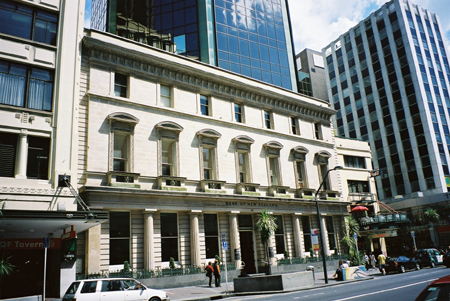
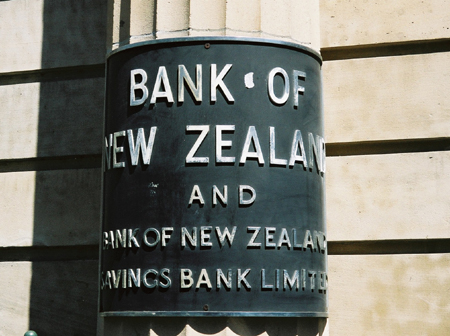
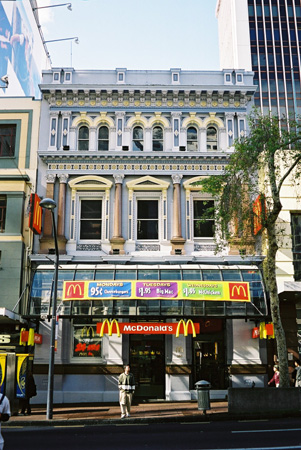
This facade is an important reminder, both of commercial life in early colonial Auckland and of the destruction of New Zealand's heritage. The bank was originally constructed in 1866-1867 by the Bank of New Zealand (BNZ), when the three-storey structure was one of the most prominent buildings in Queen Street, the main commercial thoroughfare in the city. Its construction marked the arrival of the BNZ as a financial force, having been founded by a group of prominent Auckland businessmen in 1861. The BNZ's expressed purpose was to counteract the influence of Australian banks and to cater for local needs. Its choice of the Melbourne-based architect Leonard Terry, who had just completed the Union Bank in Auckland, consequently met with some opposition.
The Greek Revival style employed by Terry was similar to other buildings he had constructed in Australia, including the Melbourne Club in 1858. He used golden-coloured Tasmanian sandstone for the bank's impressive façade, although the building extended just 4.8m (16 feet) back from the frontage. The original desire to construct a building of seven bays was curtailed to five due to the impact of a recession. The remaining bays were added in 1882, when rivals such as the Auckland Savings Bank erected large and impressive headquarters on the same street. The rear of the structure was remodelled at the same time to create new facilities, including a banking chamber that was promoted by the BNZ as probably the finest of its kind in New Zealand. A century later, the building was threatened with demolition to enable the land to be redeveloped. The facade was retained in response to local concerns about the loss of a prominent historic building, although the rest of the structure was removed.
Bereft of its original context, the surviving frontage nevertheless makes a significant contribution to the streetscape and is the earliest surviving bank architecture in central Auckland. It is a reminder of the colonial beginnings of one of New Zealand's most important financial institutions, and of the scale of confidence and wealth among the banking community in northern New Zealand immediately after the third New Zealand - or Waikato - War (1863-1864). Its materials and design illustrate the close links between New Zealand and Australia towards the end of the early colonial period, in spite of a growing sense of national and regional identity. It has important connections with prominent colonial businesmen in Auckland, including Thomas Russell (1830-1904) and John Logan Campbell (1817-1912), who were involved in the foundation of the BNZ. The facade is of value for its proximity to other historic commercial structures in the Queen Street area, including the former Auckland Savings Bank headquarters. It graphically demonstrates the widespread destruction of heritage during the property boom of the 1980s, and the removal of evidence about this country's past.
The Greek Revival style employed by Terry was similar to other buildings he had constructed in Australia, including the Melbourne Club in 1858. He used golden-coloured Tasmanian sandstone for the bank's impressive façade, although the building extended just 4.8m (16 feet) back from the frontage. The original desire to construct a building of seven bays was curtailed to five due to the impact of a recession. The remaining bays were added in 1882, when rivals such as the Auckland Savings Bank erected large and impressive headquarters on the same street. The rear of the structure was remodelled at the same time to create new facilities, including a banking chamber that was promoted by the BNZ as probably the finest of its kind in New Zealand. A century later, the building was threatened with demolition to enable the land to be redeveloped. The facade was retained in response to local concerns about the loss of a prominent historic building, although the rest of the structure was removed.
Bereft of its original context, the surviving frontage nevertheless makes a significant contribution to the streetscape and is the earliest surviving bank architecture in central Auckland. It is a reminder of the colonial beginnings of one of New Zealand's most important financial institutions, and of the scale of confidence and wealth among the banking community in northern New Zealand immediately after the third New Zealand - or Waikato - War (1863-1864). Its materials and design illustrate the close links between New Zealand and Australia towards the end of the early colonial period, in spite of a growing sense of national and regional identity. It has important connections with prominent colonial businesmen in Auckland, including Thomas Russell (1830-1904) and John Logan Campbell (1817-1912), who were involved in the foundation of the BNZ. The facade is of value for its proximity to other historic commercial structures in the Queen Street area, including the former Auckland Savings Bank headquarters. It graphically demonstrates the widespread destruction of heritage during the property boom of the 1980s, and the removal of evidence about this country's past.