Early history of the site
The site lies within a landscape that was extensively occupied by Maori before 1840. Located close to the early shoreline of the Waitemata Harbour, the place is situated on sloping ground that once led down to low cliffs at the water’s edge. The site may have lain inside or near a defended settlement at Te Reuroa, which is likely to have crowned a promontory to the south. Another pa, Tangihangapukaea (also known as Te Rerengaoraiti), was located on high ground to the north. The latter is said to have been inhabited by the Ngati Rauiti hapu of Waiohua before being captured by Ngati Whatua under Kawharu. An associated canoe landing site known as Te Hororoa or Te Ahurutanga was situated on the shoreline to the east of the pa.
A small bay (later known as Official Bay) between the two pa sites formed the outlet of a stream known as Waiariki. Although the surrounding area was temporarily abandoned by Ngati Whatua during the Musket Wars, the presence of this resource evidently encouraged a seasonal return in the late 1830s to grow potato, kumara and peaches. This occurred at a time when food was being cultivated to supply the increasing number of Pakeha visiting the Waitemata Harbour. A grove of peach trees is said to have existed close to the location of the current High Court.
In September 1840, Ngati Whatua’s offer to transfer a large area of land to the British Crown for the creation of a colonial capital at Auckland was formally agreed. After an initial town survey undertaken by Felton Mathew, the site occupied by Logan Bank formed part of a quarter acre block known as Allotment 11 Section 8. In April 1841, the Crown sold this allotment during the first land sale of town sections in the new settlement. The purchaser was a well-connected young merchant, Dr John Logan Campbell (1817-1912).
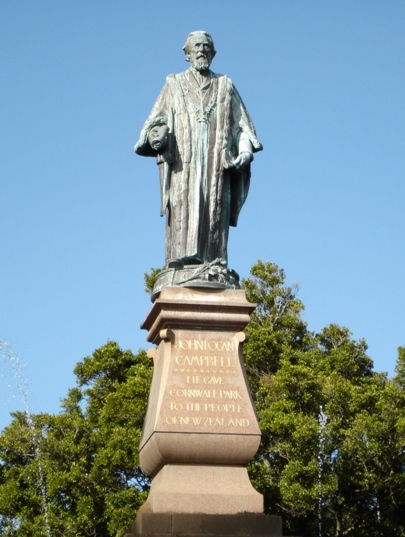
Campbell became a pioneering figure in Auckland’s colonial history, and was later known as the ‘Father of Auckland’. Born in Scotland, he was the only son of an Edinburgh medical doctor and the grandson of the fourth baronet of Aberuchill and Kilbryde. He arrived in the Waitemata Harbour in 1840, witnessing the raising of the British flag at Tangihangapukaea / Fort Britomart, which marked Auckland’s official establishment. Along with a business partner, William Brown, he created Auckland's first merchant firm, Brown and Campbell, when he pitched a tent in the fledgling settlement in December 1840.
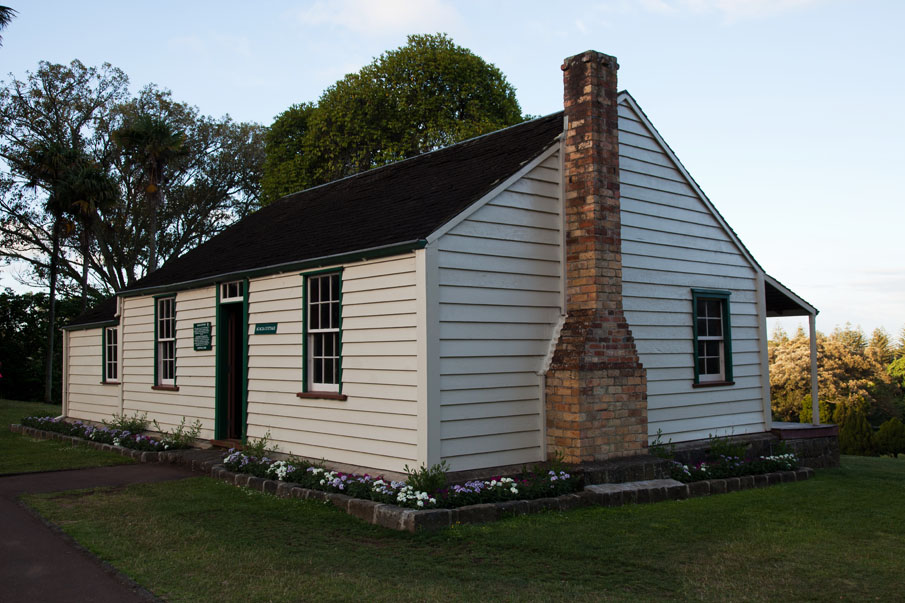
Campbell initially purchased the site of Logan Bank as an investment on his father’s behalf. The cost was higher than the average price at the first sale, which is itself said to have been without precedent in Crown auctions of colonial lands in the British Empire. The site was considered a desirable one: Official Bay had a reputation for social exclusivity as a residential area for government officials. Campbell purchased another section, with Brown, in Shortland Street for the construction of their first permanent dwelling, Acacia Cottage, and business premises.
Initial construction and use of Logan Bank (1842-1870)
Campbell erected a four-roomed, timber cottage at Logan Bank in 1842. The new residence was considered by Campbell’s parents to be a future home should they emigrate from Scotland. It may have soon been enlarged. In December 1843, the building was offered for sale or lease as a ‘comfortable and well-finished six-roomed Verandah Cottage’ on a property that was ‘capable of being laid out in a garden of the most tasteful description…’ Its situation was referred to as ‘one of the most beautiful and picturesque Water Frontages in all Auckland…’
The prestigious location of Logan Bank is emphasised by the social stature of its tenant between 1843 and 1851, the barrister and politician Edward Houghton Bartley (1798-1878). Bartley was the leading lawyer in Auckland for many years and became a notable politician after the creation of New Zealand’s first parliamentary system under the 1852 Constitution Act. He achieved particular prominence as the first Speaker of the Province (1853-7) and of the Legislative Council (1856-68). His family, who also occupied Logan Bank, included a daughter Mary, who was to marry the serving Premier, E.W. Stafford in 1859.
From 1851, Campbell himself occupied the property. He commissioned the construction of a large, two-storey wing from an Auckland builder, and personally undertook much of the finishing work and joinery over the next two years. Campbell is also said to have involved himself in every aspect of the initial design and construction. For the next three decades the property was his home whenever he was in Auckland.
By 1855, Campbell’s mercantile success was such that his personal fortune amounted to an estimated £55,000. He entered politics, serving as provincial superintendent and a member of the House of Representatives (1855-6), and also briefly as a member of Stafford’s ministry (1856) – said to have been the first stable, responsible ministry in New Zealand’s history. By this time, Logan Bank neighboured the General Assembly and Provincial Council building, which had been erected to the south of Eden (now Parliament) Street in 1854. Numerous prominent figures were invited to stay or attend events at Logan Bank, including New Zealand’s first premier, Henry Sewell (1807-79), and the superintendent of Wellington province, Dr I.E. Featherston (1813-76).
Between 1856 and 1871 Campbell travelled overseas, during which period Logan Bank was tenanted by the manager of Brown and Campbell. For a brief period in 1860-1, Campbell returned to Logan Bank with his new wife Emma Cracroft Wilson (1835-1912) and daughter Ida to restructure his business interests. In the late 1860s, Campbell determined that a more permanent return to Auckland was required. He once again planned major extensions to Logan Bank, on this occasion using the latest in European technology.
Construction of concrete addition (1870-1)
In 1870-1, Campbell undertook the construction of a large concrete addition, described at the time as ‘the pioneer of its kind in this part of the globe’. This extension was the first building of this material to be erected in Auckland, and represented an early use of concrete for large-scale residential construction nationally. The enlarged house was to be a family home, suitable for accommodating Campbell’s wife and children, including another daughter, Winifred. Its creation reflected a pivotal point in Campbell’s life, marking his long-term return to New Zealand.
Campbell had become aware of the increasing use of concrete for building construction during his stay in Europe. The material was promoted for its perceived strength, durability, cheapness, hygienic and weatherproof qualities, and fireproof nature. Its popularity gained momentum after 1865 when Joseph Tall patented a re-usable formwork apparatus that facilitated the efficient erection of mass concrete walls. This invention was referred to as ‘the first concrete appliances patented and brought into general use’. It comprised movable pairs of uprights, 18-inch horizontal panels of various lengths, and connecting bolts and thumbscrews that collectively retained concrete while it hardened. Tall’s equipment was popularised by the French Emperor, Napoleon III, who was awarded a gold medal at the 1867 Paris Exhibition for houses built using the apparatus. Campbell was to obtain two sets of the equipment for the extension to Logan Bank.
Campbell’s use of concrete was widely seen as innovative in New Zealand. Minor quantities of cement had been imported into the colony from 1843, and settlers evidently used the new material to build structures from the 1850s onwards. By early 1852 a cottage of so-called concrete was in the final stages of completion in Lyttelton, while a decade later John Gow’s impressive two storey farmhouse was erected at Invermay, near Mosgiel. Although concrete was increasingly used for small rural structures in the 1860s, notably in the South Island, it appears not to have been more widely used for prestigious residential projects and other large works until the following decade. Prior to the construction of Logan Bank, the use of structural concrete in the Auckland region was generally confined to foundation work. Brown and Campbell had themselves used it as foundations for their stamper battery at Tararu in 1869.
Campbell’s employment of concrete for the addition at Logan Bank emphasised several aspects of his identity. These included his role as an innovator and pioneer; his status within Auckland’s social and business elite; and his reputation as a widely-travelled and ‘civilised’ European gentleman.
Campbell designed the new extension to Logan Bank himself, producing detailed plans. The noted Auckland architect, Richard Keals, was employed to oversee construction. Keals was a prolific designer of commercial buildings, who had also supervised the erection of the Bank of New Zealand in Queen Street (1867). Keals was familiar with concrete, having previously employed the material in the foundations of his designs at the Lewis Brothers Warehouse on Albert Street (1865) and Gilfillans Store in Queen Street (1865). Brown and Campbell’s manager, James Mackelvie, was also involved, having been instructed that Campbell’s plans were ‘not to be deviated from in any essential particular’. Mackelvie later bequeathed a large art collection and fortune - used for the Mackelvie extension to the Auckland City Art Gallery in 1893 and on-going public purchase - which Campbell helped to administer as a trustee.
The Logan Bank extension was predominantly built between September 1870 and March 1871. It was erected on the site of the 1842-3 portion of the residence, which was dismantled. Of Italianate design, the new element was to contain five rooms on the ground floor and three rooms upstairs. The rear part of the downstairs area incorporated servants’ quarters and was floored with concrete. The roof was to be covered with slate.
The main foundations and walls were erected by a stonemason, James Read. Read had previously erected concrete buildings in Tunbridge Wells, Kent, and was brought over from England specifically for the purpose, accompanied by Tall’s formwork and some 30 tons of ‘the finest Portland cement’. Imported elements were supplemented by local materials, including shingle from Waiheke Island and scoria from Mount Eden. The walls incorporated several fireplaces, and speaking tubes that obviated the need for bell-pulls, allowing ‘commands to the servants’ to be given directly. General work was carried out by ‘Mr Sexton, builder and contractor, Remuera’ - probably Charles Thomas Saxton, who later ran a building and supplies firm in Newmarket and went on to found a major sawmilling enterprise in Pyrmont, Sydney. Campbell himself supervised the finishing of the interior.
Work also appears to have included concrete terraces and steps as part of a remodelling of the grounds. Nearby concrete stables exhibited a plaque depicting St Michael overcoming the devil, said to represent the building’s ability to resist fire.
Subsequent use and modification
Campbell’s reoccupation of the house between 1871 and 1880 coincided with an important period in his life. He took complete control of his business affairs, buying Brown out of their long-standing partnership and branching out in new commercial directions such as brewing and timber milling. He also reinforced his position among Auckland’s elite by serving on boards that controlled notable companies, financial institutions, non-political organs of local government, and artistic and scientific organisations. He gained a literary reputation in his own right after his pioneer reminiscences, published as Poenamo in 1881, were acclaimed as a colonial classic. The final draft of this manuscript was produced at Logan Bank from 1875 onwards.
Campbell’s connections with the arts extended to his associations with significant literary figures and artists. In September-October 1872, Campbell hosted the British writer Anthony Trollope (1815-1882) and his wife Rose at Logan Bank while they were on a two-year tour of the Australasian colonies. As the popular author of a prodigious output that included the Chronicles of Barsetshire, Trollope was one of the major literary voices of the mid-Victorian age. During his stay at the house, Trollope wrote according to his usual daily routine in a study set aside by Campbell. Trollope subsequently published an account of his travels in Australia and New Zealand (1873).
Another visitor was the sculptor and painter, Frank Connelly (1841-1932), whose work had included busts of members of the British aristocracy exhibited at the Royal Academy in 1871. Campbell held a showing of Connelly’s work at Logan Bank shortly before the latter’s departure in June 1878. Connelly’s presence is considered to have led Campbell to found Auckland’s first school of art, the Campbell Free (later Elam) School of Art, in the same year.
Campbell remained at Logan Bank until late 1880, although his family returned to Europe in 1876 for his daughters’ education. After the death of daughter Ida, they collectively moved into a grander residence at Kilbryde, Parnell in 1881 - again largely designed by Campbell. By this time, reclamation of Auckland harbour had removed Logan Bank’s direct connection with the waterfront, and also affected its view. Emma Campbell opposed the move, writing to her husband that ‘You actually cheat yr own family out of a concrete house and put us into brick’.
Logan Bank’s addition had influenced the creation of other concrete structures in Auckland, including a Kerosene Bonded Store erected by James Read in Mechanics Bay (1871). Grander buildings encompassed a crenelated tower addition to Josiah Firth’s ‘Clifton’ (1871-3) and the Auckland Congregational Church (1874-6). However, the cost of imported Portland cement proved a major disincentive to more widespread adoption, and it was not until the more extensive commercial production of local hydraulic lime from Warkworth that a greater number of concrete dwellings were erected in the region.
Campbell retained ownership of Logan Bank until 1884. During part of the intervening period, the residence was used as consulting rooms by a doctor and surgeon, Dr Grant. The property was subsequently occupied for several years by Mrs Banks, who advertised with regular frequency for domestic help. This included nursemaids and a companion to an invalid child.
Between 1884 and 1895, the property was owned by Thomas Edward Fitzgerald. From at least 1890 it appears to have been used as a boarding house, increasing from a ten-roomed residence in May of that year, to a twelve-roomed structure in 1892. The property is likely to have been similarly used after its purchase by Helen Baird, a widow of Otahuhu, in 1895. In 1902, additions and other works were carried out under the supervision of architectural firm, Richard Keals and Sons.
Partial demolition of Logan Bank and the creation of Anzac Avenue (1917-19)
Further changes to Auckland’s waterfront area caused the partial demolition of Logan Bank in 1917-18. Large-scale improvements to the port encouraged the creation of a new road outlet from the city which involved the major widening of Jermyn Street. Supporters of this large civic project invoked the pioneering spirit of Logan Campbell. Campbell had been knighted in 1902 and died ten years later. His funeral cortege in June 1912 was the largest in Auckland’s history.
Demolition work at Logan Bank followed the transfer of the property to the Crown in 1914. In October 1917, the city engineer instructed that walls on the southwest side of the building were to be left as high as the future level of the road ‘so as to give support to the filling’. Much of the building was advertised for removal, although solid walls were to remain. Timber sashes, doors and windows were offered for sale in January 1918.
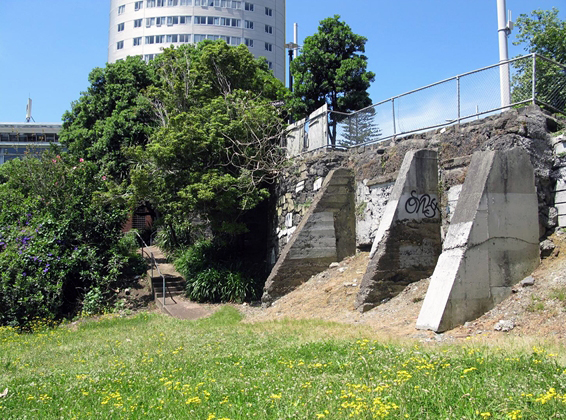
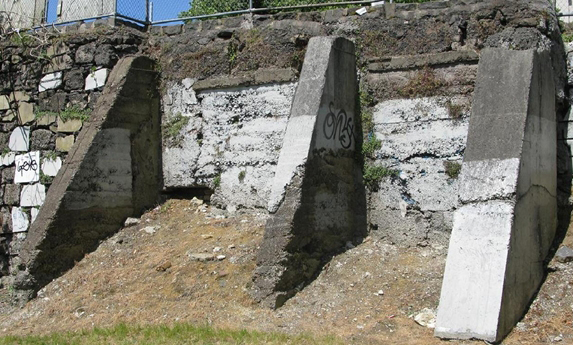
The west wall of the 1870-1 structure was incorporated into a revetment for the new road, which had been renamed Anzac Avenue in December 1916 as a ‘memorial to the brave men who had died at Gallipoli’. Other parts of the revetment on the Logan Bank site were created using concrete fragments from the demolished building. Anzac Avenue was laid as an all-concrete road in 1918-19, a relatively early example of such construction in this country. New Zealand’s first major concrete road scheme had begun in Auckland in 1916, shortly after similar developments in Australia – itself said to have been one of the first countries outside the United States of America to adopt concrete as a road material. Concrete was also used for many of the buildings that lined Anzac Avenue after completion of the works, reflecting an increasing acceptance of this material for commercial, industrial and public buildings.
The creation of Anzac Avenue involved the destruction of many remnants of Auckland’s colonial heritage. In November 1917, a civic reception was held at the former Parliament Buildings ‘to mark the approaching demolition of these historic buildings’. Public concern was also expressed about the fate of two old oak trees in the grounds of Logan Bank, one of which was said to have been planted by Anthony Trollope. After one tree blew down, the second was removed. The following year (1920), Campbell’s first permanent dwelling, Acacia Cottage, was relocated from O’Connell Street to Cornwall Park to save it from destruction. In contrast, Campbell’s last home, Kilbryde, was demolished by Auckland Council in 1924 as it ‘had no use in a public park’.
Ernest Davis Lookout (1960 onwards)
After the completion of Anzac Avenue, properties that the Council had purchased alongside the route were subdivided and sold. The new lot on which the main part of Logan Bank was situated passed through several owners, but remained undeveloped.
In 1960, the land was purchased as a gift to the city by Sir Ernest Hyam Davis (1872-1962). Davis was a prominent brewer, local politician and philanthropist who had been Mayor of Newmarket (1909-10), a City Councillor (1915-23) and Mayor of Auckland (1935-41). He was also a member of the Royal New Zealand Yacht Squadron (RNZYS), which is said to have prevailed on him to gift the land so that a view of the harbour from its club rooms on the opposite side of Anzac Avenue would remain unimpeded. The Deed of Gift to the Council stated that no buildings were to be erected. Davis had previously gifted Motukorea / Brown’s Island - Campbell’s first home after arriving in the Waitemata - to the Council. Sometime after October 1965, surviving house walls belonging to Logan Bank other than those retaining Anzac Avenue were demolished as they were considered unsafe.
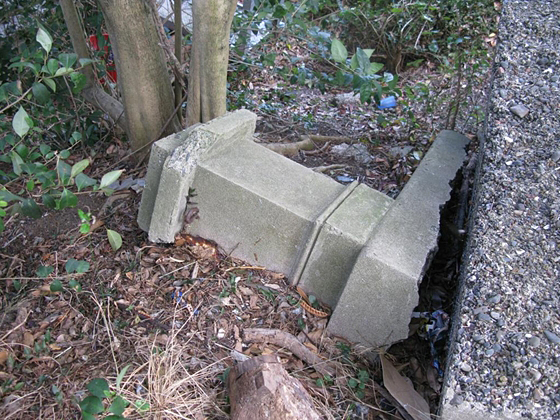
The land has since remained a reserve. It has been subject to land slips, requiring revetment in places. In 2010, concrete garden steps and an associated wall were destroyed after such a slippage. Concrete buttresses have been added to support the 1870-1 retaining wall to Anzac Avenue. The site remains in public ownership (2014).