Early history
Both iwi history and archaeological evidence show Māori occupation in the Ōtākou / Otago region since the 12th century. Tradition tells us the atua Tū-te-rākiwhanoa discovered the wrecked celestial waka of Aoraki (Te Waka o Aoraki / South Island) and carved out places for people to live, including Muaupoko / Otago Peninsular. In another telling, the atua Kahukura was believed to have shaped the Otago coastline, eaten out the harbour and thrown up the earth either side thus forming the western shore and the peninsula. Other traditions claim the taniwha Matamata carved out the harbour before crawling over the hills to the Taieri plains where he dug out the rivers and was transformed into Puke Makamaka / Saddle Hill. Today, Kāi Tahu mana whenua is recognised over a large part of Te Wai Pounamu. Kāti Māmoe and Waitaha shared occupation are always acknowledged. The hapū Kai Te Pahi, Kāti Moki, and Kāti Taoka still maintain their presence and responsibility as kaitiaki in this region. The harbour was shallow before Europeans arrived and provided abundant resources for hapū. Awa Ōtākou / Otago Habour was an ara tawhito for access to the north, south, and inland for access using waka hunua to tauraka waka where there were sites for mahika kai, nohoaka.
Edward Ellison’s submission to Otago Regional Council of 2011 details a significant number of named places indicating a vast knowledge as well as historic and continual use of the wider harbour area. The awa Ōtākou / Otago Habour was an ara tawhito for access to the north, south, and inland using waka hunua to tauraka waka to each mahika kai, and nohoaka. Kōputai was such a landing place from which hunting parties would venture to Kapukataumahaka / Mt Cargill to source weka.
Ōtākou on Muaupoko/ Otago Peninsula was historically, and continues to be, the main settlement in the area. In the 19th century there were additional small settlements on the other side of the harbour. These were mainly occupied by Taiaroa at Otaheiti, his son at Otawhero, and his cousin Kohi at Kōpūtai. Kōrero states Ōtākou warriors landed their waka here and named it after the high tide that stole away with their craft. Herries Beattie interprets Kōpūtai as, ‘filled up with the sea’ or ‘full tide’. He notes an elderly man told him about a tuaha (sacred altar), a taipo (haunted place) on the hill above the current site of Iona Church (List No. 7165). This may account for an earlier name for the place identified by Beattie as Potakere or Pou-takere. The settlement at Kōpūtai was recorded as abandoned in the 1840s. Oputae is a noted place on the New Edinburgh Purchase map from 1844. Other named places close to Kōpūtai are Koperekakahu, Te Ana o Te Makau, Te Waitohi, Rakiriri / Goat Island (List No. 7504) and Kamau Taurua / Quarantine Island (List No. 7503). Following the arrival of European sealers in the first decades of the 19th century saw Māori enter into trade with them, cultivating and supplying potatoes, flax, pigs and fresh water. Independently Māori traded with Sydney supplying dried and salted fish, port, and tītī. A successful whaling station was established at Te Umukurī / Wellers Rock by the Weller brothers, who married Ōtākou women and worked with local Māori.
Kōpūtai was included in a 16-mile² (41 km²) tract land that had previously been sold by Chief Taiaroa to Captain Pierre Darmandarits for £100 ($19, 470) on 18 May 1840. This purchase predated the signing of Te Tiriti o Waitangi at the Otago Heads on 13 June 1840 but post-dated Sir George Gipps proclamation in January 1840 which saw New Zealand fall under the jurisdiction of New South Wales. This made any land not acquired by the Crown or its appointees invalid and despite verifying the purchase and appealing, Darmandarits claim to the land failed. It also followed the 15 February 1840 sale of the South Island by a number of Chiefs to John Jones and William Wentworth. The signing of the Otago Deed between representatives of the New Zealand Company and 25 chiefs occurred at Kōpūtai on 31 July 1844 and saw the sale of a half million acres for £2,400 ($300,000) which included the site of the New Edinburgh Settlement, the site of Ōtepoti / Dunedin. During the 1879 Smith-Nairn Royal Commission of Inquiry into the Ngāi Tahu land claims, Ngāi Tahu kaumātua recorded Kōpūtai as a kāinga nohoanga, urupā, and wāhi tapu. Kōpūtai is the site of Ngā Whenua Rāhui, the Port Chalmers / Kōpūtai Native Reserve. However, the original site was never reserved, the land was used for other purposes, and the Crown was required to purchase an alternate site. A statutory acknowledgement exists for Te Tai o Arai Te Uru / Otago Coastal Marine Area of which Otago Harbour catchment / Te Riu o te Whāka o Otago, is a part. Ōtākou whanau continue to live at the kaik, and Ōtākou runaka hold multiple business interests in the area and wider Dunedin today.
European settlement
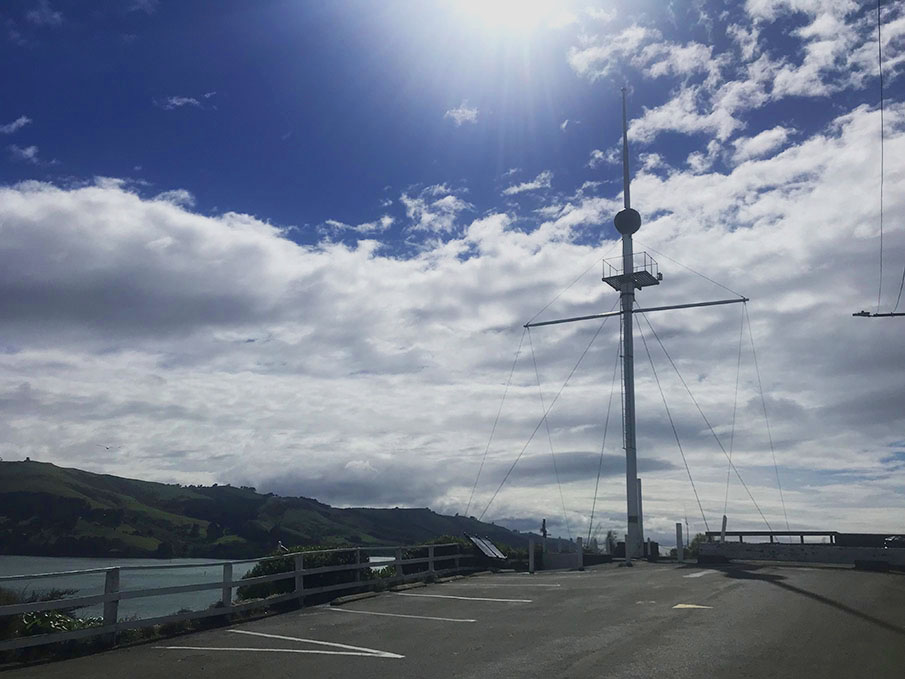
Following the sale of the Otago block, the move to settlement was swift. Charles Kettle, surveyor for the New Zealand Company, surveyed the new town of Dunedin at the head of the harbour in 1846. He was based at Kōpūtai which he designed as a seaport and while there made observations of the moon. The settlement saw the arrival of the first settlers who arrived on the John Wickliffe and Philip Laing in 1848 and was renamed Chalmers in after Thomas Chalmers, a leader in the Free Church of Scotland who had died the previous year. In 1860 the crew of HMS Acheron made the first detailed cartographic study of the harbour from Observation Point in 1860. Following the discovery of gold in 1861, Port Chalmers was flooded with settlers and sojourners seeking their fortunes, and the number of ships coming into port grew to the extent a signal station was required in 1864 and was erected on Observation Point / Flagstaff. Dredging of the harbour commenced in 1868 and has been carried out continuously since that time. In 1872 a private railway company constructed a line linking Dunedin and Port Chalmers. The Otago Harbour Board opened in 1881 and dredged the Victoria Channel from Port Chalmers to Dunedin. This opened a debate between Port Chalmers and the City as to who would have the main port. Today Port Chalmers remains a significant port and the township which is full of historic buildings, has a distinct character and identity.
The house at Aurora Terrace
In 1870 the site near the junction of Constitution Street and Aurora Terrace on Observation Point in Port Chalmers was undeveloped land in the possession of William John Putnam, an engineer. The house appears to have been constructed by Putnam in 1876. It was a square cottage of rusticated weatherboards with a door placed symmetrically between a pair of double sash windows. It had a hipped corrugated iron roof and lean-to verandah without brackets and with plain posts. It followed the typical square plan with living and kitchen on the left separated by a shared chimney and wall, and two bedrooms at the right. The house underwent few recorded alterations for close to a century.
William John Putnam (c. 1854-1926) was an engineer / stevedore, eventually becoming foreman stevedore with the New Zealand Shipping Company. Putnam was a Port Chalmers Councillor from 1886-1889 and was nominated for the Port Chalmers Licencing Committee in 1887. He was a member of the Loyal Prince of Wales Lodge, No. 5254, Port Chalmers. This Lodge was part of the Manchester Unity Independent Order of Oddfellows which was established at the Ropemakers Arms in Salford in 1809. This is worth noting as the Lodge appears in title documents for the property, presumably as a source of mortgage funds to subsequent owners, several of whom were watersiders.
Putnam sold the house in 1887-8 to Frank Juste, stevedore, who passed it to his wife Annie Juste in about 1900. Juste sold to Perry in 1905, Perry to Clifford and Clifford sold to the Prince of Wales Lodge in 1924. It was then passed to Charles Seale, the Dunedin City Council valuation book noting it was sold on 30 December 1909 to William Clifford. Thomas Porter, customs officer, owned the property from 1928 until 1948 when he sold to Frank Searle McDonald, watersider. McDonald owned it until it was transferred to his wife Ettie McDonald in April 1969 after his death. Ettie then sold to Hone Papita Raukura Hotere in December 1970.
Hone Papita Raukura Hotere
Hone Papita Raukura (Ralph) Hotere (1931-2013) is considered one of Aotearoa New Zealand’s greatest artists. He was born at Taikarawa, near Mitimiti, in the north of New Zealand, in 1931. He was the third-born son and eighth child of 15 born to Tangirau Kirihimete Hotere and Ana Maria Hotere. His hapu is Te Tao Maui and he affiliated to Te Aupouri, Te Rarawa and Ngāti Whatua ki Kaipara. The Hotere family lived modestly and self-sufficiently. Hotere’s father laboured and later ran cattle; his mother maintained a vegetable garden, looked after the family, and assisted at the church. Seafood was plentiful. Despite limited finances, Hotere’s parents provided a spiritually and emotionally rich environment, steeped in Māoritanga and with close links to the marae and Catholic church. Hotere was a quiet boy with a great sense of fun, and a good listener who paid attention when his father shared tikanga with him.
Following his schooling, Hotere studied at Auckland Teachers College which he completed in Dunedin as an arts specialist. He received a New Zealand Art Societies Fellowship which he used to study at the Central School of Art and Design in London from 1961. He left in 1962 to take up a residency at the Michael Karolyi Memorial Foundation in Vence, France which provided him with a more conducive physical environment to work in. On his return to New Zealand in 1965 he continued teaching until he was awarded the Frances Hodgkins Fellowship and returned to Dunedin in 1969 where he lived and produced a prodigious amount of work until his death in 2013. Hotere is credited with the genesis of the Māori art movement despite his ambivalence for labels, or interpretation and definitions of his work. He was a member of the New Zealand Māori Arts and Writers Association / Ngā Pua Waihunga, formed at Te Kaha in 1973, the oldest Māori arts group in New Zealand. He was the first artist of Māori descent to have been written into a history of New Zealand art by Pākeha. Hotere was the recipient of Queen Elizabeth II Arts Council grants in 1970 and 1978, and was bestowed with several significant honours including: a University of Otago Honorary Doctorate 1994, Arts Foundation of New Zealand Icon Award 2003, University of Auckland Honorary Doctorate 2005, Te Waka Toi ‘sTe Taumata Award recognising outstanding leadership and service to Māori arts and culture 2006. On 31 December 2011 he became a Member of the Order of New Zealand. At Hotere’s Requiem Mass, Minister Christopher Finlayson described him, saying,
‘Raukura refers to the most highly prized feathers and means ‘most precious’ – and we can certainly say that of Ralph’s legacy to New Zealand. He was named ‘Hone Papita’ in honour of Jean Baptiste Pompallier, New Zealand’s first Catholic bishop. Like his namesake, Ralph was a pioneer. A pioneer of contemporary art and a pioneer of new techniques and materials. And like his namesake, he was a man with a mission. Ralph certainly confirmed the pen and brush can be mightier than the sword. He used his creative gifts to confront issues such as social and political justice for Māori, threats to the environment, nuclear war, apartheid, racism – all of which he examined in his work. He felt compelled to speak through his work about the events and debates which continue to shape our nation and our place in the world.’ Later at Hotere’s tangi in Northland, Selwyn Muru (1937-) spoke of Hotere ‘as a tohunga whaikorero’, a great honour and a recognition of the oral legacy which linked Hotere via his father to the esoteric knowledge held by the elders of the Hokianga.
2 Aurora Terrace (1970-1984)
Hotere had a strong connection with Port Chalmers, living and working in the area for over 40 years and it was from this place that many of his most important works were created. The former studio at 2 Aurora Terrace was his first studio, purchased in December 1970 after completing the Frances Hodgkin’s Fellowship which provided him with use of the studio at 407 Castle Street. The second studio was the stables associated with Willowbank further along Aurora Terrace which were demolished in 1993. The third studio was in the former Bank of New Zealand (List No. 2317) on George Street in Port Chalmers. Hotere’s contemporary Katerina Mataira claims he came into his own in Dunedin, ‘he became really aware of himself as an individual, and his work began to develop a personality essentially its own.’ He created the spaces he required to work in. Cilla McQueen describes his daily visits to the new studio from their residence at 121 Forth Street in 1971,
‘He goes every day to the new studio at 2 Aurora Terrace, Port Chalmers, on the hill below Bully Hayes’ flagpole. There are four small rooms upstairs; downstairs a low-ceilinged kitchen. He’s fixing up the kitchen and rickety steps down the narrow garden full of blackberry, sloping to the harbour, islands and channel, the hills and Hereweka, the peninsula across the water, different in all lights and weather.’
‘He needs more room to work, knocks out all the upstairs to make
an open space, leaving the brick chimney free-standing in the middle.
Lead light windows across the front wall
divide the panorama into delicate frames.’
O’Sullivan describes the studio as, ‘compact, richly decorative, typical of the places where he chose to work and imposed his own taste. As Tony Stones noted, ‘you never took where Ralph worked for anything other than a place an artist had devised.’’ The studio at 2 Aurora Terrace was created as a place for work, and a place where Hotere’s famous generosity was shared. A ‘social solitary’ Hotere often worked at night under fluorescent lights, sustained on whisky laced cups of coffee and cigarettes, listening to classical music or jazz while the darkness outside, punctuated with pulsing harbour lights, pressed against the lead lights. Working on the Port Chalmers paintings at the studio, Hotere reflected his frustration in a letter to James Mack,
‘Staying nights on end at Port and working till early hours yet fucking things have not been coming out right.’
The studio took on an important role in Ralph and Cilla’s lives as it was here where they were married on 8 June 1973. Andrea, Cilla’s daughter who was adopted by Hotere, remembers a view of people’s legs from her position hiding under a table, in the sitting room upstairs.
‘The Reverend Donald Phillipps conducts our wedding, a simple
ceremony at the studio in Aurora Terrace.
Maureen Hitchings has transformed the light-filled room
into a chapel, surrounding us with sculptures, paintings, candles,
flowers, vibrant panels and test-pieces for the mural.’
Following their marriage in 1973, Ralph, Cilla and Andrea left their cottage at 121 Forth Street, Dunedin and moved to 27 Harbour Terrace, Carey’s Bay, Port Chalmers around 1975. A comment by Cilla in Merata Mita’s 2001 film, Hotere, filmed at Carey’s Bay reveals the symbiotic relationship between the artist and his places of work,
‘… his life and his work are inextricably intertwined so he’s working all the time in his heart and in his mind. He’d never really start working until the space around him was right, the atmosphere’s right. The things he looks at while he’s working have to be harmonious too.’
Ian Wedde notes Hotere’s appreciation of ordinary things went beyond ideology. Russell Moses, friend and artist, reflected on Hotere’s holistic approach to life and art,
‘With Ralph, his life and his work permeate everything. Whether it’s building a studio or pulling a wall down in his house and rebuilding it … yeah, he’s an artist. That intensity is there. I think it’s always pervaded everything.’
Marilyn Webb reflected,
‘Hone Tuwhare calls him the tohunga – and he is. I think he’s good at anything he touches. I mean Ralph’s really good at making doors … He’s good with wood. He makes beautiful buildings. He can embellish stuff. He’s just fantastic and whatever he touches.’
The importance of the University of Otago Burns and Hodgkins Fellowships in creating a network work for artists and writers can’t be overestimated. Over the years this group and their associates became a community of friends and creatives who inspired each other’s work. O’Sullivan reflects the relationships had the ‘solidarity of a guild’. Bill Manhire, Hone Tuwhare (1922-2008), Ted (O.E.) Middleton (1925-2010), Ian Wedde, Marilynn Webb (1937-2021), Chris Booth, Bill Culbert (1935-2019) and Pip Culbert (1938-2016), and Marti Friedlander (1928-2016) all spent time at the studio and Hotere was really the central force of the group, actively supporting Francis Hodgkins Fellows and creatives. Their presence is still felt in the fabric and their work which hangs in the house, similarly to how Hotere and McQueen lived at Carey’s Bay, his own and their friends work surrounding him, art, and life intertwining, informing, and inspiring each other.
‘Beautiful things all around – the house replete
with art, the studios, the view, the visitors.’
Bill Manhire reflected, ‘I don’t think Ralph works as a collaborator. He has friendships and people he works with; he brings life in the gaps and spaces and accidents that other people – and circumstances – make available.’ These connections mutually inspired each other’s work, and it was at the studio that much of Hotere’s early significant work was conceived and created. The Black Paintings (1970), Hotere’s Malady Series, was inspired by Manhire’s poem of the same name (1970). It was at Aurora Terrace that Hotere received weekly postcards from Manhire from London, inscribed with a single word for his inspiration which resulted in Pine (1972). Examples of Hotere’s work generated from this place include: Port Chalmers paintings (1972), Sangro (1972), Pine series (1972), Requiem series (1973), drawings for Pathway to the Sea (Ian Wedde) (1975), Song Cycle banners (1975-1976). It was also here that major large commissions like murals, Founders Theatre (1973) and Godwit/Kuaka (1977) for Auckland Airport, were designed at the studio but the work was completed in larger spaces nearby. The importance and influence of his early work was recognised when The Malady Panels, were selected to represent New Zealand’s first appearance at documenta 14 in 2017, one of the most critically acclaimed art exhibitions in the world.
Many, many artists, and creatives frequented the property. Hotere’s generosity extended to making the place available for visiting artists, friends and ‘refugees from life’. Some like Maureen Hitchings stayed for a while, and in the case of renown potter Barry Brickell (1935-2016) spent considerable time there living and working. Hotere wrote to Brickell in 1971, positively fizzing with enthusiasm and abundant generosity,
‘I’ve got a very beautiful old house which I’m turning into a workshop. It looks out on the harbour to the Otago Peninsular … There is also a longish shed which would be an ideal workshop for you with a kiln and spaces for trees to be grown – and a bed and a very beautiful coal range that works … and the most magnificent view in the world to stop you working too hard and ships that pass the kitchen window and seagulls, and fishermen, so why don’t you come down. You’re welcome to share it if you do. I also have my Land Rover which can carry lots of bricks and coal and clay and things.’
Brickell finally stayed and worked at the studio in 1975. During this time, he and Hotere made further renovations to the building. A concrete pad adjacent to the current extension was the location of Brickell’s kiln. Andrea remembers being snuggled in a sleeping bag in a coal bin one night under a lunar eclipse while Brickell bounded about in his notoriously small shorts tending the kiln. While resident at the studio Brickell produced a collection of pottery for the Hotere’s which was acquired by Otago Museum in 2014 and includes pieces Hotere painted. Brickell’s workshop and kiln were a feature for some years and the recycled fabric from both his workbench and bricks from his kiln have made their way into the house, given a new life as stairs, shelves, decorative elements, paving and walls, created by Hotere and later by Naomi’s friends.
Many of Hotere’s works created at Aurora Terrace were in response to people, place and events, both local, national, and international; The Port Chalmers paintings, Malady Series, Sangro Series and Te Whiti Series and Pine Series, pathway to the Sea and Song Cycle banners and Founders Theatre mural. International subjects included war, apartheid, and nuclear activity in the Pacific. Locally, he addressed New Zealand’s most significant contemporary issues including the NZ Springbok tour, the bombing of the Rainbow Warrior, and the environment of the Otago Harbour. Even after he no longer worked at the Aurora Terrace studio, his work continued to reflect the area as environmental concerns arose with the proposed aluminium smelter at Aramoana, and then closer to home, the reduction of Observation Point for the expansion of Port Otago. Protest works included various iterations of Oputae / Po-Takere (1989), lithographs, sketches, and blowtorched aluminium, sometimes incorporating phrases from McQueen’s Poem, Daisies Falling. These works, and others, restored the traditional names of places. At Hotere’s tangi, Tahu Potiki noted,
‘For whatever reason, he also took on the task of revitalising many of the long- forgotten Māori placenames in the harbour. He wrote them into his artworks, giving them a life they had not enjoyed for well over a century. Some of them are now again a part of the modern nomenclature.’
Black Phoenix I and Black Phoenix II (1984-88) were both created from the remains of the Poitrel which burned in Port Chalmers in 1984. Black Phoenix II resides in the Hotere Garden Optuae next door at 4 Aurora Terrace along with other sculptural works by friends that had also been on his property at the stables. Para Matchitt recalled, ‘Anything at all, that’s painful to people – where they’ve been bulldozed or bullied, he’ll feel that pain, and something will come out in his work.’
Hotere was a notable figure in the wider Port Chalmers community, frequenting the pub at Careys Bay, fishing, and playing golf but never discussing his work. He would trade art for services and at times sell paintings to help others get by. As his work reflected local issues, so he supported local fundraising ventures, for example, he allowed the public to visit to the studio at the old stables prior to its demolition to raise money for several community fundraisers. 'By this time Ralph was an international artist of great repute. He didn't have to do that for a community, but he was happy to do it for the community. He was generous, kind, gentlemanly. His generosity, his gift of artworks to people, was phenomenal.’ He helped raise the court costs when the action against Port Otago and their plan to reduce Observation Point was unsuccessful.
Ralph Hotere’s influence is well documented. George Hubbard reflected in the catalogue for Korurangi: New Maori Art, that ‘Ralph is an anchor-stone, an inspiration. He really did open the way for a lot of younger artists to explore mediums not traditionally associated with contemporary Maori art.’ Jonathan Mane-Wheoki (1943-2014), New Zealand art historian, academic, and curator and pioneer of the study of Māori and Pacific art history wrote about his enduring influence, ‘Hotere was the first modernist Māori painter to be wholly embraced by New Zealand’s mainstream art establishment and he was to become one of New Zealand’s most revered and honoured artists’. In the year following Hotere’s death, artists Paratene Matchitt (1933-2021) and Shane Cotton met in conversation with curator Megan Tamati-Quennell to discuss Hotere’s influence and impact. Matchitt acknowledged Hotere’s influence, ‘… you have to admire the guy for who he was … he was one of the best teachers out, he had a knack for passing things on …’
From studio to home
Close friend and assistant, Naomi Wilson took up residence at 2 Aurora Terrace in 1981 and, purchased the studio from Hotere in 1984, ‘for what Ralph insisted was not a cent more than its rateable value.’ Naomi worked with him regularly, printing silk together at the cottage, and contributing her exacting grinding skills to Black Phoenix I (1984) and Pathway to the Sea – Aramona (1991). Naomi believes the studio should be saved as it is imbued with Hotere’s wairua and mana. Over the years she has employed friends to assist with renovations and additions to the cottage and garden, all embodying Hotere’s ethos. Some of the additions, like the acoustically treated conservatory were to mitigate noise from the Port. Port Otago has successively purchased and demolished residential properties on Aurora Terrace and Constitution Street prior to and after the reduction of Oputae / Observation Point in the mid-1990s. All properties on the headland beyond where the cut was to be made were purchased and demolished, including Ralph’s studio at the stables. Hotere himself spoke out about the loss of the land,
‘This is a sacred spot. It has historic connections with early Otago. It’s an ancient urupa, and ancient living, dwelling place. And it should never be devastated. They can put their wharves up in town. They don’t need to devastate the hill, to change the landscape, you know?’
Two decades later, O’Sullivan reflects on Hotere’s response to the reduction of Observation Point,
‘The threads of his anger were entwined – the destruction of an ancient landscape, the loss of a site’s traditional significance, his personal distress at being kicked out from where he worked best as an artist, and from a building that his time and skill had transformed into something like a work of art in itself.’
The Hotere family have visited and stayed at studio over the decades, under Hotere’s ownership and latterly under Naomi’s including during his later years following his illness and after his death. As the only remaining building that maintains a strong physical and spiritual connection with Hotere and so is particularly significant to the Hotere whānau. Andrea Hotere reflected,
‘Today I love visiting the studio and Naomi, because it’s a place where I can feel that special connection with Dad, touch the things he touched and look at the view he loved and which inspired him, to know that he sought to acknowledge the Maori connections of this place which were everywhere. He honoured them and expressed himself in his work. This is now the only remaining place where people can go to get that true sense of Dad and how he worked. I would like my children and our cousins and others to be able to experience this in the future. Dad was very aware of the significance to Maori of Koputai/Port Chalmers and surrounds. It was heart breaking for him when the end of the hill (aka Observation Point, on which his other studio stood) was chopped off. He thought it was cultural vandalism. The fact that this Studio remains is highly significant.’
Hotere’s siblings Hareta (Charlotte), Ellen, Maraea, Winiata, Moss and Suri have all visited or stayed at the studio and feel aroha for the place and for Naomi and her connection to Ralph.
‘[at the studio] I feel wairua, his wairua, that the paintings and the place speak for him. It’s a feeling. You are seeing, feeling his voice. There are lots of memories. Naomi has looked after that place. You feel like you could walk in there and be at home. It gives us something of Ralph.’
Ana Tahere (Ralph’s niece) commented, ‘Naomi’s door has always been open to uncle Ralph’s siblings and whanau. It is a special place for us to visit when we are in Dunedin. There is so much of Uncle Ralph’s wairua present.’
Naomi hopes to see the studio become an artist’s studio again in the future. Over fifteen years earlier, renowned Dunedin art historian and curator, Peter Entwisle, called for the establishment of a museum dedicated to the display of Hotere’s works. Whaiora Hotere (Ralph’s Niece) expressed the importance of safeguarding the studio for the future,
‘Naomi and the whare hold a very special place in our hearts as they remind us of the determination that Ralph had to protect what was important to him. We are so grateful that Naomi is continuing to do this too, so tautoko her goal to protect the studio and its history for future generations to enjoy.’
In 2020 the penultimate house on Aurora Terrace was demolished. In 2021 this remarkable cottage remains a private residence. Vincent O’Sullivan, Hotere’s friend, and recent biographer notes,
‘This is not simply a matter of noting a building where one of our most distinctive artists planned and created important works. Its internal configuration and physical features to a marked degree are as Hotere designed and installed them, to the extent that the studio too might be considered one of his ‘works’. We have few comparable spaces that so convey and preserve the physical imprint of the artist who worked there. It was also here that so many of the painting and writing community of his time visited, and stayed. It was a rare intellectual meeting-point for his own, as well as a younger, generation … This is the only available building that so permanently retains his physical imprint.’