

In 1875, it was announced in the local Guardian newspaper that the lighthouse originally intended for the Tory Channel in the Marlborough Sounds would be erected on the terrace at Seaview. Land was reserved in 1876, and a new lighthouse constructed in 1879 to the design of 'Marine Engineer to the General Government' John Blackett - known as the 'father of our lighthouse system'. Between 1871 and 1889, Blackett was responsible for the erection of 14 lighthouses throughout the country. The Hokitika light was a 'fifth order dioptric white light' visible at a distance of 16 miles in clear weather. Gas operated via the town supply, it was first shown on 22 September 1879.
By the early twentieth century, use of the port had declined significantly. Shipping ceased completely in 1929. The light ceased operation on 31 October 1924, and the lamp fittings were removed to the Marine Store in Wellington the following year. The tower was to be demolished by the Marine Department, but gained a reprieve when Seaview Hospital expressed a desire to use it as an observation tower for the hospital sports ground. Later, during WWII, the National Reserve used the tower as a coast watching station.
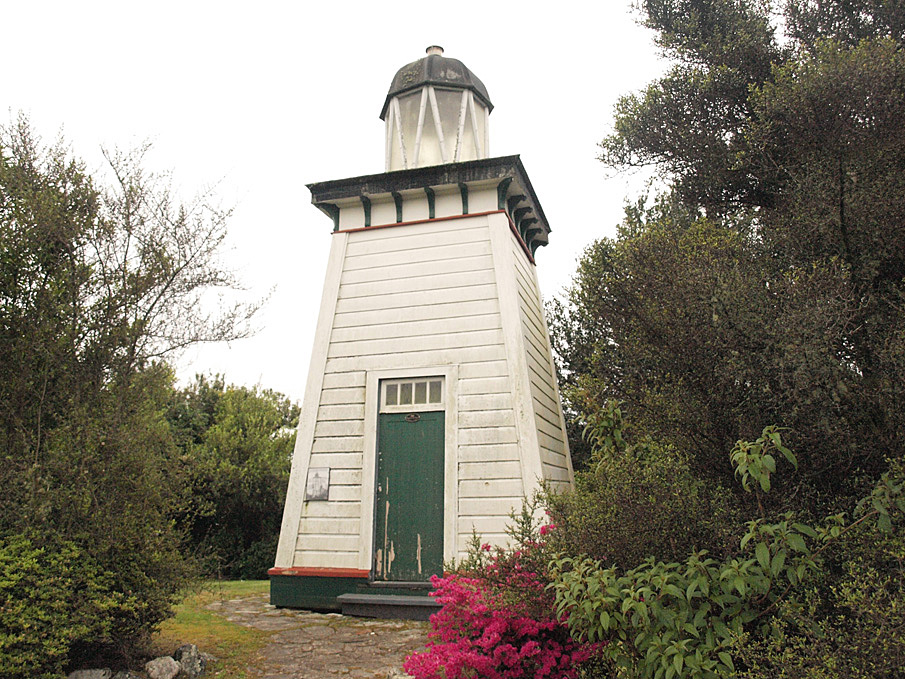
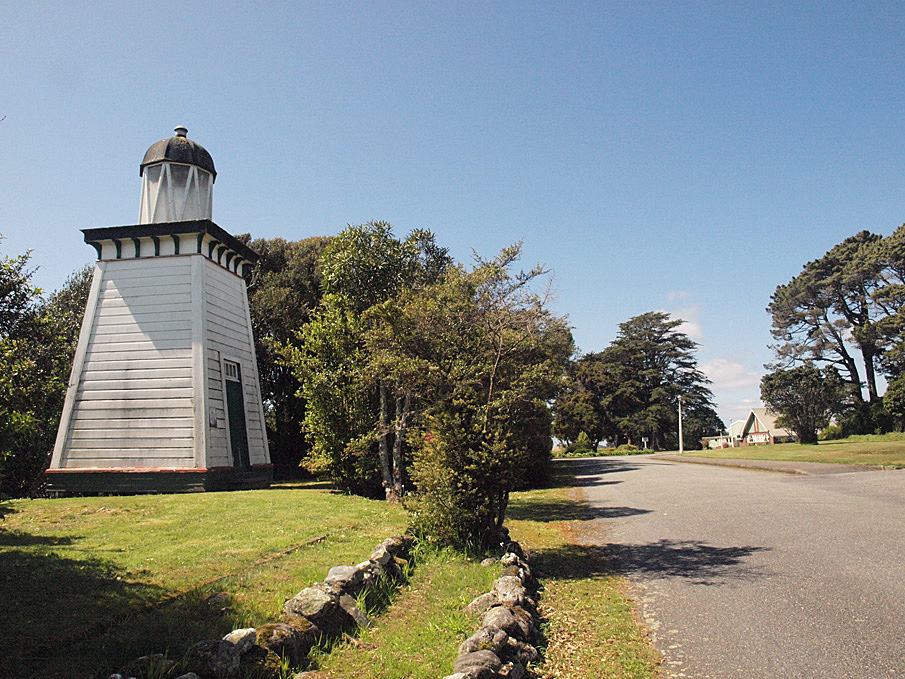
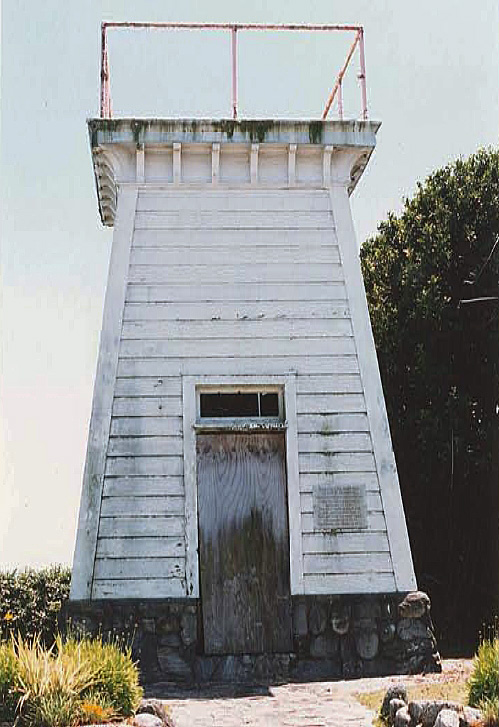
After the war the lighthouse tower was neglected, and began to deteriorate. In 1976 a discourse on the future of the structure was initiated by the hospital management committee at Seaview, who were at that stage responsible for its maintenance. The lighthouse was surveyed and found to be badly decayed. Despite weatherproofing by the Ministry of Works in 1983, the structure was declared unsound by a hospital engineer in 1987. The erection of a replica was considered at this time. A fire further damaged the structure in 1989. However following the completion of a conservation plan by Chris Cochran in 1989, the Regional Committee of the NZHPT applied to the Trust for a grant for full restoration. A sum was granted in 1991, and the Regional Committee accepted the tender of the Westland District Council to restore the lower 1.5 metres of the tower. This took place in late 1992. Thereafter the lighthouse restoration project languished until 1998, when Heritage Hokitika announced plans to move the lighthouse to a site in the town. Although a discussion document was circulated, the decision was made to preserve the lighthouse on its original site. In 2002 Heritage Hokitika carried out a full restoration. The lantern was replaced and a solar powered working light installed as a token reminder of the building's function.
List Entry Information
Status
Listed
List Entry Status
Historic Place Category 2
Access
Private/No Public Access
List Number
1704
Date Entered
2nd April 2004
Date of Effect
2nd April 2004
City/District Council
Westland District
Region
West Coast Region
Extent of List Entry
Extent includes part of the land described as RS 5041 (RTs 704597 and 704598) Westland Land District and the building known as Seaview Lighthouse thereon. (Refer to extent map tabled at Rārangi Kōrero meeting 9 June 2022)
Legal description
RS 5041 (RTs 704597 and 704598), Westland Land District
Status
Listed
List Entry Status
Historic Place Category 2
Access
Private/No Public Access
List Number
1704
Date Entered
2nd April 2004
Date of Effect
2nd April 2004
City/District Council
Westland District
Region
West Coast Region
Extent of List Entry
Extent includes part of the land described as RS 5041 (RTs 704597 and 704598) Westland Land District and the building known as Seaview Lighthouse thereon. (Refer to extent map tabled at Rārangi Kōrero meeting 9 June 2022)
Legal description
RS 5041 (RTs 704597 and 704598), Westland Land District
Why is this place significant?
Historic Significance
Historical Significance or Value The Seaview Lighthouse has historical value as one of very few reminders of the formerly significant port at Hokitika.
Physical Significance
Technological value as a rare surviving timber framed lighthouse of the 1870s.
Why is this place Category 1 / Category 2?
Detail Of Assessed Criteria
(a) it is representative of the first phase of the development of the national transportation infrastructure in the 1870s. (b) it has associations with John Blackett, who amongst other roles was New Zealand's marine engineer between 1871 and 1889. (e) it has community associations as a well-known and prominent landmark in the town of Hokitika. (f) it is important for public education as a reminder of the importance of the port of Hokitika in the nineteenth century, and of the danger the port posed to shipping; and it has technical accomplishmet. (j) rarity value as an example of an 1870s timber lighthouse (albeit with original light removed).
Why is this place significant?
Historic Significance
Historical Significance or Value The Seaview Lighthouse has historical value as one of very few reminders of the formerly significant port at Hokitika.
Physical Significance
Technological value as a rare surviving timber framed lighthouse of the 1870s.
Why is this place Category 1 / Category 2?
Detail Of Assessed Criteria
(a) it is representative of the first phase of the development of the national transportation infrastructure in the 1870s. (b) it has associations with John Blackett, who amongst other roles was New Zealand's marine engineer between 1871 and 1889. (e) it has community associations as a well-known and prominent landmark in the town of Hokitika. (f) it is important for public education as a reminder of the importance of the port of Hokitika in the nineteenth century, and of the danger the port posed to shipping; and it has technical accomplishmet. (j) rarity value as an example of an 1870s timber lighthouse (albeit with original light removed).
Construction Professional
Name
Blackett, John
Type
Engineer
Biography
John Blackett (1818-93) was one of New Zealand's leading nineteenth century civil engineers and the chief designer of many of the public works undertaken during the Vogel era. Born in Newcastle-on-Tyne, he served his apprenticeship with R. & W. Hawthorne, Engineers from 1834-40, and then became a draughtsman and office engineer with the Great Western Railway Company. In 1844 Blackett was made head engineer of a London firm of ship builders and railway contractors, and from 1846 he worked for a copper mining company in Wales. Blackett established his own practice in 1849 but two years later he emigrated to New Zealand and settled near New Plymouth. In 1856 Blackett moved to Nelson where he was appointed Provincial Engineer in 1859. Six years later he became the first Commissioner for the West Coast Goldfields. After a decade of working in the civil service at a provincial level John Blackett was appointed Marine Engineer and Acting Engineer-in-Chief for the Colony on 1 October 1870. As Marine Engineer, he was responsible for the design of twenty-five lighthouses which were erected during one of the most prolific periods of lighthouse construction in New Zealand. This achievement is considered to be his most significant contribution to engineering in this country, although his work for the Public Works Department was also very important, particularly as it related to the development of the national rail network. Engineer-in-Charge of the North Island Public Works Department from 1878, Blackett was promoted to the office of Engineer-in-Chief of New Zealand in 1884. In this capacity he ran the Engineering Branch of the Public Works Department until 1890 when he was appointed Consulting and Inspecting Engineer for the Colony, resident in London. Blackett returned to New Zealand just before his death in 1893 and he is remembered for the skill with which he realised the ambitious public works programmes fostered by Vogel and his successors.
Name
Sinclair
Type
Builder
Biography
No biography is currently available for this construction professional
Name
Jack
Type
Builder
Biography
No biography is currently available for this construction professional
Construction Details
Start Year
1879
Type
Original Construction
Start Year
1925
Type
Modification
Description
Light removed.
Type
Modification
Description
Ladder moved inside.
Type
Modification
Description
Stone plinth constructed, interior lining and floor removed?
Period
1970s
Start Year
1983
Type
Other
Description
Waterproofing with Butynol carried out by Ministry of Works.
Start Year
1989
Type
Other
Description
Damaged by fire.
Start Year
1992
Type
Modification
Description
Westland District Council carries out a partial restoration. The stone plinth is removed, new foundations installed, and the lower 1.5 metres weatherboarded.
Start Year
2002
Finish Year
2003
Type
Modification
Description
Heritage Hokitika carries out full restoration. Lantern and light are replaced.
Construction Materials
Predominantly Kauri frame and rusticated weatherboards, on Australian hardwood plates. Concrete foundations.
Construction Professional
Name
Blackett, John
Type
Engineer
Biography
John Blackett (1818-93) was one of New Zealand's leading nineteenth century civil engineers and the chief designer of many of the public works undertaken during the Vogel era. Born in Newcastle-on-Tyne, he served his apprenticeship with R. & W. Hawthorne, Engineers from 1834-40, and then became a draughtsman and office engineer with the Great Western Railway Company. In 1844 Blackett was made head engineer of a London firm of ship builders and railway contractors, and from 1846 he worked for a copper mining company in Wales. Blackett established his own practice in 1849 but two years later he emigrated to New Zealand and settled near New Plymouth. In 1856 Blackett moved to Nelson where he was appointed Provincial Engineer in 1859. Six years later he became the first Commissioner for the West Coast Goldfields. After a decade of working in the civil service at a provincial level John Blackett was appointed Marine Engineer and Acting Engineer-in-Chief for the Colony on 1 October 1870. As Marine Engineer, he was responsible for the design of twenty-five lighthouses which were erected during one of the most prolific periods of lighthouse construction in New Zealand. This achievement is considered to be his most significant contribution to engineering in this country, although his work for the Public Works Department was also very important, particularly as it related to the development of the national rail network. Engineer-in-Charge of the North Island Public Works Department from 1878, Blackett was promoted to the office of Engineer-in-Chief of New Zealand in 1884. In this capacity he ran the Engineering Branch of the Public Works Department until 1890 when he was appointed Consulting and Inspecting Engineer for the Colony, resident in London. Blackett returned to New Zealand just before his death in 1893 and he is remembered for the skill with which he realised the ambitious public works programmes fostered by Vogel and his successors.
Name
Sinclair
Type
Builder
Biography
No biography is currently available for this construction professional
Name
Jack
Type
Builder
Biography
No biography is currently available for this construction professional
Construction Details
Start Year
1879
Type
Original Construction
Start Year
1925
Type
Modification
Description
Light removed.
Type
Modification
Description
Ladder moved inside.
Type
Modification
Description
Stone plinth constructed, interior lining and floor removed?
Period
1970s
Start Year
1983
Type
Other
Description
Waterproofing with Butynol carried out by Ministry of Works.
Start Year
1989
Type
Other
Description
Damaged by fire.
Start Year
1992
Type
Modification
Description
Westland District Council carries out a partial restoration. The stone plinth is removed, new foundations installed, and the lower 1.5 metres weatherboarded.
Start Year
2002
Finish Year
2003
Type
Modification
Description
Heritage Hokitika carries out full restoration. Lantern and light are replaced.
Construction Materials
Predominantly Kauri frame and rusticated weatherboards, on Australian hardwood plates. Concrete foundations.
A square shaped 18 foot lighthouse tower, with canted walls clad with rusticated weather boards. The crowning lantern rests on a flat roof with the walkway around it originally protected by an iron balustrade. Access to the interior is provided through a timber, four- panelled door, with a rectangular four-pane transom above. An iron ladder provides access to the roof from the interior, though there was originally an external ladder. The simple utilitarian nature of the building is relieved by the decorative brackets which support the flat roof, and are highlighted by the paint colour.
A square shaped 18 foot lighthouse tower, with canted walls clad with rusticated weather boards. The crowning lantern rests on a flat roof with the walkway around it originally protected by an iron balustrade. Access to the interior is provided through a timber, four- panelled door, with a rectangular four-pane transom above. An iron ladder provides access to the roof from the interior, though there was originally an external ladder. The simple utilitarian nature of the building is relieved by the decorative brackets which support the flat roof, and are highlighted by the paint colour.
Historical and Associated Iwi / Hapū / Whānau
Completion Date
8th September 2004
Report Written By
Pam Wilson
Information Sources
Department of Conservation
Department of Conservation
Dictionary of New Zealand Biography
Dictionary of New Zealand Biography
May, 1962
Philip Ross May. The West Coast Gold Rushes, 1962.
Guardian
The Guardian
Conservation Plan
Conservation Plan
Other Information
A fully referenced version of this report is available from the NZHPT Southern Region Office. Please note that entry on the New Zealand Heritage List/Rarangi Korero identifies only the heritage values of the property concerned, and should not be construed as advice on the state of the property, or as a comment of its soundness or safety, including in regard to earthquake risk, safety in the event of fire, or insanitary conditions.
Historical and Associated Iwi / Hapū / Whānau
Completion Date
8th September 2004
Report Written By
Pam Wilson
Information Sources
Department of Conservation
Department of Conservation
Dictionary of New Zealand Biography
Dictionary of New Zealand Biography
May, 1962
Philip Ross May. The West Coast Gold Rushes, 1962.
Guardian
The Guardian
Conservation Plan
Conservation Plan
Other Information
A fully referenced version of this report is available from the NZHPT Southern Region Office. Please note that entry on the New Zealand Heritage List/Rarangi Korero identifies only the heritage values of the property concerned, and should not be construed as advice on the state of the property, or as a comment of its soundness or safety, including in regard to earthquake risk, safety in the event of fire, or insanitary conditions.
Current Usages
Uses: Commemoration
Specific Usage: Monuments, memorial, site of particular event - other
Former Usages
General Usage: Transport
Specific Usage: Lighthouse
Current Usages
Uses: Commemoration
Specific Usage: Monuments, memorial, site of particular event - other
Former Usages
General Usage: Transport
Specific Usage: Lighthouse
Sign up to hear more
Get the latest heritage news, features and events delivered
straight to your inbox.
