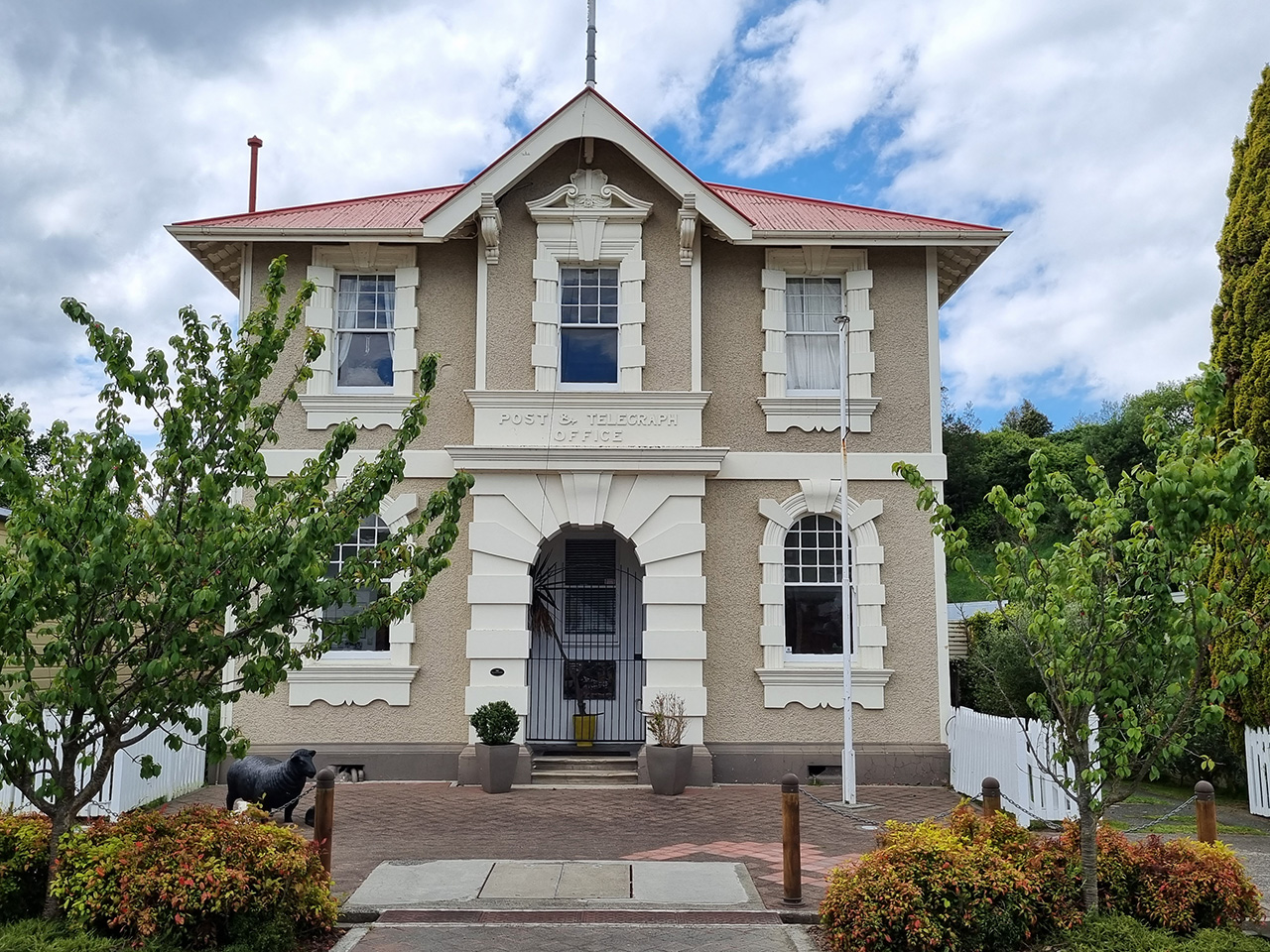
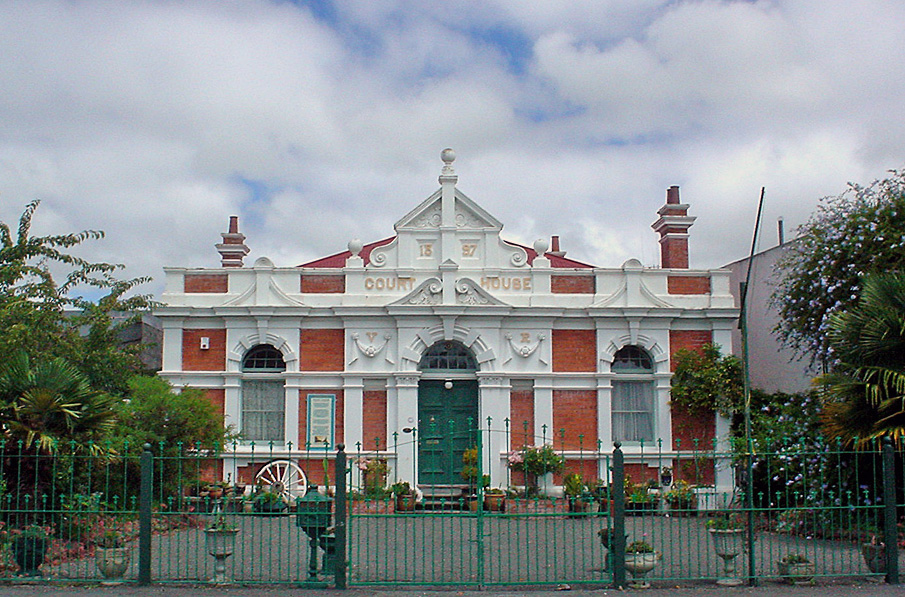
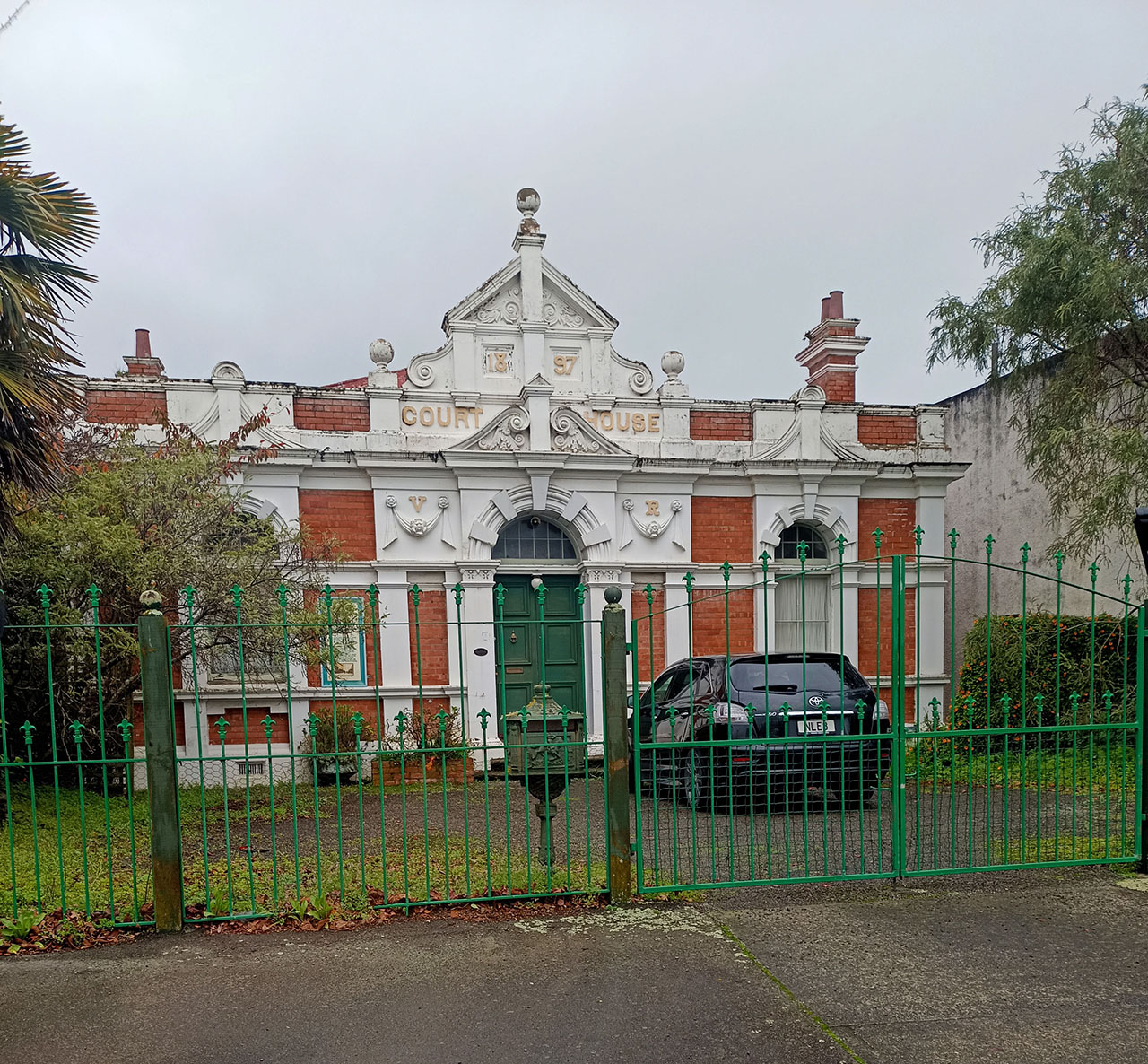
This courthouse was designed by John Campbell, the Government Architect (1890-1922). It was built by Messrs. Zajonskowski Bros. of Marton and completed by October 1897. (The Zajonskowski Bros. also built the Hunterville Post Office, another registered historic place.) When built, the new courthouse contained a witness's room, Magistrate's room, law library and a courtroom. The building continued to serve the Marton community and wider district throughout most of the twentieth century. However, as the population grew the building proved too small. In 1975 the court moved to a new building and this courthouse was closed. For a short time the former courthouse was used by the Marton Historical Society as a part-time museum and by the Marton Community Centre as its headquarters. In 1982 the building was sold and converted to a restaurant and dwelling. During the 1990s the courthouse became an antique shop. It is now a private dwelling.
The former Marton Courthouse is significant as a particularly fine example of John Campbell's favoured Edwardian Baroque style, modest in size but carefully detailed. The building also served the community for over 80 years as the district courthouse.
List Entry Information
Status
Listed
List Entry Status
Historic Place Category 1
Access
Private/No Public Access
List Number
190
Date Entered
27th June 1985
Date of Effect
27th June 1985
City/District Council
Rangitīkei District
Region
Horizons (Manawatū-Whanganui) Region
Legal description
Sec 135 Rangitikei Agricultural Reserve, (RT WN36B/949)
Status
Listed
List Entry Status
Historic Place Category 1
Access
Private/No Public Access
List Number
190
Date Entered
27th June 1985
Date of Effect
27th June 1985
City/District Council
Rangitīkei District
Region
Horizons (Manawatū-Whanganui) Region
Legal description
Sec 135 Rangitikei Agricultural Reserve, (RT WN36B/949)
Construction Professional
Name
Campbell, John
Type
Architect
Biography
John Campbell (1857-1942) served his articles under John Gordon (c1835-1912) in Glasgow. He arrived in Dunedin in 1882 and after a brief period as a draughtsman with Mason and Wales joined the Dunedin branch of the Public Works Department in 1883. His first known work, an unbuilt design for the Dunedin Railway Station, reveals an early interest in Baroque architecture. In November 1888 Campbell was transferred to Wellington where in 1889 he took up the position of draughtsman in charge of the Public Buildings Division of the Public Works Department. He remained in charge of the design of government buildings throughout New Zealand until his retirement in 1922, becoming in 1909 the first person to hold the position of Government Architect. Government architecture designed under his aegis evidences a change in style from Queen Anne to Edwardian Baroque. His best-known Queen Anne design is the Dunedin Police Station (1895-8), modelled on Richard Norman Shaw's New Scotland Yard (1887-90). Among his most exuberant Edwardian Baroque buildings is the Public Trust Office, Wellington (1905-09). Although Campbell designed the Dunedin Law Courts (1899-1902) in the Gothic style with a Scottish Baronial inflection, he established Edwardian Baroque as the government style for police stations, courthouses and post offices throughout New Zealand. In 1911 Campbell won the nation-wide architectural competition for the design of Parliament Buildings, Wellington. Although only partially completed, Parliament House is the crowning achievement of Campbell's career.
Name
Zajonskowski Bros.
Type
Builder
Biography
No biography is currently available for this construction professional
Construction Details
Start Year
1897
Type
Original Construction
Start Year
1982
Type
Modification
Description
Converted to a restaurant, addition of a lean-to as a kitchen.
Construction Materials
Of cavity brick construction sited on brick foundations with corrugated iron roof.
Notable Features
Elements visible from the street that have significance comprise: brickwork elevations cement rendered decorative elements including pediment, cornice, balled finials, pilasters, window architraves, sill course, swags timber door and window joinery chimneys Although not visible the rear elevation and roof are also of significance.
Construction Professional
Name
Campbell, John
Type
Architect
Biography
John Campbell (1857-1942) served his articles under John Gordon (c1835-1912) in Glasgow. He arrived in Dunedin in 1882 and after a brief period as a draughtsman with Mason and Wales joined the Dunedin branch of the Public Works Department in 1883. His first known work, an unbuilt design for the Dunedin Railway Station, reveals an early interest in Baroque architecture. In November 1888 Campbell was transferred to Wellington where in 1889 he took up the position of draughtsman in charge of the Public Buildings Division of the Public Works Department. He remained in charge of the design of government buildings throughout New Zealand until his retirement in 1922, becoming in 1909 the first person to hold the position of Government Architect. Government architecture designed under his aegis evidences a change in style from Queen Anne to Edwardian Baroque. His best-known Queen Anne design is the Dunedin Police Station (1895-8), modelled on Richard Norman Shaw's New Scotland Yard (1887-90). Among his most exuberant Edwardian Baroque buildings is the Public Trust Office, Wellington (1905-09). Although Campbell designed the Dunedin Law Courts (1899-1902) in the Gothic style with a Scottish Baronial inflection, he established Edwardian Baroque as the government style for police stations, courthouses and post offices throughout New Zealand. In 1911 Campbell won the nation-wide architectural competition for the design of Parliament Buildings, Wellington. Although only partially completed, Parliament House is the crowning achievement of Campbell's career.
Name
Zajonskowski Bros.
Type
Builder
Biography
No biography is currently available for this construction professional
Construction Details
Start Year
1897
Type
Original Construction
Start Year
1982
Type
Modification
Description
Converted to a restaurant, addition of a lean-to as a kitchen.
Construction Materials
Of cavity brick construction sited on brick foundations with corrugated iron roof.
Notable Features
Elements visible from the street that have significance comprise: brickwork elevations cement rendered decorative elements including pediment, cornice, balled finials, pilasters, window architraves, sill course, swags timber door and window joinery chimneys Although not visible the rear elevation and roof are also of significance.
Historical and Associated Iwi / Hapū / Whānau
Information Sources
Beaglehole, 1975
A Beaglehole, 1975, Building Classification Committee - Research Report Court House Marton. Held on file by NZHPT, Wellington.
Rangitikei Mail
Rangitikei Mail
Other Information
This place was identified as significant under previous legislation with different information requirements. It remains significant under the current legislation. There is opportunity under our legislation and policies to add to this information. Further information about this place may be available from the Central Regional Office of Heritage New Zealand Pouhere Taonga. Please note that entry on the New Zealand Heritage List/Rarangi Korero identifies only the heritage values of the property concerned, and should not be construed as advice on the state of the property, or as a comment of its soundness or safety, including in regard to earthquake risk, safety in the event of fire, or insanitary conditions.
Historical and Associated Iwi / Hapū / Whānau
Information Sources
Beaglehole, 1975
A Beaglehole, 1975, Building Classification Committee - Research Report Court House Marton. Held on file by NZHPT, Wellington.
Rangitikei Mail
Rangitikei Mail
Other Information
This place was identified as significant under previous legislation with different information requirements. It remains significant under the current legislation. There is opportunity under our legislation and policies to add to this information. Further information about this place may be available from the Central Regional Office of Heritage New Zealand Pouhere Taonga. Please note that entry on the New Zealand Heritage List/Rarangi Korero identifies only the heritage values of the property concerned, and should not be construed as advice on the state of the property, or as a comment of its soundness or safety, including in regard to earthquake risk, safety in the event of fire, or insanitary conditions.
Current Usages
Uses: Accommodation
Specific Usage: House
Former Usages
General Usage: Law Enforcement
Specific Usage: Courthouse
General Usage: Trade
Specific Usage: Restaurant/cafe/tearoom
General Usage: Trade
Specific Usage: Shop
Current Usages
Uses: Accommodation
Specific Usage: House
Former Usages
General Usage: Law Enforcement
Specific Usage: Courthouse
General Usage: Trade
Specific Usage: Restaurant/cafe/tearoom
General Usage: Trade
Specific Usage: Shop