

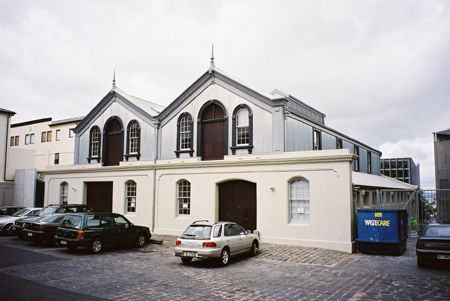
Designed by Robert Watt, the stables building was at the forefront of local technology when erected in 1883. Early mass concrete was used for the ground floor of the structure, where there were stalls for at least 30 Clydesdale horses and an elaborate drainage system for the disposal of waste. Its upper level was of timber-framed construction with corrugated iron cladding, and was employed for storing horse feed, equipment and items from Winstone's furniture-removal business. The building was conceived from the outset as part of a larger complex, with workers' housing to the rear. The Italianate style of the structure's main facade mirrored that of William Winstone's house, which was also located within the complex, fronting Symonds Street. Changes were made to the stables as the company expanded, with extensions being added in about 1885 and 1896. A major fire in 1897 caused damage to the interior, although all of the horses were saved. In 1929 Winstone's leased part of the structure to Claude Neon Lights, producers of the first neon lights in the country, following their investment in motorised transport. Subsequently used as a food factory and artists' quarters, the building was saved from possible demolition after a public campaign in the late 1990s and conserved, with the loss of some of its additions, for commercial use.
The building is significant as one of the earliest known concrete buildings for industrial use in Auckland. It is an unusually ornate example of industrial vernacular architecture from the later colonial period, reflecting the prosperity of some companies in the road haulage industry. It is of value for illustrating the everyday role of horse transport in late nineteenth- and early-twentieth century urban life, and provides important information about animal welfare, sanitation and working conditions for employees. The building is significant as one of the only major remnants of a much larger working complex, whose layout reflected the close nineteenth-century relationship between the workplace and the home. The structure provides evidence of later industrial activity, including neon light and confectionery manufacture. It is significant for its links with prominent companies such as Winstone's and Claude Neon Lights. The building is held in high public esteem, and illustrates the light industrial history of the Newton area of Auckland, which is rapidly disappearing. Other industrial structures nearby include the Colonial Ammunition Company Shot Tower in Mt Eden.
List Entry Information
Status
Listed
List Entry Status
Historic Place Category 1
Access
Private/No Public Access
List Number
7425
Date Entered
30th June 1998
Date of Effect
30th June 1998
City/District Council
Auckland Council
Region
Auckland Council
Legal description
part of Lot 1 DP 32276 & Lot 1 DP 42851 pt Allot 3 Sec 7, Suburbs of Auckland
Status
Listed
List Entry Status
Historic Place Category 1
Access
Private/No Public Access
List Number
7425
Date Entered
30th June 1998
Date of Effect
30th June 1998
City/District Council
Auckland Council
Region
Auckland Council
Legal description
part of Lot 1 DP 32276 & Lot 1 DP 42851 pt Allot 3 Sec 7, Suburbs of Auckland
Construction Professional
Name
Watt, Robert Martin
Type
Architect
Biography
Watt (1860-1907) was born in Scotland and studied architecture in Glasgow with the firm of Barclay Bros. He immigrated to New Zealand about 1878 for health reasons and practised in Auckland both on his own account and, from about 1892, with John Mitchell (c.1859-1947). Mitchell and Watt were appointed architects to the Auckland Education Board in 1892 and while Mitchell undertook new work, Watt was responsible for rebuilding projects and renovations to existing buildings. In 1960 Watt was elected president of the Auckland branch of the New Zealand Institute of Architects. Watt was responsible for the design of the Ley's Institute, Ponsonby (1905-06), and the partnership of Mitchell and Watt was responsible for schools at Te Mata (1905) and Maungatautari (1905), additions to schools at Cambridge (1900) and Dargaville (1905), the Seddon Memorial Technical College (1903-13), and Mt Eden Congregational Church (1900).
Construction Details
Type
Other
Description
Site of early colonial garden
Period
pre-1882
Start Year
1883
Type
Original Construction
Description
Construction of Winstone's Stables
Start Year
1885
startYearCirca
Type
Addition
Description
East wing added
Start Year
1896
startYearCirca
Type
Addition
Description
South wing added
Start Year
1897
Type
Modification
Description
Modifications after major fire
Start Year
1929
Type
Modification
Description
Internal modifications
Type
Addition
Description
Second floor added to east wing
Period
pre-1933
Start Year
1945
Type
Modification
Description
Internal modifications
Type
Modification
Description
East and south wings foreshortened
Period
1950s
Start Year
1999
Finish Year
2000
Type
Modification
Description
Demolition of east wing and part of south wing, with conservation of the remaining structure
Notable Features
Registration covers the main building, its fixtures and finishes, and all land and other structures within the title boundary. It also includes all recent modifications. The building lies in the grounds of an earlier colonial homestead.
Construction Professional
Name
Watt, Robert Martin
Type
Architect
Biography
Watt (1860-1907) was born in Scotland and studied architecture in Glasgow with the firm of Barclay Bros. He immigrated to New Zealand about 1878 for health reasons and practised in Auckland both on his own account and, from about 1892, with John Mitchell (c.1859-1947). Mitchell and Watt were appointed architects to the Auckland Education Board in 1892 and while Mitchell undertook new work, Watt was responsible for rebuilding projects and renovations to existing buildings. In 1960 Watt was elected president of the Auckland branch of the New Zealand Institute of Architects. Watt was responsible for the design of the Ley's Institute, Ponsonby (1905-06), and the partnership of Mitchell and Watt was responsible for schools at Te Mata (1905) and Maungatautari (1905), additions to schools at Cambridge (1900) and Dargaville (1905), the Seddon Memorial Technical College (1903-13), and Mt Eden Congregational Church (1900).
Construction Details
Type
Other
Description
Site of early colonial garden
Period
pre-1882
Start Year
1883
Type
Original Construction
Description
Construction of Winstone's Stables
Start Year
1885
startYearCirca
Type
Addition
Description
East wing added
Start Year
1896
startYearCirca
Type
Addition
Description
South wing added
Start Year
1897
Type
Modification
Description
Modifications after major fire
Start Year
1929
Type
Modification
Description
Internal modifications
Type
Addition
Description
Second floor added to east wing
Period
pre-1933
Start Year
1945
Type
Modification
Description
Internal modifications
Type
Modification
Description
East and south wings foreshortened
Period
1950s
Start Year
1999
Finish Year
2000
Type
Modification
Description
Demolition of east wing and part of south wing, with conservation of the remaining structure
Notable Features
Registration covers the main building, its fixtures and finishes, and all land and other structures within the title boundary. It also includes all recent modifications. The building lies in the grounds of an earlier colonial homestead.
Historical and Associated Iwi / Hapū / Whānau
Completion Date
21st August 2001
Report Written By
Martin Jones
Information Sources
New Zealand Herald
New Zealand Herald, 12 July 1932, p. 6; 28 September 1933, p. 6.
Auckland City Council
Auckland City Council
Conservation Plan
Conservation Plan
Other Information
This place was identified as significant under previous legislation with different information requirements. It remains significant under the current legislation. There is opportunity under our legislation and policies to add to this information. Further information about this place may be available from the Northern Regional Office of Heritage New Zealand Pouhere Taonga. Please note that entry on the New Zealand Heritage List/Rarangi Korero identifies only the heritage values of the property concerned, and should not be construed as advice on the state of the property, or as a comment of its soundness or safety, including in regard to earthquake risk, safety in the event of fire, or insanitary conditions.
Historical and Associated Iwi / Hapū / Whānau
Completion Date
21st August 2001
Report Written By
Martin Jones
Information Sources
New Zealand Herald
New Zealand Herald, 12 July 1932, p. 6; 28 September 1933, p. 6.
Auckland City Council
Auckland City Council
Conservation Plan
Conservation Plan
Other Information
This place was identified as significant under previous legislation with different information requirements. It remains significant under the current legislation. There is opportunity under our legislation and policies to add to this information. Further information about this place may be available from the Northern Regional Office of Heritage New Zealand Pouhere Taonga. Please note that entry on the New Zealand Heritage List/Rarangi Korero identifies only the heritage values of the property concerned, and should not be construed as advice on the state of the property, or as a comment of its soundness or safety, including in regard to earthquake risk, safety in the event of fire, or insanitary conditions.
Current Usages
Uses: Trade
Specific Usage: Office building/Offices
Former Usages
General Usage: Manufacturing
Specific Usage: Factory/workshop
General Usage: Trade
Specific Usage: Commercial garage
General Usage: Trade
Specific Usage: Stables - commercial
Current Usages
Uses: Trade
Specific Usage: Office building/Offices
Former Usages
General Usage: Manufacturing
Specific Usage: Factory/workshop
General Usage: Trade
Specific Usage: Commercial garage
General Usage: Trade
Specific Usage: Stables - commercial
Sign up to hear more
Get the latest heritage news, features and events delivered
straight to your inbox.
