

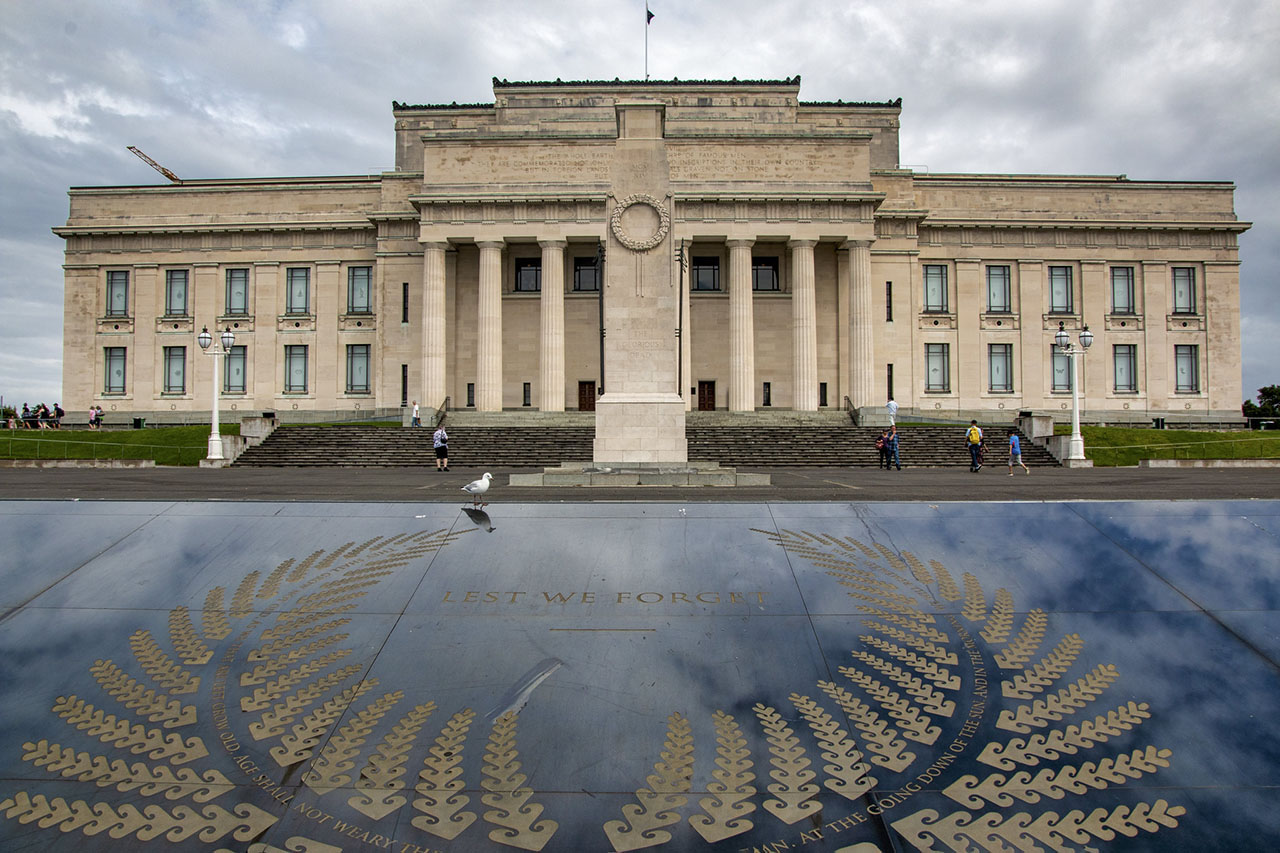
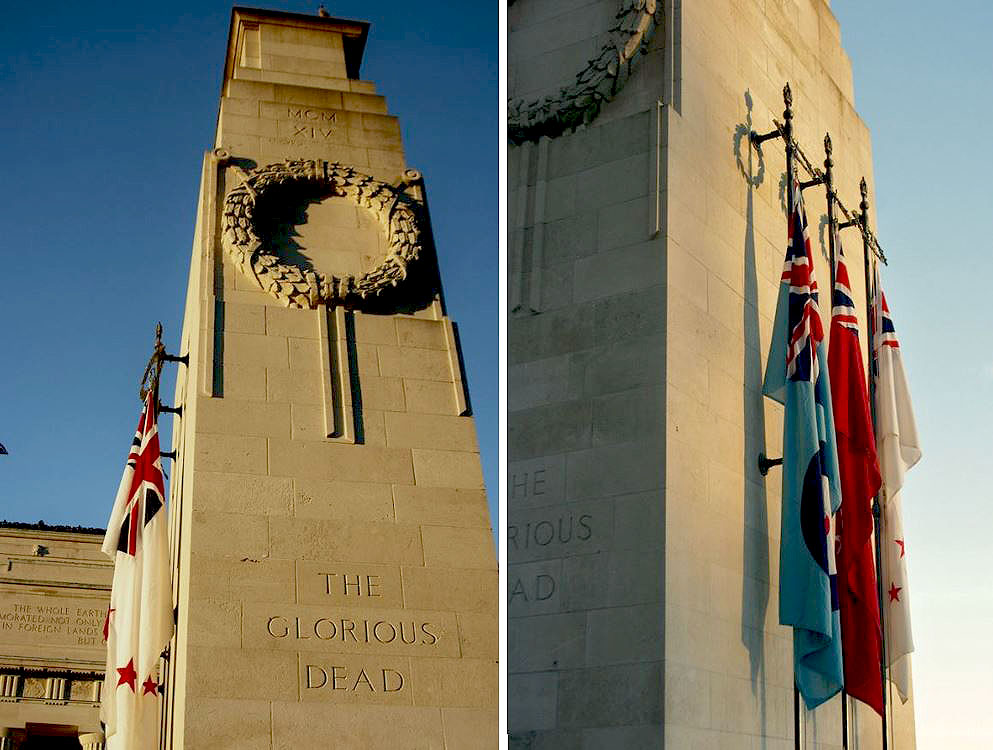
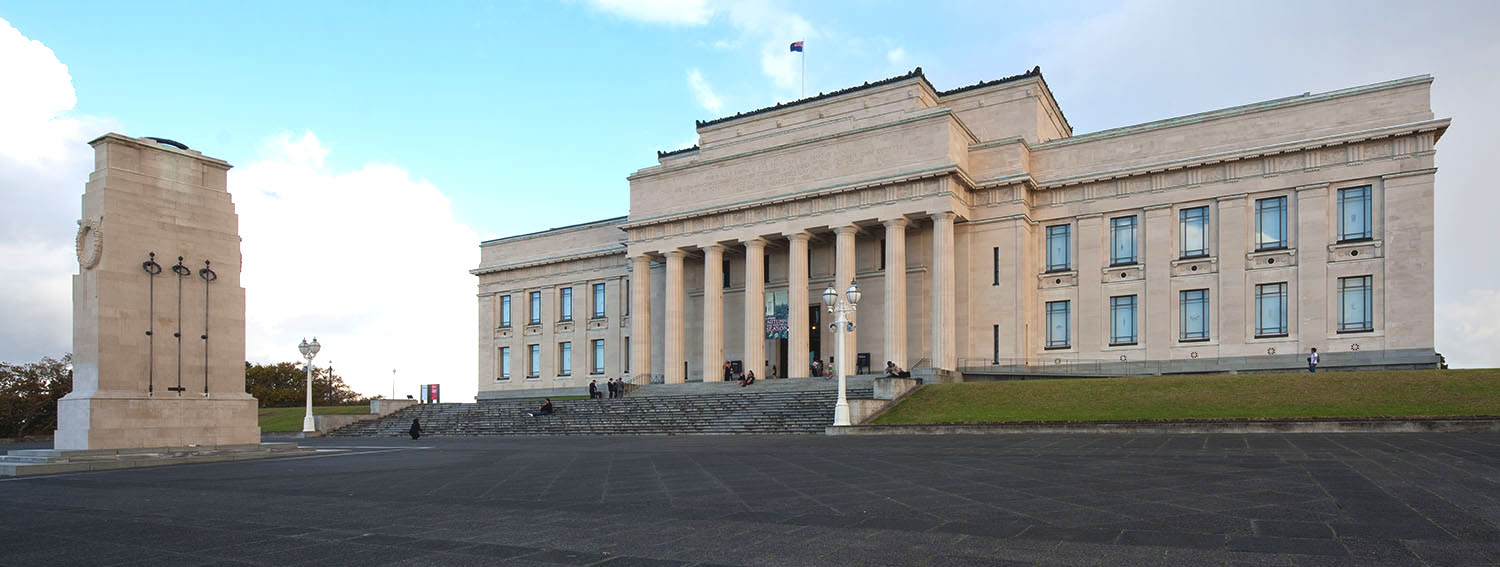
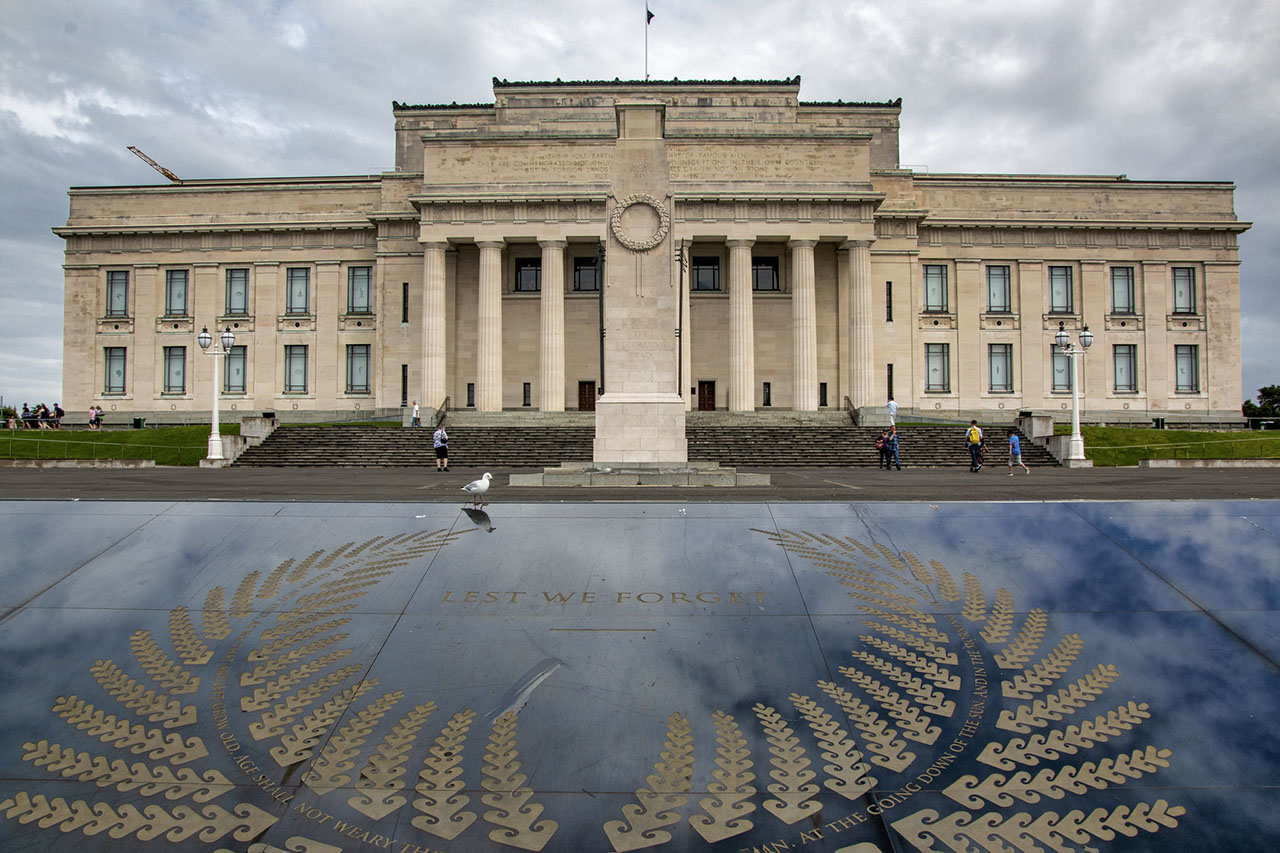
The memorial is surrounded by a Court of Honour, and consists of rectangular pylon surmounted by a sarcophagus and bronze wreath. Its simple, Stripped Classical design is modelled on the 1920 Empire Cenotaph in Whitehall, London, designed by Edwin Lutyens. The Auckland cenotaph was considered to be the most faithful replica of the Whitehall memorial in the empire, reflecting New Zealand's role as a major British partner during the First World War. Imperial ties are also demonstrated through its use of imported Portland stone, which was used in structures of public importance in Britain, and which was also used to face the adjacent museum. Consecrated by the Archbishop of New Zealand in November 1929, the cenotaph has been little modified beyond the engraving of dates on its east and west faces, marking the duration of the Second World War.
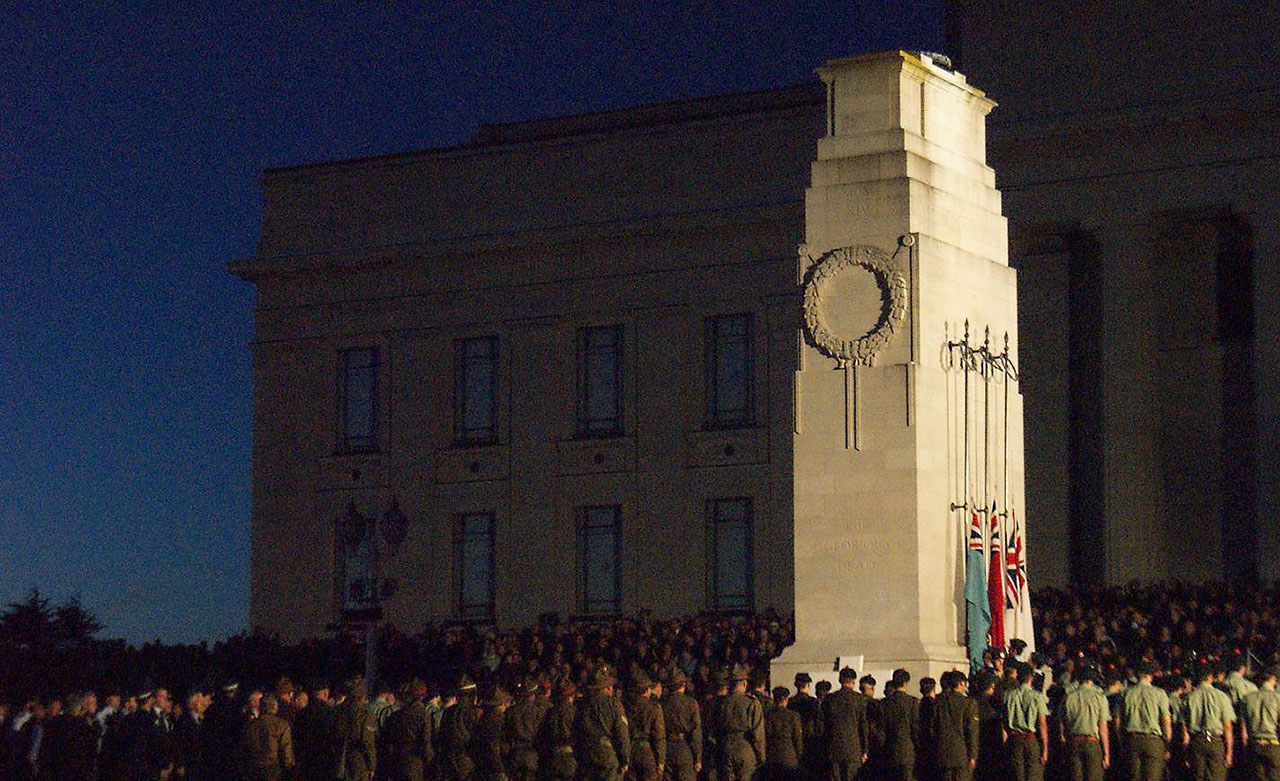
The Auckland Cenotaph has considerable spiritual significance as the focus of Anzac Day commemorations in the city, when those who died in war are remembered. It is important for its connections with the two world wars, when so many Maori and Pakeha died. Its construction was an expression of New Zealanders' feeling about the Great War, being funded and built by people with a direct experience of that conflict. Architecturally, it demonstrates the strength of Imperial ties in the 1920s, while taking on broader meanings as a focus for national remembrance. The monument is prominently located in its immediate landscape, and also visible from afar. It has strong associations with other places in the Auckland Domain including the Auckland War Memorial Museum, with conceptual links to Pukekaroa pa - where a peace-making ceremony was held between Tainui and Ngapuhi in 1828 - and the Maori battle site of Toki Whatinui.
List Entry Information
Status
Listed
List Entry Status
Historic Place Category 1
Access
Able to Visit
List Number
122
Date Entered
16th November 1989
Date of Effect
16th November 1989
City/District Council
Auckland Council
Region
Auckland Council
Legal description
Pt Auckland Domain (RT NA75C/138), North Auckland Land District
Status
Listed
List Entry Status
Historic Place Category 1
Access
Able to Visit
List Number
122
Date Entered
16th November 1989
Date of Effect
16th November 1989
City/District Council
Auckland Council
Region
Auckland Council
Legal description
Pt Auckland Domain (RT NA75C/138), North Auckland Land District
Why is this place significant?
Historic Significance
Historical Significance or Value The Cenotaph, which originally symbolised selfless sacrifice to Empire and honour, now provides an additional focus of national maturity. The architects consciously strove to replicate the Whitehall Cenotaph to cement imperial bonds.
Physical Significance
ARCHITECTURAL QUALITY: The architects carefully copied the Empire Cenotaph in Whitehall, London. Sir Edwin Lutyens' design was obviously regarded as the embodiment of the concept of a 'cenotaph' and it was he who revived the usage of the word. Authentic measured drawings not being available, they made use of photographs and recorded dimensions, together with sketches made on the spot by Aimer during a visit to London. They believed that the finished monument would be the most faithful copy in the Empire. The cenotaph was even constructed from imported Portland stone, the same material used for the original design. Originally a memorial to the New Zealand dead of World War I, it now commemorates the dead of all wars in which New Zealanders have participated. Lutyens' achievement was to translate his pure abstract design into a timeless memorial. TOWNSCAPE/LANDMARK SIGNIFICANCE: Its superb siting on rising ground gives it a prominence enabling it to be seen from many parts of the city. It has outstanding landscape qualities and its relation to the museum is masterly.
Why is this place significant?
Historic Significance
Historical Significance or Value The Cenotaph, which originally symbolised selfless sacrifice to Empire and honour, now provides an additional focus of national maturity. The architects consciously strove to replicate the Whitehall Cenotaph to cement imperial bonds.
Physical Significance
ARCHITECTURAL QUALITY: The architects carefully copied the Empire Cenotaph in Whitehall, London. Sir Edwin Lutyens' design was obviously regarded as the embodiment of the concept of a 'cenotaph' and it was he who revived the usage of the word. Authentic measured drawings not being available, they made use of photographs and recorded dimensions, together with sketches made on the spot by Aimer during a visit to London. They believed that the finished monument would be the most faithful copy in the Empire. The cenotaph was even constructed from imported Portland stone, the same material used for the original design. Originally a memorial to the New Zealand dead of World War I, it now commemorates the dead of all wars in which New Zealanders have participated. Lutyens' achievement was to translate his pure abstract design into a timeless memorial. TOWNSCAPE/LANDMARK SIGNIFICANCE: Its superb siting on rising ground gives it a prominence enabling it to be seen from many parts of the city. It has outstanding landscape qualities and its relation to the museum is masterly.
Construction Professional
Name
Grierson, Aimer & Draffin
Type
Architectural Partnership
Biography
Hugh Cresswell Grierson (1886-1953) was practising as an architect prior to the First World War. He served in the New Zealand Army and remained overseas to continue his studies at the Architectural Association in London. He became an Associate of the Royal Institute of British Architects. He returned to New Zealand and went into partnership with Kenneth Walter Aimer (1891-1960), a fellow student in London. Aimer was educated at Auckland Teachers' Training College and Auckland University College. He became a registered architect in 1918, and later travelled to England to continue his studies. He became an Associate of the Royal Institute of British Architects in 1925. Malcolm Keith Draffin (1890-1964) was in partnership with Edward Bartley and his son Alva when the First World War began. Draffin served in the army and was awarded the Military Cross. He remained in London after the war to study at the Architectural Association, and was elected a Fellow of the Royal Institute of British Architects. Following Edward Bartley's death in 1919, Alva Bartley and Draffin dissolved the partnership. The Auckland Institute and Museum complex was the major work of the firm, for which they were awarded a Gold Medal by the New Zealand Institute of Architects in 1929. The firm's other work includes the South British Insurance Company, Shortland Street and a number of cinema's including the Capitol, Dominion Rd (1922), the Rialto, Newmarket (1923), the Collosseum/Majestic, Queen Street (1924) and the Edendale cinema (1926). They were one of the first Auckland firms to adopt the Art Deco style popular in America, as can be seen in the Gifford's Building (1929), and they also designed in the Stripped Neo-Classical style as seen in the Northcote War Memorial Pavilion (1922) and the Parnell Library (1923). The Depression halted most building activity and as a result the partnership was disbanded. Draffin and Aimer practised separately while Grierson took up farming.
Construction Details
Start Year
1929
Type
Original Construction
Description
Construction of Cenotaph
Type
Modification
Description
Engraving of Second World War dates on east and west faces
Period
post-1945
Construction Materials
Reinforced concrete, faced with Portland stone. This same stone was used for the museum building. The wreaths and flagstaffs are bronze.
Notable Features
Registration covers the structure, its fixtures and finishes. The structure is considered to lie on the site of Pukekawa, which may have been used for horticultural activity in the pre-colonial period.
Construction Professional
Name
Grierson, Aimer & Draffin
Type
Architectural Partnership
Biography
Hugh Cresswell Grierson (1886-1953) was practising as an architect prior to the First World War. He served in the New Zealand Army and remained overseas to continue his studies at the Architectural Association in London. He became an Associate of the Royal Institute of British Architects. He returned to New Zealand and went into partnership with Kenneth Walter Aimer (1891-1960), a fellow student in London. Aimer was educated at Auckland Teachers' Training College and Auckland University College. He became a registered architect in 1918, and later travelled to England to continue his studies. He became an Associate of the Royal Institute of British Architects in 1925. Malcolm Keith Draffin (1890-1964) was in partnership with Edward Bartley and his son Alva when the First World War began. Draffin served in the army and was awarded the Military Cross. He remained in London after the war to study at the Architectural Association, and was elected a Fellow of the Royal Institute of British Architects. Following Edward Bartley's death in 1919, Alva Bartley and Draffin dissolved the partnership. The Auckland Institute and Museum complex was the major work of the firm, for which they were awarded a Gold Medal by the New Zealand Institute of Architects in 1929. The firm's other work includes the South British Insurance Company, Shortland Street and a number of cinema's including the Capitol, Dominion Rd (1922), the Rialto, Newmarket (1923), the Collosseum/Majestic, Queen Street (1924) and the Edendale cinema (1926). They were one of the first Auckland firms to adopt the Art Deco style popular in America, as can be seen in the Gifford's Building (1929), and they also designed in the Stripped Neo-Classical style as seen in the Northcote War Memorial Pavilion (1922) and the Parnell Library (1923). The Depression halted most building activity and as a result the partnership was disbanded. Draffin and Aimer practised separately while Grierson took up farming.
Construction Details
Start Year
1929
Type
Original Construction
Description
Construction of Cenotaph
Type
Modification
Description
Engraving of Second World War dates on east and west faces
Period
post-1945
Construction Materials
Reinforced concrete, faced with Portland stone. This same stone was used for the museum building. The wreaths and flagstaffs are bronze.
Notable Features
Registration covers the structure, its fixtures and finishes. The structure is considered to lie on the site of Pukekawa, which may have been used for horticultural activity in the pre-colonial period.
ARCHITECTURAL DESCRIPTION The Cenotaph is Stripped Classical in style and is a replica of the 1920 Whitehall Cenotaph in London by Sir Edwin Lutyens. In form the cenotaph is a pylon, surmounted by a sarcophagus and bronze wreath. There are few if any embellishments.
ARCHITECTURAL DESCRIPTION The Cenotaph is Stripped Classical in style and is a replica of the 1920 Whitehall Cenotaph in London by Sir Edwin Lutyens. In form the cenotaph is a pylon, surmounted by a sarcophagus and bronze wreath. There are few if any embellishments.
Historical and Associated Iwi / Hapū / Whānau
Completion Date
21st August 2001
Report Written By
Martin Jones
Information Sources
Auckland Star
Auckland Star
Bush, 1971
G .W. A. Bush, 'Decently and In Order: The Government of the City of Auckland 1840-1971', Auckland, 1971
New Zealand Building Progress
New Zealand Building Progress
New Zealand Herald
New Zealand Herald, 12 July 1932, p. 6; 28 September 1933, p. 6.
New Zealand Historic Places Trust (NZHPT)
New Zealand Historic Places Trust
University of Auckland
University of Auckland
Gradidge, R 1981
R Gradidge, Edwin Lutyens, Architect Laureate, London 1981 Hitchock H.R.
Gray, 1985
A S Gray. Edwardian Architecture, London 1985
Conservation Plan
Conservation Plan
Other Information
This historic place was registered under the Historic Places Act 1980. This report includes the text from the original Building Classification Committee report considered by the NZHPT Board at the time of registration. Please note that entry on the New Zealand Heritage List/Rarangi Korero identifies only the heritage values of the property concerned, and should not be construed as advice on the state of the property, or as a comment of its soundness or safety, including in regard to earthquake risk, safety in the event of fire, or insanitary conditions.
Historical and Associated Iwi / Hapū / Whānau
Completion Date
21st August 2001
Report Written By
Martin Jones
Information Sources
Auckland Star
Auckland Star
Bush, 1971
G .W. A. Bush, 'Decently and In Order: The Government of the City of Auckland 1840-1971', Auckland, 1971
New Zealand Building Progress
New Zealand Building Progress
New Zealand Herald
New Zealand Herald, 12 July 1932, p. 6; 28 September 1933, p. 6.
New Zealand Historic Places Trust (NZHPT)
New Zealand Historic Places Trust
University of Auckland
University of Auckland
Gradidge, R 1981
R Gradidge, Edwin Lutyens, Architect Laureate, London 1981 Hitchock H.R.
Gray, 1985
A S Gray. Edwardian Architecture, London 1985
Conservation Plan
Conservation Plan
Other Information
This historic place was registered under the Historic Places Act 1980. This report includes the text from the original Building Classification Committee report considered by the NZHPT Board at the time of registration. Please note that entry on the New Zealand Heritage List/Rarangi Korero identifies only the heritage values of the property concerned, and should not be construed as advice on the state of the property, or as a comment of its soundness or safety, including in regard to earthquake risk, safety in the event of fire, or insanitary conditions.
Current Usages
Uses: Commemoration
Specific Usage: Memorial - World War One
Uses: Commemoration
Specific Usage: Memorial - World War Two
Web Links
description: The Memorials Register, New Zealand History Online, Ministry for Culture and Heritage.
Current Usages
Uses: Commemoration
Specific Usage: Memorial - World War One
Uses: Commemoration
Specific Usage: Memorial - World War Two
Web Links
description: The Memorials Register, New Zealand History Online, Ministry for Culture and Heritage.
Location
Related listings
Sign up to hear more
Get the latest heritage news, features and events delivered
straight to your inbox.
