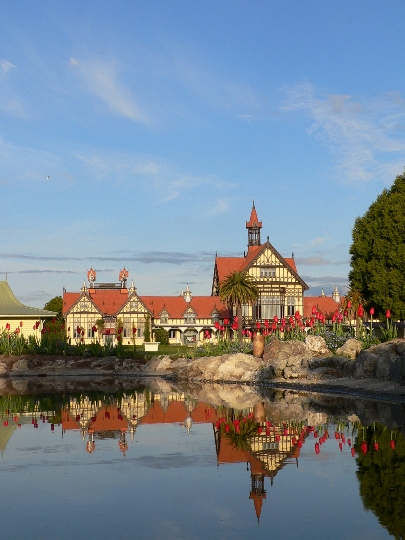
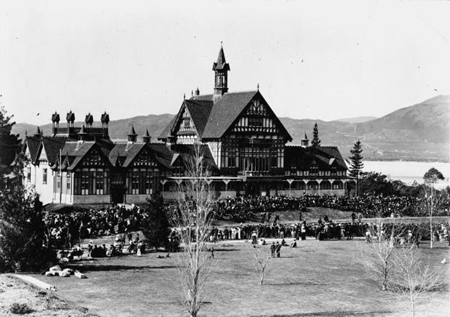
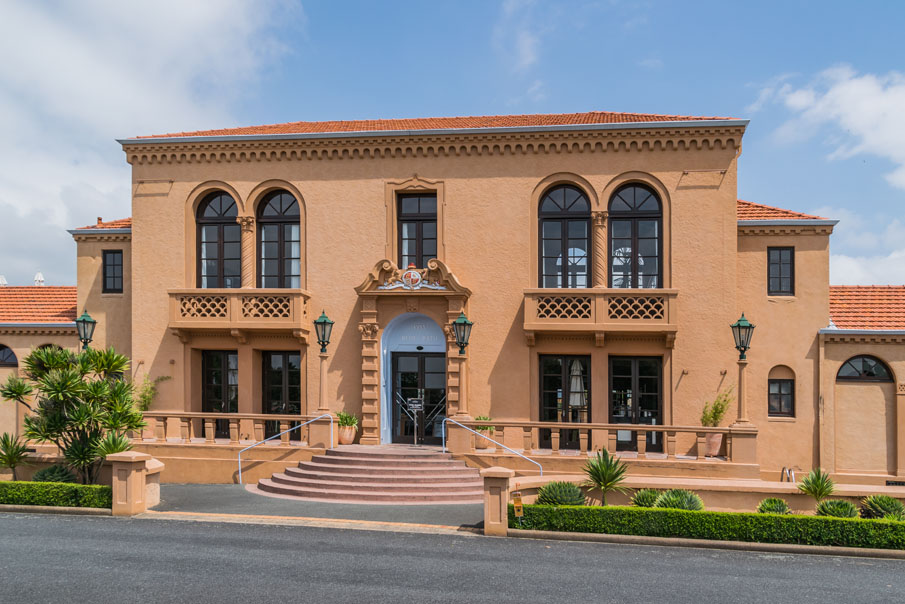
The Bath House is an imposing timber-framed building that demonstrates attempts by the New Zealand government to establish Rotorua as a spa resort of international renown. Erected in a geothermal area now known as the Government Gardens, the Bath House was constructed in 1906-1908 by the newly-created Department of Tourist and Health Resorts. It stands on land that had been gifted by Ngati Whakaue 'hei oranga mo nga iwi katoa o te Ao' ('for the benefit of the people of the world') when the government established Rotorua as a tourist resort in 1880. Although several timber bathhouses had been erected in the late nineteenth century, it was not until the town had been put under the administration of the Tourist Department in 1901 that large-scale investment in the spa occurred. The Bath House was the centrepiece of development in the resort, being designed to attract wealthy visitors from the northern hemisphere for medical treatment and genteel relaxation. It was erected at the considerable cost of £40,000, and was opened in 1908 by Prime Minister Joseph Ward (1856-1930). As a prestigious project, attempts were made to stimulate overseas interest from the start, with Admiral Sperry, commander of the visiting American Atlantic Fleet, being invited to participate in the opening ceremony.
The building was consciously designed to evoke a European atmosphere, comparable to that found in northern hemisphere spas. One of the few genuinely timber-framed buildings constructed in New Zealand during the Edwardian era, it incorporated innovative techniques, such as pumice concrete panels between the individual timbers. Contributions to its design came from a number of sources, including B.S. Cortlett, Inspector of Works of the Tourism Department and Dr Arthur Stanley Wohlmann, who had become the first Government Balneologist in 1902. Its opulent interior contained a large entrance foyer used as a meeting place, like a pump room or 'kursaal' in European spas. The baths combined medical treatment for complaints, such as rheumatism and psoriasis, with relaxation in the form of massage and mud baths. Using up-to-date equipment, men and women were treated in separate parts of the building, with extensions to the uncompleted women's wing being erected in 1911-1912. Hydrogen sulphide, acidic water and steam led to maintenance difficulties in the ensuing decades, although large numbers of visitors were admitted, including several hundred wounded soldiers during the First World War and notable worthies such as Crown Princess Louise of Sweden. With the decline of spas as centres for medical treatment, the baths were eventually closed in 1966 when much of the equipment was removed. Original fixtures were uncovered during an extensive conservation programme in 1995 and are on display as part of the building's current function as Rotorua Museum of Art and History Te Whare Taonga o Te Arawa.
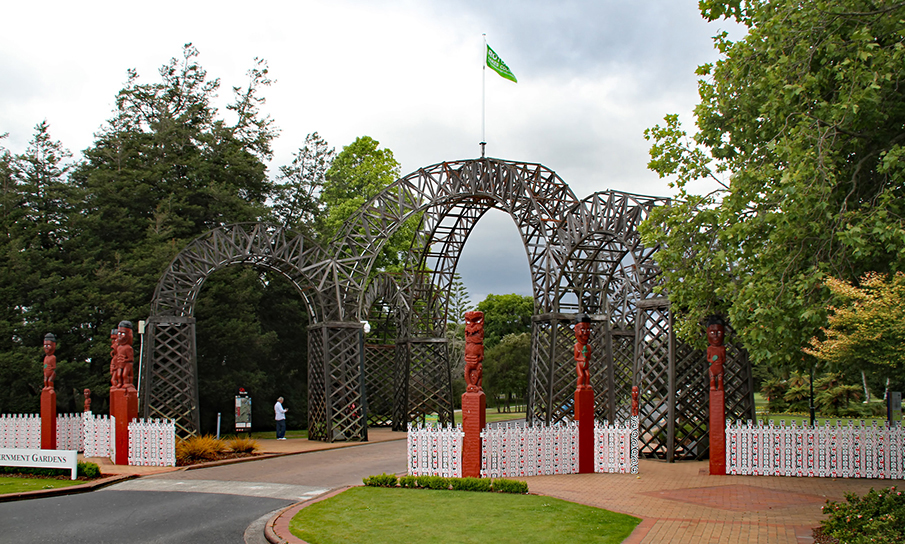
The Bath House is of national and international significance for its associations with the development of overseas tourism to New Zealand. It was the first major building project carried out by the government to stimulate international interest in its spas. It graphically demonstrates the scale of state involvement in its early promotion of New Zealand as a 'healthy' destination, and was part of a broader state interest in health and well-being, with Joseph Ward having previously been appointed as the first Minister of Public Health in the British Empire. The building is considered to be a unique example of a timber-framed spa building in the southern hemisphere, and has also been referred to as the most impressive Elizabethan Revival building in New Zealand. It is important as a rare example of early twentieth-century timber-framing carried out on a large scale, and incorporates innovative construction techniques. The architectural style and function of the building demonstrates the strength of cultural and economic ties with the northern hemisphere, and Britain in particular. It is of great significance for our understanding of medical science and technology in early twentieth-century New Zealand, as well as attitudes to class, gender and leisure. It contains internal fixtures that are unusual or unique in New Zealand, including numerous sculptures by Australian sculptor Charles Francis Summers. The building is the only bath house to survive from the first 45 years of Rotorua's history, and enjoys considerable public esteem as an icon for the city. It is significant as an integral part of the Government Gardens - designated an historic area - which includes associated structures, buried archaeological deposits, historic plantings and geothermal features. It is culturally significant as a visible manifestation of the land gifted by Ngati Whakaue, and currently houses items of importance to Te Arawa.
The building was consciously designed to evoke a European atmosphere, comparable to that found in northern hemisphere spas. One of the few genuinely timber-framed buildings constructed in New Zealand during the Edwardian era, it incorporated innovative techniques, such as pumice concrete panels between the individual timbers. Contributions to its design came from a number of sources, including B.S. Cortlett, Inspector of Works of the Tourism Department and Dr Arthur Stanley Wohlmann, who had become the first Government Balneologist in 1902. Its opulent interior contained a large entrance foyer used as a meeting place, like a pump room or 'kursaal' in European spas. The baths combined medical treatment for complaints, such as rheumatism and psoriasis, with relaxation in the form of massage and mud baths. Using up-to-date equipment, men and women were treated in separate parts of the building, with extensions to the uncompleted women's wing being erected in 1911-1912. Hydrogen sulphide, acidic water and steam led to maintenance difficulties in the ensuing decades, although large numbers of visitors were admitted, including several hundred wounded soldiers during the First World War and notable worthies such as Crown Princess Louise of Sweden. With the decline of spas as centres for medical treatment, the baths were eventually closed in 1966 when much of the equipment was removed. Original fixtures were uncovered during an extensive conservation programme in 1995 and are on display as part of the building's current function as Rotorua Museum of Art and History Te Whare Taonga o Te Arawa.
The Bath House is of national and international significance for its associations with the development of overseas tourism to New Zealand. It was the first major building project carried out by the government to stimulate international interest in its spas. It graphically demonstrates the scale of state involvement in its early promotion of New Zealand as a 'healthy' destination, and was part of a broader state interest in health and well-being, with Joseph Ward having previously been appointed as the first Minister of Public Health in the British Empire. The building is considered to be a unique example of a timber-framed spa building in the southern hemisphere, and has also been referred to as the most impressive Elizabethan Revival building in New Zealand. It is important as a rare example of early twentieth-century timber-framing carried out on a large scale, and incorporates innovative construction techniques. The architectural style and function of the building demonstrates the strength of cultural and economic ties with the northern hemisphere, and Britain in particular. It is of great significance for our understanding of medical science and technology in early twentieth-century New Zealand, as well as attitudes to class, gender and leisure. It contains internal fixtures that are unusual or unique in New Zealand, including numerous sculptures by Australian sculptor Charles Francis Summers. The building is the only bath house to survive from the first 45 years of Rotorua's history, and enjoys considerable public esteem as an icon for the city. It is significant as an integral part of the Government Gardens - designated an historic area - which includes associated structures, buried archaeological deposits, historic plantings and geothermal features. It is culturally significant as a visible manifestation of the land gifted by Ngati Whakaue, and currently houses items of importance to Te Arawa.