

Both iwi history and archaeological evidence show Māori occupation in the Ōtākou / Otago region since the 12th century. Today, Kāi Tahu mana whenua is recognised over a large part of Te Wai Pounamu. Kāti Māmoe and Waitaha shared occupation are always acknowledged. The hapū Kāi Te Pahi, Kāti Moki, and Kāti Taoka still maintain their presence and responsibility as kaitiaki in this region. The coastal area now known as Waikouaiti, was a resource-rich area for iwi, with the Matainaka Lagoon (now known as Hawksbury Lagoon) as a major whitebait spawning area and the Waikouaiti River providing abundant food resources. Settlement was focused around Huriawa, Puketeraki and Karitane. Following the arrival of the Magnet immigrant ship from Sydney in 1840, it took only a few years for the Waikouaiti landscape to become nearly unrecognisable from its Māori origins.
The colonial postal service in New Zealand began in 1840, and the first post office in Dunedin opened in 1855. The first record of a post office at Waikouaiti dates to 1863, when a wooden building with two rooms was constructed.. At that time, mail was carried from Dunedin on packhorses over the Blueskin Range. A Iarge European population, many living in tents, had settled in Waikouaiti, as it was on route to the Dunstan goldfields.
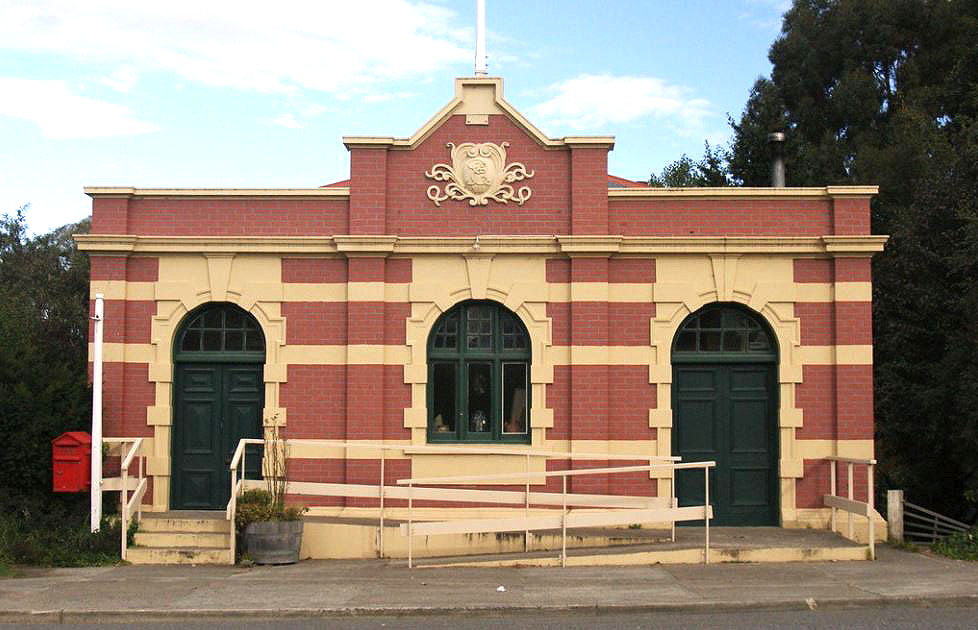
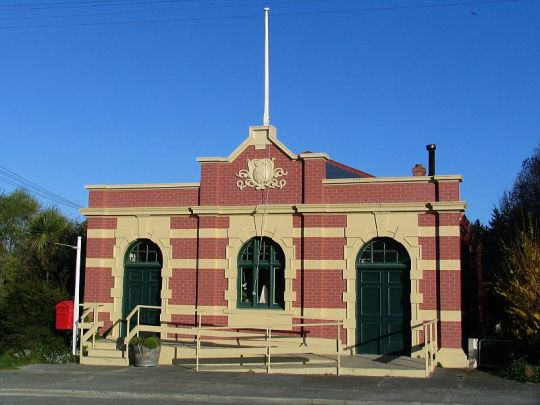
The Waikouaiti Post Office, built in 1907, is a single-storey structure in the early Renaissance style, constructed from double brick with cement dressings. It was designed by John Campbell (1857-1942), Government Architect. Between 1900 and 1914, New Zealand saw a boom in post office construction and Campbell developed two standard models for smaller post offices. With some variation, these were built throughout the country. Erecting new post offices was influenced by the completion of the North Island Main Trunk Line in in 1908, the replacement of old timber buildings with moremore permanent materials, and the the expanding telegraphic network throughout New Zealand. The Waikouaiti Post Office, however, differs from the common style.
The Waikouaiti Post Office can claim to be first post office opened under Dominion status. Built on strong foundations, it remains structurally sound over a century later, with no cracks in the main building. At the opening ceremony it was noted that the community were much indebted to MP Thomas Mackenzie. The front elevation has a central feature of a large arched window, with a gabolet above it and a flagstaff. On either side are arched entrances -one originally to the public office and the other leading to a private letterbox lobby. The public portion of the building included a vestibule, private box lobby, mailroom, public office, telephone bureau, and a separate telephone room connected with the mailroom. The residential quarters at the back of the building consisted of a sitting room, two bedrooms, kitchen, and scullery. The contractors were Messrs Robson and Crawford, of Mornington, the amount of their tender being £1332 3s 6d.
Only one of the outbuildings remains the small brick shed that is included on the original plans. This once housed a copper for washing, a toilet and a coal storage for the fires. Other, more recent structures on-site, include several sheds, one containing two kilns and a carport. The manual telephone exchange was dismantled decades later and replaced by an automatic exchange that was built in Beach Street. To this day, numerous telephone wires under the floor of the room where the manual exchange once stood. Since 1989, the building has served as the residence and art studio of potter Peter Gregory and painter Laura Gregory.
List Entry Information
Status
Listed
List Entry Status
Historic Place Category 2
Access
Private/No Public Access
List Number
2358
Date Entered
2nd July 1982
Date of Effect
2nd July 1982
City/District Council
Dunedin City
Region
Otago Region
Extent of List Entry
Extent includes the land described as Sec 5 Blk XII SO 14312 (OT12A/1273) Town of Hawksbury, Otago Land District and the building known as Waikouaiti Post Office (Former), thereon. The extent does not include modern outbuildings built from 1988
Legal description
Sec 5 Blk XII SO 14312 (OT12A/1273) Town of Hawksbury, Otago Land District
Status
Listed
List Entry Status
Historic Place Category 2
Access
Private/No Public Access
List Number
2358
Date Entered
2nd July 1982
Date of Effect
2nd July 1982
City/District Council
Dunedin City
Region
Otago Region
Extent of List Entry
Extent includes the land described as Sec 5 Blk XII SO 14312 (OT12A/1273) Town of Hawksbury, Otago Land District and the building known as Waikouaiti Post Office (Former), thereon. The extent does not include modern outbuildings built from 1988
Legal description
Sec 5 Blk XII SO 14312 (OT12A/1273) Town of Hawksbury, Otago Land District
Construction Details
Start Year
1907
Type
Original Construction
Construction Details
Start Year
1907
Type
Original Construction
Historical and Associated Iwi / Hapū / Whānau
Completion Date
21st November 2024
Report Written By
Alison Breese
Information Sources
Richardson, 1988
Peter Richardson, 'An Architecture of Empire: The Government Buildings of John Campbell in New Zealand', MA Thesis, University of Canterbury, 1988
Howard, 1964
A History of the Post Office in New Zealand, Wellington, 1964.
Wellington City Council Heritage Inventory, 2016
Wellington City Council, ‘Government Architect – John Campbell’, 2016 https://www.wellingtoncityheritage.org.nz/architects/government-architect-john-campbell
Heritage New Zealand Pouhere Taonga
12005-053
Gregory, Peter and Laura, ‘A Short History of the Waikouaiti Post Office’,
https://opogallery.blogspot.com/2009/01/short-history-of-waikouaiti-post-office.html
Other Information
This place was identified as significant under previous legislation with different information requirements. It remains significant under the current legislation. There is opportunity under our legislation and policies to add to this information. Further information about this place may be available from the Otago/Southland Office of Heritage New Zealand Pouhere Taonga. Please note that entry on the New Zealand Heritage List/Rarangi Korero identifies only the heritage values of the property concerned, and should not be construed as advice on the state of the property, or as a comment of its soundness or safety, including in regard to earthquake risk, safety in the event of fire, or insanitary conditions.
Historical and Associated Iwi / Hapū / Whānau
Completion Date
21st November 2024
Report Written By
Alison Breese
Information Sources
Richardson, 1988
Peter Richardson, 'An Architecture of Empire: The Government Buildings of John Campbell in New Zealand', MA Thesis, University of Canterbury, 1988
Howard, 1964
A History of the Post Office in New Zealand, Wellington, 1964.
Wellington City Council Heritage Inventory, 2016
Wellington City Council, ‘Government Architect – John Campbell’, 2016 https://www.wellingtoncityheritage.org.nz/architects/government-architect-john-campbell
Heritage New Zealand Pouhere Taonga
12005-053
Gregory, Peter and Laura, ‘A Short History of the Waikouaiti Post Office’,
https://opogallery.blogspot.com/2009/01/short-history-of-waikouaiti-post-office.html
Other Information
This place was identified as significant under previous legislation with different information requirements. It remains significant under the current legislation. There is opportunity under our legislation and policies to add to this information. Further information about this place may be available from the Otago/Southland Office of Heritage New Zealand Pouhere Taonga. Please note that entry on the New Zealand Heritage List/Rarangi Korero identifies only the heritage values of the property concerned, and should not be construed as advice on the state of the property, or as a comment of its soundness or safety, including in regard to earthquake risk, safety in the event of fire, or insanitary conditions.
Current Usages
Uses: Accommodation
Specific Usage: Artist's Residence
Former Usages
General Usage: Communication
Specific Usage: Post Office
General Usage: Communication
Specific Usage: Postal & Telecommunications - Other
Current Usages
Uses: Accommodation
Specific Usage: Artist's Residence
Former Usages
General Usage: Communication
Specific Usage: Post Office
General Usage: Communication
Specific Usage: Postal & Telecommunications - Other
Location
Related listings
Stay up to date with Heritage this month
