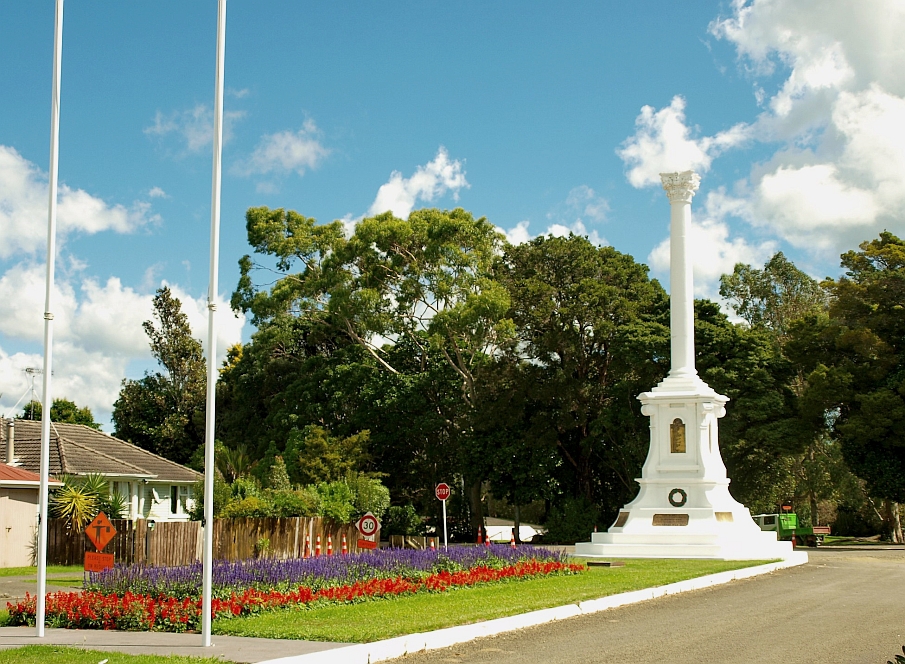
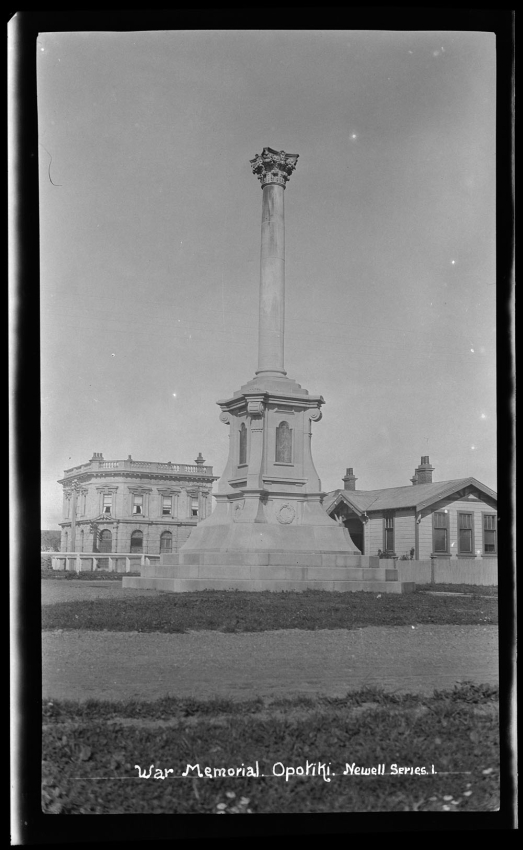
The War Memorial in Opotiki commemorates men from the eastern Bay of Plenty who fought and died in the First and Second World Wars. Probably constructed in 1922-1923, the tall column and plinth was erected close to a number of government buildings in the formal heart of the settlement. Positioned at the western end of Elliott Street, the monument was visible from the Waioeka River - which provided one of the main access routes in and out of Opotiki - and from the major commercial thoroughfare of Church Street. It replaced a temporary memorial made from packing cases, which had stood at the junction of Church and King Streets, at the more 'fashionable' end of the town. This had first been erected in 1918 and was a focal point for commemorations every Anzac Day (25 April) until 1922.
The new monument was initially built to commemorate soldiers from the district who had died in the First World War (1914-1918). Opotiki had strong connections with martial activity, having been established as a military and commercial township in the 1860s, following the capture by Imperial forces of Pa Kowhai - a large Te Whakatohea settlement on the same site. Subsequently protected by a local militia and - later - the armed constabulary, patriotic feelings towards the British Crown among the settler population remained high. During the South African War (1899-1902), the citizenry formed a local volunteer force - the Opotiki Mounted Rifles - while 25 men served on overseas duty without loss. In early 1914 a memorial to those who died in the New Zealand Wars was unveiled in the town. At the outbreak of the First World War, numerous men from the district, both Pakeha and Maori, volunteered for action, including Richard (Dick) Travis (1884-1918) who was awarded a posthumous Victoria Cross for his actions at Rossignol Wood in 1918. Many of those who stayed at home contributed in other ways, with over £1,000 being raised by a patriotic fund within three months of the outbreak of war.
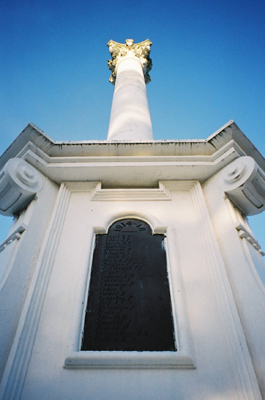
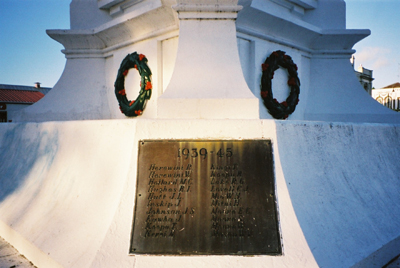
An unusually grand memorial for a small town, the monument was designed as a Corinthian column of white marble, on top of a supporting plinth and stepped base. The plinth contained bronze plaques listing the dead, while the base was decorated with stylised wreaths. Unlike the broken obelisk design adopted by other war memorials, the soaring qualities of the Opotiki monument can be seen to reflect a more triumphant tone. The classical column as a monument - such as Nelson's Column in London - was frequently associated with the achievements of Empire through its connection with ancient imperial power. The bronze plaques - manufactured by W. H Worrall of Auckland - list men in alphabetical order and not according to rank, reflecting a comparatively egalitarian attitude towards the fallen. Following further loss of life in the Second World War (1939-1945), additional plaques were added to the monument's base. These were manufactured by the same company, and are similarly arranged. The monument continues to act as an annual focus for Anzac Day commemorations.
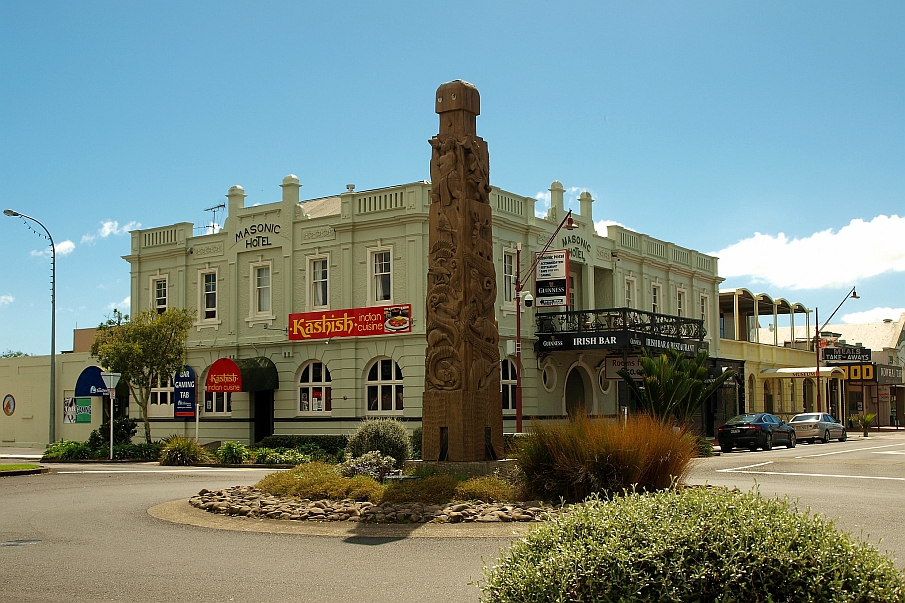
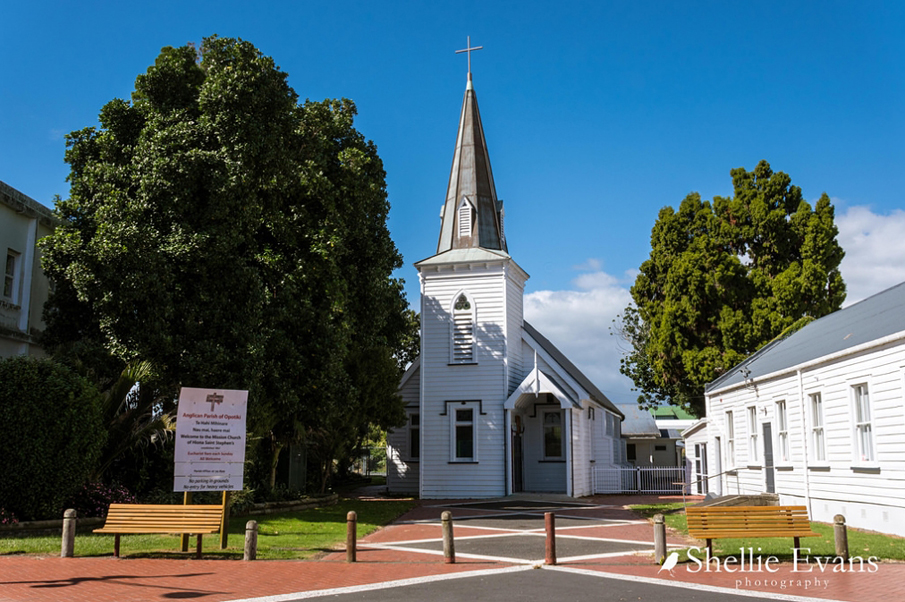
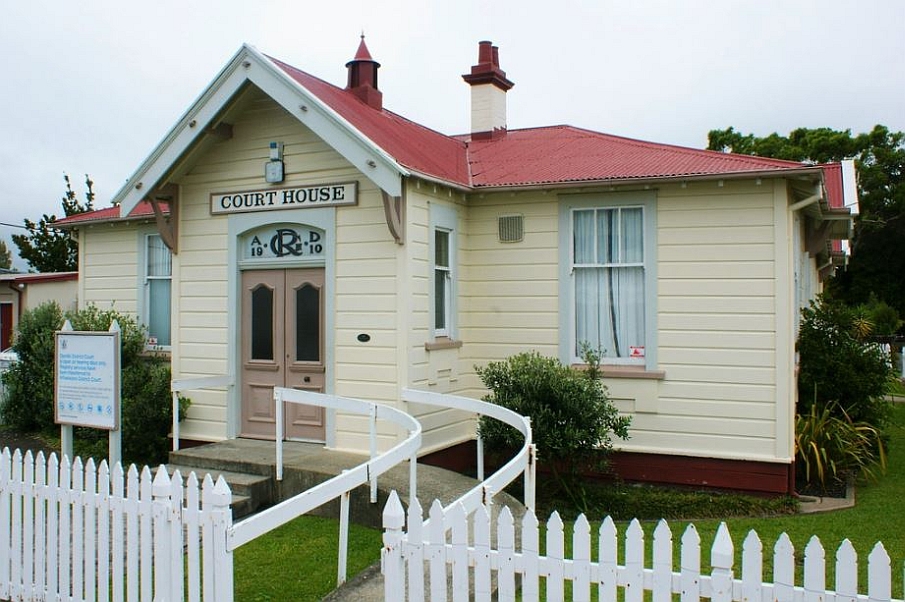
The War Memorial in Opotiki is significant as a highly distinctive monument of unusual design. It demonstrates early twentieth-century attitudes in New Zealand towards military conflict and the British Empire. It also reflects the particularly close association between Opotiki and aspects of New Zealand's military history. The monument is important for commemorating the lives of many men from the Opotiki district, both Maori and Pakeha, including Richard Travis. As the centrepiece for Anzac celebrations for 80 years, it has played a significant role in the commemorative life of the town. The memorial has important aesthetic and streetscape values, being a visually prominent component of the urban centre. It is part of a wider historic and archaeological landscape of late nineteenth and early twentieth-century date, with adjacent historic buildings including the courthouse and Masonic Hotel. It has close links with other commemorative and military-related structures in the town, including the 1914 New Zealand Wars memorial in Kelly Street, the 1914-1915 drill hall in Ford Street, and the archaeological remains of the military redoubt around St Stephen's Church.
The new monument was initially built to commemorate soldiers from the district who had died in the First World War (1914-1918). Opotiki had strong connections with martial activity, having been established as a military and commercial township in the 1860s, following the capture by Imperial forces of Pa Kowhai - a large Te Whakatohea settlement on the same site. Subsequently protected by a local militia and - later - the armed constabulary, patriotic feelings towards the British Crown among the settler population remained high. During the South African War (1899-1902), the citizenry formed a local volunteer force - the Opotiki Mounted Rifles - while 25 men served on overseas duty without loss. In early 1914 a memorial to those who died in the New Zealand Wars was unveiled in the town. At the outbreak of the First World War, numerous men from the district, both Pakeha and Maori, volunteered for action, including Richard (Dick) Travis (1884-1918) who was awarded a posthumous Victoria Cross for his actions at Rossignol Wood in 1918. Many of those who stayed at home contributed in other ways, with over £1,000 being raised by a patriotic fund within three months of the outbreak of war.
An unusually grand memorial for a small town, the monument was designed as a Corinthian column of white marble, on top of a supporting plinth and stepped base. The plinth contained bronze plaques listing the dead, while the base was decorated with stylised wreaths. Unlike the broken obelisk design adopted by other war memorials, the soaring qualities of the Opotiki monument can be seen to reflect a more triumphant tone. The classical column as a monument - such as Nelson's Column in London - was frequently associated with the achievements of Empire through its connection with ancient imperial power. The bronze plaques - manufactured by W. H Worrall of Auckland - list men in alphabetical order and not according to rank, reflecting a comparatively egalitarian attitude towards the fallen. Following further loss of life in the Second World War (1939-1945), additional plaques were added to the monument's base. These were manufactured by the same company, and are similarly arranged. The monument continues to act as an annual focus for Anzac Day commemorations.
The War Memorial in Opotiki is significant as a highly distinctive monument of unusual design. It demonstrates early twentieth-century attitudes in New Zealand towards military conflict and the British Empire. It also reflects the particularly close association between Opotiki and aspects of New Zealand's military history. The monument is important for commemorating the lives of many men from the Opotiki district, both Maori and Pakeha, including Richard Travis. As the centrepiece for Anzac celebrations for 80 years, it has played a significant role in the commemorative life of the town. The memorial has important aesthetic and streetscape values, being a visually prominent component of the urban centre. It is part of a wider historic and archaeological landscape of late nineteenth and early twentieth-century date, with adjacent historic buildings including the courthouse and Masonic Hotel. It has close links with other commemorative and military-related structures in the town, including the 1914 New Zealand Wars memorial in Kelly Street, the 1914-1915 drill hall in Ford Street, and the archaeological remains of the military redoubt around St Stephen's Church.