Quick links


Quick links
Quick links
Quick links
Quick links
Quick links
121 Church Street, Elliott Street and Potts Avenue, OPOTIKI
Public
Historic Place Category 2
List No. 3500
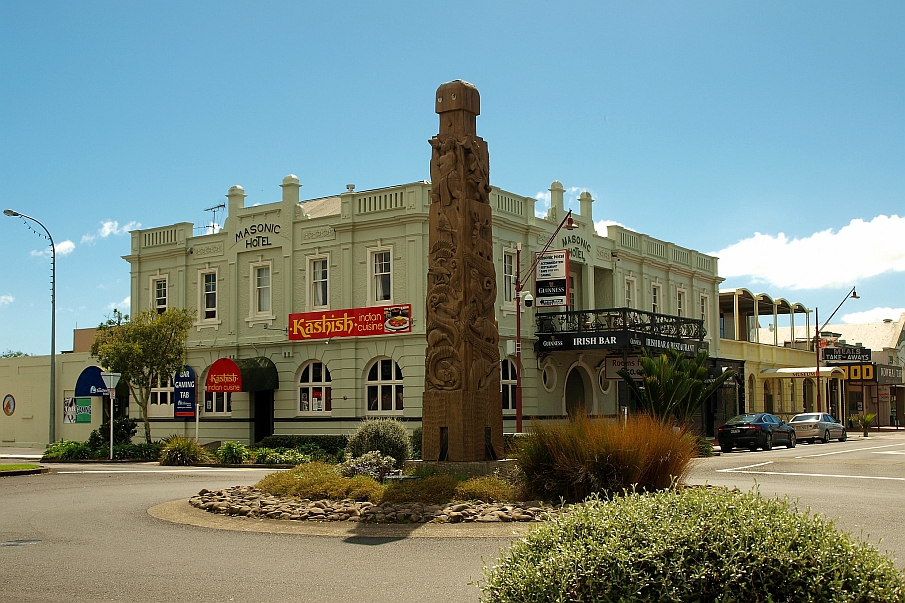
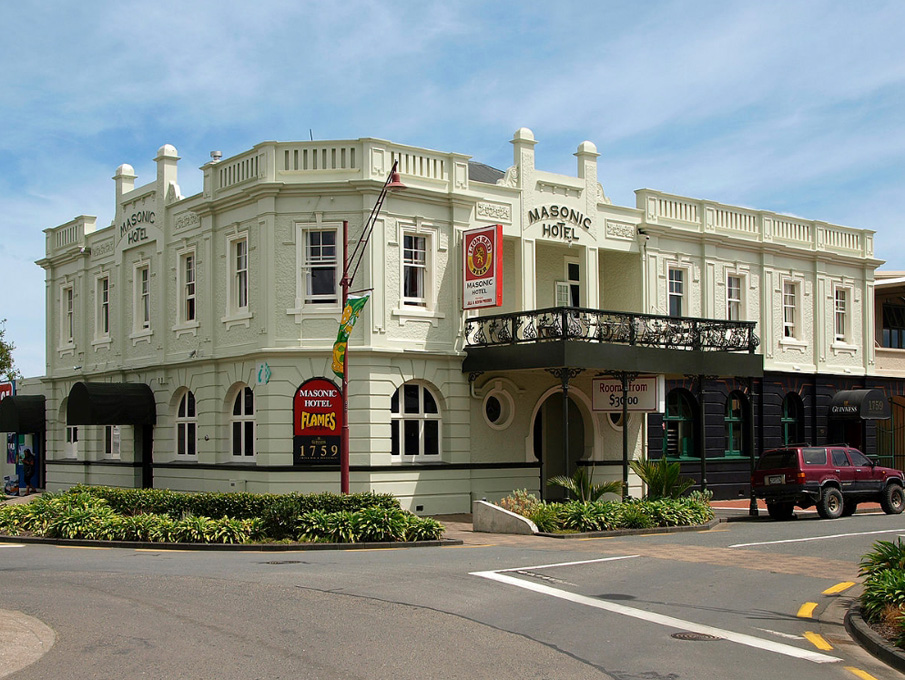
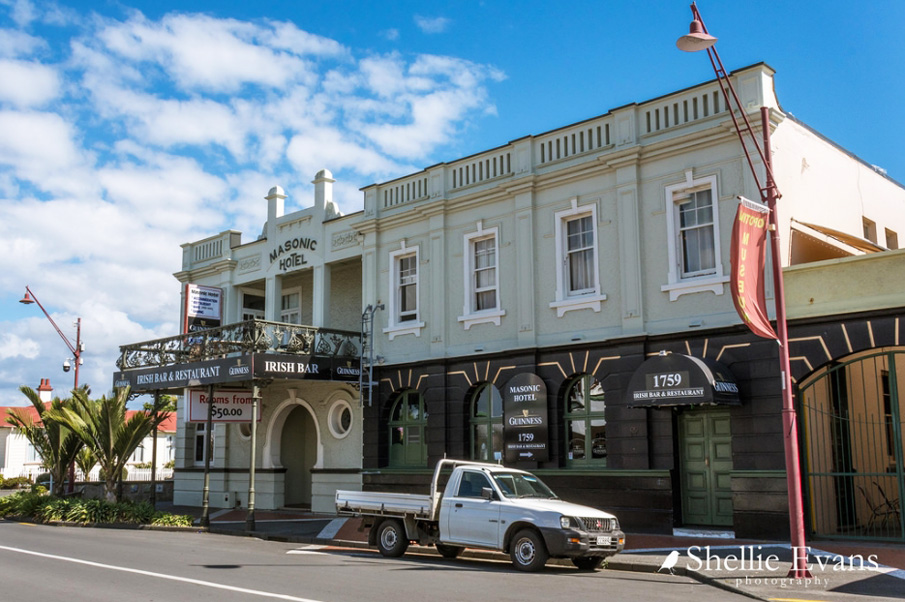
List Entry Information
Status
Listed
List Entry Status
Historic Place Category 2
Access
Able to Visit
List Number
3500
Date Entered
5th April 1984
Date of Effect
5th April 1984
City/District Council
Ōpōtiki District
Region
Bay of Plenty Region
Legal description
Lot 2 DP 3538 (RT GS5B/1062), Gisborne Land District
Status
Listed
List Entry Status
Historic Place Category 2
Access
Able to Visit
List Number
3500
Date Entered
5th April 1984
Date of Effect
5th April 1984
City/District Council
Ōpōtiki District
Region
Bay of Plenty Region
Legal description
Lot 2 DP 3538 (RT GS5B/1062), Gisborne Land District
Construction Details
Type
Other
Description
First Masonic Hotel
Period
late 1860s-early 1870
Start Year
1916
Type
Original Construction
Description
Rebuilding or extensive remodelling
Start Year
1918
Type
Addition
Description
Extension after remaining part of first hotel destroyed by fire
Finish Year
1919
Type
Modification
Description
Internal modifications to ground floor
Period
1970s
Start Year
1990
Type
Addition
Description
Public Bar addition on Elliott Street
Start Year
2003
Type
Modification
Description
Additional entrance on Church Street façade
Construction Details
Type
Other
Description
First Masonic Hotel
Period
late 1860s-early 1870
Start Year
1916
Type
Original Construction
Description
Rebuilding or extensive remodelling
Start Year
1918
Type
Addition
Description
Extension after remaining part of first hotel destroyed by fire
Finish Year
1919
Type
Modification
Description
Internal modifications to ground floor
Period
1970s
Start Year
1990
Type
Addition
Description
Public Bar addition on Elliott Street
Start Year
2003
Type
Modification
Description
Additional entrance on Church Street façade
Historical and Associated Iwi / Hapū / Whānau
Completion Date
27th June 2007
Report Written By
Martin Jones and Shirley Arabin
Information Sources
Auckland Weekly News
Auckland Weekly News
Connor, 1994
Kath Connor, Narena Olliver and Annabel Allan, Opotiki:the Women's Stories/Nga Pura Kau a Nga Wahine, Opotiki, 1994
Cresswell, 1982
John Cresswell, Parkinson of Opotiki, Titirangi, 1982
Matthews & Matthews Architects Ltd, 2006
Matthews & Matthews Architects Ltd., Lyn Williams, R. A. Skidmore and Associates and Archaeology B.O.P., 'Opotiki Town Centre Historic Heritage Study, Part Two: Inventory and Record Forms', [Auckland], 2006
McCallion, 1956
McCallion, A., Their Greatness: Tales of the Pioneers of the Eastern Bay of Plenty, Rotorua, 1956
Other Information
This place was identified as significant under previous legislation with different information requirements. It remains significant under the current legislation. There is opportunity under our legislation and policies to add to this information. Further information about this place may be available from the Lower Northern Office of Heritage New Zealand Pouhere Taonga. Please note that entry on the New Zealand Heritage List/Rarangi Korero identifies only the heritage values of the property concerned, and should not be construed as advice on the state of the property, or as a comment of its soundness or safety, including in regard to earthquake risk, safety in the event of fire, or insanitary conditions.
Historical and Associated Iwi / Hapū / Whānau
Completion Date
27th June 2007
Report Written By
Martin Jones and Shirley Arabin
Information Sources
Auckland Weekly News
Auckland Weekly News
Connor, 1994
Kath Connor, Narena Olliver and Annabel Allan, Opotiki:the Women's Stories/Nga Pura Kau a Nga Wahine, Opotiki, 1994
Cresswell, 1982
John Cresswell, Parkinson of Opotiki, Titirangi, 1982
Matthews & Matthews Architects Ltd, 2006
Matthews & Matthews Architects Ltd., Lyn Williams, R. A. Skidmore and Associates and Archaeology B.O.P., 'Opotiki Town Centre Historic Heritage Study, Part Two: Inventory and Record Forms', [Auckland], 2006
McCallion, 1956
McCallion, A., Their Greatness: Tales of the Pioneers of the Eastern Bay of Plenty, Rotorua, 1956
Other Information
This place was identified as significant under previous legislation with different information requirements. It remains significant under the current legislation. There is opportunity under our legislation and policies to add to this information. Further information about this place may be available from the Lower Northern Office of Heritage New Zealand Pouhere Taonga. Please note that entry on the New Zealand Heritage List/Rarangi Korero identifies only the heritage values of the property concerned, and should not be construed as advice on the state of the property, or as a comment of its soundness or safety, including in regard to earthquake risk, safety in the event of fire, or insanitary conditions.
Current Usages
Uses: Trade
Specific Usage: Pub/bar/tavern/public hotel
Former Usages
General Usage: Trade
Specific Usage: Pub/bar/tavern/public hotel
Current Usages
Uses: Trade
Specific Usage: Pub/bar/tavern/public hotel
Former Usages
General Usage: Trade
Specific Usage: Pub/bar/tavern/public hotel
Location
Get the latest heritage news, features and events delivered
straight to your inbox.
