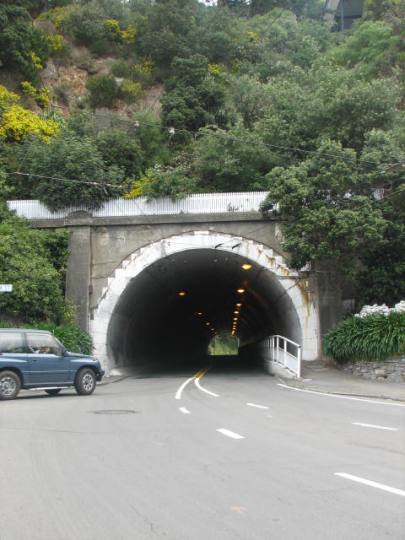
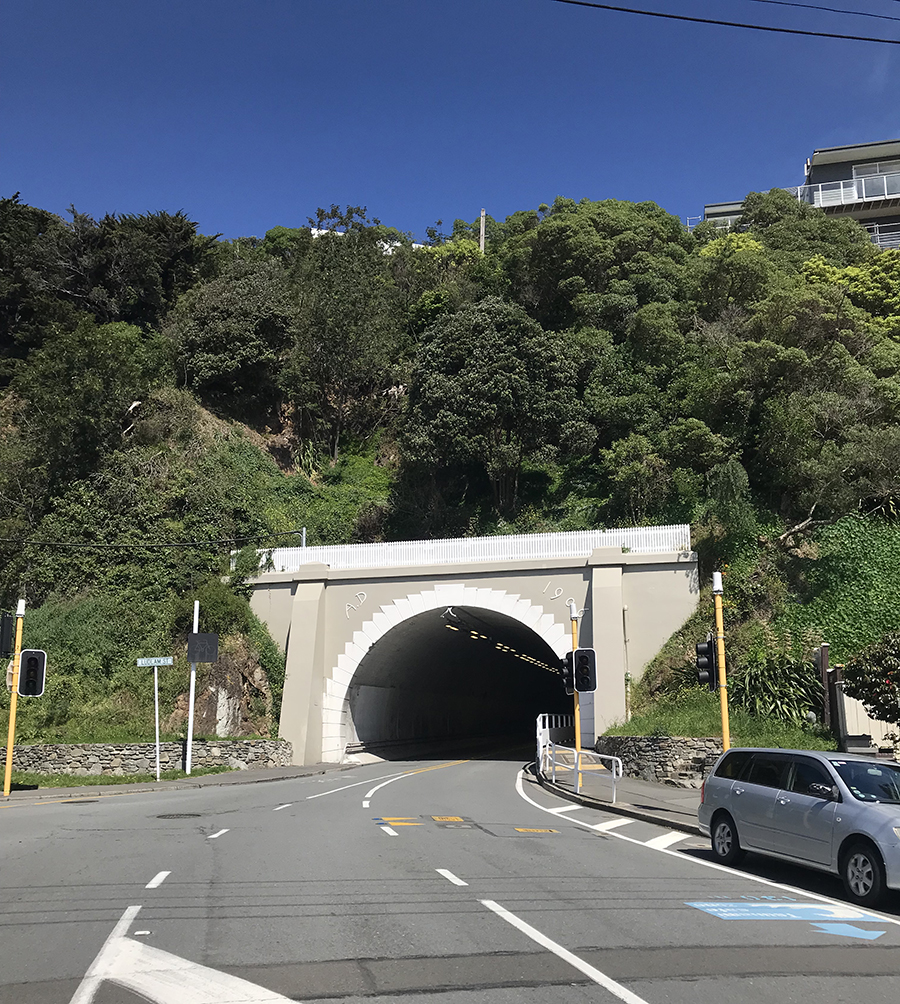
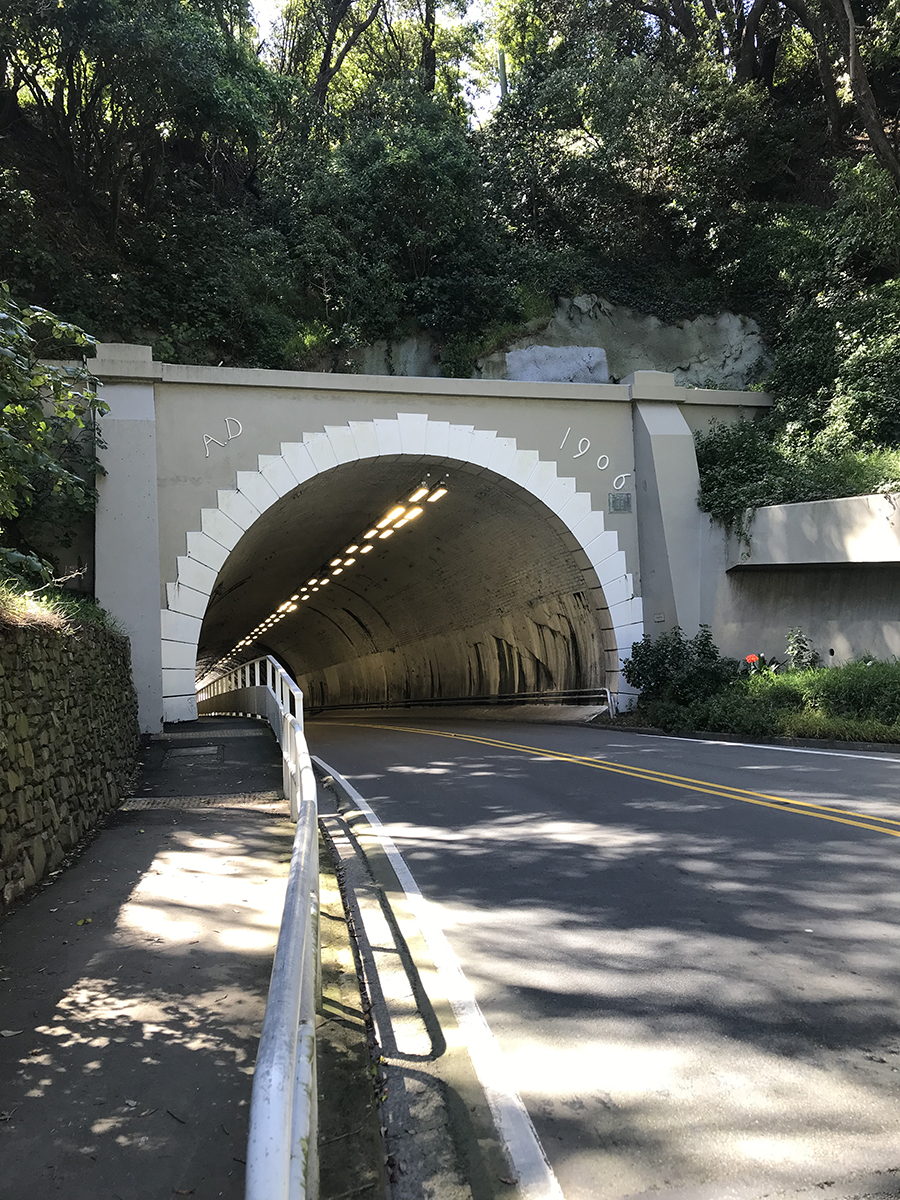
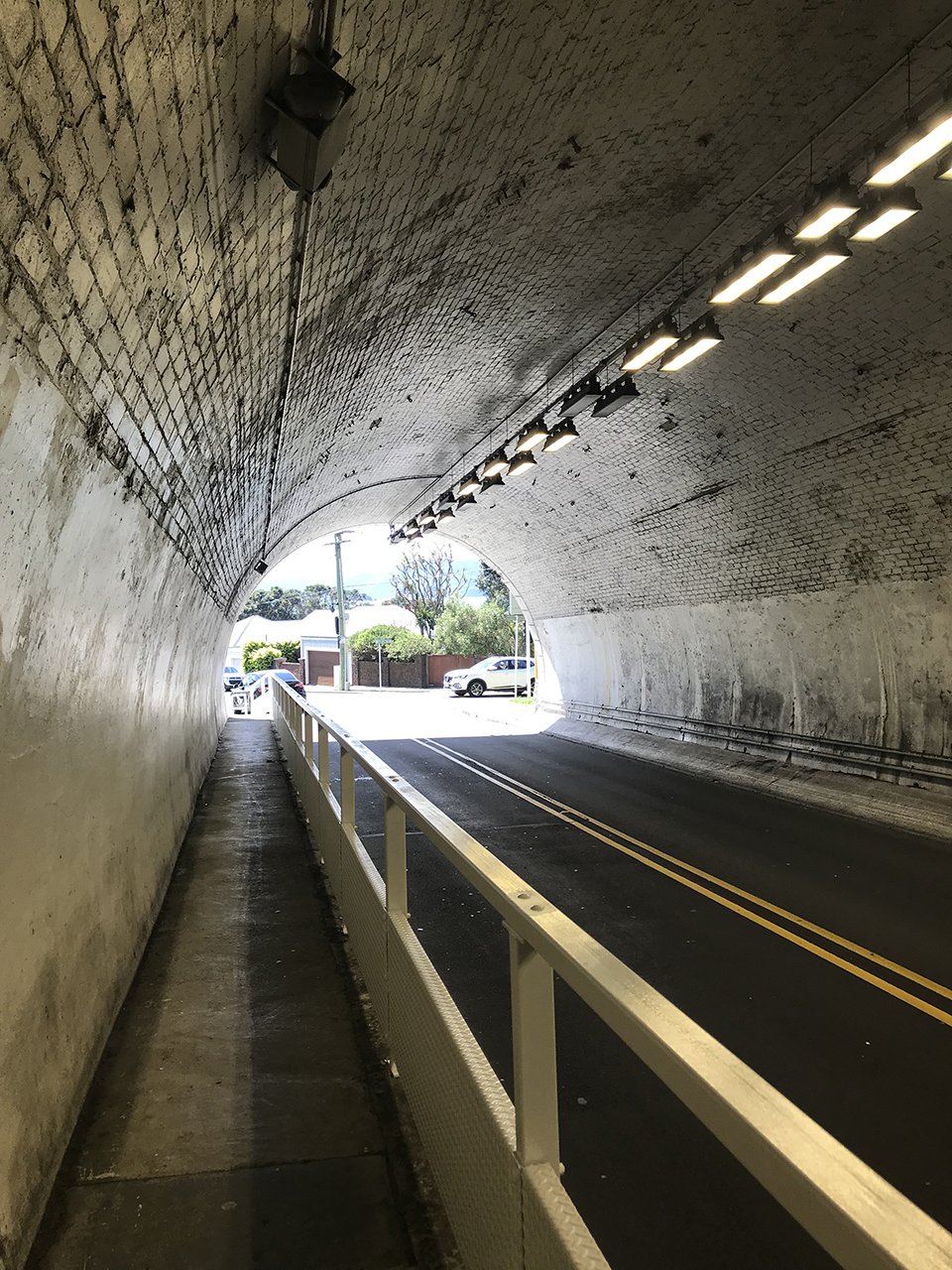
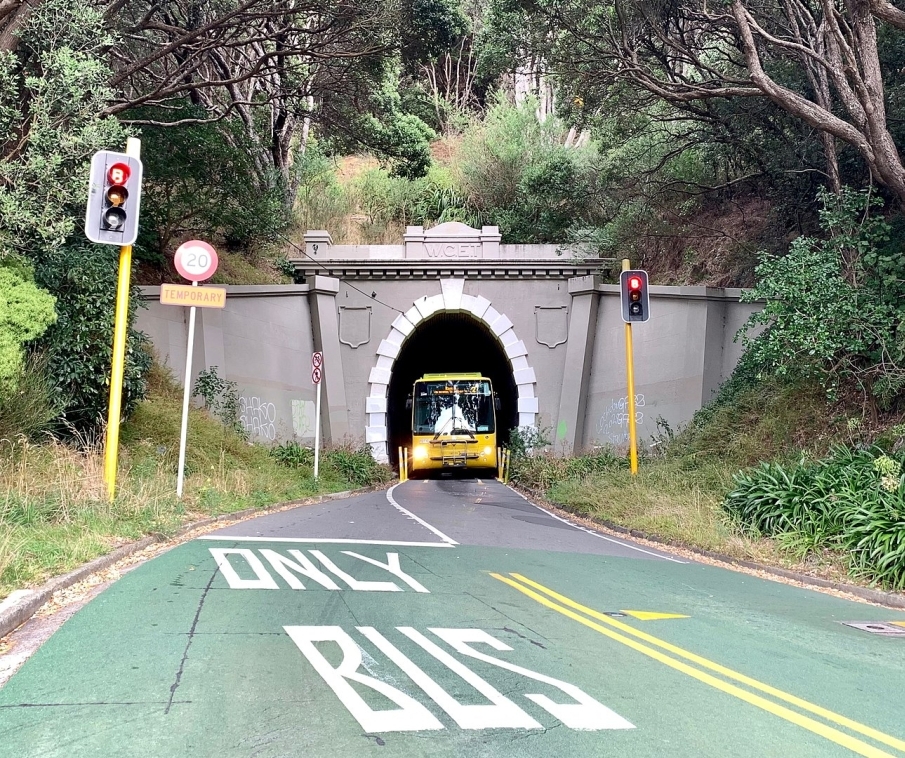
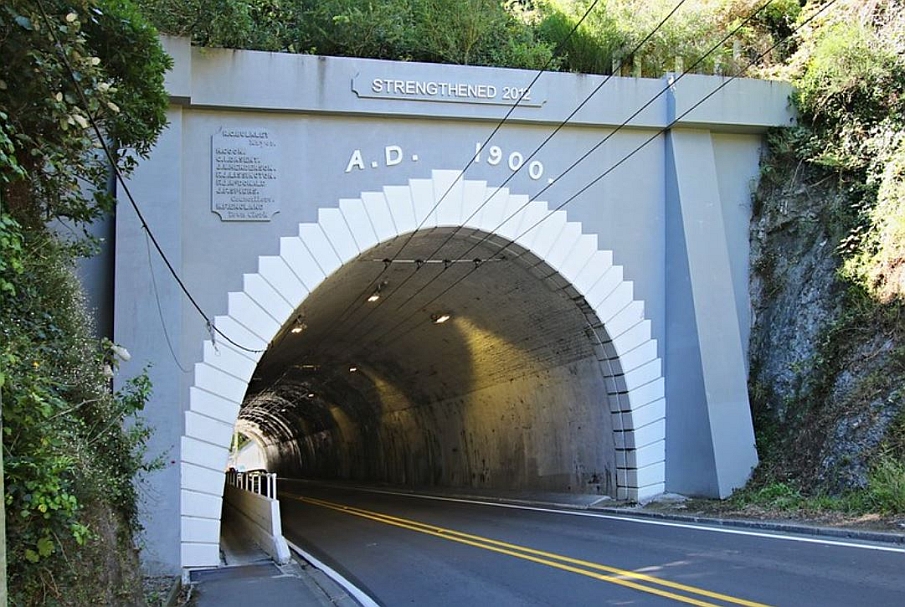
The Seatoun Tunnel was built in 1906-1907 by the Miramar Borough Council between the Wellington suburbs of Seatoun and Strathmore. Its construction was a crucial step in the opening up of the Seatoun area to suburban development. The tunnel has remained the suburb’s main access point and so has been a significant piece of the city’s transport infrastructure for over a century. It is also historically significant as a remnant of Wellington’s tram system, and the now-defunct Miramar Borough Council. It is one of three tunnels built around the same time providing access to the hilly districts of Wellington. The tunnel has minimal ornamentation except raised voussoir decorations (traditionally made of stone blocks, but in this case created in concrete) with the date ‘AD 1906’ on both portal ends. The brick lining of the tunnel can still be clearly seen.
In 1904 Wellington City Council began the process of building its first electric tramway, replacing its existing horse and steam trams. The Miramar Borough Council, which governed the Miramar peninsula at the time, followed suit, building its own tramway to meet the City Council’s routes and take trams into Seatoun and Miramar. The Borough Council took out a controversial large loan to construct the tramway, with further funds coming from Miramar land syndicates, which stood to make money from the sale of house sections on the peninsula.
The Seatoun tunnel was begun in 1906 and opened in 1907. Work was slow due to the hard rock and the death of two lead contractors. To open the tunnel, the first tramcar to Seatoun travelled up what is now Broadway in Strathmore and broke through a ribbon stretched across the tunnel mouth. The tunnel measured 144m (470 feet) long, and 8.2m (27 feet) wide. At the time it opened it was said to be ‘the widest tunnel in Australasia’.
The Borough Council kept their tramway within its own management, even though it was an expensive asset for the small council. Having two councils running the system meant travellers had to buy separate tickets for the same trip, a source of constant complaints. However, the tramway was the making of the peninsula, allowing much greater urbanisation of the suburbs. Miramar Borough Council amalgamated with the Wellington City Council in February 1921, and the ownership of the tram infrastructure, including the tunnel, was transferred to Wellington’s council. Little remains of the Miramar Borough Council’s tram system; this tunnel and a bus shelter in Miramar being the notable exceptions. Trams travelled to the eastern suburbs until 1957-58, when the construction of the Wellington airport required the destruction of the tramlines; the tracks were removed from the tunnel and overhead trolley-bus lines installed instead. The tunnel has since been used by buses, cars and pedestrians; although it originally had footpaths on either side, it now has only one. In the 2010s assessments found some structural elements of the tunnel could be seismically vulnerable and remedial work is planned at the time of writing (2019).
In 1904 Wellington City Council began the process of building its first electric tramway, replacing its existing horse and steam trams. The Miramar Borough Council, which governed the Miramar peninsula at the time, followed suit, building its own tramway to meet the City Council’s routes and take trams into Seatoun and Miramar. The Borough Council took out a controversial large loan to construct the tramway, with further funds coming from Miramar land syndicates, which stood to make money from the sale of house sections on the peninsula.
The Seatoun tunnel was begun in 1906 and opened in 1907. Work was slow due to the hard rock and the death of two lead contractors. To open the tunnel, the first tramcar to Seatoun travelled up what is now Broadway in Strathmore and broke through a ribbon stretched across the tunnel mouth. The tunnel measured 144m (470 feet) long, and 8.2m (27 feet) wide. At the time it opened it was said to be ‘the widest tunnel in Australasia’.
The Borough Council kept their tramway within its own management, even though it was an expensive asset for the small council. Having two councils running the system meant travellers had to buy separate tickets for the same trip, a source of constant complaints. However, the tramway was the making of the peninsula, allowing much greater urbanisation of the suburbs. Miramar Borough Council amalgamated with the Wellington City Council in February 1921, and the ownership of the tram infrastructure, including the tunnel, was transferred to Wellington’s council. Little remains of the Miramar Borough Council’s tram system; this tunnel and a bus shelter in Miramar being the notable exceptions. Trams travelled to the eastern suburbs until 1957-58, when the construction of the Wellington airport required the destruction of the tramlines; the tracks were removed from the tunnel and overhead trolley-bus lines installed instead. The tunnel has since been used by buses, cars and pedestrians; although it originally had footpaths on either side, it now has only one. In the 2010s assessments found some structural elements of the tunnel could be seismically vulnerable and remedial work is planned at the time of writing (2019).