DonateMembershipVisit Heritage
  • Tūrangawaewae
    Places
  • Tira Māori
    Māori Heritage
  • Poutairangahia
    Archaeology
  • Rauemi
    Resources
  • Mō Tātou
    About Us
  • New Zealand Heritage List
  • Nominate and submit
  • Explore the List
  • National Historic Landmarks
  • Plaques
  • Rainbow List Project
  • Lost heritage
  • Visit Heritage
  • Our properties
  • Turnbull House Project
  • Collections
  • Shop
  • Tohu Whenua
  • Tira Māori
  • Conserving Māori heritage
  • Marae built heritage
  • Māori heritage on the List
  • Hinemihi—Te Hokinga Mai
  • What is archaeology?
  • Is there a site on my property?
  • What are my legal requirements?
  • Affecting an archaeological site
  • Declaring an archaeological site
  • Archaeology FAQs
  • Archaeology Digital Library
  • Archaeology guidelines and templates
  • Resources
  • Funding
  • Publications
  • Sustainable management guides
  • Disaster recovery
  • Podcasts & digital resources
  • Education Hub
  • Conservation plans
  • About
  • Board
  • Māori Heritage Council
  • Senior Staff
  • Offices
  • Contact us
  • Careers
  • Covenants
  • Fast-track
  • Corporate documents
  • Currently consulting on
  • Our submissions
  • News
  • Covid-19 response
Quick links
Rārangi Kōrero | The List
Explore the List
National Historic Landmarks
Ngā Manawhenua o Aotearoa me ōna Kōrero Tūturu
Quick links
Tapuwae
A Vision for Places of Māori Heritage
Funding for Māori Heritage
Resources
Quick links
Archaeological Authority Portal
Applying for an archaeological authority
Archaeology FAQs
Browse the most frequently asked questions about archaeological authorities and the archaeological process.
Quick links
Quick links
News
News Keep up to date with Heritage New Zealand Pouhere Taonga
Membership
Membership Find out more and sign up today
DonateMembershipVisit Heritage
  • Tūrangawaewae
    Places
  • Tira Māori
    Māori Heritage
  • Poutairangahia
    Archaeology
  • Rauemi
    Resources
  • Mō Tātou
    About Us
  • New Zealand Heritage List
  • Nominate and submit
  • Explore the List
  • National Historic Landmarks
  • Plaques
  • Rainbow List Project
  • Lost heritage
  • Visit Heritage
  • Our properties
  • Turnbull House Project
  • Collections
  • Shop
  • Tohu Whenua
  • Tira Māori
  • Conserving Māori heritage
  • Marae built heritage
  • Māori heritage on the List
  • Hinemihi—Te Hokinga Mai
  • What is archaeology?
  • Is there a site on my property?
  • What are my legal requirements?
  • Affecting an archaeological site
  • Declaring an archaeological site
  • Archaeology FAQs
  • Archaeology Digital Library
  • Archaeology guidelines and templates
  • Resources
  • Funding
  • Publications
  • Sustainable management guides
  • Disaster recovery
  • Podcasts & digital resources
  • Education Hub
  • Conservation plans
  • About
  • Board
  • Māori Heritage Council
  • Senior Staff
  • Offices
  • Contact us
  • Careers
  • Covenants
  • Fast-track
  • Corporate documents
  • Currently consulting on
  • Our submissions
  • News
  • Covid-19 response
Quick links
Rārangi Kōrero | The List
Explore the List
National Historic Landmarks
Ngā Manawhenua o Aotearoa me ōna Kōrero Tūturu
Quick links
Tapuwae
A Vision for Places of Māori Heritage
Funding for Māori Heritage
Resources
Quick links
Archaeological Authority Portal
Applying for an archaeological authority
Archaeology FAQs
Browse the most frequently asked questions about archaeological authorities and the archaeological process.
Quick links
Quick links
News
News Keep up to date with Heritage New Zealand Pouhere Taonga
Membership
Membership Find out more and sign up today
  • Nominate and submit
  • National Historic Landmarks
  • Nominate and submit
  • National Historic Landmarks
  • Conserving Māori heritage
  • Marae built heritage
  • Conserving Māori heritage
  • Marae built heritage
  • Archaeological authorities
  • Archaeology Digital Library
  • Archaeological authorities
  • Archaeology Digital Library
  • All resources
  • Publications
  • Funding
  • All resources
  • Publications
  • Funding
  • FAQs
  • FAQs
Follow us on:
Places
  • Nominate and submit
  • National Historic Landmarks
Tira Māori
  • Conserving Māori heritage
  • Marae built heritage
Archaeology
  • Archaeological authorities
  • Archaeology Digital Library
Resources
  • All resources
  • Publications
  • Funding
FAQs
  • FAQs
Follow us on
HomePrivacyTerms and conditionsAbout this site
© Heritage New Zealand Pouhere Taonga 2026.
 
Mangahao Power Station Superintendent's House (Former)

1 Hay Street, MANGAORE

Private

Historic Place Category 2

List No. 4056

Quick links:
List GalleryLocationDetails
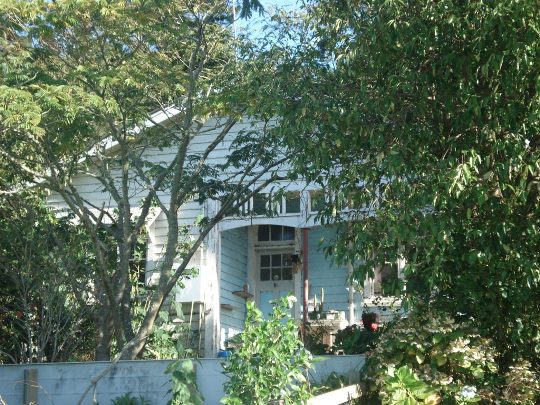
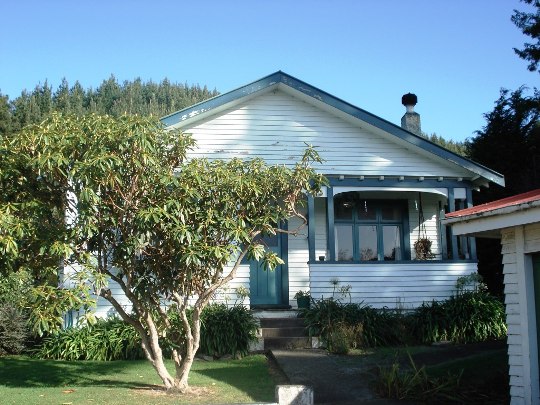
Constructed ca. 1922-23, the house built for use by the superintendent of the Mangahao Hydroelectric Power Station was the most distinctive of the early staff bungalows that comprised the new village of Mangaore, near Shannon. It has historical heritage value for its relationship to the significant Mangahao power scheme, which, supplying Wellington, Horowhenua, Taranaki, Hawke’s Bay and the Wairarapa, was the first of many large hydro power stations to be built in New Zealand under a Government-resourced plan to provide a national electricity supply. The bungalow also has some architectural heritage value as a representative example of a widespread early-twentieth-century residential building form.

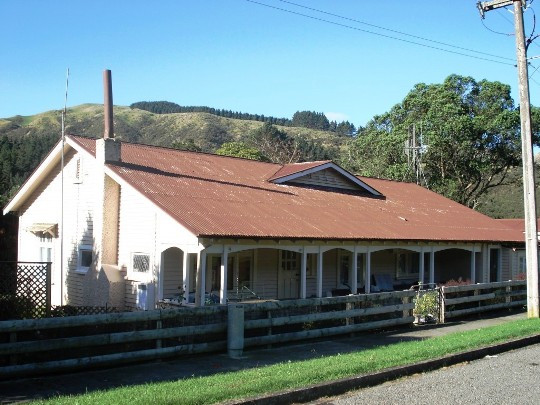
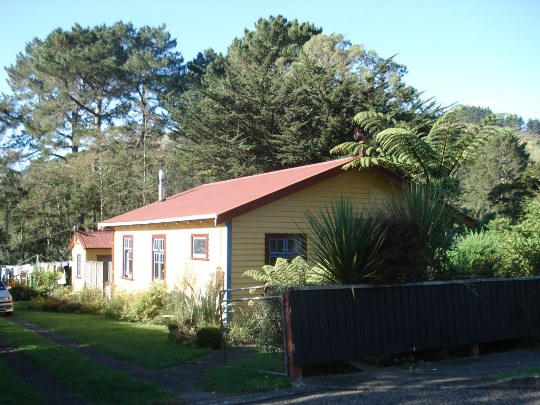
The beginning of a permanent settlement at Mangaore dates to 1919 when construction of the Mangahao hydroelectric power scheme began. By May 1920, three camps had been established at the principal work areas of the project. In addition to more modest worker housing, the original settlement at Mangaore also included a ‘village’ of permanent five-room bungalows. These were built for engineering staff working on the construction and, later, maintenance of the power plant.

In December 1922, the Press reported: ‘Mr A. Blackwood, superintending engineer at the Lake Coleridge power-station, has received notification of his transfer to the Mangahao power-station.’ Archibald ‘Archie’ Blackwood (1876-1951) installed the ‘plant’ or power generating components of the power-house and stayed on after completion to manage its operation. While the specifics of their relationship are not clear, it is wholly plausible that Frederick Kissel, the electrical engineer who designed the Mangahao power scheme, was primarily responsible for Blackwood’s move to Mangaore as they had worked together in similar roles at Lake Coleridge. At the party feting Blackwood and his family on their departure from Canterbury in April 1923, friends and co-workers praised Blackwood’s contributions to the field, as noted: ‘many interesting references were made to the pioneering work which had so capably been carried out, and brought to a successful issue under the superintendency of the departing guest.’ He transferred to the Mangahao project around the time that much progress was being made with the powerhouse construction and he would have been well settled by the time the generating equipment began to be installed.

The Public Works Department constructed a four-bedroom bungalow for the Blackwoods that was larger and showed a higher level of design than the other bungalows built at Mangaore. It is not known whether the distinctive house was a general perk of the position or a specific outcome of negotiations regarding his relocation; regardless, it provided ample room for Archie Blackwood, his wife ‘Lou,’ and their children. The December 1922 notice explained that Archie Blackwood would ‘take up his duties next month.’ The family’s departure party did not occur until April 1923, suggesting that even if Blackwood had started work the previous January the family did not relocate until April, perhaps because the house was not ready.

The superintendent’s house occupied a quiet section on the edge of Mangaore Village. Its form was more complicated than the other bungalows, featuring two front-facing gable roofs, slightly offset, and a cross-gable extension on the northwest wall. Design flourishes included scrolled trim around the inset porch, a front-facing bay window, and a small arched oriel window to the left of the porch. The house would have undoubtedly appealed to Lou Blackwood as the modern bungalow was touted as providing families with both ‘elegance and comfort.’

The staff houses at Mangaore were owned by a succession of government entities until sold off in the mid-1990s as part of the privatisation of New Zealand’s electricity sector. From the exterior, the house appears to remain in good condition and retains its original outbuilding and garage.
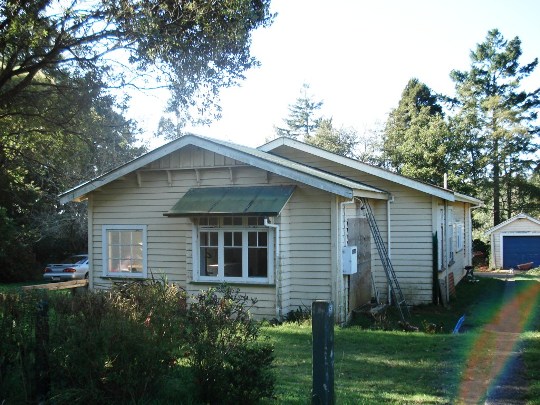
Mangahao Power Station Superintendent’s House (Former) | http://horowhenua.kete.net.nz/site/images/show/7042-1-hay-street

List Entry Information

Overview

Status
Listed

List Entry Status
Historic Place Category 2

Access
Private/No Public Access

List Number
4056

Date Entered
5th September 1985

Date of Effect
5th September 1985

City/District Council
Horowhenua District

Region
Horizons (Manawatū-Whanganui) Region

Extent of List Entry

Extent includes the land described as Lot 1 DP 71906 (RT WN41C/857), Wellington Land District, and the building known as Mangahao Power Station Superintendent’s House (Former) thereon.

Legal description

Lot 1 DP 71906 (RT WN41C/857), Wellington Land District

Detailed List Entry

Construction Professional

Name

Public Works Department

Type

Builder

Biography

No biography is currently available for this construction professional

Construction Details

Start Year

1922

Finish Year

1923

Type

Original Construction

Reference

Completion Date

2nd February 2017

Report Written By

James A. Jacobs

Information Sources

Salmond, 1986

Jeremy Salmond, Old New Zealand Houses 1800-1940, Auckland, 1986, Reed Methuen

Institute of Professional Engineers in NZ (IPENZ)

Institute of Professional Engineers in NZ

Te Ara - The Encyclopedia of New Zealand

www.TeAra.govt.nz

Report Written By

This place was identified as significant under previous legislation with different information requirements. It remains significant under the current legislation. There is opportunity under our legislation and policies to add to this information. Further information about this place may be available from the Central Regional Office of Heritage New Zealand Pouhere Taonga. Please note that entry on the New Zealand Heritage List/Rarangi Korero identifies only the heritage values of the property concerned, and should not be construed as advice on the state of the property, or as a comment of its soundness or safety, including in regard to earthquake risk, safety in the event of fire, or insanitary conditions. A fully referenced upgrade report is available on request from the Central region Office of Heritage New Zealand.

Further Information

Current Usages

Uses: Accommodation

Specific Usage: House

Former Usages

General Usage:: Accommodation

Specific Usage: House

Themes

Web Links

Overview

Status

Listed

List Entry Status

Historic Place Category 2

Access

Private/No Public Access

List Number

4056

Date Entered

5th September 1985

Date of Effect

5th September 1985

City/District Council

Horowhenua District

Region

Horizons (Manawatū-Whanganui) Region

Extent of List Entry

Extent includes the land described as Lot 1 DP 71906 (RT WN41C/857), Wellington Land District, and the building known as Mangahao Power Station Superintendent’s House (Former) thereon.

Legal description

Lot 1 DP 71906 (RT WN41C/857), Wellington Land District

Status

Listed

List Entry Status

Historic Place Category 2

Access

Private/No Public Access

List Number

4056

Date Entered

5th September 1985

Date of Effect

5th September 1985

City/District Council

Horowhenua District

Region

Horizons (Manawatū-Whanganui) Region

Extent of List Entry

Extent includes the land described as Lot 1 DP 71906 (RT WN41C/857), Wellington Land District, and the building known as Mangahao Power Station Superintendent’s House (Former) thereon.

Legal description

Lot 1 DP 71906 (RT WN41C/857), Wellington Land District

Construction Information

Construction Professional

Name

Public Works Department

Type

Builder

Biography

No biography is currently available for this construction professional

Construction Details

Start Year

1922

Finish Year

1923

Type

Original Construction

Construction Professional

Name

Public Works Department

Type

Builder

Biography

No biography is currently available for this construction professional

Construction Details

Start Year

1922

Finish Year

1923

Type

Original Construction

Reference

Historical and Associated Iwi / Hapū / Whānau

Completion Date

2nd February 2017

Report Written By

James A. Jacobs

Information Sources

Salmond, 1986

Jeremy Salmond, Old New Zealand Houses 1800-1940, Auckland, 1986, Reed Methuen

Institute of Professional Engineers in NZ (IPENZ)

Institute of Professional Engineers in NZ

Te Ara - The Encyclopedia of New Zealand

www.TeAra.govt.nz

Other Information

This place was identified as significant under previous legislation with different information requirements. It remains significant under the current legislation. There is opportunity under our legislation and policies to add to this information. Further information about this place may be available from the Central Regional Office of Heritage New Zealand Pouhere Taonga. Please note that entry on the New Zealand Heritage List/Rarangi Korero identifies only the heritage values of the property concerned, and should not be construed as advice on the state of the property, or as a comment of its soundness or safety, including in regard to earthquake risk, safety in the event of fire, or insanitary conditions. A fully referenced upgrade report is available on request from the Central region Office of Heritage New Zealand.

Historical and Associated Iwi / Hapū / Whānau

Completion Date

2nd February 2017

Report Written By

James A. Jacobs

Information Sources

Salmond, 1986

Jeremy Salmond, Old New Zealand Houses 1800-1940, Auckland, 1986, Reed Methuen

Institute of Professional Engineers in NZ (IPENZ)

Institute of Professional Engineers in NZ

Te Ara - The Encyclopedia of New Zealand

www.TeAra.govt.nz

Other Information

This place was identified as significant under previous legislation with different information requirements. It remains significant under the current legislation. There is opportunity under our legislation and policies to add to this information. Further information about this place may be available from the Central Regional Office of Heritage New Zealand Pouhere Taonga. Please note that entry on the New Zealand Heritage List/Rarangi Korero identifies only the heritage values of the property concerned, and should not be construed as advice on the state of the property, or as a comment of its soundness or safety, including in regard to earthquake risk, safety in the event of fire, or insanitary conditions. A fully referenced upgrade report is available on request from the Central region Office of Heritage New Zealand.

Further Information

Current Usages

Uses: Accommodation

Specific Usage: House

Former Usages

General Usage: Accommodation

Specific Usage: House

Current Usages

Uses: Accommodation

Specific Usage: House

Former Usages

General Usage: Accommodation

Specific Usage: House

Location

Loading
Related listings
House
House
House
House
Staff Hostel (Former)
House
House
House. 1996
House
Mangahao Hydroelectric Power Station
House
House
House
House
House. 1996
House
House
House
Mangahao Hydroelectric Power Station
Staff Hostel (Former)
Stay up to date with Heritage this month