DonateSupporterVisit Heritage
  • Tūrangawaewae
    Places
  • Tira Māori
    Māori Heritage
  • Poutairangahia
    Archaeology
  • Rauemi
    Resources
  • Mō Tātou
    About Us
  • New Zealand Heritage List
  • Nominate and submit
  • Explore the List
  • National Historic Landmarks
  • Plaques
  • Rainbow List Project
  • Lost heritage
  • Visit Heritage
  • Our properties
  • Turnbull House Project
  • Collections
  • Shop
  • Tohu Whenua
  • Tira Māori
  • Conserving Māori heritage
  • Marae built heritage
  • Māori heritage on the List
  • Hinemihi—Te Hokinga Mai
  • What is archaeology?
  • Is there a site on my property?
  • What are my legal requirements?
  • Affecting an archaeological site
  • Declaring an archaeological site
  • Archaeology FAQs
  • Archaeology Digital Library
  • Archaeology guidelines and templates
  • Resources
  • Funding
  • Publications
  • Sustainable management guides
  • Disaster recovery
  • Podcasts & digital resources
  • Education Hub
  • Conservation plans
  • About
  • Board
  • Māori Heritage Council
  • Senior Staff
  • Offices
  • Contact us
  • Careers
  • Covenants
  • Fast-track
  • Corporate documents
  • Currently consulting on
  • Our submissions
  • News
  • Covid-19 response
Quick links
Rārangi Kōrero | The List
Explore the List
National Historic Landmarks
Ngā Manawhenua o Aotearoa me ōna Kōrero Tūturu
Quick links
Tapuwae
A Vision for Places of Māori Heritage
Funding for Māori Heritage
Resources
Quick links
Archaeological Authority Portal
Applying for an archaeological authority
Archaeology FAQs
Browse the most frequently asked questions about archaeological authorities and the archaeological process.
Quick links
Quick links
Contact us
Offices
DonateSupporterVisit Heritage
  • Tūrangawaewae
    Places
  • Tira Māori
    Māori Heritage
  • Poutairangahia
    Archaeology
  • Rauemi
    Resources
  • Mō Tātou
    About Us
  • New Zealand Heritage List
  • Nominate and submit
  • Explore the List
  • National Historic Landmarks
  • Plaques
  • Rainbow List Project
  • Lost heritage
  • Visit Heritage
  • Our properties
  • Turnbull House Project
  • Collections
  • Shop
  • Tohu Whenua
  • Tira Māori
  • Conserving Māori heritage
  • Marae built heritage
  • Māori heritage on the List
  • Hinemihi—Te Hokinga Mai
  • What is archaeology?
  • Is there a site on my property?
  • What are my legal requirements?
  • Affecting an archaeological site
  • Declaring an archaeological site
  • Archaeology FAQs
  • Archaeology Digital Library
  • Archaeology guidelines and templates
  • Resources
  • Funding
  • Publications
  • Sustainable management guides
  • Disaster recovery
  • Podcasts & digital resources
  • Education Hub
  • Conservation plans
  • About
  • Board
  • Māori Heritage Council
  • Senior Staff
  • Offices
  • Contact us
  • Careers
  • Covenants
  • Fast-track
  • Corporate documents
  • Currently consulting on
  • Our submissions
  • News
  • Covid-19 response
Quick links
Rārangi Kōrero | The List
Explore the List
National Historic Landmarks
Ngā Manawhenua o Aotearoa me ōna Kōrero Tūturu
Quick links
Tapuwae
A Vision for Places of Māori Heritage
Funding for Māori Heritage
Resources
Quick links
Archaeological Authority Portal
Applying for an archaeological authority
Archaeology FAQs
Browse the most frequently asked questions about archaeological authorities and the archaeological process.
Quick links
Quick links
Contact us
Offices
  • Places
  • Nominate and submit
  • National Historic Landmarks
  • Places
  • Nominate and submit
  • National Historic Landmarks
  • Tira Māori
  • Conserving Māori heritage
  • Marae built heritage
  • Tira Māori
  • Conserving Māori heritage
  • Marae built heritage
  • Archaeological authorities
  • Archaeology Digital Library
  • Archaeological authorities
  • Archaeology Digital Library
  • All resources
  • Publications
  • Funding
  • All resources
  • Publications
  • Funding
  • FAQs
  • FAQs
Follow us on:
Places
  • Places
  • Nominate and submit
  • National Historic Landmarks
Tira Māori
  • Tira Māori
  • Conserving Māori heritage
  • Marae built heritage
Archaeology
  • Archaeological authorities
  • Archaeology Digital Library
Resources
  • All resources
  • Publications
  • Funding
FAQs
  • FAQs
Follow us on
HomePrivacyTerms and conditionsAbout this site
© Heritage New Zealand Pouhere Taonga 2026.
 
South End Signal Box

North Island Main Trunk Line, State Highway 59, Beach Road and Tilley Road, PAEKĀKĀRIKI

Private

Historic Place Category 1

List No. 4706

Quick links:
List GalleryLocationDetails
Between 1910 and 1985 the South End Signal Box at Paekakariki Railway Station was the main control centre for trains travelling through Paekakariki on the Manawatu Railway line. It is now a relatively rare, remaining example of the once common signal box.

The Manawatu Railway line was built and operated by the Wellington & Manawatu Railway Company and was extended as far as Paekakariki in 1886. In 1908 the Government purchased the line from the company and the Railways Department embarked on an extensive programme to upgrade facilities at Paekakariki Station. As well as constructing two signal boxes and several new buildings, the Department spent £2,500 on installing the newly developed 'electric train tablet signalling system'. Controlled by the signal boxes, the electric train tablet signalling system was designed to prevent crashes by ensuring that trains travelling in and out of the station maintained a safe distance from each other.

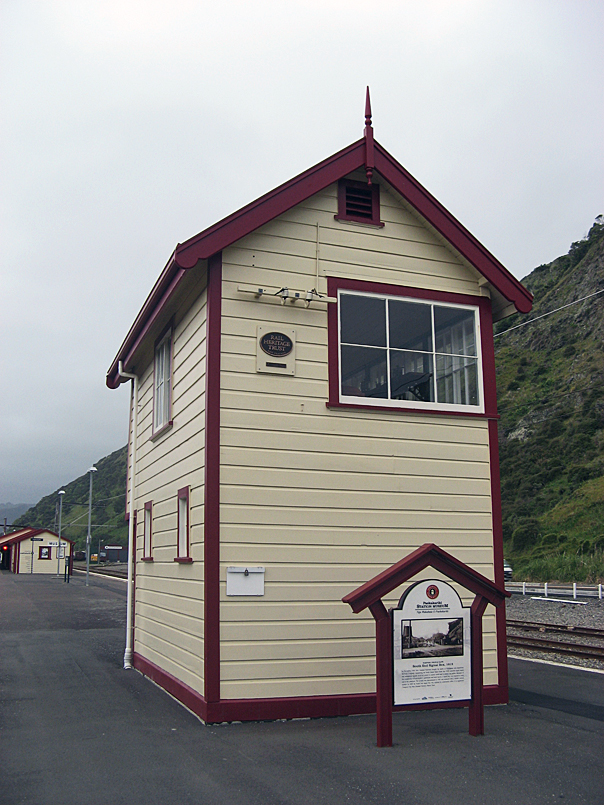
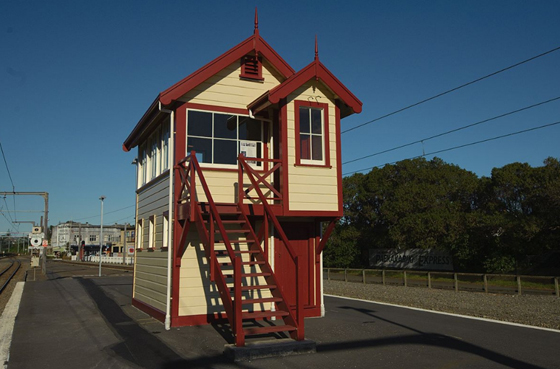
Signal boxes were constructed to a standard design throughout the country and the South End Signal Box is a typical example. The South End Signal Box was a two storey, timber building. It was 8 metres high and consisted of two small rooms which measured 3.4 metres by 4.9 metres. Access to the upper storey was via an external, dogleg staircase and it featured large, continuous windows that gave the signalman an excellent view of the railway line. From the South End Signal Box all train movements on the main-line were monitored and controlled with the aid of a 24-lever operating system that was linked to the North End Signal Box, and the station signals and points. To prevent accidents, an interlocking system on the ground floor ensured that the signalman could not mistakenly send signals that would allow two trains to proceed along a piece of track in opposing directions at the same time.

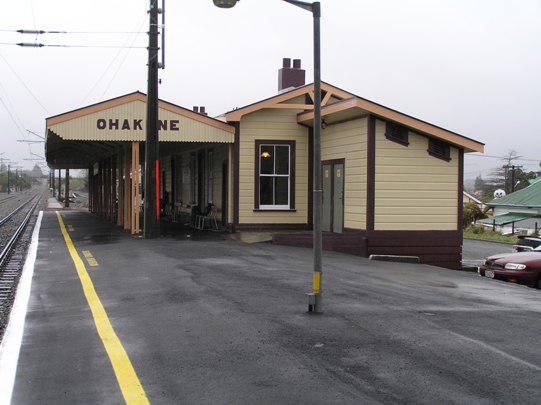
The signal boxes and signalling system came into use on 31 January 1910. Upgraded a number of times, the South End Signal Box remained in use until 1985, when the 'Central Traffic Control System' (CTC) finally reached Paekakariki. First used in the early 1940s, CTC allowed all signals along a railway line to be remotely controlled from the Train Control office in Wellington, effectively removing signalling responsibilities from individual railway stations. Made redundant by CTC, Paekakariki's North End Signal Box was removed, and is now part of the historic Ohakune Railway Station complex. The South End Signal Box, owned by the Paekakariki Station Precinct Trust was relocated to railway land north of the station and then across the rail tracks adjacent to the station car park. It has been fully restored by local community efforts and returned to the south end of the station platform to its original siting in December 2007. It was re-opened on 6 August 2008, coinciding with the centennial of the North Island Main Trunk Line when a Parliamentary Special Steam Train stopped at Paekakariki Station for the unveiling.

The South End Signal Box has national significance as a rare, remaining example of the signal boxes that controlled train movements throughout New Zealand in the early twentieth-century. One of the few still located near its original site, the Signal Box is part of an important railway complex that adds significant insight into its traditional function and increases its educational potential. The Signal Box has historical significance for its association with the development of the North Island Main Trunk Line and technological advances on the New Zealand railway. The Signal Box is also of considerable physical interest as it is in close to its original form and still contains the levers and interlocking system that controlled the station signals and points.
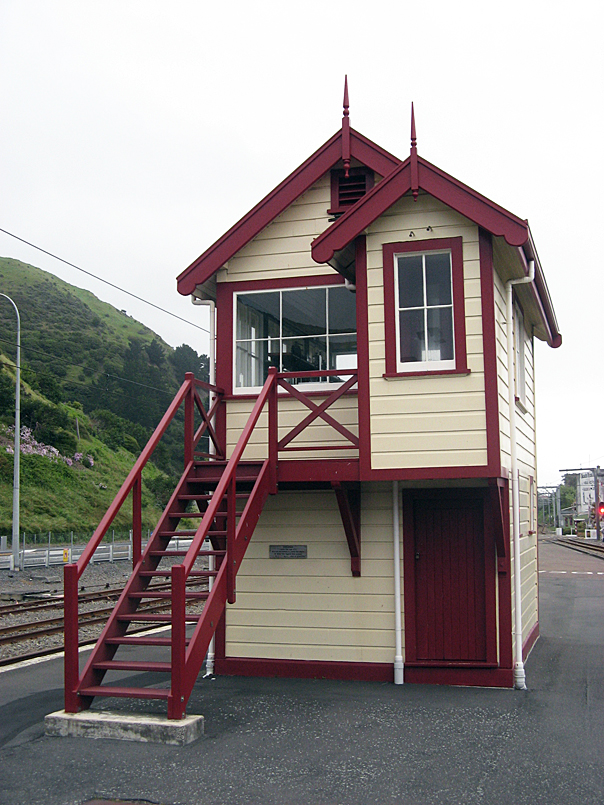
South End Signal Box, Paekakariki | B Wagstaff | 22/10/2013 | Heritage New Zealand
South End Signal Box, Paekakariki. Image courtesy of commons.wikimedia.org | Karora | 22/09/2012 | Public Domain
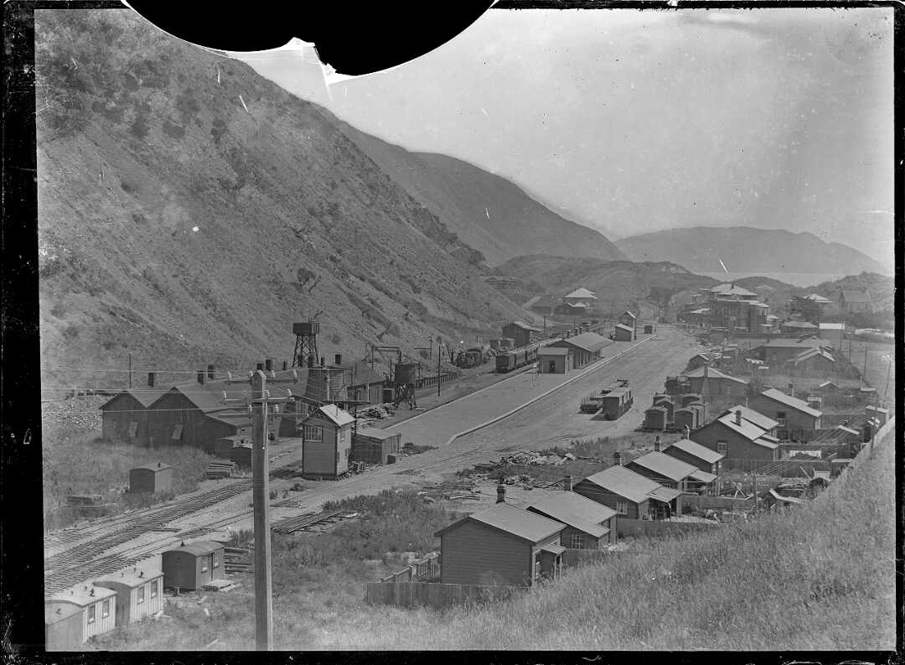
South End Signal Box, Paekakariki. View of Paekakariki railway station and houses, looking south, in January 1910. Ref: APG-0393-1/2-G | Unknown | 01/01/1910 | Alexander Turnbull Library, Wellington, N.Z.
South End Signal Box, Paekakariki | B Wagstaff | 22/10/2013 | Heritage New Zealand
South End Signal Box, Paekakariki. Image courtesy of commons.wikimedia.org | Karora | 22/09/2012 | Public Domain
South End Signal Box, Paekakariki. View of Paekakariki railway station and houses, looking south, in January 1910. Ref: APG-0393-1/2-G | Unknown | 01/01/1910 | Alexander Turnbull Library, Wellington, N.Z.

List Entry Information

Overview

Status
Listed

List Entry Status
Historic Place Category 1

Access
Private/No Public Access

List Number
4706

Date Entered
25th September 1986

Date of Effect
25th September 1986

City/District Council
Kāpiti Coast District

Region
Wellington Region

Extent of List Entry

Extent includes part of the land described as Railway Land, and the building known as South End Signal Box thereon. Refer to the extent map tabled at the Rārangi Kōrero Committee meeting on 30 May 2024.

Legal description

Railway Land

Location Description

The signal box is located approximately 250 metres north of the main station platform, between the main trunk southbound lines and the sidings used by Steam Incorporated.

Detailed List Entry

Construction Details

Start Year

1909

Type

Original Construction

Start Year

1918

Type

Modification

Description

Signals and interlocking system rearranged; two additional signals incorporated

Start Year

1943

Type

Modification

Description

Installation of electric frame and interlocking system

Start Year

1946

Type

Modification

Description

Addition of a small, rectangular concrete structure in front of the box

Type

Modification

Description

Roof replaced with corrugated asbestos cement sheeting

Start Year

1962

Type

Modification

Description

Departure signals changed to double-unit signals

Start Year

1986

Type

Relocation

Type

Modification

Description

External staircase and finials removed; windows boarded over

Start Year

2003

Type

Relocation

Description

Relocated adjacent to station car park.

Start Year

2007

Type

Reconstruction

Description

Fully restored by local community and returned to original site.

Construction Materials

The Signal Box is a two-storey structure. It has a timber frame and is clad in timber, rusticated weatherboards. The interior linings are tongue and groove boarding. It has a roof of corrugated asbestos concrete sheeting. The structure has no ground floor framing as it was built directly over the ground of the platform. It now rests on a concrete foundation. It is 4.9 metres long and 3.4 metres wide. It reaches a height of approximately 8 metres. Inside the Signal Box is a 24 lever, electric operating system.

Notable Features

The interior of the building features a 24 lever, electric operating system

Reference

Completion Date

11th August 2008

Report Written By

Rebecca O'Brien

Information Sources

Cassells, 1994

K. R. Cassells, Uncommon Carrier, the history of the Wellington and Manawatu Railway Co. 1882-1908, Wellington, 1994

Churchman, 1990

Geoffrey B. Churchman and Tony Hurst, 'The Railways of New Zealand, a journey through history', Auckland, 1990

New Zealand Railway Observer

New Zealand Railway Observer

Conservation Plan

Conservation Plan

Report Written By

This place was identified as significant under previous legislation with different information requirements. It remains significant under the current legislation. There is opportunity under our legislation and policies to add to this information. Further information about this place may be available from the Central Regional Office of Heritage New Zealand Pouhere Taonga. A fully referenced version of this report is available from the NZHPT Central Region office Please note that entry on the New Zealand Heritage List/Rarangi Korero identifies only the heritage values of the property concerned, and should not be construed as advice on the state of the property, or as a comment of its soundness or safety, including in regard to earthquake risk, safety in the event of fire, or insanitary conditions.

Further Information

Current Usages

Former Usages

Themes

North Island Main Trunk Line

Web Links

Overview

Status

Listed

List Entry Status

Historic Place Category 1

Access

Private/No Public Access

List Number

4706

Date Entered

25th September 1986

Date of Effect

25th September 1986

City/District Council

Kāpiti Coast District

Region

Wellington Region

Extent of List Entry

Extent includes part of the land described as Railway Land, and the building known as South End Signal Box thereon. Refer to the extent map tabled at the Rārangi Kōrero Committee meeting on 30 May 2024.

Legal description

Railway Land

Location Description

The signal box is located approximately 250 metres north of the main station platform, between the main trunk southbound lines and the sidings used by Steam Incorporated.

Status

Listed

List Entry Status

Historic Place Category 1

Access

Private/No Public Access

List Number

4706

Date Entered

25th September 1986

Date of Effect

25th September 1986

City/District Council

Kāpiti Coast District

Region

Wellington Region

Extent of List Entry

Extent includes part of the land described as Railway Land, and the building known as South End Signal Box thereon. Refer to the extent map tabled at the Rārangi Kōrero Committee meeting on 30 May 2024.

Legal description

Railway Land

Location Description

The signal box is located approximately 250 metres north of the main station platform, between the main trunk southbound lines and the sidings used by Steam Incorporated.

Construction Information

Construction Details

Start Year

1909

Type

Original Construction

Start Year

1918

Type

Modification

Description

Signals and interlocking system rearranged; two additional signals incorporated

Start Year

1943

Type

Modification

Description

Installation of electric frame and interlocking system

Start Year

1946

startYearCirca

Type

Modification

Description

Addition of a small, rectangular concrete structure in front of the box

Type

Modification

Description

Roof replaced with corrugated asbestos cement sheeting

Start Year

1962

Type

Modification

Description

Departure signals changed to double-unit signals

Start Year

1986

Type

Relocation

Type

Modification

Description

External staircase and finials removed; windows boarded over

Start Year

2003

Type

Relocation

Description

Relocated adjacent to station car park.

Start Year

2007

Type

Reconstruction

Description

Fully restored by local community and returned to original site.

Construction Materials

The Signal Box is a two-storey structure. It has a timber frame and is clad in timber, rusticated weatherboards. The interior linings are tongue and groove boarding. It has a roof of corrugated asbestos concrete sheeting. The structure has no ground floor framing as it was built directly over the ground of the platform. It now rests on a concrete foundation. It is 4.9 metres long and 3.4 metres wide. It reaches a height of approximately 8 metres. Inside the Signal Box is a 24 lever, electric operating system.

Notable Features

The interior of the building features a 24 lever, electric operating system

Construction Details

Start Year

1909

Type

Original Construction

Start Year

1918

Type

Modification

Description

Signals and interlocking system rearranged; two additional signals incorporated

Start Year

1943

Type

Modification

Description

Installation of electric frame and interlocking system

Start Year

1946

startYearCirca

Type

Modification

Description

Addition of a small, rectangular concrete structure in front of the box

Type

Modification

Description

Roof replaced with corrugated asbestos cement sheeting

Start Year

1962

Type

Modification

Description

Departure signals changed to double-unit signals

Start Year

1986

Type

Relocation

Type

Modification

Description

External staircase and finials removed; windows boarded over

Start Year

2003

Type

Relocation

Description

Relocated adjacent to station car park.

Start Year

2007

Type

Reconstruction

Description

Fully restored by local community and returned to original site.

Construction Materials

The Signal Box is a two-storey structure. It has a timber frame and is clad in timber, rusticated weatherboards. The interior linings are tongue and groove boarding. It has a roof of corrugated asbestos concrete sheeting. The structure has no ground floor framing as it was built directly over the ground of the platform. It now rests on a concrete foundation. It is 4.9 metres long and 3.4 metres wide. It reaches a height of approximately 8 metres. Inside the Signal Box is a 24 lever, electric operating system.

Notable Features

The interior of the building features a 24 lever, electric operating system

Reference

Historical and Associated Iwi / Hapū / Whānau

Completion Date

11th August 2008

Report Written By

Rebecca O'Brien

Information Sources

Cassells, 1994

K. R. Cassells, Uncommon Carrier, the history of the Wellington and Manawatu Railway Co. 1882-1908, Wellington, 1994

Churchman, 1990

Geoffrey B. Churchman and Tony Hurst, 'The Railways of New Zealand, a journey through history', Auckland, 1990

New Zealand Railway Observer

New Zealand Railway Observer

Conservation Plan

Conservation Plan

Other Information

This place was identified as significant under previous legislation with different information requirements. It remains significant under the current legislation. There is opportunity under our legislation and policies to add to this information. Further information about this place may be available from the Central Regional Office of Heritage New Zealand Pouhere Taonga. A fully referenced version of this report is available from the NZHPT Central Region office Please note that entry on the New Zealand Heritage List/Rarangi Korero identifies only the heritage values of the property concerned, and should not be construed as advice on the state of the property, or as a comment of its soundness or safety, including in regard to earthquake risk, safety in the event of fire, or insanitary conditions.

Historical and Associated Iwi / Hapū / Whānau

Completion Date

11th August 2008

Report Written By

Rebecca O'Brien

Information Sources

Cassells, 1994

K. R. Cassells, Uncommon Carrier, the history of the Wellington and Manawatu Railway Co. 1882-1908, Wellington, 1994

Churchman, 1990

Geoffrey B. Churchman and Tony Hurst, 'The Railways of New Zealand, a journey through history', Auckland, 1990

New Zealand Railway Observer

New Zealand Railway Observer

Conservation Plan

Conservation Plan

Other Information

This place was identified as significant under previous legislation with different information requirements. It remains significant under the current legislation. There is opportunity under our legislation and policies to add to this information. Further information about this place may be available from the Central Regional Office of Heritage New Zealand Pouhere Taonga. A fully referenced version of this report is available from the NZHPT Central Region office Please note that entry on the New Zealand Heritage List/Rarangi Korero identifies only the heritage values of the property concerned, and should not be construed as advice on the state of the property, or as a comment of its soundness or safety, including in regard to earthquake risk, safety in the event of fire, or insanitary conditions.

Further Information

Themes

North Island Main Trunk Line

Themes

North Island Main Trunk Line

Location

Loading
Related listings
Paekakariki Railway Station
Paekākāriki Railway Station
Ohakune Railway Station
Paekakariki Railway Yard Water Vats
Paekākāriki Railway Yard Water Vats
Paekakariki Railway Station and Yard Historic Area
Paekākāriki Railway Station and Yard Historic Area
North Island Main Trunk (NIMT) Historic Area. (New) Hapuawhenua Viaduct from (Old) Hapuawhenua Viaduct
North Island Main Trunk (NIMT) Historic Area
Paekakariki Railway Yard Water Vats
Paekākāriki Railway Yard Water Vats
Paekakariki Railway Station
Paekākāriki Railway Station
Paekakariki Railway Station and Yard Historic Area
Paekākāriki Railway Station and Yard Historic Area
Ohakune Railway Station
North Island Main Trunk (NIMT) Historic Area. (New) Hapuawhenua Viaduct from (Old) Hapuawhenua Viaduct
North Island Main Trunk (NIMT) Historic Area
Sign up to hear more

Get the latest heritage news, features and events delivered
straight to your inbox.

Subscribe