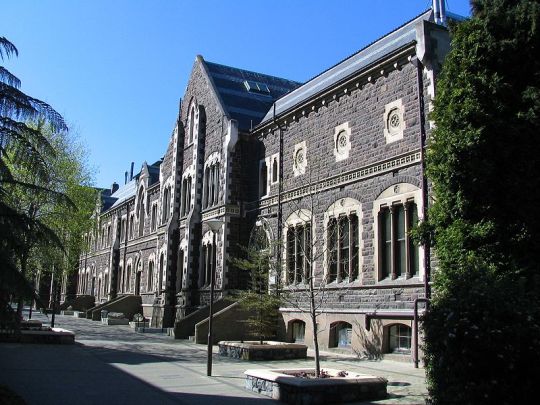
Prof John Halliday Scott (1851-1914) arrived at the University in 1877 where he taught anatomy and physiology at the first University building on Princes Street. When he arrived the medical school did not yet exist, there were five students and he was the sole staff member responsible for all teaching and administration. In March 1883 the University Council applied to the senate of the University of New Zealand for recognition of the University of Otago as a Medical School, which was granted. The medical school was originally sited in the Geology Block (List No.4765) by 1913 the school had 140 students, and despite several additions, the building was no longer adequate. A government grant of £10,000 ($1,562,389) was obtained for further extentions to the medical school on the university campus and after some opposition it was decided to construct a new building closer to the hospital. Scott died in 1914 and Sir Lindo Ferguson (1858-1948) then became Dean. The idea of having a new building for Pathology and Bacteriology near the hospital was posited by the sub-dean, Professor Sydney Champtaloup (1880-1921). His brochure targeting citizens was published in 1914 and raised £10,000 ($1,562,388). After visiting overseas universities he drew up specifications for the new building estimated at £13,000 ($2,031,105). The site was purchased from the Otago Hospital Board for £1,050 ($153,021). Mason and Wales won the commission for the design of the Scott Building. Problems later occurred with the discovery of springs when digging the foundations which cost an additional £1,000 ($145,735). The final cost of the building was £20,000 ($2,914,694).
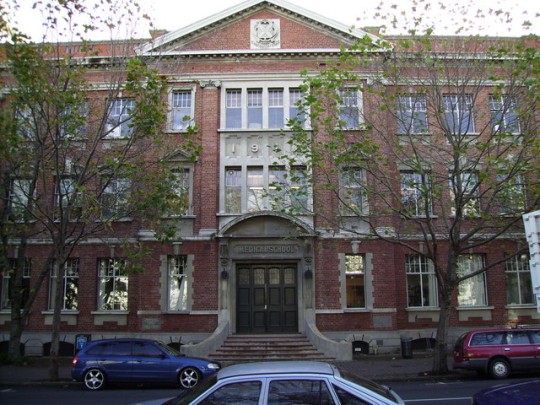
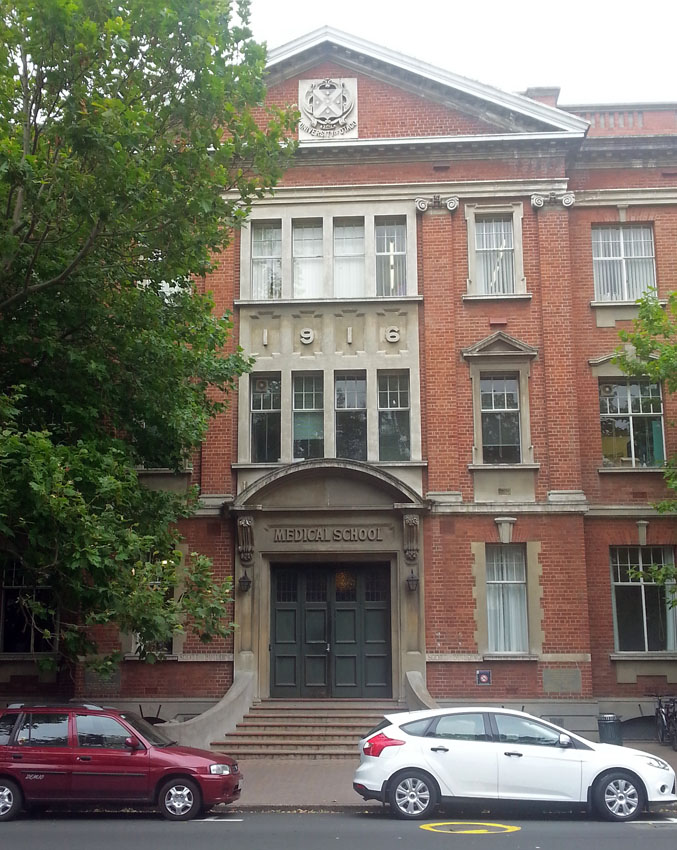
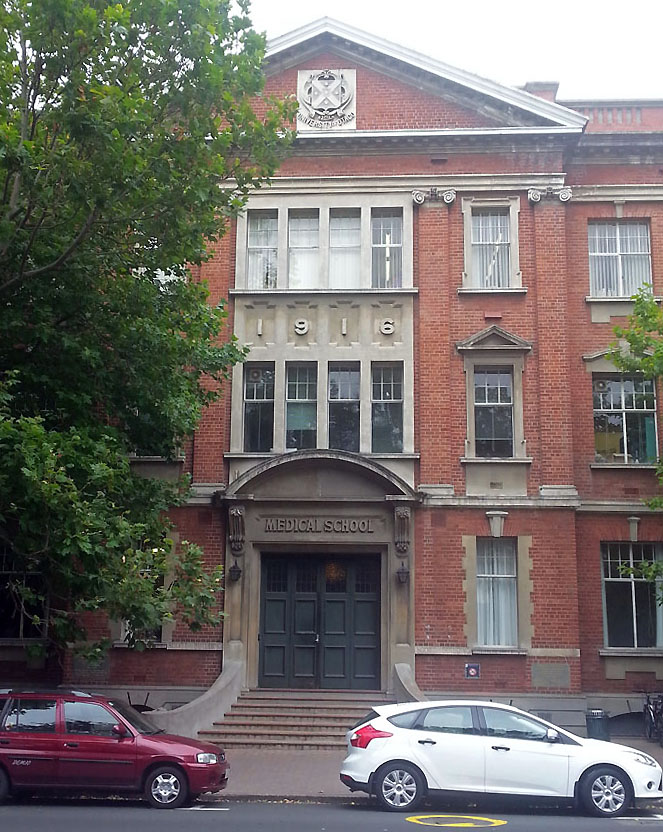
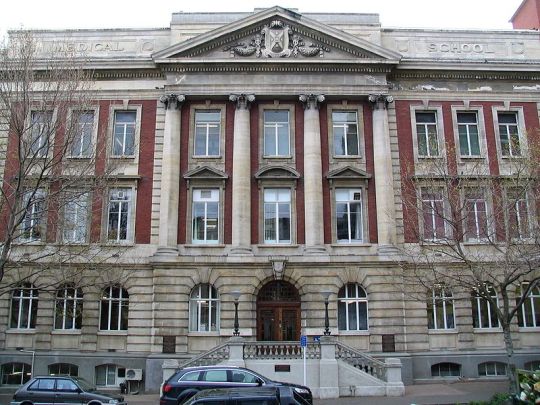
The Scott building marked the initiation of Dean Lindo Ferguson’s expansive masterplan for the Otago Medical School. The Scott is a three storey rectangular brick building with Ōamaru stone facings in a classical style. It displays three orders of fenestration with interesting drip molds on the some of the architraves of the second storey. The windows are steel framed. The projecting central portion of the the facade is surmounted by a dentilled pediment containing the University crest. Ionic capitals topping brick pilasters run beween the second and third floors either side of a central block of windows. Pilasters also feature on the corners of the projection. A dentilled cornice is topped by a brick parapet. The ground floor originally consisted of lecture rooms, student rooms, offices and a museum; the first floor held the Department of Pathology and library, the Professors office and lab, and the Materia Medica Museum; the second floor was mostly for Bacteriology and had a number of laborartories, private rooms, kitchen and preparatory spaces and store rooms. The flat roof held the animal houses and in the basement were storerooms and a darkroom. The oak internal entrance doors frame stained glass featuring the University crest and other decorative elements. There are elaborate decorative plaster ceilings showing Art Deco influence and decorative architraves, some archways retain decorative brackets. A hanging concrete staircase with steel and wood balustrade and decorative newal posts connects the floors and a large stained glass window in stairwell at the southern end of the building.
The Scott Building was the first University building to be built away from the central campus and is an important feature in the streetscape. Its proximity to the hospital was crucial to functioning of the medical curriculum and interactions with the hospital. Dean Lindo Ferguson’s Master Plan for the Otago Medical School eventuated in the building of the Hercus (1948), Scott (1917), Lindo Ferguson (1927), Sayers (1972) and Wellcome buildings (1963). This block is testiment to the imagination, vision and tenacity of Lindo Ferguson. The Scott Building continues to be an integral part of a working medical school and teaching and research space within the Division of Health Sciences at the University of Otago.
List Entry Information
Status
Listed
List Entry Status
Historic Place Category 2
Access
Private/No Public Access
List Number
4790
Date Entered
25th September 1986
Date of Effect
25th September 1986
City/District Council
Dunedin City
Region
Otago Region
Extent of List Entry
Extent includes the land described as Pt Sec 19 and Sec 18 Blk XXIII Town of Dunedin (RT OT177/177), Otago Land District and the building known as the Scott Building – Otago Medical School, thereon. Refer to the extent map tabled at the Heritage List/ Rārangi Kōrero Committee meeting on 30 July 2020.
Legal description
Pt Sec 19 and Sec 18 Blk XXIII Town of Dunedin (RT OT177/177), Otago Land District
Status
Listed
List Entry Status
Historic Place Category 2
Access
Private/No Public Access
List Number
4790
Date Entered
25th September 1986
Date of Effect
25th September 1986
City/District Council
Dunedin City
Region
Otago Region
Extent of List Entry
Extent includes the land described as Pt Sec 19 and Sec 18 Blk XXIII Town of Dunedin (RT OT177/177), Otago Land District and the building known as the Scott Building – Otago Medical School, thereon. Refer to the extent map tabled at the Heritage List/ Rārangi Kōrero Committee meeting on 30 July 2020.
Legal description
Pt Sec 19 and Sec 18 Blk XXIII Town of Dunedin (RT OT177/177), Otago Land District
Construction Professional
Name
Fletcher Construction Company
Type
Builder
Biography
Fletcher Construction Company was founded by Scottish-born James Fletcher (1886 - 1974), the son of a builder. Six months after his arrival in Dunedin in 1908, Fletcher formed a house-building partnership with Bert Morris. They soon moved into larger-scale construction work, building the St Kilda Town Hall (1911), and the main dormitory block and Ross Chapel at Knox College (1912). Fletcher's brothers, William, Andrew and John joined the business in 1911, which then became known as Fletcher Brothers. A branch was opened in Invercargill. While holidaying in Auckland in 1916, James tendered for the construction of the the Auckland City Markets. By 1919 the company, then known as Fletcher Construction, was firmly established in Auckland and Wellington. Notable landmarks constructed by the company during the Depression included the Auckland University College Arts Building (completed 1926); Landmark House (the former Auckland Electric Power Board Building, 1927); Auckland Civic Theatre (1929); the Chateau Tongariro (1929); and the Dominion Museum, Wellington (1934). Prior to the election of the first Labour Government, Fletcher (a Reform supporter) had advised the Labour Party on housing policy as hbe believed in large-scale planning and in the inter-dependence of government and business. However, he declined an approach by Prime Minister Michael Joseph Savage in December 1935 to sell the company to the government, when the latter wanted to ensure the large-scale production of rental state housing. Although Fletchers ultimately went on to build many of New Zealand's state houses, for several years Residential Construction Ltd (the subsidiary established to undertake their construction) sustained heavy financial losses. Fletcher Construction became a public company, Fletcher Holdings, in 1940. Already Fletchers' interests were wide ranging: brickyards, engineering shops, joinery factories, marble quarries, structural steel plants and other enterprises had been added the original construction firm. Further expansion could only be undertaken with outside capital. During the Second World War James Fletcher, having retired as chairman of Fletcher Holdings, was seconded to the newly created position of Commissioner of State Construction which he held during 1942 and 1943. Directly responsible to Prime Minister Peter Fraser, Fletcher had almost complete control over the deployment of workers and resources. He also became the Commissioner of the Ministry of Works, set up in 1943, a position he held until December 1945. In 1981 Fletcher Holdings; Tasman Pulp and Paper; and Challenge Corporation amalgamated to form Fletcher Challenge Ltd, at that time New Zealand's largest company. Williamson Construction Company - main contract
Name
Mason & Wales Architects Ltd
Type
Architectural Partnership
Biography
Mason and Wales Architects Ltd is the oldest architectural practice in New Zealand, having been founded by William Mason (1810-1897) in 1862 Dunedin. Mason was born in England, studied under Peter Nicholson and worked under Thomas Telford and Edward Blore. In 1838 he immigrated to New South Wales, and came to New Zealand in 1840. Having spent 22 years in Auckland he went to Dunedin at the time of the gold discoveries and was elected the first mayor of Dunedin in 1865. He was active in politics as well as in architecture. Mason was in partnership firstly with David Ross (1827-1908) and William Henry Clayton (1823-1877) and he took in N.Y.A. Wales (1832-1903) when Clayton left the firm to become Colonial Architect in Wellington. Wales had worked as a clerk of works and was very competent in all aspects of construction. The firm was responsible for many of Dunedin's early important buildings such as the Post Office (later known as the Exchange Building), Princes Street (1864-68), the Exhibition Building (later the Dunedin Hospital), Great King Street (1864), St Matthew's Church, Stafford Street (1873), and the Wains Hotel, Princes Street (1878). Mason and Wales designed the Abbotsford Farm Steading (1871) at Outram, Otago (NZHPT Reg. No. 7579). This farm steading was designed for James Shand, a prominent land owner, politician and businessman in the area. Mason and Wales designed another farm steading for Shand at his property Berkeley in 1881 (demolished 1981). In 1881, Mason and Wales also designed a plain concrete Chicory Kiln (NZHPT Reg. No. 3359, Cat II) at Inch Clutha, South Otago for Gregg and Coy. Mason and Wales continues today. N.Y.A. Wales (b.1927) is a fourth generation director of the firm. WALES, Nathaniel Young Armstrong (1832-1903) Wales was born in Northumberland, England, and educated at Jedburgh, Scotland. He immigrated to Australia in 1854 and found employment as a carpenter working on the buildings for the first exhibition held in Melbourne. He arrived in Dunedin about 1863, and was a clerk of works for William Mason on the old Bank of New Zealand Building (1862-64), the Post Office Building (1864-68) and the Port Chalmers Graving Dock (1868-72). Wales entered partnership with William Mason in 1871. The firm of Mason and Wales was responsible for many fine buildings in Dunedin including Bishopscourt (1873), St Matthew's Church (1873), Government Life Insurance Building (1897) and Wains Hotel (1878). Wales had military and political interests and was a Member of Parliament for some years. He occupied a seat on the Dunedin Harbour Board and was a Dunedin City Councillor. In 1895 he was elected Mayor of Dunedin. In 1900 he was elected a Fellow of the Royal Institute of British Architects.
Construction Details
Start Year
1924
Type
Modification
Description
Alterations to roof in central lecture hall
Start Year
2000
Type
Addition
Description
Ducting system
Start Year
1917
Type
Original Construction
Construction Professional
Name
Fletcher Construction Company
Type
Builder
Biography
Fletcher Construction Company was founded by Scottish-born James Fletcher (1886 - 1974), the son of a builder. Six months after his arrival in Dunedin in 1908, Fletcher formed a house-building partnership with Bert Morris. They soon moved into larger-scale construction work, building the St Kilda Town Hall (1911), and the main dormitory block and Ross Chapel at Knox College (1912). Fletcher's brothers, William, Andrew and John joined the business in 1911, which then became known as Fletcher Brothers. A branch was opened in Invercargill. While holidaying in Auckland in 1916, James tendered for the construction of the the Auckland City Markets. By 1919 the company, then known as Fletcher Construction, was firmly established in Auckland and Wellington. Notable landmarks constructed by the company during the Depression included the Auckland University College Arts Building (completed 1926); Landmark House (the former Auckland Electric Power Board Building, 1927); Auckland Civic Theatre (1929); the Chateau Tongariro (1929); and the Dominion Museum, Wellington (1934). Prior to the election of the first Labour Government, Fletcher (a Reform supporter) had advised the Labour Party on housing policy as hbe believed in large-scale planning and in the inter-dependence of government and business. However, he declined an approach by Prime Minister Michael Joseph Savage in December 1935 to sell the company to the government, when the latter wanted to ensure the large-scale production of rental state housing. Although Fletchers ultimately went on to build many of New Zealand's state houses, for several years Residential Construction Ltd (the subsidiary established to undertake their construction) sustained heavy financial losses. Fletcher Construction became a public company, Fletcher Holdings, in 1940. Already Fletchers' interests were wide ranging: brickyards, engineering shops, joinery factories, marble quarries, structural steel plants and other enterprises had been added the original construction firm. Further expansion could only be undertaken with outside capital. During the Second World War James Fletcher, having retired as chairman of Fletcher Holdings, was seconded to the newly created position of Commissioner of State Construction which he held during 1942 and 1943. Directly responsible to Prime Minister Peter Fraser, Fletcher had almost complete control over the deployment of workers and resources. He also became the Commissioner of the Ministry of Works, set up in 1943, a position he held until December 1945. In 1981 Fletcher Holdings; Tasman Pulp and Paper; and Challenge Corporation amalgamated to form Fletcher Challenge Ltd, at that time New Zealand's largest company. Williamson Construction Company - main contract
Name
Mason & Wales Architects Ltd
Type
Architectural Partnership
Biography
Mason and Wales Architects Ltd is the oldest architectural practice in New Zealand, having been founded by William Mason (1810-1897) in 1862 Dunedin. Mason was born in England, studied under Peter Nicholson and worked under Thomas Telford and Edward Blore. In 1838 he immigrated to New South Wales, and came to New Zealand in 1840. Having spent 22 years in Auckland he went to Dunedin at the time of the gold discoveries and was elected the first mayor of Dunedin in 1865. He was active in politics as well as in architecture. Mason was in partnership firstly with David Ross (1827-1908) and William Henry Clayton (1823-1877) and he took in N.Y.A. Wales (1832-1903) when Clayton left the firm to become Colonial Architect in Wellington. Wales had worked as a clerk of works and was very competent in all aspects of construction. The firm was responsible for many of Dunedin's early important buildings such as the Post Office (later known as the Exchange Building), Princes Street (1864-68), the Exhibition Building (later the Dunedin Hospital), Great King Street (1864), St Matthew's Church, Stafford Street (1873), and the Wains Hotel, Princes Street (1878). Mason and Wales designed the Abbotsford Farm Steading (1871) at Outram, Otago (NZHPT Reg. No. 7579). This farm steading was designed for James Shand, a prominent land owner, politician and businessman in the area. Mason and Wales designed another farm steading for Shand at his property Berkeley in 1881 (demolished 1981). In 1881, Mason and Wales also designed a plain concrete Chicory Kiln (NZHPT Reg. No. 3359, Cat II) at Inch Clutha, South Otago for Gregg and Coy. Mason and Wales continues today. N.Y.A. Wales (b.1927) is a fourth generation director of the firm. WALES, Nathaniel Young Armstrong (1832-1903) Wales was born in Northumberland, England, and educated at Jedburgh, Scotland. He immigrated to Australia in 1854 and found employment as a carpenter working on the buildings for the first exhibition held in Melbourne. He arrived in Dunedin about 1863, and was a clerk of works for William Mason on the old Bank of New Zealand Building (1862-64), the Post Office Building (1864-68) and the Port Chalmers Graving Dock (1868-72). Wales entered partnership with William Mason in 1871. The firm of Mason and Wales was responsible for many fine buildings in Dunedin including Bishopscourt (1873), St Matthew's Church (1873), Government Life Insurance Building (1897) and Wains Hotel (1878). Wales had military and political interests and was a Member of Parliament for some years. He occupied a seat on the Dunedin Harbour Board and was a Dunedin City Councillor. In 1895 he was elected Mayor of Dunedin. In 1900 he was elected a Fellow of the Royal Institute of British Architects.
Construction Details
Start Year
1924
Type
Modification
Description
Alterations to roof in central lecture hall
Start Year
2000
Type
Addition
Description
Ducting system
Start Year
1917
Type
Original Construction
Historical and Associated Iwi / Hapū / Whānau
Completion Date
6th June 2020
Report Written By
Sarah Gallagher
Information Sources
Parry, 1975
G P Parry, Otago Medical School 1875-1975. 1975
Morrell, 1969
W P Morrell, The University of Otago: A Centennial History, Otago University Press, Dunedin, 1969
Thompson, 1919
G E. Thompson, History of the Otago University; J Wilkie & Co, Dunedin, 1919.
Clarke, 2018
Alison Clarke, Otago: 150 Years of New Zealand’s First University, Otago University Press, Dunedin, 2018.
Carmalt Jones, 1945
D.W. Carmalt Jones., Annals of the University of Otago Medical School 1875-1939, A.H. and A.W. Reed, Wellington, 1945.
Hercus and Bell, 1964
Sir Charles Hercus and Sir Gordon Bell., The Otago Medical School Under the First Three Deans, E & S Livingstone, Edinburgh & London, 1964.
Page, 2008
Dorothy Page., Anatomy of a Medical School: A History of Medicine at the University of Otago 1875-2000. OUP, Dunedin, 2008.
Other Information
This place was identified as significant under previous legislation with different information requirements. It remains significant under the current legislation. There is opportunity under our legislation and policies to add to this information. Further information about this place may be available from the Otago/Southland Office of Heritage New Zealand Pouhere Taonga. Please note that entry on the New Zealand Heritage List/Rarangi Korero identifies only the heritage values of the property concerned, and should not be construed as advice on the state of the property, or as a comment of its soundness or safety, including in regard to earthquake risk, safety in the event of fire, or insanitary conditions. A fully referenced upgrade report is available on request from the Otago/Southland Office of Heritage New Zealand.
Historical and Associated Iwi / Hapū / Whānau
Completion Date
6th June 2020
Report Written By
Sarah Gallagher
Information Sources
Parry, 1975
G P Parry, Otago Medical School 1875-1975. 1975
Morrell, 1969
W P Morrell, The University of Otago: A Centennial History, Otago University Press, Dunedin, 1969
Thompson, 1919
G E. Thompson, History of the Otago University; J Wilkie & Co, Dunedin, 1919.
Clarke, 2018
Alison Clarke, Otago: 150 Years of New Zealand’s First University, Otago University Press, Dunedin, 2018.
Carmalt Jones, 1945
D.W. Carmalt Jones., Annals of the University of Otago Medical School 1875-1939, A.H. and A.W. Reed, Wellington, 1945.
Hercus and Bell, 1964
Sir Charles Hercus and Sir Gordon Bell., The Otago Medical School Under the First Three Deans, E & S Livingstone, Edinburgh & London, 1964.
Page, 2008
Dorothy Page., Anatomy of a Medical School: A History of Medicine at the University of Otago 1875-2000. OUP, Dunedin, 2008.
Other Information
This place was identified as significant under previous legislation with different information requirements. It remains significant under the current legislation. There is opportunity under our legislation and policies to add to this information. Further information about this place may be available from the Otago/Southland Office of Heritage New Zealand Pouhere Taonga. Please note that entry on the New Zealand Heritage List/Rarangi Korero identifies only the heritage values of the property concerned, and should not be construed as advice on the state of the property, or as a comment of its soundness or safety, including in regard to earthquake risk, safety in the event of fire, or insanitary conditions. A fully referenced upgrade report is available on request from the Otago/Southland Office of Heritage New Zealand.
Current Usages
Uses: Education
Specific Usage: University
Current Usages
Uses: Education
Specific Usage: University
Location
Related listings
Stay up to date with Heritage this month