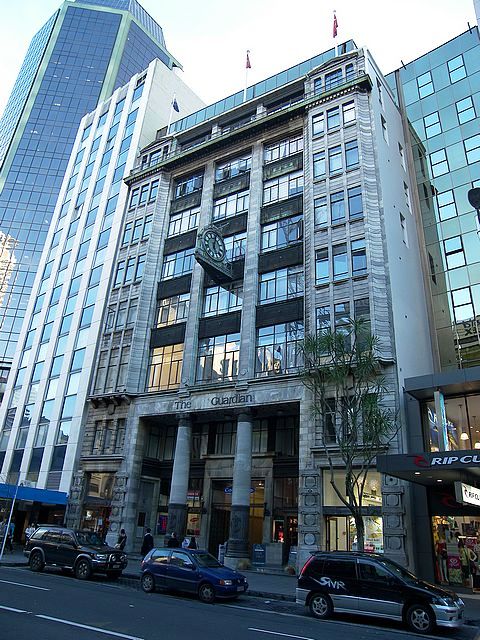
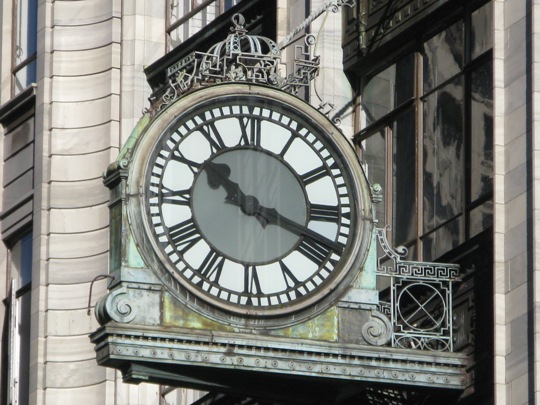
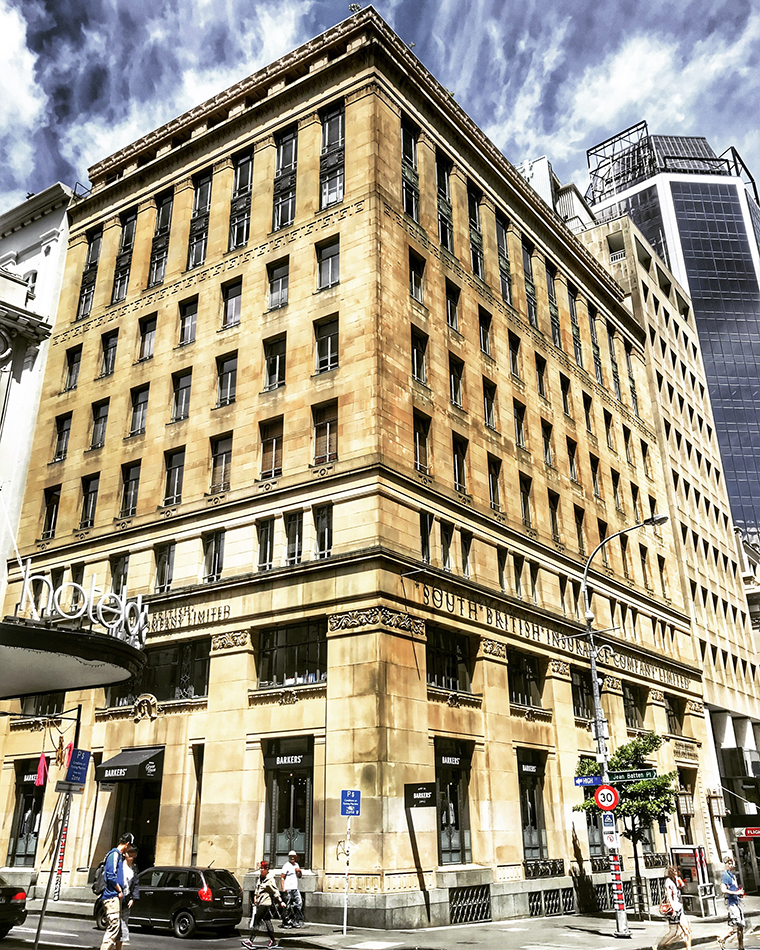
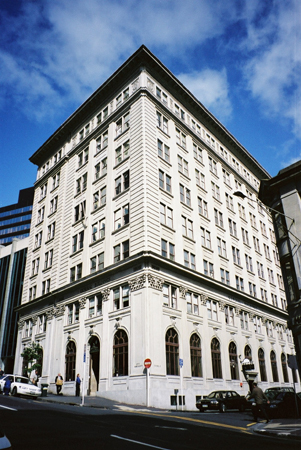
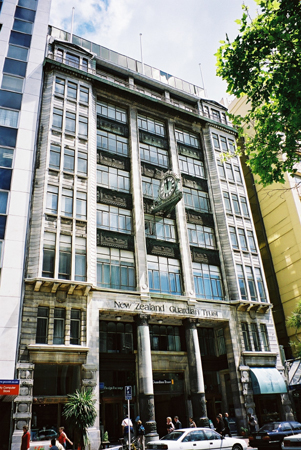
The eight-storey structure housed head and branch office accommodation, as well a further 137 offices for let to other firms. It replaced a three-storey NZI building on the site, which had itself been considered an imposing Queen Street landmark. Designed by William Gummer, the new structure was modelled on turn-of-the-century commercial buildings in America and elsewhere, and was of Stripped Classical style. Stripped Classical adapted nineteenth-century classical architecture to the requirements of twentieth-century office blocks, which included a need for height and a large amount of natural light. The size of the new headquarters dramatically exceeded most other office structures in the city, enabling the company to project an image of solidity and wealth while generating a long-term income from rent. The building, which incorporates a clock from the earlier NZI structure on the site, was refurbished in the 1960s. After the NZI merged with the South British Insurance Company in 1982, it was renamed the New Zealand Guardian Trust Building and extended with an additional storey.
The New Zealand Guardian Trust Building is significant as the earliest remaining high-rise office block in Auckland, reflecting important changes in commercial design and the organisation of business in early twentieth-century New Zealand. It is important for its associations with the NZI, which was one of the first public companies in the country to be floated using local finance. The structure is an early example of a Stripped Classical design, and the earliest major building by William Gummer, one of the most influential architects in early twentieth-century New Zealand. It has important landmark qualities and makes a significant contribution to the Queen Street streetscape. It is valuable as one of a group of historic buildings in the Queen Street and Shortland Street area that show successive changes in commercial design and organisation from the nineteenth to the early twentieth century.


List Entry Information
Status
Listed
List Entry Status
Historic Place Category 1
Access
Private/No Public Access
List Number
623
Date Entered
19th April 1990
Date of Effect
19th April 1990
City/District Council
Auckland Council
Region
Auckland Council
Legal description
Pt Allots 5 6 & 7 Sec 17 City of Auckland
Status
Listed
List Entry Status
Historic Place Category 1
Access
Private/No Public Access
List Number
623
Date Entered
19th April 1990
Date of Effect
19th April 1990
City/District Council
Auckland Council
Region
Auckland Council
Legal description
Pt Allots 5 6 & 7 Sec 17 City of Auckland
Construction Professional
Name
Gummer, William Henry
Type
Architect
Biography
Gummer (1884-1966) was articled to W.A. Holman, an Auckland architect, and qualified as an Associate of the Royal Institute of British Architects in 1910. From 1908 to 1913 he travelled in the United Kingdom, Europe and the United States. During this time he worked for Edwin Lutyens, a leading English architect of the time, and for Daniel Burnham in Chicago. Burnham was a major American architect and one of the founders of the influential Chicago School of Architecture. Gummer joined the firm of Hoggard and Prouse of Auckland and Wellington in 1913. Significant commissions undertaken during this period included the New Zealand Insurance (later known as the Guardian Trust) Building, Auckland (1914-18). In 1923 Gummer, one of the most outstanding architects working in New Zealand in the first half of the twentieth century, joined with Charles Reginald Ford (1880-1972) to create an architectural partnership of national significance. The practice was responsible for the design of the Dilworth Building (1926), Auckland, the Dominion Museum (1936) and the State Insurance Building (1940), both Wellington. Gummer and Ford were awarded Gold Medals by the New Zealand Institute of Architects for their designs of the Auckland Railway Station and Remuera Library. Gummer was also responsible for the Bridge of Remembrance, Christchurch and the Cenotaph in Dunedin (1927), and the stylistically and structurally advanced Tauroa (1916), Craggy Range (1919), Arden (1926) and Te Mata (1935) homesteads at Havelock North. Elected a Fellow of the New Zealand Institute of Architects in 1914, he was president of the Institute from 1933-4 and was later elected a life member.
Construction Details
Type
Other
Description
Site of first NZI building
Period
pre-1870s
Start Year
1914
Finish Year
1918
Type
Original Construction
Description
Construction of second New Zealand Insurance building
Type
Modification
Description
Internal alterations
Period
1960s
Start Year
1990
startYearCirca
Type
Addition
Description
Addition of ninth storey
Notable Features
Registration covers the building, its fixtures and finishes. It also includes recent modifications and extensions. The building lies on the site of nineteenth-century commercial buildings.
Construction Professional
Name
Gummer, William Henry
Type
Architect
Biography
Gummer (1884-1966) was articled to W.A. Holman, an Auckland architect, and qualified as an Associate of the Royal Institute of British Architects in 1910. From 1908 to 1913 he travelled in the United Kingdom, Europe and the United States. During this time he worked for Edwin Lutyens, a leading English architect of the time, and for Daniel Burnham in Chicago. Burnham was a major American architect and one of the founders of the influential Chicago School of Architecture. Gummer joined the firm of Hoggard and Prouse of Auckland and Wellington in 1913. Significant commissions undertaken during this period included the New Zealand Insurance (later known as the Guardian Trust) Building, Auckland (1914-18). In 1923 Gummer, one of the most outstanding architects working in New Zealand in the first half of the twentieth century, joined with Charles Reginald Ford (1880-1972) to create an architectural partnership of national significance. The practice was responsible for the design of the Dilworth Building (1926), Auckland, the Dominion Museum (1936) and the State Insurance Building (1940), both Wellington. Gummer and Ford were awarded Gold Medals by the New Zealand Institute of Architects for their designs of the Auckland Railway Station and Remuera Library. Gummer was also responsible for the Bridge of Remembrance, Christchurch and the Cenotaph in Dunedin (1927), and the stylistically and structurally advanced Tauroa (1916), Craggy Range (1919), Arden (1926) and Te Mata (1935) homesteads at Havelock North. Elected a Fellow of the New Zealand Institute of Architects in 1914, he was president of the Institute from 1933-4 and was later elected a life member.
Construction Details
Type
Other
Description
Site of first NZI building
Period
pre-1870s
Start Year
1914
Finish Year
1918
Type
Original Construction
Description
Construction of second New Zealand Insurance building
Type
Modification
Description
Internal alterations
Period
1960s
Start Year
1990
startYearCirca
Type
Addition
Description
Addition of ninth storey
Notable Features
Registration covers the building, its fixtures and finishes. It also includes recent modifications and extensions. The building lies on the site of nineteenth-century commercial buildings.
Historical and Associated Iwi / Hapū / Whānau
Completion Date
15th August 2001
Report Written By
Martin Jones
Information Sources
Cooper, 1988
Mary Cooper and Noni Boyd, 'NZ Guardian Trust (Formerly NZI), 103-107 Queen Street', NZHPT Buildings Classification Committee Report, Wellington, 1988 (held by NZHPT, Auckland)
New Zealand Building Progress
New Zealand Insurance Company, 1959
New Zealand Insurance Company, Bold Century: 1859-1959, Auckland, 1959
Vennell, 1972
C. W. Vennell, Risks and Rewards, A Policy of Enterprise 1872-1972: A Centennial History of the South British Insurance Company Limited, Auckland, 1972
Other Information
This place was identified as significant under previous legislation with different information requirements. It remains significant under the current legislation. There is opportunity under our legislation and policies to add to this information. Further information about this place may be available from the Northern Regional Office of Heritage New Zealand Pouhere Taonga. Please note that entry on the New Zealand Heritage List/Rarangi Korero identifies only the heritage values of the property concerned, and should not be construed as advice on the state of the property, or as a comment of its soundness or safety, including in regard to earthquake risk, safety in the event of fire, or insanitary conditions.
Historical and Associated Iwi / Hapū / Whānau
Completion Date
15th August 2001
Report Written By
Martin Jones
Information Sources
Cooper, 1988
Mary Cooper and Noni Boyd, 'NZ Guardian Trust (Formerly NZI), 103-107 Queen Street', NZHPT Buildings Classification Committee Report, Wellington, 1988 (held by NZHPT, Auckland)
New Zealand Building Progress
New Zealand Insurance Company, 1959
New Zealand Insurance Company, Bold Century: 1859-1959, Auckland, 1959
Vennell, 1972
C. W. Vennell, Risks and Rewards, A Policy of Enterprise 1872-1972: A Centennial History of the South British Insurance Company Limited, Auckland, 1972
Other Information
This place was identified as significant under previous legislation with different information requirements. It remains significant under the current legislation. There is opportunity under our legislation and policies to add to this information. Further information about this place may be available from the Northern Regional Office of Heritage New Zealand Pouhere Taonga. Please note that entry on the New Zealand Heritage List/Rarangi Korero identifies only the heritage values of the property concerned, and should not be construed as advice on the state of the property, or as a comment of its soundness or safety, including in regard to earthquake risk, safety in the event of fire, or insanitary conditions.
Current Usages
Uses: Trade
Specific Usage: Office building/Offices
Current Usages
Uses: Trade
Specific Usage: Office building/Offices
Location
Stay up to date with Heritage this month