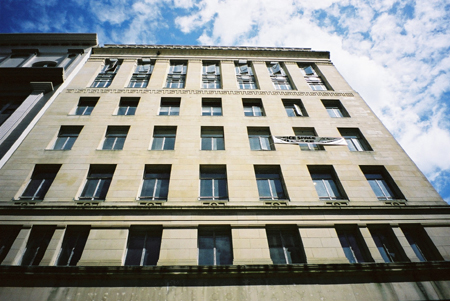
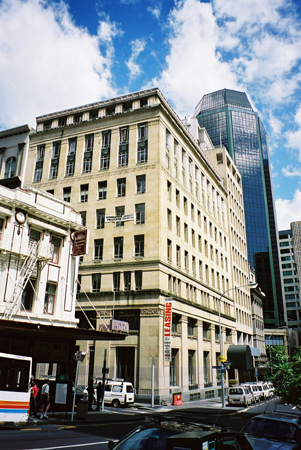
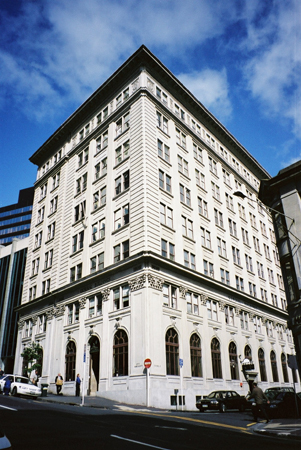
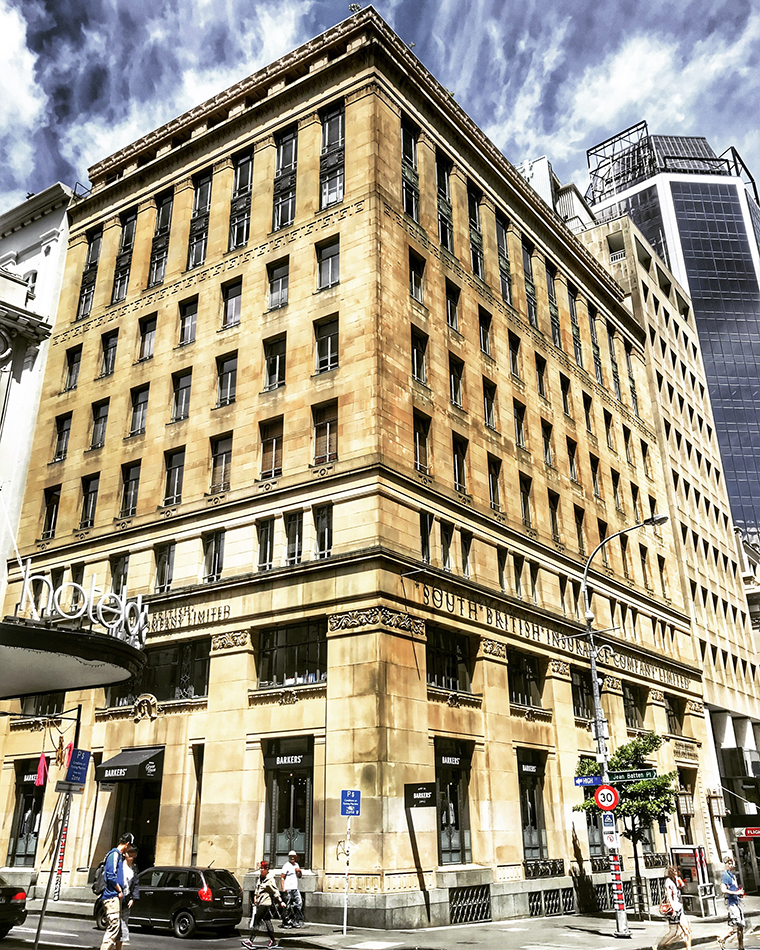
The new building was one of the tallest structures in Auckland, and of self-consciously 'modern' design. The South British company offices were prominently located at street and first floor level, separated from the company boardrooms at the top of the building by several floors rented out to other firms. Although the design was heavily influenced by American prototypes, the British connections of the company were reflected in its employment of English stone cladding and the re-use of a statue of Britannia, which had surmounted the previous South British headquarters in Blackett's Building. The architects - Grierson, Aimer and Draffin - were also involved in the contemporaneous construction of the Auckland War Memorial Museum. The South British occupied the offices until 1982, when the firm was amalgamated with the New Zealand Insurance Company.
The South British Insurance Building is significant as the largest and one of the finest 'Chicago-style' high-rises in Auckland, which reflects the prosperity of one of the city's most prominent financial institutions. It is particularly valuable for its location next to Blackett's Building, showing important changes in commercial architecture and business organisation from the late nineteenth to early twentieth centuries. Its interiors include some of the finest Art Deco ornamentation in the city centre, and it makes an important contribution to the urban streetscape. It is additionally significant as one of a group of buildings in the commercial district that show Auckland's prosperity as a financial centre in the 1920s.


List Entry Information
Status
Listed
List Entry Status
Historic Place Category 1
Access
Private/No Public Access
List Number
121
Date Entered
17th July 1985
Date of Effect
17th July 1985
City/District Council
Auckland Council
Region
Auckland Council
Legal description
Lot 1 DP 20508
Location Description
Postal Address: PO BOX 305417 Triton Plaza Auckland 0757
Status
Listed
List Entry Status
Historic Place Category 1
Access
Private/No Public Access
List Number
121
Date Entered
17th July 1985
Date of Effect
17th July 1985
City/District Council
Auckland Council
Region
Auckland Council
Legal description
Lot 1 DP 20508
Location Description
Postal Address: PO BOX 305417 Triton Plaza Auckland 0757
Construction Professional
Name
Grierson, Aimer & Draffin
Type
Architectural Partnership
Biography
Hugh Cresswell Grierson (1886-1953) was practising as an architect prior to the First World War. He served in the New Zealand Army and remained overseas to continue his studies at the Architectural Association in London. He became an Associate of the Royal Institute of British Architects. He returned to New Zealand and went into partnership with Kenneth Walter Aimer (1891-1960), a fellow student in London. Aimer was educated at Auckland Teachers' Training College and Auckland University College. He became a registered architect in 1918, and later travelled to England to continue his studies. He became an Associate of the Royal Institute of British Architects in 1925. Malcolm Keith Draffin (1890-1964) was in partnership with Edward Bartley and his son Alva when the First World War began. Draffin served in the army and was awarded the Military Cross. He remained in London after the war to study at the Architectural Association, and was elected a Fellow of the Royal Institute of British Architects. Following Edward Bartley's death in 1919, Alva Bartley and Draffin dissolved the partnership. The Auckland Institute and Museum complex was the major work of the firm, for which they were awarded a Gold Medal by the New Zealand Institute of Architects in 1929. The firm's other work includes the South British Insurance Company, Shortland Street and a number of cinema's including the Capitol, Dominion Rd (1922), the Rialto, Newmarket (1923), the Collosseum/Majestic, Queen Street (1924) and the Edendale cinema (1926). They were one of the first Auckland firms to adopt the Art Deco style popular in America, as can be seen in the Gifford's Building (1929), and they also designed in the Stripped Neo-Classical style as seen in the Northcote War Memorial Pavilion (1922) and the Parnell Library (1923). The Depression halted most building activity and as a result the partnership was disbanded. Draffin and Aimer practised separately while Grierson took up farming.
Construction Details
Start Year
1927
Finish Year
1929
Type
Original Construction
Description
Construction of South British Insurance Company Building
Start Year
1958
Type
Modification
Description
Internal alterations
Start Year
1962
Finish Year
1968
Type
Modification
Description
Internal alterations
Start Year
1842
Type
Other
Description
Site of homestead
Start Year
1874
Type
Other
Description
Site of commercial premises
Start Year
1982
startYearCirca
Type
Modification
Description
Removal of statue of Britannia
Start Year
2001
Type
Modification
Description
Extensive refurbishment
Notable Features
Registration covers the building, its fixtures and finishes. It includes recent modifications. The structure lies on the site of an 1842 homestead, and a number of early colonial, commercial buildings.
Construction Professional
Name
Grierson, Aimer & Draffin
Type
Architectural Partnership
Biography
Hugh Cresswell Grierson (1886-1953) was practising as an architect prior to the First World War. He served in the New Zealand Army and remained overseas to continue his studies at the Architectural Association in London. He became an Associate of the Royal Institute of British Architects. He returned to New Zealand and went into partnership with Kenneth Walter Aimer (1891-1960), a fellow student in London. Aimer was educated at Auckland Teachers' Training College and Auckland University College. He became a registered architect in 1918, and later travelled to England to continue his studies. He became an Associate of the Royal Institute of British Architects in 1925. Malcolm Keith Draffin (1890-1964) was in partnership with Edward Bartley and his son Alva when the First World War began. Draffin served in the army and was awarded the Military Cross. He remained in London after the war to study at the Architectural Association, and was elected a Fellow of the Royal Institute of British Architects. Following Edward Bartley's death in 1919, Alva Bartley and Draffin dissolved the partnership. The Auckland Institute and Museum complex was the major work of the firm, for which they were awarded a Gold Medal by the New Zealand Institute of Architects in 1929. The firm's other work includes the South British Insurance Company, Shortland Street and a number of cinema's including the Capitol, Dominion Rd (1922), the Rialto, Newmarket (1923), the Collosseum/Majestic, Queen Street (1924) and the Edendale cinema (1926). They were one of the first Auckland firms to adopt the Art Deco style popular in America, as can be seen in the Gifford's Building (1929), and they also designed in the Stripped Neo-Classical style as seen in the Northcote War Memorial Pavilion (1922) and the Parnell Library (1923). The Depression halted most building activity and as a result the partnership was disbanded. Draffin and Aimer practised separately while Grierson took up farming.
Construction Details
Start Year
1927
Finish Year
1929
Type
Original Construction
Description
Construction of South British Insurance Company Building
Start Year
1958
Type
Modification
Description
Internal alterations
Start Year
1962
Finish Year
1968
Type
Modification
Description
Internal alterations
Start Year
1842
Type
Other
Description
Site of homestead
Start Year
1874
Type
Other
Description
Site of commercial premises
Start Year
1982
startYearCirca
Type
Modification
Description
Removal of statue of Britannia
Start Year
2001
Type
Modification
Description
Extensive refurbishment
Notable Features
Registration covers the building, its fixtures and finishes. It includes recent modifications. The structure lies on the site of an 1842 homestead, and a number of early colonial, commercial buildings.
Historical and Associated Iwi / Hapū / Whānau
Completion Date
12th December 2001
Report Written By
Martin Jones
Information Sources
Vennell, 1972
C. W. Vennell, Risks and Rewards, A Policy of Enterprise 1872-1972: A Centennial History of the South British Insurance Company Limited, Auckland, 1972
Conservation Plan
Conservation Plan
Other Information
This place was identified as significant under previous legislation with different information requirements. It remains significant under the current legislation. There is opportunity under our legislation and policies to add to this information. Further information about this place may be available from the Northern Regional Office of Heritage New Zealand Pouhere Taonga. Please note that entry on the New Zealand Heritage List/Rarangi Korero identifies only the heritage values of the property concerned, and should not be construed as advice on the state of the property, or as a comment of its soundness or safety, including in regard to earthquake risk, safety in the event of fire, or insanitary conditions.
Historical and Associated Iwi / Hapū / Whānau
Completion Date
12th December 2001
Report Written By
Martin Jones
Information Sources
Vennell, 1972
C. W. Vennell, Risks and Rewards, A Policy of Enterprise 1872-1972: A Centennial History of the South British Insurance Company Limited, Auckland, 1972
Conservation Plan
Conservation Plan
Other Information
This place was identified as significant under previous legislation with different information requirements. It remains significant under the current legislation. There is opportunity under our legislation and policies to add to this information. Further information about this place may be available from the Northern Regional Office of Heritage New Zealand Pouhere Taonga. Please note that entry on the New Zealand Heritage List/Rarangi Korero identifies only the heritage values of the property concerned, and should not be construed as advice on the state of the property, or as a comment of its soundness or safety, including in regard to earthquake risk, safety in the event of fire, or insanitary conditions.
Current Usages
Uses: Accommodation
Specific Usage: Complex of flats
Former Usages
General Usage: Trade
Specific Usage: Office building/Offices
Current Usages
Uses: Accommodation
Specific Usage: Complex of flats
Former Usages
General Usage: Trade
Specific Usage: Office building/Offices
Location
Related listings


Stay up to date with Heritage this month