DonateMembershipVisit Heritage
  • Tūrangawaewae
    Places
  • Tira Māori
    Māori Heritage
  • Poutairangahia
    Archaeology
  • Rauemi
    Resources
  • Mō Tātou
    About Us
  • New Zealand Heritage List
  • Nominate and submit
  • Explore the List
  • National Historic Landmarks
  • Plaques
  • Rainbow List Project
  • Lost heritage
  • Visit Heritage
  • Our properties
  • Turnbull House Project
  • Collections
  • Shop
  • Tohu Whenua
  • Tira Māori
  • Conserving Māori heritage
  • Marae built heritage
  • Māori heritage on the List
  • Hinemihi—Te Hokinga Mai
  • What is archaeology?
  • Is there a site on my property?
  • What are my legal requirements?
  • Affecting an archaeological site
  • Declaring an archaeological site
  • Archaeology FAQs
  • Archaeology Digital Library
  • Archaeology guidelines and templates
  • Resources
  • Funding
  • Publications
  • Sustainable management guides
  • Disaster recovery
  • Podcasts & digital resources
  • Education Hub
  • Conservation plans
  • About
  • Board
  • Māori Heritage Council
  • Senior Staff
  • Offices
  • Contact us
  • Careers
  • Covenants
  • Fast-track
  • Corporate documents
  • Currently consulting on
  • Our submissions
  • News
  • Covid-19 response
Quick links
Rārangi Kōrero | The List
Explore the List
National Historic Landmarks
Ngā Manawhenua o Aotearoa me ōna Kōrero Tūturu
Quick links
Tapuwae
A Vision for Places of Māori Heritage
Funding for Māori Heritage
Resources
Quick links
Archaeological Authority Portal
Applying for an archaeological authority
Archaeology FAQs
Browse the most frequently asked questions about archaeological authorities and the archaeological process.
Quick links
Quick links
News
News Keep up to date with Heritage New Zealand Pouhere Taonga
Membership
Membership Find out more and sign up today
DonateMembershipVisit Heritage
  • Tūrangawaewae
    Places
  • Tira Māori
    Māori Heritage
  • Poutairangahia
    Archaeology
  • Rauemi
    Resources
  • Mō Tātou
    About Us
  • New Zealand Heritage List
  • Nominate and submit
  • Explore the List
  • National Historic Landmarks
  • Plaques
  • Rainbow List Project
  • Lost heritage
  • Visit Heritage
  • Our properties
  • Turnbull House Project
  • Collections
  • Shop
  • Tohu Whenua
  • Tira Māori
  • Conserving Māori heritage
  • Marae built heritage
  • Māori heritage on the List
  • Hinemihi—Te Hokinga Mai
  • What is archaeology?
  • Is there a site on my property?
  • What are my legal requirements?
  • Affecting an archaeological site
  • Declaring an archaeological site
  • Archaeology FAQs
  • Archaeology Digital Library
  • Archaeology guidelines and templates
  • Resources
  • Funding
  • Publications
  • Sustainable management guides
  • Disaster recovery
  • Podcasts & digital resources
  • Education Hub
  • Conservation plans
  • About
  • Board
  • Māori Heritage Council
  • Senior Staff
  • Offices
  • Contact us
  • Careers
  • Covenants
  • Fast-track
  • Corporate documents
  • Currently consulting on
  • Our submissions
  • News
  • Covid-19 response
Quick links
Rārangi Kōrero | The List
Explore the List
National Historic Landmarks
Ngā Manawhenua o Aotearoa me ōna Kōrero Tūturu
Quick links
Tapuwae
A Vision for Places of Māori Heritage
Funding for Māori Heritage
Resources
Quick links
Archaeological Authority Portal
Applying for an archaeological authority
Archaeology FAQs
Browse the most frequently asked questions about archaeological authorities and the archaeological process.
Quick links
Quick links
News
News Keep up to date with Heritage New Zealand Pouhere Taonga
Membership
Membership Find out more and sign up today
  • Places
  • Nominate and submit
  • National Historic Landmarks
  • Places
  • Nominate and submit
  • National Historic Landmarks
  • Tira Māori
  • Conserving Māori heritage
  • Marae built heritage
  • Tira Māori
  • Conserving Māori heritage
  • Marae built heritage
  • Archaeological authorities
  • Archaeology Digital Library
  • Archaeological authorities
  • Archaeology Digital Library
  • All resources
  • Publications
  • Funding
  • All resources
  • Publications
  • Funding
  • FAQs
  • FAQs
Follow us on:
Places
  • Places
  • Nominate and submit
  • National Historic Landmarks
Tira Māori
  • Tira Māori
  • Conserving Māori heritage
  • Marae built heritage
Archaeology
  • Archaeological authorities
  • Archaeology Digital Library
Resources
  • All resources
  • Publications
  • Funding
FAQs
  • FAQs
Follow us on
HomePrivacyTerms and conditionsAbout this site
© Heritage New Zealand Pouhere Taonga 2026.
 
Johnstone Farmhouse

25 Ashton St, MOSGIEL

Private

Historic Place Category 1

List No. 7146

Quick links:
List GalleryLocationDetails
Johnstone Farmhouse is situated at the end of Ashton Street, Mosgiel, 15km from Dunedin. Built in 1864, it was designed by preeminent architect RA Lawson for Andrew Todd, an early settler and farmer. It is a unique residence of outstanding architectural, historical and aesthetic significance for these reasons. It remains as a place that reflects the important contribution and significance of the Todd family to the early agricultural development of the Taieri Plain.

Kōrero tuku iho tells us the Taiari/Taieri and its various waterways were created by the taniwha Makaka who is immortalised as Pukemakamaka / Saddle Hill. Kāi Tahu ki Otago used all areas of the Taiari / Taieri Plain as evidenced by the hundreds of mahika kai sites associated with the numerous waterways, lakes and wetlands in the area, which was one of the most significant food baskets of the Otago region.

Few European settlers took on the daunting task of converting the wetlands of the Taieri Plain into land for use as agricultural fields for the fledgling Dunedin settlement. One of the first settlers to take on this task was Andrew Todd Junior, who, upon arrival into Dunedin in 1850, acquired land on the plains. The Todd Family’s success is evident in the construction of Johnstone Farmhouse in 1864 and the continued development of the Taieri Plain into viable farmland, resulting in the family and the house becoming a focal point for the community and influence on the wider historical landscape of the Taieri Plain.

The house is two storeyed with a hipped roof, originally of slate and now corrugated iron. It was a large house in 1865 with 10 rooms reflecting the affluence and success of the Todds’ farm. The Todds, McDonalds and Rutherford’s, have owned and operated the farm since 1852 and the building since 1865. The Rutherford’s, who have owned the property since 1960, have been particularly influential in renovating the property into the condition it is today.

Johnstone Farmhouse is a unique property on the Taieri Plain as the one of only two Georgian designed houses and is significant as it showcases an original 1860s residence by one of New Zealand’s pre-eminent architects Robert Lawson. Its setting within mature gardens and tree has maintained a sense of seclusion and separation traditionally associated with farmhouses despite the surrounding residential development.

Johnstone Farmhouse tells the story of early European practices in agriculture in a challenging, wetland environment and of the hard work and community required to succeed. The Taieri Plain is noted for its early European domestic dwellings associated with the establishment of the small settlements such as Woodside, East Taieri, North Taieri, West Taieri and Outram. As a focal farming homestead in the East Taieri area, this early property forms part of a wider historical and cultural story of the area and its enduring legacy as a home and farm.

Johnstone Farmhouse has historical significance as a result of its association with the Todd family, one of the pioneering families of the Taieri Plain who were significant in the settlement and development of the area. Andrew Todd Snr was involved with local affairs including the Presbyterian Church and sat on the Otago Provincial Council in 1860.

Johnstone Farmhouse was completed by 1861 and is a picturesque example of mid 19th Century domestic architecture utilising restrained Georgian symmetrical design. The exterior is roughcast, applied to the weatherboard cladding in the 1920's. Interior features include wood panelling of the entrance foyer, a variety of wooden dados and pressed metal ceiling in the front drawing room.
Johnstone Farmhouse, Mosgiel | Alison Rutherford

List Entry Information

Overview

Status
Listed

List Entry Status
Historic Place Category 1

Access
Private/No Public Access

List Number
7146

Date Entered
24th February 1994

Date of Effect
12th May 2025

City/District Council
Dunedin City

Region
Otago Region

Extent of List Entry

Extent includes the land described as Lot 2 DP 528790 (RT 855570), Otago Land District and the building and structures known as Johnstone Farmhouse thereon. (Refer to map in Appendix 1 of the List entry report for further information)

Legal description

Lot 2 DP 528790 (RT 855570), Otago Land District

Detailed List Entry
Significance

Historic Significance

Historical Significance or Value The Johnstone Farmhouse has outstanding historical significance with its strong ties to the first early European settlement of the Taieri area. It was constructed by the area’s earliest settlers, the Todd family, who had settled by 1852. Andrew Todd Jnr was the first settler on the Taieri Plain and may have been the first to plough the land in 1851. The Todd family was one of the pioneering families of the Taieri Plain and were significant in the settlement and development of the area. All the Todd family held many positions of responsibility and leadership on various Taieri boards and associations including the Presbyterian Church and shaped the settlement of not just East Taieri but the whole Taieri Plain. The house is evidence of their success in agriculture and provides knowledge about early European practices in agriculture in a challenging wetland environment. It tells the history of hard work and community of an early agricultural period in the 1850s and 1860s New Zealand. As a focal farming homestead in the East Taieri area, this property forms part of a wider historical and cultural story of the area. Johnstone Farmhouse has outstanding significance with its association with architect Robert A Lawson. Set against a backdrop of a burgeoning European settlement in Dunedin and the Taieri, this is an exemplary example of Lawson’s early work, as well as an 1860s example of his lesser-known residential buildings. The 1860s was a time of developing building technology and materials as more became available and as settlers became more established had money to spend on larger homes, as the Todd’s did with Johnstone Farmhouse.

Physical Significance

Aesthetic Significance or Value Johnstone Farmhouse has special aesthetic significance as an early stately building in a rural setting on the Taieri Plain. Historically, the dwelling was situated in a rural landscape with views across the Taieri Plain to the East Taieri Presbyterian Church and Saddle Hill. Despite the subsequent residential development that now surrounds the house, the property has maintained a sense of seclusion and separation that is traditionally associated with farmhouses. It is surrounded by mature gardens, trees and farmland with access via a tree lined driveway from Ashton Street. It is set amongst trees that were planted by various owners of the property over 150 years and although the access into the property has changed, the Farmhouse maintains a similar aesthetic and setting as when it was constructed. Other historic properties within the East Taieri have lost the sense of isolation through the development of State Highway 1 as well as residential development, thus making the Johnstone Farmhouse setting unique. Architectural Significance or Value The Johnstone Farmhouse is an outstanding representative of an era of New Zealand’s early European architecture, where larger dwellings were able to be constructed by a more affluent community. Greater access to local and imported construction materials enabled more substantial buildings to be built. Johnstone Farmhouse is a unique property on the Taieri Plain as the one of only two Georgian designed houses on the Taieri and is significant as it showcases an original 1860s residence by one of New Zealand’s pre-eminent architects Robert Lawson. Lawson was in the early years of his career in a burgeoning settlement and making a name for himself and was designing a huge number of buildings in the 1860s. Despite being heavily influenced by Gothic architecture that was popular in the United Kingdom, Lawson also designed in other styles as well such as Scottish Baronial, Tudor, Classical, Palazzo and Georgian. There does not appear to be any other Lawson designed buildings that remain today in the Georgian style. Johnstone Farmhouse has a classic villa-style roofline, with a hipped roof and large boxed eaves along the front elevation. The interior gives a sense of the history and successive generations of the family who lived here, and it has been modernised in a sympathetic way by the Rutherford family. The farmhouse contains popular, decorative features such as patterned glass in the front door, depicting a symmetrical stylised floral design, which was popular as a centrepiece in ornamental windows or glazed door as well as decorative features common to the Victorian period of the 1860s-1870s, including moulded and tongue and groove ceilings, and a panelled timber dado running along the hallway. The Johnstone Farmhouse reflects an early design of Lawson’s with a prominent central breakfront, which was a feature of many of Lawson’s designs, with other features such as faux quoins and weatherboards to mimic stone, now covered with roughcast. The exterior has altered little from its original design and is still largely as it was designed. The grandness of the Johnstone Farmhouse design also represented the Todd family’s success as agriculturalists and settlers. Before 1850 settlement was extremely limited and most buildings were in a simple and functional that reflected pioneering conditions in New Zealand. The full diversity of Victorian architectural ideas did not have a major impact upon building in New Zealand until the 1860s and Johnstone Farmhouse is outstanding example of this.

Detail Of Assessed Criteria

This place was assessed against the Section 66(3) criteria and found to qualify under the following criteria a, b, f, i, j and k. The assessment concludes that this place should be listed as a Category 1 historic place. (a) The extent to which the place reflects important or representative aspects of New Zealand history The Johnstone Farmhouse is of special outstanding historical significance with its direct ties to the first early European agricultural settlement of the Taieri area and architect RA Lawson. It is a place which tells the story of a struggling settler community and their transformation of wetlands into agricultural farmland. The house itself showcases those who were successful in these endeavours and how it established colonial settlers in their new chosen home. During the 1860s the landscape was transformed and the area’s history and future use was altered with the house reflecting this story. Johnstone Farmhouse is a rare early survivor of both an 1860s house built by a successful settler family and an 1860s Lawson residential design and remains an intact example of this. (b) The association of the place with events, persons, or ideas of importance in New Zealand history Johnstone Farmhouse was constructed by the Taieri area’s earliest European settlers, the Todd family, who had settled by 1852. Andrew Todd Jnr was the first Scottish settler on the Taieri Plain and was the first to plough the land in 1851. The whole Todd family were one of the pioneering families of the Taieri Plain and were significant in the success of the settlement and development of the area. Robert Lawson became a preeminent Victorian architect – more renowned today than in his own time. Lawson, through his community links, was employed by Todd as architect. They were both heavily involved in the Presbyterian Church, with Lawson also commissioned to build the East Taieri Church which Andrew Todd advocated in getting established and built. Lawson had newly arrived in Dunedin in 1862 and was working on many different works for income as well as building his reputation within the Otago colony. Johnstone Farmhouse was the 18th residence he had designed in Dunedin. (f) The potential of the place for public education Johnstone Farmhouse has special characteristics that convey information about little known facts about the early European Settlement of the Taieri Plains and agricultural which deserve to be more widely known. The Farmhouse is still within its original setting and has been little altered from its original design with a high level of authenticity. While not publicly accessible currently, it does have the potential to teach the public about the Todd family history, which has been largely missing from local general histories, and how a settler family evolved in their new environment. The scale of the building and the layout within the farm demonstrates the organization and lifestyle of an early New Zealand farming family and the infrastructure associated with this. The significant trees exemplify the special setting the farmhouse sits in, on the edge of suburbia. The site itself has had continuous use as a farm for over 170 years. (i) The importance of identifying historic places known to date from an early period of New Zealand settlement Built in 1865, Johnstone Farmhouse is of special outstanding significance with its direct ties to the first early period of organised 1840-1860s European settlement of New Zealand. The direct link the house and farm has with one of the original settler families and time period is extremely significant and special. The exterior is largely original, and the interior still retains original elements from the early period such as wood panelling of the entrance foyer, wooden dados, original fireplaces, original firewall and a pressed metal ceiling. The 1860s in New Zealand was a time of developing building technology and materials. Set against the backdrop of the gold rushes and an increase in population, Johnstone Farmhouse is representative of an era of New Zealand’s early European architecture, where larger dwellings were able to be constructed by a more affluent community. It showcases an early 1860s residence by one of New Zealand’s pre-eminent architects RA Lawson, who was only 2 years into his practice when he designed this building. j) The importance of identifying rare types of historic places Johnstone Farmhouse is a rare example of a timber Georgian domestic style architecture by architect RA Lawson on the Taieri. Its long retention within only two families, has led to its survival as the owners recognised its history and importance. The Farmhouse also is a special rare example of an early residential work of Lawson as he was establishing his architectural practice. (k) The extent to which the place forms part of a wider historical and cultural area The farmhouse is tangible evidence of the tremendous undertaking settlers took in the early agricultural period in the 1850s-1860s New Zealand. It reflects the path of the settlers who were successful in their early endeavours on the Taieri Plain and much of the district’s history was impacted by the early Todd family of Johnstone Farm. The East Taieri community used this property as a focal point of the community with early meetings and many social events being held on the property. Summary of Significance or Values This place has been assessed for and found to possess outstanding architectural and historical and high aesthetic significance. This place qualifies as an outstanding example of mid-nineteenth century domestic architecture along with its association to the first farming family on the Taieri Plains as part of New Zealand’s historic and cultural heritage. It is a rare example of a timber construction, Georgian style house on the Taieri and was designed by pre-eminent Victorian architect, RA Lawson. Johnstone Farmhouse provides knowledge about early European practices in agriculture in a challenging wetland environment and tells the history of the hard work and community of an early agricultural period in the 1850s and 1860s New Zealand. As an early focal farming homestead in the East Taieri area, this property is a special part of the wider historical and cultural story of the area and continues to be a farm today.

Construction Professional

Name

Lawson, Robert Arthur

Type

Architect

Biography

Born in Scotland, Lawson (1833-1902) began his professional career in Perth. At the age of 25 he moved to Melbourne and was engaged in goldmining and journalism before resuming architectural practice. In 1862 Lawson sailed for Dunedin, where his sketch plans had won the competition for the design of First Church. This was built 1867-73. Lawson went on to become one of the most important architects in New Zealand. First Church is regarded as his masterpiece and one of the finest nineteenth century churches in New Zealand. He was also responsible for the design of the Trinity Church (now Fortune Theatre), Dunedin (1869-70), the East Taieri Presbyterian Church (1870), and Knox Church, Dunedin (1874). He designed Park's School (1864) and the ANZ Bank (originally Union Bank, 1874). In Oamaru he designed the Bank of Otago (later National Bank building, 1870) and the adjoining Bank of New South Wales (now Forrester Gallery, 1881). See also: Ledgerwood, Norman, 2013. 'R.A. Lawson: Victorian Architect of Dunedin'. Historic Cemeteries Conservation NZ.

Construction Details

Start Year

1865

Type

Original Construction

Start Year

1865

Type

Addition

Description

Exterior weatherboard roughcast over.

Start Year

1865

Type

Modification

Description

A third original chimney to the rear of the house has been removed (served the kitchen and upstairs bedroom)

Start Year

1960

Type

Modification

Description

A third original chimney to the rear of the house has been removed (served the kitchen and upstairs bedroom)

Finish Year

1864

Type

Designed

Description

Tender called by RA Lawson for a house for Andrew Todd, East Taieri

Start Year

1965

Type

Modification

Description

Original dark stained windowpanes over stairs replaced with clear leadlight windows

Start Year

1968

Type

Modification

Description

Original farm access shifted as railway is widened and Owhiro Stream recontoured into a straight channel.

Start Year

1960

Finish Year

1981

Type

Refurbishment/renovation

Description

New Kitchen Bedrooms and upstairs front room above the porch - walls relined. Electricity downstairs renewed and added to upstairs area. Original ceiling replaced in the front northeast facing bedroom upstairs. Built in wardrobes to bedrooms.

Start Year

1987

Type

Addition

Description

Yunca Fire (inbuilt) replaced original fireplace, Silverpeaks County Council

Start Year

2003

Type

Refurbishment/renovation

Description

New bathroom upstairs

Type

Modification

Description

Roughcast applied to the weatherboard cladding

Period

1920s

Start Year

2004

Type

Refurbishment/renovation

Description

Double glazed window timber. New kitchen and bathroom downstairs,

Construction Materials

Australian jarrah, Baltic pine flooring, Handmade nails, Kauri doors, Brick fire wall

Historical Narrative

From its source, the Taiari/Taieri River flows almost entirely around Pātearoa (the Rock & Pillar Range) before discharging into Te Tai-o-Āraiteuru (the Otago coastline). Oral history tells us the Taiari and its various waterways was created by the taniwha Makaka who is immortalised as Pukemakamaka / Saddle Hill. Kāi Tahu ki Otago used all areas of the Taiari / Taieri Plain as evidenced by the hundreds of mahika kai sites associated with the numerous waterways, lakes and wetlands in the area, which was one of the most significant food baskets of the Otago region. The lower Taiari was an important occupation site with the Maitapapa kāinga at Henley. An important route, referred to by J. H. Beattie as a ‘Maori track’, passed through the area. Ngāi Tahu kaumātua recorded Taiari specifically as a kāinga mahinga tuna and kāinga nohoanga (settlement). In July 1844, the Otago Purchase, negotiated by Frederick Tuckett, was signed at Kōpūtai / Port Chalmers. This agreement alienated large areas of land around Dunedin into European hands and saw a native reserve (2,300 acres) established on the north bank of the Taiari awa. The Ōwhiro Stream, formerly known as Scroggs Creek, flows across the Taieri Plain into the Taieri River near the Allanton township, west of Mosgiel. The name Ōwhiro was used to denote the eastern part of the Taiari plain. The first Europeans to settle in the Taieri area were William and Margaret Jaffray who settled on Saddle Hill above the Taieri Plain in 1848 straight off the Philip Laing along with fellow shipmate John de la Condamine Carnegie. Other settlers began populating the central Dunedin area with few risking the journey out to the Taieri Plain. The first road from Dunedin was constructed in 1849, and with this farms and houses began to be constructed along this road. As the Taieri Plain was originally wetlands, few settlers took on the daunting task of converting the land to useful agricultural fields in the 1850s. This changed with the arrival of Rev Thomas Burns (1796-1871), on the ship Philip Laing on 15 April 1848. Before arriving in New Zealand, Burns had purchased rural sections on behalf of the Lay Association of Scotland Church Trustees and supporters of the Free Church project, and he chose a large majority from the plain. This purchase of rural sections was completed at the end of 1847 and was not without criticism from those not sure the Taieri Plain was suitable or rich farmland. Upon his first visited the Taieri Plain in 1849 he described it as “a truly magnificent plain”. He continued to make multiple visits out to the Taieri Plain, recording the development of the settlement and progress in the area in his diary. From an early survey map of the Taieri and Waihola Survey District in 1859 Johnstone Farm’s land is in between the Trustees of the Presbyterian Church and various members of the Burns family. Early in 1851 a property on the plain was taken up by Andrew Todd Jnr (1826-1853). Andrew Todd arrived in Dunedin on the ship Phoebe Dunbar in October 1850. The Phoebe Dunbar was the last ship dispatched to Port Chalmers by the New Zealand Shipping Company. According to family history, he travelled to New Zealand to live in a warmer climate to treat his tuberculosis. The land he worked was acquired from Gilbert Burns, the brother of Rev Burns, who was in a drapery business in Dublin with William Todd, Andrew’s uncle, and Alexander Findlater as a financial partner and all three brought sections on the Taieri via the Lay Association of Scotland. He wrote to his uncle a few weeks after arriving: “I have now taken up my abode on the Tiera [sic] Plain eight miles from Dunedin on a section Mr Burns exchanged with me for Mr Findlater’s. The section I have got is a very good one. No timber but I can get timber off the road line running through the bush for a long time, and the reserve timber is not far distant…I have got no house put up yet. I have got timber sawn and expect to have the house up in about a fortnight. I have been living in (what is called a whari) a hut made of sods and thatched with cabbage trees. I find it very comfortable. I find my health improves in the whari.” Andrew Junior was one of the first settlers to arrive on the Taieri Plain. He got to work on his farm and, along with Robert Hastie, was the first to plough on the Taieri. Todd planted potatoes and acquired two bullocks and four heifers, and after a good first return brought some of them into Dunedin for sale, being the first bullock team brought into Dunedin from the South. He was soon joined by his father Andrew Todd Senior (1796-1873), mother Ann Sangster (1799-1870), sister Jane (1835-1860) and brothers, William (1838-1921) and Robert (1844-1901) on board the Simlah in 1851. Brother, Charles (1829-1865), arrived shortly after in 1852, and another brother, James (1831-1915), arrived in 1858 with his pregnant wife and young daughter. The Todd family was originally from Perthshire, Scotland but had farmed in Ireland from 1840. The farm was named Johnstown/Johnstone Farm (the name was first referred to in the newspaper in 1853 as “Johnston” and then “Johnstown” in 1854), the name of which still remains today. This may have been named after the Georgian built Johnstown House, Enfield which is near where Andrew Todd Snr was a tenant farmer near Moygaddy Castle, Kildare, County Meath (County Kildare and Meath border each other). The house that was to be built “in a fortnight” mentioned in Andrew Junior’s 1851 letter was presumably built before his mother and father arrived in September of 1851. Descendants mentioned that a house was under construction when James arrived with his wife on the ship Agra in 1858. “The house was built but the kitchen still had a sod floor. The women were cooking in the kitchen and James was met in Dunedin by his three brothers with a bullock wagon”. This may have been the second iteration of the house on site. Andrew Jnr suffered from tuberculosis and although he reported his health was improving in the New Zealand climate, he became unwell and died in 1853. He was described in his obituary as one of the first settlers on the Plain, and whose assistance and energetic example contributed to much of the prosperity of the area. The land then passed to Andrew Todd Snr in 1854. It has been mentioned in local histories that the house at Johnstone Farm was standing in 1861, when it has been told that Rev Thomas Burns described the current house as a “…well-established farm on the level below the church hill. Andrew Todd had built a large white house, which stands there still. With his former experience of farming in Ireland, Mr Todd had brought this farm into splendid condition and he made agricultural history by harvesting a fine crop of barley in the month of December.” However, Burns had no Visitation Books in 1861 (his books continue until 1857) so this date does not seem correct. In December 1864, tenders were called by architect RA Lawson (1833-1902) for the construction of a residence at East Taieri for Andrew Todd. The date of this tender notice suggests that construction on this residence could have started in 1865. The 1897 valuation records report a dwelling on site, constructed from brick and timber with a slate roof valued at £400 ($95,574). The dwelling was recorded as 31 years old, which would give a construction date of 1866. A barn/stable, cowshed, and dairy were also recorded on site. RA Lawson was one of New Zealand’s pre-eminent architects. He had moved to Dunedin to build First Church in 1862 and then built his practice designing other churches and public buildings but also residential houses in the area. With both the Todd’s and Lawson’s involvement in the Presbyterian Church, the two parties would likely have been known to each other. The 1860s was a time of developing building technology and materials as more became available and as settlers became more established had money to spend on larger homes, as the Todd’s did with Johnstone Farmhouse. Lawson had designed Donald Reid’s Salisbury (List no. 2125) in April of the same year and advertised a tender two years later in 1866 for James Shand, settler, to build his house at his farm Abbotsford, West Taieri (near Allanton). Lawson designed the North Taieri Manse the next year in 1867-1868 and then went onto design the East Taieri Church (List no. 2260) in 1870. The East Taieri settler community were a tight knit group and relied on each other in the early years to establish themselves and their farms in the new colony. They supported new settlers arriving by giving a day’s worth of ploughing – up to 7 to 9 ploughs would be used to turn several acres and get the land ready for use. As the earliest settlers on the Taieri Plain, the Todd family became instrumental in the settlement’s establishment. Andrew Todd Snr was an elder of the East Taieri Presbyterian Church and one of the original committee members who instigated the establishment of the first East Taieri School and Church in 1852. He was also chairman of the East Taieri Roading Committee, the first president of the Taieri A&P Society, Justice of the Peace, member of the Provincial Government and a warden of the Hundred of East Taieri. He was an instigator of all things political, religious, and educational on the Taieri and took an active role in the advancement of the area. The Todd barn hosted the Harvest Home in 1854, which was celebrated by the settlers of East Taieri. The barn was decorated for the Harvest Home with fern, flax, and tutu. “Nearly 100 sat down to a sumptuous dinner at 6 o'clock, after which and the usual adjuncts, the floor was cleared for the dance, music, song, alternating till an early hour in the morning”. The farm also hosted many Annual Ploughing Matches. The whole Todd family were an enterprising group. The children established their own paths, and all did not travel far from Johnstone Farm. James Todd went into the drapery business like his Uncle William in Ireland. He married Ann Cash of Cash Drapery Firm in England and ran a store at East Taieri from April 1861 until December 1862. His farm was named as “Southam” on the Taieri (he sold the farm in 1868) and he died in 1915. Jane Todd married David Oughton, who built a house for them in 1851. He named this ‘Janefield’ (List No 4736) – the house is still standing, and the surrounding area is known as ‘Janefield.’ Jane sadly died of consumption in 1860. Charles married Margaret Shand in 1857 and he died in 1865 at Johnstone Farm after some years as a storekeeper and butcher, which he took over from his brother James. Robert, the youngest son, took over Johnstone Farm when their father died in 1879. William A Todd had a farm called Willow Acres and was known for breeding Leicester sheep. The Johnstone Farmhouse was built in a Georgian style with Australian jarrah used for the outer walls, Baltic pine flooring, handmade nails, and kauri doors. There is a brick fire wall running through the full width of the house, which is an unusual inclusion. A c.1900 photograph of the farmhouse shows it clad in weatherboards, with quoins at the corners, giving the illusion of channel-jointed stonework. This look was introduced in Wellington in the 1860s and became increasingly popular in the 1880s. Timber was a common construction material, which was sourced locally and imported from Australia. Andrew Todd Jnr mentions in 1851 how he had no timber on his section, but he could access timber off the road line running through the bush for a long time, and the reserve timber is “not far distant”. The township now known as Mosgiel was known as Big Bush and was covered in red, white, and black pine and totora. Brick was less common, being more expensive and the inclusion of a brick ‘fire wall’ in the farmhouse is a relatively unusual feature for a building of this age. There were, however, brick works operating nearby in particular by the settler family Callanders between Springbank and Springbank View in East Taieri as well as Salisbury, North Taieri. The house was exceptionally designed with five good sized bedrooms and a sunroom on the upper floor. Downstairs was a drawing room, dining room, and kitchen. A staircase connected the two levels, with the effect heightened by Italianate round arched windows. The nails were handmade and the fireplace in what is now the lounge is in black Italian marble imported by Andrew Todd Snr. Locks on the doors were brought from Scotland and most are still in use. Andrew Todd Snr died in 1879 at Johnstone. Robert inherited the farmhouse and all other property owned and leased by his father in 1879. Like his father, he was heavily involved in the Taieri Agricultural and Pastoral Association, of which he was president for some years, and took an active part in church work and educational matters. Robert was also a volunteer and a member of the Otago Hussars. He married Jane Paton, daughter of John Paton, who arrived in 1863, by the ship Silistria of North Taieri. Robert died in 1901, and the title passed to his son, another Andrew Todd. Andrew Todd continued to farm at Johnstone and was involved in many of the associations. He was a member of the Taieri Agricultural and Pastoral Association and Society including a stint as President, and a member of the East Taieri Farmers Union and the East Taieri Rifle Volunteers. After doctors’ orders to move north, due to his ill health in 1910, the property was leased to George McDonald in May 1909. McDonald Family (1909-1960) George McDonald was born in 1850 in Coull, Aberdeenshire, Scotland and arrived in New Zealand in 1868 on the ship Helenslee. He originally farmed in Inchclutha on the farm ‘Matua Bank’ and married Annie Dutton in 1877. They moved to East Taieri in 1907. George died aged 68 in 1917 and after George’s death the ownership of Johnstone was transferred to his wife Annie in August 1922. Following Annie’s death in 1938, the property was transferred to siblings Mary Rebecca (known as May) McDonald and John Thomas Charles McDonald as tenants in common. John worked as a farm assistant and farmer on Johnstone Farm from at least 1916 until 1958 when he died. At some point during the McDonald’s ownership, roughcast was applied to the exterior of the house and the third chimney at the rear of the house was removed. While the farm continued production, the farmhouse became run down and trees overgrown. John McDonald’s share was transferred to his wife Violet Constance McDonald in 1959 after his death. Rutherford Family (1960-Present) The property was purchased by Stanley Rutherford, nephew of John and May McDonald, in January 1960 and began its transformation. Rutherford and his wife (Marion Heather Rose known as Heather) were also active in the community, holding various roles in the East Taieri Presbyterian Church and school. Rutherford was also a former bomber pilot and RAF Officer during World War II, receiving the DFM during active service in North Africa and Italy. Mrs Rutherford worked as a telephonist intermittently throughout her life. The Rutherford’s undertook the large task of restoring Johnstone Farmhouse with a young family. The family had been living in Northland, New Zealand when they had the opportunity to purchase Johnstone Farm. The state of the farmhouse when Heather first saw the property was dire – no electricity on the first floor, animals were roaming throughout, sheep dip and other toxic chemicals were kept near the house and it was very dilapidated. Under the Rutherford’s ownership, the homestead was restored with fittings and fixtures to the era of the house. The wooden curtain rods and rings in the living room were sourced from Francis Scott Pillan’s home at Inchclutha who had arrived on the John Wickliffe. The original dark stained glass in the stair windows was replaced with clear leadlight around 1965 brightening the space. All bedrooms were relined, with wardrobes built into the rooms, and some original ceilings were replaced. The other rooms and hallway were also renovated, with walls throughout the house relined as the original plaster and kauri had deteriorated beyond repair. In the 1960s, the kitchen was renovated with a new floor, cabinetry and plaster ceiling. The ceiling was lowered approximately 18 inches (45 cms) and covered with a plaster ceiling fixed to the original beams. The Rutherford’s youngest son, was named Todd as a tribute to the original family and history of the house. He was the only child to be born in the house in the twentieth century. Two original windows were replaced, and one large window was added to the north-western elevation which looks out on the backyard and garden. The kitchen floor was re-piled and replaced and laid with linoleum with new cabinetry. The garden was redeveloped with silver birch trees planted along the driveway and a Leylandii hedge along the south-west boundary of the house. During the 1960s, the original Todd barn and diary were demolished, and a new farm shed, and dairy shed erected. Some trees near to the houses were felled as they had grown large against it, with some the timber being later repurposed within the house. The accessway to the farmhouse was shifted circa 1968-1970, when property was taken by the Crown to expand the nearby railway and recontour the Ōwhiro Stream into a straight channel. The original driveway accessed the property from Gladstone Road and crossed the railway line. Following Stanley Rutherford’s death in 1972, the farm was leased until 1992. Mrs Rutherford continued to renovate the house and often opened the home for tours. In 1996, daughter Alison Rutherford, took over farming the property and eventually purchased it in 2002. Over this time, several trees planted by the Todd and McDonald families were recognised on the Dunedin City Council District Plan. Further trees and shelter belts have been planted since, including riparian plantings along the Ōwhiro Stream. The house was renovated between 2003 to 2015, with all the rooms redecorated. A new bathroom was installed in 2003, replacing a bedroom on the first floor. The existing bathroom window was repaired and retained and refitted with safety glass. The floor was covered with particle board and vinyl and colonial skirting and cornices were added to match the existing ones. In 2005, renovations were carried out in the kitchen, dining, and bathroom on the ground floor. In the kitchen and dining areas, the ceiling was insulated and replaced at the same height as the existing. The walls were insulated and relined and all windows were replaced with double glazed units. In 2005, Alison renovated the kitchen and included macrocarpa timber in the joiner that was milled from trees planted by the Todd family. The bathroom on the ground floor was removed, and French doors were installed in the kitchen, where the bathroom was, to form a new tiled entry and T&G lined porch. A wall separating the kitchen and hallway (which provided access to the downstairs bathroom, living room, and bedroom) was removed.

Physical Description

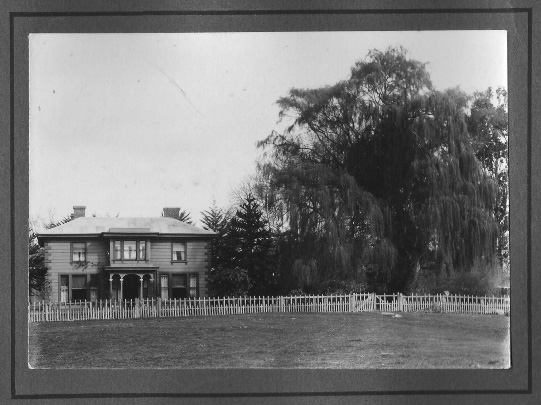
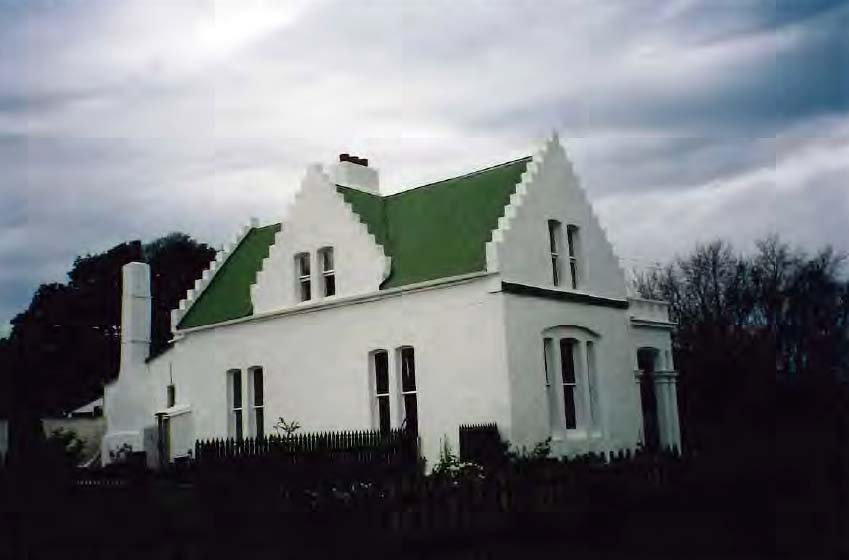
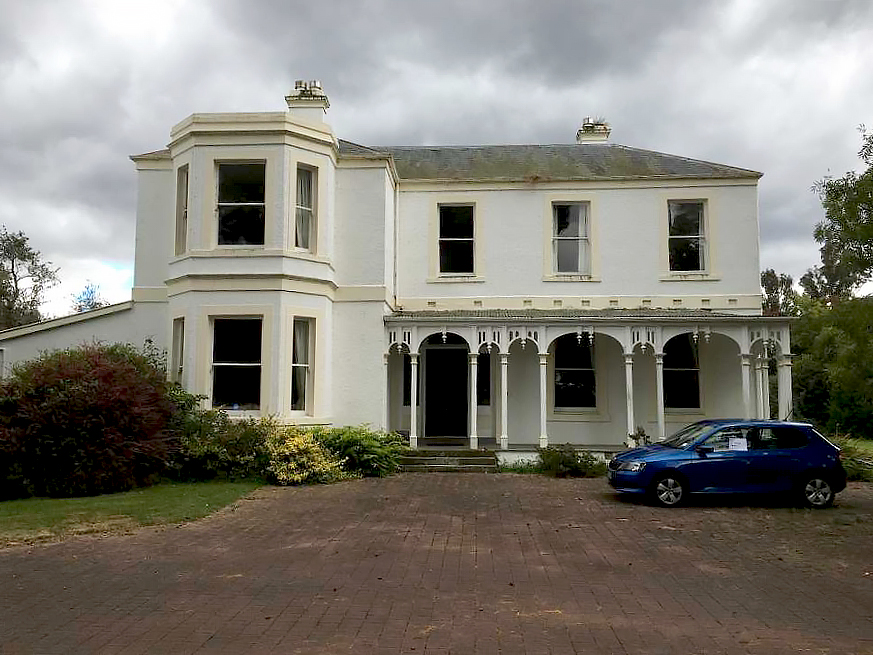
Current Description Johnstone Farmhouse is located at the end of Ashton Street, Mosgiel, 15 km from Dunedin. The predominant appearance of the land is that of a pastoral farming operation that includes significant fencing, shelterbelt planting, and large areas of open space. The area surrounding the property is residential to the east with extensive paddocks dominating the area to the west. The neighbour’s property has recently been rezoned residential. The house, which faces east, is two storeyed with a hipped roof, originally of slate and now corrugated iron. It was a large house at the time with 10 rooms. The front façade is symmetrical with a pillared entrance which has a square bay above. The exterior was roughcast sometime before 1940. It is timber framed other than one central brick firewall running through the house. The house is constructed of three main timber materials – Australian Jarrah, Baltic Pine and kauri. The framing and exterior bearing wall timber and front porch posts is Jarrah. The interior of the walls has a lath and plaster lining with the floors of Baltic Pine and the doors and wall panelling and some of the ceilings are kauri. The floors are hand sawn planks. The foundations of the house are a series of local basalt rock interspersed with bluestone rock. Two large double hung windows, one on either side of the front bay (containing the porch), look out from the dining and drawing rooms on the ground floor. On the first floor two smaller, double hung windows, one of either side of the bay containing a small sitting sunroom above the porch are centred above the two larger windows below. To the left of the house, facing towards the East Taieri Church, a bay window extends from the front drawing room. The porch is an open raised seam porch with a flat roof and a series of arches between the posts. An arch is also found above the main hallway and frames the entrance to the bay window in the drawing room. In addition, three narrow Italianate style round arch windows are found above the landing on the stairway. The interior has original elements such as wood panelling of the entrance foyer, wooden dados, original fireplaces and a pressed metal ceiling in the front drawing room. The main living areas are on the ground floor and the bedrooms are on the first floor. The two floors are connected by a stairway leading off from the ground floor main entrance hallway. Many of the ornate fixtures and fittings found on the porch posts and in the panelling below the main entrance windows and on the door are repeated throughout the house. There are four narrow double-hung windows surrounding the main door with a single ‘light’ window above the door. The eaves are wooden and consist of a plain soffit supported on ornately curved brackets, with T&G joinery between them. The eaves only extend around the front and onto one side of the house as others have been removed. Bullnose dado separates the wall panelling from the wall lining. The two types of wall panels are also found in the two main ceiling types found within the bedrooms. The ceilings in the drawing and dining rooms differ from the bedrooms and from each other. The drawing room has a pressed steel ceiling with a plaster ceiling above the bay window area. The dining room has a plaster ceiling. The moulding surrounding the ceilings is wither simple or a decorative variation on standard ogee moulding. In addition, all of the architraves and skirting boards have a standard decorative pattern which is seen throughout the house. The kauri staircase is simple in design. The house is surrounded by several significant trees, 100 years or older such as macrocarpa, Bluegum, Ash, English Walnut, Chestnut, Copper Beech, native Red Beech, Scarlet Oak and Bon Chretien Pear. Six of these are listed on the Dunedin City Council A1.3 Schedule of Trees. Many of these trees were planted by the various owners of the property, including a walnut tree that Jane Todd planted. Some of the trees that have been felled over the years have been used in some way within renovations in the house or for furniture within the house. Comparative Analysis This comparative analysis is drawing on the remaining listed residential homesteads designed by architect Robert A Lawson and other Taieri settler residences built in the early 1860s. Very few 1860s houses have survived on the Taieri Plain making Johnstone Farmhouse a rare structure in the area, especially one designed by a pre-eminent Victorian architect. RA Lawson Designed Homesteads Lawson designed 134 residences in his career, four of these were designed on the Taieri in the 1860s with only three of these residences remaining on the Taieri – Salisbury (List No 2125, Category 2 historic place), the North Taieri Manse (not listed) and Johnstone Farmhouse. Brooklands Homestead, Goodwood, North Otago (List No. 5238 Category 2 historic place) built 1867 is another remaining Lawson homestead in Otago. Lawson arrived in Dunedin in 1862, where his sketch plans had won the competition for the design of Dunedin’s First Church (built 1867-73). Lawson went on to become one of the most important architects in New Zealand and did more to shape the architectural face of Victorian Dunedin than any other architect. First Church is regarded as his masterpiece and one of the finest nineteenth century churches in New Zealand. He was also responsible for the design of the Trinity Church (now Fortune Theatre), Dunedin (1869-70), the East Taieri Presbyterian Church (1870), and Knox Church, Dunedin (1874). He designed Park's School (1864) and the ANZ Bank (originally Union Bank, 1874). While Lawson specialised in ecclesiastical and commercial buildings, he designed 134 residential buildings throughout his career with 67 of these built in the 1860s. His connections with the business community brought Lawson several commissions for large residences. The most famous of these is Larnach Castle on the Otago Peninsula, built for William Larnach. His other connections with the Presbyterian Church would have led to relationships with many of the Taieri settlers who were staunch Presbyterians and were instrumental in getting the East Taieri Church built. The Manse is not listed and the other two are significant examples of Lawson’s residential work. However, Johnstone Farmhouse retains its original 1864 design and has some aesthetic qualities, particularly the Italianate arched bay windows, which are a feature of RA Lawson’s architecture. Salisbury has had a significant 1873 addition to the 1864 house. Salisbury (List No. 2125, Category 2 Historic Place) Salisbury is a substantial two-storey brick residence built as the home for prominent settler, farmer and politician Donald Reid (1833-1919) between 1863 and 1873 at North Taieri, Taieri Plains. Like Andrew Todd Snr, Donald Reid was influential on the Taieri (North Taieri in this case) and was one of the early settlers who established a successful farm enterprise. The house was designed in two stages by RA Lawson, the first the same year as Johnstone Farmhouse, in April 1864 and the second in 1873. The house has architectural and historical significance, as an example of Lawson’s early residences and as one of the Taieri Plains most substantial estate homesteads. The development of farmhouses from small wattle and daub cottages to smaller houses, to substantial homesteads mirrored that of the Todd’s settlement experience. Both houses had influential early Scottish owners who played an important role in the development of agricultural practices and had business enterprises that remain today. Johnstone Farmhouse has a higher rarity value as the only 2 storey wooden residence still surviving on the Taieri Plain. Brooklands Homestead (List No 5238 Category 2 Historic Place) Designed in 1867 by RA Lawson, Brooklands estate is a landmark building at Goodwood, North Otago. It was built for Lawson’s brother-in-law James Paterson Hepburn. Like Johnstone Farmhouse, Brooklands Homestead has architectural significance as an example of Lawson’s residential designs (built within a few years of Johnstone Farmhouse) and historical significance for its association with the early European farming settlement in Otago. In 1857, George Hepburn (1803-1883) bought Brooklands for his sons James and George. Hepburn brought his wife and family of eight from Fifeshire to Dunedin in 1850, becoming a prominent businessman, churchman and politician. The house designed by Lawson was one-and-a-half storeys, with five small bedrooms on the first floor, and two living rooms with a lean-to kitchen, scullery and bathroom on the ground floor. Later, like Johnstone Farmhouse, the house was roughcast. The roof was also originally slate but later replaced with corrugated iron, as was Johnstone Farmhouse. However, unlike the larger, wooden Georgian style Johnstone farmhouse, Brooklands Homestead was built of locally quarried limestone and was built in a Scottish baronial style. Taieri Plains 1850-60s Residences Other similar aged residences have high significance due to their connection with early settler families on the Taieri Plain. Johnstone’s Farmhouse has an outstanding level of historical significance with its significant ties to the Todd family, the first family who began farming on the Taieri Plain. Other properties such as Janefield (List 4736 – Category 1) and Invermay (List 2350 – Category 1) are outstanding in their historical significance with connections to European settlers and Johnstone Farmhouse also clearly shows early and continuous occupation and connection to the land. Dunrobin, (List No 5242 – Category 2) is a contemporary of Johnstone Farmhouse and the only other Georgian style house on the Taieri Plains.   Janefield (List No 4736 Category 1) Janefield is considered to be the oldest house on the Taieri Plain still standing and lived in. David Oughton built it in the 1850s for his first wife, Jane Todd, after which it is named. It is an example of the typical simple wooden cottage of the moderately well-to-do pioneer family. This was presumably built by the owner, rather than designed by an architect and never eventuated into a more substantial two storey dwelling like Johnstone Farmhouse. Johnstone Farmhouse’s original owners have a longer and continuous occupation and connection to the land than Janefield.   Invermay (List No 2350 Category 1) John Gow arrived in New Zealand from Dunkeld, Perthshire, with his brother, James and sister and wife in 1852, a year after the arrival of the Todd’s. John Gow built first a sod cottage (where the Reverend Burns visited them in 1852), then a mud brick cottage and finally this substantial home, following a similar path to the Todd family and other successful Taieri settlers. The Land Registry records show that John Gow was in residence early enough to have built his house in 1862. However, it is likely that this building was constructed in the 1870s and no exact date has been determined. Although not as early as Johnstone Farmhouse, it is one of the larger homes on the Taieri and is in a setting of significantly listed trees and plantings although surrounding modern buildings have altered the historic setting. Unlike the wooden Johnstone Farmhouse, it is a technologically significant concrete Victorian house with some modifications and additions over the years.   Dunrobin (List No 5242 Category 2) The only other Georgian house on the Taieri is Dunrobin. This house was built as a home for Alexander McKay and his family sometime in early 1860s on land they were farming. The McKay’s were first recorded as living at the property by Rev. Thomas Burns in 1851 and they named it Dunrobin after Dunrobin Castle in Sutherlandshire near McKay’s birthplace. Built in Neo-Georgian style, the two-storey, square plan comprises of nine rooms with a double-hipped roof and is built of Baltic pine and kauri similar to Johnstone Farmhouse. It has rebated weatherboarding on the front facade, with decorative quoins on the front and dentils under the side bay window eaves. Four and 12 pane sash windows perforate the building. The south elevation features three two-paned double hung sash windows on the first floor, a central door flanked by two-paned double hung sash windows. In the 1970s a semi-circular porch with decorative brackets and pillars was installed over the central front door. The house has been largely relined, and the kitchen has been extensively remodelled with the inclusion of a concrete aggregate floor. Many heritage elements have been preserved such as windows, board and batten ceilings, fireplace surrounds, and the coal range.

Reference

Completion Date

11th May 2025

Report Written By

Alison Breese

Information Sources

Heritage New Zealand Pouhere Taonga File

36007-785

Report Written By

Disclaimer Please note that entry on the New Zealand Heritage List/Rārangi Kōrero identifies only the heritage values of the property concerned, and should not be construed as advice on the state of the property, or as a comment of its soundness or safety, including in regard to earthquake risk, safety in the event of fire, or insanitary conditions. Archaeological sites are protected by the Heritage New Zealand Pouhere Taonga Act 2014, regardless of whether they are entered on the New Zealand Heritage List/Rārangi Kōrero or not. Archaeological sites include ‘places associated with pre-1900 human activity, where there may be evidence relating to the history of New Zealand’. This List entry report should not be read as a statement on whether or not the archaeological provisions of the Act apply to the property (s) concerned. Please contact your local Heritage New Zealand Pouhere Taonga office for archaeological advice. A fully referenced New Zealand Heritage List/Rārangi Kōrero review report is available on request from the Southern Area Office of Heritage New Zealand Pouhere Taonga.

Further Information

Current Usages

Uses: Accommodation

Specific Usage: House

Former Usages

General Usage:: Accommodation

Specific Usage: House

Themes

Web Links

Overview

Status

Listed

List Entry Status

Historic Place Category 1

Access

Private/No Public Access

List Number

7146

Date Entered

24th February 1994

Date of Effect

12th May 2025

City/District Council

Dunedin City

Region

Otago Region

Extent of List Entry

Extent includes the land described as Lot 2 DP 528790 (RT 855570), Otago Land District and the building and structures known as Johnstone Farmhouse thereon. (Refer to map in Appendix 1 of the List entry report for further information)

Legal description

Lot 2 DP 528790 (RT 855570), Otago Land District

Status

Listed

List Entry Status

Historic Place Category 1

Access

Private/No Public Access

List Number

7146

Date Entered

24th February 1994

Date of Effect

12th May 2025

City/District Council

Dunedin City

Region

Otago Region

Extent of List Entry

Extent includes the land described as Lot 2 DP 528790 (RT 855570), Otago Land District and the building and structures known as Johnstone Farmhouse thereon. (Refer to map in Appendix 1 of the List entry report for further information)

Legal description

Lot 2 DP 528790 (RT 855570), Otago Land District

Significance

Why is this place significant?

Historic Significance

Historical Significance or Value The Johnstone Farmhouse has outstanding historical significance with its strong ties to the first early European settlement of the Taieri area. It was constructed by the area’s earliest settlers, the Todd family, who had settled by 1852. Andrew Todd Jnr was the first settler on the Taieri Plain and may have been the first to plough the land in 1851. The Todd family was one of the pioneering families of the Taieri Plain and were significant in the settlement and development of the area. All the Todd family held many positions of responsibility and leadership on various Taieri boards and associations including the Presbyterian Church and shaped the settlement of not just East Taieri but the whole Taieri Plain. The house is evidence of their success in agriculture and provides knowledge about early European practices in agriculture in a challenging wetland environment. It tells the history of hard work and community of an early agricultural period in the 1850s and 1860s New Zealand. As a focal farming homestead in the East Taieri area, this property forms part of a wider historical and cultural story of the area. Johnstone Farmhouse has outstanding significance with its association with architect Robert A Lawson. Set against a backdrop of a burgeoning European settlement in Dunedin and the Taieri, this is an exemplary example of Lawson’s early work, as well as an 1860s example of his lesser-known residential buildings. The 1860s was a time of developing building technology and materials as more became available and as settlers became more established had money to spend on larger homes, as the Todd’s did with Johnstone Farmhouse.

Physical Significance

Aesthetic Significance or Value Johnstone Farmhouse has special aesthetic significance as an early stately building in a rural setting on the Taieri Plain. Historically, the dwelling was situated in a rural landscape with views across the Taieri Plain to the East Taieri Presbyterian Church and Saddle Hill. Despite the subsequent residential development that now surrounds the house, the property has maintained a sense of seclusion and separation that is traditionally associated with farmhouses. It is surrounded by mature gardens, trees and farmland with access via a tree lined driveway from Ashton Street. It is set amongst trees that were planted by various owners of the property over 150 years and although the access into the property has changed, the Farmhouse maintains a similar aesthetic and setting as when it was constructed. Other historic properties within the East Taieri have lost the sense of isolation through the development of State Highway 1 as well as residential development, thus making the Johnstone Farmhouse setting unique. Architectural Significance or Value The Johnstone Farmhouse is an outstanding representative of an era of New Zealand’s early European architecture, where larger dwellings were able to be constructed by a more affluent community. Greater access to local and imported construction materials enabled more substantial buildings to be built. Johnstone Farmhouse is a unique property on the Taieri Plain as the one of only two Georgian designed houses on the Taieri and is significant as it showcases an original 1860s residence by one of New Zealand’s pre-eminent architects Robert Lawson. Lawson was in the early years of his career in a burgeoning settlement and making a name for himself and was designing a huge number of buildings in the 1860s. Despite being heavily influenced by Gothic architecture that was popular in the United Kingdom, Lawson also designed in other styles as well such as Scottish Baronial, Tudor, Classical, Palazzo and Georgian. There does not appear to be any other Lawson designed buildings that remain today in the Georgian style. Johnstone Farmhouse has a classic villa-style roofline, with a hipped roof and large boxed eaves along the front elevation. The interior gives a sense of the history and successive generations of the family who lived here, and it has been modernised in a sympathetic way by the Rutherford family. The farmhouse contains popular, decorative features such as patterned glass in the front door, depicting a symmetrical stylised floral design, which was popular as a centrepiece in ornamental windows or glazed door as well as decorative features common to the Victorian period of the 1860s-1870s, including moulded and tongue and groove ceilings, and a panelled timber dado running along the hallway. The Johnstone Farmhouse reflects an early design of Lawson’s with a prominent central breakfront, which was a feature of many of Lawson’s designs, with other features such as faux quoins and weatherboards to mimic stone, now covered with roughcast. The exterior has altered little from its original design and is still largely as it was designed. The grandness of the Johnstone Farmhouse design also represented the Todd family’s success as agriculturalists and settlers. Before 1850 settlement was extremely limited and most buildings were in a simple and functional that reflected pioneering conditions in New Zealand. The full diversity of Victorian architectural ideas did not have a major impact upon building in New Zealand until the 1860s and Johnstone Farmhouse is outstanding example of this.

Why is this place Category 1 / Category 2?

Detail Of Assessed Criteria

This place was assessed against the Section 66(3) criteria and found to qualify under the following criteria a, b, f, i, j and k. The assessment concludes that this place should be listed as a Category 1 historic place. (a) The extent to which the place reflects important or representative aspects of New Zealand history The Johnstone Farmhouse is of special outstanding historical significance with its direct ties to the first early European agricultural settlement of the Taieri area and architect RA Lawson. It is a place which tells the story of a struggling settler community and their transformation of wetlands into agricultural farmland. The house itself showcases those who were successful in these endeavours and how it established colonial settlers in their new chosen home. During the 1860s the landscape was transformed and the area’s history and future use was altered with the house reflecting this story. Johnstone Farmhouse is a rare early survivor of both an 1860s house built by a successful settler family and an 1860s Lawson residential design and remains an intact example of this. (b) The association of the place with events, persons, or ideas of importance in New Zealand history Johnstone Farmhouse was constructed by the Taieri area’s earliest European settlers, the Todd family, who had settled by 1852. Andrew Todd Jnr was the first Scottish settler on the Taieri Plain and was the first to plough the land in 1851. The whole Todd family were one of the pioneering families of the Taieri Plain and were significant in the success of the settlement and development of the area. Robert Lawson became a preeminent Victorian architect – more renowned today than in his own time. Lawson, through his community links, was employed by Todd as architect. They were both heavily involved in the Presbyterian Church, with Lawson also commissioned to build the East Taieri Church which Andrew Todd advocated in getting established and built. Lawson had newly arrived in Dunedin in 1862 and was working on many different works for income as well as building his reputation within the Otago colony. Johnstone Farmhouse was the 18th residence he had designed in Dunedin. (f) The potential of the place for public education Johnstone Farmhouse has special characteristics that convey information about little known facts about the early European Settlement of the Taieri Plains and agricultural which deserve to be more widely known. The Farmhouse is still within its original setting and has been little altered from its original design with a high level of authenticity. While not publicly accessible currently, it does have the potential to teach the public about the Todd family history, which has been largely missing from local general histories, and how a settler family evolved in their new environment. The scale of the building and the layout within the farm demonstrates the organization and lifestyle of an early New Zealand farming family and the infrastructure associated with this. The significant trees exemplify the special setting the farmhouse sits in, on the edge of suburbia. The site itself has had continuous use as a farm for over 170 years. (i) The importance of identifying historic places known to date from an early period of New Zealand settlement Built in 1865, Johnstone Farmhouse is of special outstanding significance with its direct ties to the first early period of organised 1840-1860s European settlement of New Zealand. The direct link the house and farm has with one of the original settler families and time period is extremely significant and special. The exterior is largely original, and the interior still retains original elements from the early period such as wood panelling of the entrance foyer, wooden dados, original fireplaces, original firewall and a pressed metal ceiling. The 1860s in New Zealand was a time of developing building technology and materials. Set against the backdrop of the gold rushes and an increase in population, Johnstone Farmhouse is representative of an era of New Zealand’s early European architecture, where larger dwellings were able to be constructed by a more affluent community. It showcases an early 1860s residence by one of New Zealand’s pre-eminent architects RA Lawson, who was only 2 years into his practice when he designed this building. j) The importance of identifying rare types of historic places Johnstone Farmhouse is a rare example of a timber Georgian domestic style architecture by architect RA Lawson on the Taieri. Its long retention within only two families, has led to its survival as the owners recognised its history and importance. The Farmhouse also is a special rare example of an early residential work of Lawson as he was establishing his architectural practice. (k) The extent to which the place forms part of a wider historical and cultural area The farmhouse is tangible evidence of the tremendous undertaking settlers took in the early agricultural period in the 1850s-1860s New Zealand. It reflects the path of the settlers who were successful in their early endeavours on the Taieri Plain and much of the district’s history was impacted by the early Todd family of Johnstone Farm. The East Taieri community used this property as a focal point of the community with early meetings and many social events being held on the property. Summary of Significance or Values This place has been assessed for and found to possess outstanding architectural and historical and high aesthetic significance. This place qualifies as an outstanding example of mid-nineteenth century domestic architecture along with its association to the first farming family on the Taieri Plains as part of New Zealand’s historic and cultural heritage. It is a rare example of a timber construction, Georgian style house on the Taieri and was designed by pre-eminent Victorian architect, RA Lawson. Johnstone Farmhouse provides knowledge about early European practices in agriculture in a challenging wetland environment and tells the history of the hard work and community of an early agricultural period in the 1850s and 1860s New Zealand. As an early focal farming homestead in the East Taieri area, this property is a special part of the wider historical and cultural story of the area and continues to be a farm today.

Why is this place significant?

Historic Significance

Historical Significance or Value The Johnstone Farmhouse has outstanding historical significance with its strong ties to the first early European settlement of the Taieri area. It was constructed by the area’s earliest settlers, the Todd family, who had settled by 1852. Andrew Todd Jnr was the first settler on the Taieri Plain and may have been the first to plough the land in 1851. The Todd family was one of the pioneering families of the Taieri Plain and were significant in the settlement and development of the area. All the Todd family held many positions of responsibility and leadership on various Taieri boards and associations including the Presbyterian Church and shaped the settlement of not just East Taieri but the whole Taieri Plain. The house is evidence of their success in agriculture and provides knowledge about early European practices in agriculture in a challenging wetland environment. It tells the history of hard work and community of an early agricultural period in the 1850s and 1860s New Zealand. As a focal farming homestead in the East Taieri area, this property forms part of a wider historical and cultural story of the area. Johnstone Farmhouse has outstanding significance with its association with architect Robert A Lawson. Set against a backdrop of a burgeoning European settlement in Dunedin and the Taieri, this is an exemplary example of Lawson’s early work, as well as an 1860s example of his lesser-known residential buildings. The 1860s was a time of developing building technology and materials as more became available and as settlers became more established had money to spend on larger homes, as the Todd’s did with Johnstone Farmhouse.

Physical Significance

Aesthetic Significance or Value Johnstone Farmhouse has special aesthetic significance as an early stately building in a rural setting on the Taieri Plain. Historically, the dwelling was situated in a rural landscape with views across the Taieri Plain to the East Taieri Presbyterian Church and Saddle Hill. Despite the subsequent residential development that now surrounds the house, the property has maintained a sense of seclusion and separation that is traditionally associated with farmhouses. It is surrounded by mature gardens, trees and farmland with access via a tree lined driveway from Ashton Street. It is set amongst trees that were planted by various owners of the property over 150 years and although the access into the property has changed, the Farmhouse maintains a similar aesthetic and setting as when it was constructed. Other historic properties within the East Taieri have lost the sense of isolation through the development of State Highway 1 as well as residential development, thus making the Johnstone Farmhouse setting unique. Architectural Significance or Value The Johnstone Farmhouse is an outstanding representative of an era of New Zealand’s early European architecture, where larger dwellings were able to be constructed by a more affluent community. Greater access to local and imported construction materials enabled more substantial buildings to be built. Johnstone Farmhouse is a unique property on the Taieri Plain as the one of only two Georgian designed houses on the Taieri and is significant as it showcases an original 1860s residence by one of New Zealand’s pre-eminent architects Robert Lawson. Lawson was in the early years of his career in a burgeoning settlement and making a name for himself and was designing a huge number of buildings in the 1860s. Despite being heavily influenced by Gothic architecture that was popular in the United Kingdom, Lawson also designed in other styles as well such as Scottish Baronial, Tudor, Classical, Palazzo and Georgian. There does not appear to be any other Lawson designed buildings that remain today in the Georgian style. Johnstone Farmhouse has a classic villa-style roofline, with a hipped roof and large boxed eaves along the front elevation. The interior gives a sense of the history and successive generations of the family who lived here, and it has been modernised in a sympathetic way by the Rutherford family. The farmhouse contains popular, decorative features such as patterned glass in the front door, depicting a symmetrical stylised floral design, which was popular as a centrepiece in ornamental windows or glazed door as well as decorative features common to the Victorian period of the 1860s-1870s, including moulded and tongue and groove ceilings, and a panelled timber dado running along the hallway. The Johnstone Farmhouse reflects an early design of Lawson’s with a prominent central breakfront, which was a feature of many of Lawson’s designs, with other features such as faux quoins and weatherboards to mimic stone, now covered with roughcast. The exterior has altered little from its original design and is still largely as it was designed. The grandness of the Johnstone Farmhouse design also represented the Todd family’s success as agriculturalists and settlers. Before 1850 settlement was extremely limited and most buildings were in a simple and functional that reflected pioneering conditions in New Zealand. The full diversity of Victorian architectural ideas did not have a major impact upon building in New Zealand until the 1860s and Johnstone Farmhouse is outstanding example of this.

Why is this place Category 1 / Category 2?

Detail Of Assessed Criteria

This place was assessed against the Section 66(3) criteria and found to qualify under the following criteria a, b, f, i, j and k. The assessment concludes that this place should be listed as a Category 1 historic place. (a) The extent to which the place reflects important or representative aspects of New Zealand history The Johnstone Farmhouse is of special outstanding historical significance with its direct ties to the first early European agricultural settlement of the Taieri area and architect RA Lawson. It is a place which tells the story of a struggling settler community and their transformation of wetlands into agricultural farmland. The house itself showcases those who were successful in these endeavours and how it established colonial settlers in their new chosen home. During the 1860s the landscape was transformed and the area’s history and future use was altered with the house reflecting this story. Johnstone Farmhouse is a rare early survivor of both an 1860s house built by a successful settler family and an 1860s Lawson residential design and remains an intact example of this. (b) The association of the place with events, persons, or ideas of importance in New Zealand history Johnstone Farmhouse was constructed by the Taieri area’s earliest European settlers, the Todd family, who had settled by 1852. Andrew Todd Jnr was the first Scottish settler on the Taieri Plain and was the first to plough the land in 1851. The whole Todd family were one of the pioneering families of the Taieri Plain and were significant in the success of the settlement and development of the area. Robert Lawson became a preeminent Victorian architect – more renowned today than in his own time. Lawson, through his community links, was employed by Todd as architect. They were both heavily involved in the Presbyterian Church, with Lawson also commissioned to build the East Taieri Church which Andrew Todd advocated in getting established and built. Lawson had newly arrived in Dunedin in 1862 and was working on many different works for income as well as building his reputation within the Otago colony. Johnstone Farmhouse was the 18th residence he had designed in Dunedin. (f) The potential of the place for public education Johnstone Farmhouse has special characteristics that convey information about little known facts about the early European Settlement of the Taieri Plains and agricultural which deserve to be more widely known. The Farmhouse is still within its original setting and has been little altered from its original design with a high level of authenticity. While not publicly accessible currently, it does have the potential to teach the public about the Todd family history, which has been largely missing from local general histories, and how a settler family evolved in their new environment. The scale of the building and the layout within the farm demonstrates the organization and lifestyle of an early New Zealand farming family and the infrastructure associated with this. The significant trees exemplify the special setting the farmhouse sits in, on the edge of suburbia. The site itself has had continuous use as a farm for over 170 years. (i) The importance of identifying historic places known to date from an early period of New Zealand settlement Built in 1865, Johnstone Farmhouse is of special outstanding significance with its direct ties to the first early period of organised 1840-1860s European settlement of New Zealand. The direct link the house and farm has with one of the original settler families and time period is extremely significant and special. The exterior is largely original, and the interior still retains original elements from the early period such as wood panelling of the entrance foyer, wooden dados, original fireplaces, original firewall and a pressed metal ceiling. The 1860s in New Zealand was a time of developing building technology and materials. Set against the backdrop of the gold rushes and an increase in population, Johnstone Farmhouse is representative of an era of New Zealand’s early European architecture, where larger dwellings were able to be constructed by a more affluent community. It showcases an early 1860s residence by one of New Zealand’s pre-eminent architects RA Lawson, who was only 2 years into his practice when he designed this building. j) The importance of identifying rare types of historic places Johnstone Farmhouse is a rare example of a timber Georgian domestic style architecture by architect RA Lawson on the Taieri. Its long retention within only two families, has led to its survival as the owners recognised its history and importance. The Farmhouse also is a special rare example of an early residential work of Lawson as he was establishing his architectural practice. (k) The extent to which the place forms part of a wider historical and cultural area The farmhouse is tangible evidence of the tremendous undertaking settlers took in the early agricultural period in the 1850s-1860s New Zealand. It reflects the path of the settlers who were successful in their early endeavours on the Taieri Plain and much of the district’s history was impacted by the early Todd family of Johnstone Farm. The East Taieri community used this property as a focal point of the community with early meetings and many social events being held on the property. Summary of Significance or Values This place has been assessed for and found to possess outstanding architectural and historical and high aesthetic significance. This place qualifies as an outstanding example of mid-nineteenth century domestic architecture along with its association to the first farming family on the Taieri Plains as part of New Zealand’s historic and cultural heritage. It is a rare example of a timber construction, Georgian style house on the Taieri and was designed by pre-eminent Victorian architect, RA Lawson. Johnstone Farmhouse provides knowledge about early European practices in agriculture in a challenging wetland environment and tells the history of the hard work and community of an early agricultural period in the 1850s and 1860s New Zealand. As an early focal farming homestead in the East Taieri area, this property is a special part of the wider historical and cultural story of the area and continues to be a farm today.

Construction Information

Construction Professional

Name

Lawson, Robert Arthur

Type

Architect

Biography

Born in Scotland, Lawson (1833-1902) began his professional career in Perth. At the age of 25 he moved to Melbourne and was engaged in goldmining and journalism before resuming architectural practice. In 1862 Lawson sailed for Dunedin, where his sketch plans had won the competition for the design of First Church. This was built 1867-73. Lawson went on to become one of the most important architects in New Zealand. First Church is regarded as his masterpiece and one of the finest nineteenth century churches in New Zealand. He was also responsible for the design of the Trinity Church (now Fortune Theatre), Dunedin (1869-70), the East Taieri Presbyterian Church (1870), and Knox Church, Dunedin (1874). He designed Park's School (1864) and the ANZ Bank (originally Union Bank, 1874). In Oamaru he designed the Bank of Otago (later National Bank building, 1870) and the adjoining Bank of New South Wales (now Forrester Gallery, 1881). See also: Ledgerwood, Norman, 2013. 'R.A. Lawson: Victorian Architect of Dunedin'. Historic Cemeteries Conservation NZ.

Construction Details

Start Year

1865

Type

Original Construction

Start Year

1865

Type

Addition

Description

Exterior weatherboard roughcast over.

Start Year

1865

Type

Modification

Description

A third original chimney to the rear of the house has been removed (served the kitchen and upstairs bedroom)

Start Year

1960

startYearCirca

Type

Modification

Description

A third original chimney to the rear of the house has been removed (served the kitchen and upstairs bedroom)

Finish Year

1864

Type

Designed

Description

Tender called by RA Lawson for a house for Andrew Todd, East Taieri

Start Year

1965

Type

Modification

Description

Original dark stained windowpanes over stairs replaced with clear leadlight windows

Start Year

1968

Type

Modification

Description

Original farm access shifted as railway is widened and Owhiro Stream recontoured into a straight channel.

Start Year

1960

startYearCirca

Finish Year

1981

finishYearCirca

Type

Refurbishment/renovation

Description

New Kitchen Bedrooms and upstairs front room above the porch - walls relined. Electricity downstairs renewed and added to upstairs area. Original ceiling replaced in the front northeast facing bedroom upstairs. Built in wardrobes to bedrooms.

Start Year

1987

Type

Addition

Description

Yunca Fire (inbuilt) replaced original fireplace, Silverpeaks County Council

Start Year

2003

Type

Refurbishment/renovation

Description

New bathroom upstairs

Type

Modification

Description

Roughcast applied to the weatherboard cladding

Period

1920s

Start Year

2004

Type

Refurbishment/renovation

Description

Double glazed window timber. New kitchen and bathroom downstairs,

Construction Materials

Australian jarrah, Baltic pine flooring, Handmade nails, Kauri doors, Brick fire wall

Construction Professional

Name

Lawson, Robert Arthur

Type

Architect

Biography

Born in Scotland, Lawson (1833-1902) began his professional career in Perth. At the age of 25 he moved to Melbourne and was engaged in goldmining and journalism before resuming architectural practice. In 1862 Lawson sailed for Dunedin, where his sketch plans had won the competition for the design of First Church. This was built 1867-73. Lawson went on to become one of the most important architects in New Zealand. First Church is regarded as his masterpiece and one of the finest nineteenth century churches in New Zealand. He was also responsible for the design of the Trinity Church (now Fortune Theatre), Dunedin (1869-70), the East Taieri Presbyterian Church (1870), and Knox Church, Dunedin (1874). He designed Park's School (1864) and the ANZ Bank (originally Union Bank, 1874). In Oamaru he designed the Bank of Otago (later National Bank building, 1870) and the adjoining Bank of New South Wales (now Forrester Gallery, 1881). See also: Ledgerwood, Norman, 2013. 'R.A. Lawson: Victorian Architect of Dunedin'. Historic Cemeteries Conservation NZ.

Construction Details

Start Year

1865

Type

Original Construction

Start Year

1865

Type

Addition

Description

Exterior weatherboard roughcast over.

Start Year

1865

Type

Modification

Description

A third original chimney to the rear of the house has been removed (served the kitchen and upstairs bedroom)

Start Year

1960

startYearCirca

Type

Modification

Description

A third original chimney to the rear of the house has been removed (served the kitchen and upstairs bedroom)

Finish Year

1864

Type

Designed

Description

Tender called by RA Lawson for a house for Andrew Todd, East Taieri

Start Year

1965

Type

Modification

Description

Original dark stained windowpanes over stairs replaced with clear leadlight windows

Start Year

1968

Type

Modification

Description

Original farm access shifted as railway is widened and Owhiro Stream recontoured into a straight channel.

Start Year

1960

startYearCirca

Finish Year

1981

finishYearCirca

Type

Refurbishment/renovation

Description

New Kitchen Bedrooms and upstairs front room above the porch - walls relined. Electricity downstairs renewed and added to upstairs area. Original ceiling replaced in the front northeast facing bedroom upstairs. Built in wardrobes to bedrooms.

Start Year

1987

Type

Addition

Description

Yunca Fire (inbuilt) replaced original fireplace, Silverpeaks County Council

Start Year

2003

Type

Refurbishment/renovation

Description

New bathroom upstairs

Type

Modification

Description

Roughcast applied to the weatherboard cladding

Period

1920s

Start Year

2004

Type

Refurbishment/renovation

Description

Double glazed window timber. New kitchen and bathroom downstairs,

Construction Materials

Australian jarrah, Baltic pine flooring, Handmade nails, Kauri doors, Brick fire wall

Historical Narrative

From its source, the Taiari/Taieri River flows almost entirely around Pātearoa (the Rock & Pillar Range) before discharging into Te Tai-o-Āraiteuru (the Otago coastline). Oral history tells us the Taiari and its various waterways was created by the taniwha Makaka who is immortalised as Pukemakamaka / Saddle Hill. Kāi Tahu ki Otago used all areas of the Taiari / Taieri Plain as evidenced by the hundreds of mahika kai sites associated with the numerous waterways, lakes and wetlands in the area, which was one of the most significant food baskets of the Otago region. The lower Taiari was an important occupation site with the Maitapapa kāinga at Henley. An important route, referred to by J. H. Beattie as a ‘Maori track’, passed through the area. Ngāi Tahu kaumātua recorded Taiari specifically as a kāinga mahinga tuna and kāinga nohoanga (settlement). In July 1844, the Otago Purchase, negotiated by Frederick Tuckett, was signed at Kōpūtai / Port Chalmers. This agreement alienated large areas of land around Dunedin into European hands and saw a native reserve (2,300 acres) established on the north bank of the Taiari awa. The Ōwhiro Stream, formerly known as Scroggs Creek, flows across the Taieri Plain into the Taieri River near the Allanton township, west of Mosgiel. The name Ōwhiro was used to denote the eastern part of the Taiari plain. The first Europeans to settle in the Taieri area were William and Margaret Jaffray who settled on Saddle Hill above the Taieri Plain in 1848 straight off the Philip Laing along with fellow shipmate John de la Condamine Carnegie. Other settlers began populating the central Dunedin area with few risking the journey out to the Taieri Plain. The first road from Dunedin was constructed in 1849, and with this farms and houses began to be constructed along this road. As the Taieri Plain was originally wetlands, few settlers took on the daunting task of converting the land to useful agricultural fields in the 1850s. This changed with the arrival of Rev Thomas Burns (1796-1871), on the ship Philip Laing on 15 April 1848. Before arriving in New Zealand, Burns had purchased rural sections on behalf of the Lay Association of Scotland Church Trustees and supporters of the Free Church project, and he chose a large majority from the plain. This purchase of rural sections was completed at the end of 1847 and was not without criticism from those not sure the Taieri Plain was suitable or rich farmland. Upon his first visited the Taieri Plain in 1849 he described it as “a truly magnificent plain”. He continued to make multiple visits out to the Taieri Plain, recording the development of the settlement and progress in the area in his diary. From an early survey map of the Taieri and Waihola Survey District in 1859 Johnstone Farm’s land is in between the Trustees of the Presbyterian Church and various members of the Burns family. Early in 1851 a property on the plain was taken up by Andrew Todd Jnr (1826-1853). Andrew Todd arrived in Dunedin on the ship Phoebe Dunbar in October 1850. The Phoebe Dunbar was the last ship dispatched to Port Chalmers by the New Zealand Shipping Company. According to family history, he travelled to New Zealand to live in a warmer climate to treat his tuberculosis. The land he worked was acquired from Gilbert Burns, the brother of Rev Burns, who was in a drapery business in Dublin with William Todd, Andrew’s uncle, and Alexander Findlater as a financial partner and all three brought sections on the Taieri via the Lay Association of Scotland. He wrote to his uncle a few weeks after arriving: “I have now taken up my abode on the Tiera [sic] Plain eight miles from Dunedin on a section Mr Burns exchanged with me for Mr Findlater’s. The section I have got is a very good one. No timber but I can get timber off the road line running through the bush for a long time, and the reserve timber is not far distant…I have got no house put up yet. I have got timber sawn and expect to have the house up in about a fortnight. I have been living in (what is called a whari) a hut made of sods and thatched with cabbage trees. I find it very comfortable. I find my health improves in the whari.” Andrew Junior was one of the first settlers to arrive on the Taieri Plain. He got to work on his farm and, along with Robert Hastie, was the first to plough on the Taieri. Todd planted potatoes and acquired two bullocks and four heifers, and after a good first return brought some of them into Dunedin for sale, being the first bullock team brought into Dunedin from the South. He was soon joined by his father Andrew Todd Senior (1796-1873), mother Ann Sangster (1799-1870), sister Jane (1835-1860) and brothers, William (1838-1921) and Robert (1844-1901) on board the Simlah in 1851. Brother, Charles (1829-1865), arrived shortly after in 1852, and another brother, James (1831-1915), arrived in 1858 with his pregnant wife and young daughter. The Todd family was originally from Perthshire, Scotland but had farmed in Ireland from 1840. The farm was named Johnstown/Johnstone Farm (the name was first referred to in the newspaper in 1853 as “Johnston” and then “Johnstown” in 1854), the name of which still remains today. This may have been named after the Georgian built Johnstown House, Enfield which is near where Andrew Todd Snr was a tenant farmer near Moygaddy Castle, Kildare, County Meath (County Kildare and Meath border each other). The house that was to be built “in a fortnight” mentioned in Andrew Junior’s 1851 letter was presumably built before his mother and father arrived in September of 1851. Descendants mentioned that a house was under construction when James arrived with his wife on the ship Agra in 1858. “The house was built but the kitchen still had a sod floor. The women were cooking in the kitchen and James was met in Dunedin by his three brothers with a bullock wagon”. This may have been the second iteration of the house on site. Andrew Jnr suffered from tuberculosis and although he reported his health was improving in the New Zealand climate, he became unwell and died in 1853. He was described in his obituary as one of the first settlers on the Plain, and whose assistance and energetic example contributed to much of the prosperity of the area. The land then passed to Andrew Todd Snr in 1854. It has been mentioned in local histories that the house at Johnstone Farm was standing in 1861, when it has been told that Rev Thomas Burns described the current house as a “…well-established farm on the level below the church hill. Andrew Todd had built a large white house, which stands there still. With his former experience of farming in Ireland, Mr Todd had brought this farm into splendid condition and he made agricultural history by harvesting a fine crop of barley in the month of December.” However, Burns had no Visitation Books in 1861 (his books continue until 1857) so this date does not seem correct. In December 1864, tenders were called by architect RA Lawson (1833-1902) for the construction of a residence at East Taieri for Andrew Todd. The date of this tender notice suggests that construction on this residence could have started in 1865. The 1897 valuation records report a dwelling on site, constructed from brick and timber with a slate roof valued at £400 ($95,574). The dwelling was recorded as 31 years old, which would give a construction date of 1866. A barn/stable, cowshed, and dairy were also recorded on site. RA Lawson was one of New Zealand’s pre-eminent architects. He had moved to Dunedin to build First Church in 1862 and then built his practice designing other churches and public buildings but also residential houses in the area. With both the Todd’s and Lawson’s involvement in the Presbyterian Church, the two parties would likely have been known to each other. The 1860s was a time of developing building technology and materials as more became available and as settlers became more established had money to spend on larger homes, as the Todd’s did with Johnstone Farmhouse. Lawson had designed Donald Reid’s Salisbury (List no. 2125) in April of the same year and advertised a tender two years later in 1866 for James Shand, settler, to build his house at his farm Abbotsford, West Taieri (near Allanton). Lawson designed the North Taieri Manse the next year in 1867-1868 and then went onto design the East Taieri Church (List no. 2260) in 1870. The East Taieri settler community were a tight knit group and relied on each other in the early years to establish themselves and their farms in the new colony. They supported new settlers arriving by giving a day’s worth of ploughing – up to 7 to 9 ploughs would be used to turn several acres and get the land ready for use. As the earliest settlers on the Taieri Plain, the Todd family became instrumental in the settlement’s establishment. Andrew Todd Snr was an elder of the East Taieri Presbyterian Church and one of the original committee members who instigated the establishment of the first East Taieri School and Church in 1852. He was also chairman of the East Taieri Roading Committee, the first president of the Taieri A&P Society, Justice of the Peace, member of the Provincial Government and a warden of the Hundred of East Taieri. He was an instigator of all things political, religious, and educational on the Taieri and took an active role in the advancement of the area. The Todd barn hosted the Harvest Home in 1854, which was celebrated by the settlers of East Taieri. The barn was decorated for the Harvest Home with fern, flax, and tutu. “Nearly 100 sat down to a sumptuous dinner at 6 o'clock, after which and the usual adjuncts, the floor was cleared for the dance, music, song, alternating till an early hour in the morning”. The farm also hosted many Annual Ploughing Matches. The whole Todd family were an enterprising group. The children established their own paths, and all did not travel far from Johnstone Farm. James Todd went into the drapery business like his Uncle William in Ireland. He married Ann Cash of Cash Drapery Firm in England and ran a store at East Taieri from April 1861 until December 1862. His farm was named as “Southam” on the Taieri (he sold the farm in 1868) and he died in 1915. Jane Todd married David Oughton, who built a house for them in 1851. He named this ‘Janefield’ (List No 4736) – the house is still standing, and the surrounding area is known as ‘Janefield.’ Jane sadly died of consumption in 1860. Charles married Margaret Shand in 1857 and he died in 1865 at Johnstone Farm after some years as a storekeeper and butcher, which he took over from his brother James. Robert, the youngest son, took over Johnstone Farm when their father died in 1879. William A Todd had a farm called Willow Acres and was known for breeding Leicester sheep. The Johnstone Farmhouse was built in a Georgian style with Australian jarrah used for the outer walls, Baltic pine flooring, handmade nails, and kauri doors. There is a brick fire wall running through the full width of the house, which is an unusual inclusion. A c.1900 photograph of the farmhouse shows it clad in weatherboards, with quoins at the corners, giving the illusion of channel-jointed stonework. This look was introduced in Wellington in the 1860s and became increasingly popular in the 1880s. Timber was a common construction material, which was sourced locally and imported from Australia. Andrew Todd Jnr mentions in 1851 how he had no timber on his section, but he could access timber off the road line running through the bush for a long time, and the reserve timber is “not far distant”. The township now known as Mosgiel was known as Big Bush and was covered in red, white, and black pine and totora. Brick was less common, being more expensive and the inclusion of a brick ‘fire wall’ in the farmhouse is a relatively unusual feature for a building of this age. There were, however, brick works operating nearby in particular by the settler family Callanders between Springbank and Springbank View in East Taieri as well as Salisbury, North Taieri. The house was exceptionally designed with five good sized bedrooms and a sunroom on the upper floor. Downstairs was a drawing room, dining room, and kitchen. A staircase connected the two levels, with the effect heightened by Italianate round arched windows. The nails were handmade and the fireplace in what is now the lounge is in black Italian marble imported by Andrew Todd Snr. Locks on the doors were brought from Scotland and most are still in use. Andrew Todd Snr died in 1879 at Johnstone. Robert inherited the farmhouse and all other property owned and leased by his father in 1879. Like his father, he was heavily involved in the Taieri Agricultural and Pastoral Association, of which he was president for some years, and took an active part in church work and educational matters. Robert was also a volunteer and a member of the Otago Hussars. He married Jane Paton, daughter of John Paton, who arrived in 1863, by the ship Silistria of North Taieri. Robert died in 1901, and the title passed to his son, another Andrew Todd. Andrew Todd continued to farm at Johnstone and was involved in many of the associations. He was a member of the Taieri Agricultural and Pastoral Association and Society including a stint as President, and a member of the East Taieri Farmers Union and the East Taieri Rifle Volunteers. After doctors’ orders to move north, due to his ill health in 1910, the property was leased to George McDonald in May 1909. McDonald Family (1909-1960) George McDonald was born in 1850 in Coull, Aberdeenshire, Scotland and arrived in New Zealand in 1868 on the ship Helenslee. He originally farmed in Inchclutha on the farm ‘Matua Bank’ and married Annie Dutton in 1877. They moved to East Taieri in 1907. George died aged 68 in 1917 and after George’s death the ownership of Johnstone was transferred to his wife Annie in August 1922. Following Annie’s death in 1938, the property was transferred to siblings Mary Rebecca (known as May) McDonald and John Thomas Charles McDonald as tenants in common. John worked as a farm assistant and farmer on Johnstone Farm from at least 1916 until 1958 when he died. At some point during the McDonald’s ownership, roughcast was applied to the exterior of the house and the third chimney at the rear of the house was removed. While the farm continued production, the farmhouse became run down and trees overgrown. John McDonald’s share was transferred to his wife Violet Constance McDonald in 1959 after his death. Rutherford Family (1960-Present) The property was purchased by Stanley Rutherford, nephew of John and May McDonald, in January 1960 and began its transformation. Rutherford and his wife (Marion Heather Rose known as Heather) were also active in the community, holding various roles in the East Taieri Presbyterian Church and school. Rutherford was also a former bomber pilot and RAF Officer during World War II, receiving the DFM during active service in North Africa and Italy. Mrs Rutherford worked as a telephonist intermittently throughout her life. The Rutherford’s undertook the large task of restoring Johnstone Farmhouse with a young family. The family had been living in Northland, New Zealand when they had the opportunity to purchase Johnstone Farm. The state of the farmhouse when Heather first saw the property was dire – no electricity on the first floor, animals were roaming throughout, sheep dip and other toxic chemicals were kept near the house and it was very dilapidated. Under the Rutherford’s ownership, the homestead was restored with fittings and fixtures to the era of the house. The wooden curtain rods and rings in the living room were sourced from Francis Scott Pillan’s home at Inchclutha who had arrived on the John Wickliffe. The original dark stained glass in the stair windows was replaced with clear leadlight around 1965 brightening the space. All bedrooms were relined, with wardrobes built into the rooms, and some original ceilings were replaced. The other rooms and hallway were also renovated, with walls throughout the house relined as the original plaster and kauri had deteriorated beyond repair. In the 1960s, the kitchen was renovated with a new floor, cabinetry and plaster ceiling. The ceiling was lowered approximately 18 inches (45 cms) and covered with a plaster ceiling fixed to the original beams. The Rutherford’s youngest son, was named Todd as a tribute to the original family and history of the house. He was the only child to be born in the house in the twentieth century. Two original windows were replaced, and one large window was added to the north-western elevation which looks out on the backyard and garden. The kitchen floor was re-piled and replaced and laid with linoleum with new cabinetry. The garden was redeveloped with silver birch trees planted along the driveway and a Leylandii hedge along the south-west boundary of the house. During the 1960s, the original Todd barn and diary were demolished, and a new farm shed, and dairy shed erected. Some trees near to the houses were felled as they had grown large against it, with some the timber being later repurposed within the house. The accessway to the farmhouse was shifted circa 1968-1970, when property was taken by the Crown to expand the nearby railway and recontour the Ōwhiro Stream into a straight channel. The original driveway accessed the property from Gladstone Road and crossed the railway line. Following Stanley Rutherford’s death in 1972, the farm was leased until 1992. Mrs Rutherford continued to renovate the house and often opened the home for tours. In 1996, daughter Alison Rutherford, took over farming the property and eventually purchased it in 2002. Over this time, several trees planted by the Todd and McDonald families were recognised on the Dunedin City Council District Plan. Further trees and shelter belts have been planted since, including riparian plantings along the Ōwhiro Stream. The house was renovated between 2003 to 2015, with all the rooms redecorated. A new bathroom was installed in 2003, replacing a bedroom on the first floor. The existing bathroom window was repaired and retained and refitted with safety glass. The floor was covered with particle board and vinyl and colonial skirting and cornices were added to match the existing ones. In 2005, renovations were carried out in the kitchen, dining, and bathroom on the ground floor. In the kitchen and dining areas, the ceiling was insulated and replaced at the same height as the existing. The walls were insulated and relined and all windows were replaced with double glazed units. In 2005, Alison renovated the kitchen and included macrocarpa timber in the joiner that was milled from trees planted by the Todd family. The bathroom on the ground floor was removed, and French doors were installed in the kitchen, where the bathroom was, to form a new tiled entry and T&G lined porch. A wall separating the kitchen and hallway (which provided access to the downstairs bathroom, living room, and bedroom) was removed.
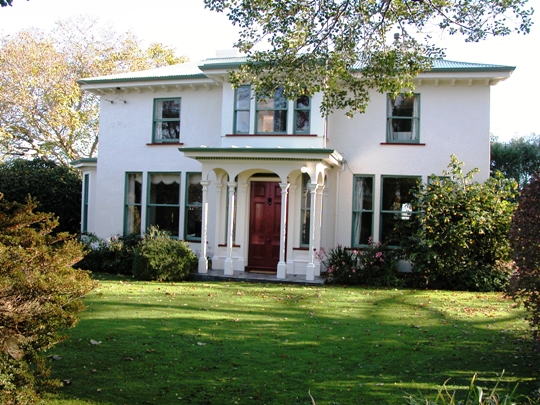
From its source, the Taiari/Taieri River flows almost entirely around Pātearoa (the Rock & Pillar Range) before discharging into Te Tai-o-Āraiteuru (the Otago coastline). Oral history tells us the Taiari and its various waterways was created by the taniwha Makaka who is immortalised as Pukemakamaka / Saddle Hill. Kāi Tahu ki Otago used all areas of the Taiari / Taieri Plain as evidenced by the hundreds of mahika kai sites associated with the numerous waterways, lakes and wetlands in the area, which was one of the most significant food baskets of the Otago region. The lower Taiari was an important occupation site with the Maitapapa kāinga at Henley. An important route, referred to by J. H. Beattie as a ‘Maori track’, passed through the area. Ngāi Tahu kaumātua recorded Taiari specifically as a kāinga mahinga tuna and kāinga nohoanga (settlement). In July 1844, the Otago Purchase, negotiated by Frederick Tuckett, was signed at Kōpūtai / Port Chalmers. This agreement alienated large areas of land around Dunedin into European hands and saw a native reserve (2,300 acres) established on the north bank of the Taiari awa. The Ōwhiro Stream, formerly known as Scroggs Creek, flows across the Taieri Plain into the Taieri River near the Allanton township, west of Mosgiel. The name Ōwhiro was used to denote the eastern part of the Taiari plain. The first Europeans to settle in the Taieri area were William and Margaret Jaffray who settled on Saddle Hill above the Taieri Plain in 1848 straight off the Philip Laing along with fellow shipmate John de la Condamine Carnegie. Other settlers began populating the central Dunedin area with few risking the journey out to the Taieri Plain. The first road from Dunedin was constructed in 1849, and with this farms and houses began to be constructed along this road. As the Taieri Plain was originally wetlands, few settlers took on the daunting task of converting the land to useful agricultural fields in the 1850s. This changed with the arrival of Rev Thomas Burns (1796-1871), on the ship Philip Laing on 15 April 1848. Before arriving in New Zealand, Burns had purchased rural sections on behalf of the Lay Association of Scotland Church Trustees and supporters of the Free Church project, and he chose a large majority from the plain. This purchase of rural sections was completed at the end of 1847 and was not without criticism from those not sure the Taieri Plain was suitable or rich farmland. Upon his first visited the Taieri Plain in 1849 he described it as “a truly magnificent plain”. He continued to make multiple visits out to the Taieri Plain, recording the development of the settlement and progress in the area in his diary. From an early survey map of the Taieri and Waihola Survey District in 1859 Johnstone Farm’s land is in between the Trustees of the Presbyterian Church and various members of the Burns family. Early in 1851 a property on the plain was taken up by Andrew Todd Jnr (1826-1853). Andrew Todd arrived in Dunedin on the ship Phoebe Dunbar in October 1850. The Phoebe Dunbar was the last ship dispatched to Port Chalmers by the New Zealand Shipping Company. According to family history, he travelled to New Zealand to live in a warmer climate to treat his tuberculosis. The land he worked was acquired from Gilbert Burns, the brother of Rev Burns, who was in a drapery business in Dublin with William Todd, Andrew’s uncle, and Alexander Findlater as a financial partner and all three brought sections on the Taieri via the Lay Association of Scotland. He wrote to his uncle a few weeks after arriving: “I have now taken up my abode on the Tiera [sic] Plain eight miles from Dunedin on a section Mr Burns exchanged with me for Mr Findlater’s. The section I have got is a very good one. No timber but I can get timber off the road line running through the bush for a long time, and the reserve timber is not far distant…I have got no house put up yet. I have got timber sawn and expect to have the house up in about a fortnight. I have been living in (what is called a whari) a hut made of sods and thatched with cabbage trees. I find it very comfortable. I find my health improves in the whari.” Andrew Junior was one of the first settlers to arrive on the Taieri Plain. He got to work on his farm and, along with Robert Hastie, was the first to plough on the Taieri. Todd planted potatoes and acquired two bullocks and four heifers, and after a good first return brought some of them into Dunedin for sale, being the first bullock team brought into Dunedin from the South. He was soon joined by his father Andrew Todd Senior (1796-1873), mother Ann Sangster (1799-1870), sister Jane (1835-1860) and brothers, William (1838-1921) and Robert (1844-1901) on board the Simlah in 1851. Brother, Charles (1829-1865), arrived shortly after in 1852, and another brother, James (1831-1915), arrived in 1858 with his pregnant wife and young daughter. The Todd family was originally from Perthshire, Scotland but had farmed in Ireland from 1840. The farm was named Johnstown/Johnstone Farm (the name was first referred to in the newspaper in 1853 as “Johnston” and then “Johnstown” in 1854), the name of which still remains today. This may have been named after the Georgian built Johnstown House, Enfield which is near where Andrew Todd Snr was a tenant farmer near Moygaddy Castle, Kildare, County Meath (County Kildare and Meath border each other). The house that was to be built “in a fortnight” mentioned in Andrew Junior’s 1851 letter was presumably built before his mother and father arrived in September of 1851. Descendants mentioned that a house was under construction when James arrived with his wife on the ship Agra in 1858. “The house was built but the kitchen still had a sod floor. The women were cooking in the kitchen and James was met in Dunedin by his three brothers with a bullock wagon”. This may have been the second iteration of the house on site. Andrew Jnr suffered from tuberculosis and although he reported his health was improving in the New Zealand climate, he became unwell and died in 1853. He was described in his obituary as one of the first settlers on the Plain, and whose assistance and energetic example contributed to much of the prosperity of the area. The land then passed to Andrew Todd Snr in 1854. It has been mentioned in local histories that the house at Johnstone Farm was standing in 1861, when it has been told that Rev Thomas Burns described the current house as a “…well-established farm on the level below the church hill. Andrew Todd had built a large white house, which stands there still. With his former experience of farming in Ireland, Mr Todd had brought this farm into splendid condition and he made agricultural history by harvesting a fine crop of barley in the month of December.” However, Burns had no Visitation Books in 1861 (his books continue until 1857) so this date does not seem correct. In December 1864, tenders were called by architect RA Lawson (1833-1902) for the construction of a residence at East Taieri for Andrew Todd. The date of this tender notice suggests that construction on this residence could have started in 1865. The 1897 valuation records report a dwelling on site, constructed from brick and timber with a slate roof valued at £400 ($95,574). The dwelling was recorded as 31 years old, which would give a construction date of 1866. A barn/stable, cowshed, and dairy were also recorded on site. RA Lawson was one of New Zealand’s pre-eminent architects. He had moved to Dunedin to build First Church in 1862 and then built his practice designing other churches and public buildings but also residential houses in the area. With both the Todd’s and Lawson’s involvement in the Presbyterian Church, the two parties would likely have been known to each other. The 1860s was a time of developing building technology and materials as more became available and as settlers became more established had money to spend on larger homes, as the Todd’s did with Johnstone Farmhouse. Lawson had designed Donald Reid’s Salisbury (List no. 2125) in April of the same year and advertised a tender two years later in 1866 for James Shand, settler, to build his house at his farm Abbotsford, West Taieri (near Allanton). Lawson designed the North Taieri Manse the next year in 1867-1868 and then went onto design the East Taieri Church (List no. 2260) in 1870. The East Taieri settler community were a tight knit group and relied on each other in the early years to establish themselves and their farms in the new colony. They supported new settlers arriving by giving a day’s worth of ploughing – up to 7 to 9 ploughs would be used to turn several acres and get the land ready for use. As the earliest settlers on the Taieri Plain, the Todd family became instrumental in the settlement’s establishment. Andrew Todd Snr was an elder of the East Taieri Presbyterian Church and one of the original committee members who instigated the establishment of the first East Taieri School and Church in 1852. He was also chairman of the East Taieri Roading Committee, the first president of the Taieri A&P Society, Justice of the Peace, member of the Provincial Government and a warden of the Hundred of East Taieri. He was an instigator of all things political, religious, and educational on the Taieri and took an active role in the advancement of the area. The Todd barn hosted the Harvest Home in 1854, which was celebrated by the settlers of East Taieri. The barn was decorated for the Harvest Home with fern, flax, and tutu. “Nearly 100 sat down to a sumptuous dinner at 6 o'clock, after which and the usual adjuncts, the floor was cleared for the dance, music, song, alternating till an early hour in the morning”. The farm also hosted many Annual Ploughing Matches. The whole Todd family were an enterprising group. The children established their own paths, and all did not travel far from Johnstone Farm. James Todd went into the drapery business like his Uncle William in Ireland. He married Ann Cash of Cash Drapery Firm in England and ran a store at East Taieri from April 1861 until December 1862. His farm was named as “Southam” on the Taieri (he sold the farm in 1868) and he died in 1915. Jane Todd married David Oughton, who built a house for them in 1851. He named this ‘Janefield’ (List No 4736) – the house is still standing, and the surrounding area is known as ‘Janefield.’ Jane sadly died of consumption in 1860. Charles married Margaret Shand in 1857 and he died in 1865 at Johnstone Farm after some years as a storekeeper and butcher, which he took over from his brother James. Robert, the youngest son, took over Johnstone Farm when their father died in 1879. William A Todd had a farm called Willow Acres and was known for breeding Leicester sheep. The Johnstone Farmhouse was built in a Georgian style with Australian jarrah used for the outer walls, Baltic pine flooring, handmade nails, and kauri doors. There is a brick fire wall running through the full width of the house, which is an unusual inclusion. A c.1900 photograph of the farmhouse shows it clad in weatherboards, with quoins at the corners, giving the illusion of channel-jointed stonework. This look was introduced in Wellington in the 1860s and became increasingly popular in the 1880s. Timber was a common construction material, which was sourced locally and imported from Australia. Andrew Todd Jnr mentions in 1851 how he had no timber on his section, but he could access timber off the road line running through the bush for a long time, and the reserve timber is “not far distant”. The township now known as Mosgiel was known as Big Bush and was covered in red, white, and black pine and totora. Brick was less common, being more expensive and the inclusion of a brick ‘fire wall’ in the farmhouse is a relatively unusual feature for a building of this age. There were, however, brick works operating nearby in particular by the settler family Callanders between Springbank and Springbank View in East Taieri as well as Salisbury, North Taieri. The house was exceptionally designed with five good sized bedrooms and a sunroom on the upper floor. Downstairs was a drawing room, dining room, and kitchen. A staircase connected the two levels, with the effect heightened by Italianate round arched windows. The nails were handmade and the fireplace in what is now the lounge is in black Italian marble imported by Andrew Todd Snr. Locks on the doors were brought from Scotland and most are still in use. Andrew Todd Snr died in 1879 at Johnstone. Robert inherited the farmhouse and all other property owned and leased by his father in 1879. Like his father, he was heavily involved in the Taieri Agricultural and Pastoral Association, of which he was president for some years, and took an active part in church work and educational matters. Robert was also a volunteer and a member of the Otago Hussars. He married Jane Paton, daughter of John Paton, who arrived in 1863, by the ship Silistria of North Taieri. Robert died in 1901, and the title passed to his son, another Andrew Todd. Andrew Todd continued to farm at Johnstone and was involved in many of the associations. He was a member of the Taieri Agricultural and Pastoral Association and Society including a stint as President, and a member of the East Taieri Farmers Union and the East Taieri Rifle Volunteers. After doctors’ orders to move north, due to his ill health in 1910, the property was leased to George McDonald in May 1909. McDonald Family (1909-1960) George McDonald was born in 1850 in Coull, Aberdeenshire, Scotland and arrived in New Zealand in 1868 on the ship Helenslee. He originally farmed in Inchclutha on the farm ‘Matua Bank’ and married Annie Dutton in 1877. They moved to East Taieri in 1907. George died aged 68 in 1917 and after George’s death the ownership of Johnstone was transferred to his wife Annie in August 1922. Following Annie’s death in 1938, the property was transferred to siblings Mary Rebecca (known as May) McDonald and John Thomas Charles McDonald as tenants in common. John worked as a farm assistant and farmer on Johnstone Farm from at least 1916 until 1958 when he died. At some point during the McDonald’s ownership, roughcast was applied to the exterior of the house and the third chimney at the rear of the house was removed. While the farm continued production, the farmhouse became run down and trees overgrown. John McDonald’s share was transferred to his wife Violet Constance McDonald in 1959 after his death. Rutherford Family (1960-Present) The property was purchased by Stanley Rutherford, nephew of John and May McDonald, in January 1960 and began its transformation. Rutherford and his wife (Marion Heather Rose known as Heather) were also active in the community, holding various roles in the East Taieri Presbyterian Church and school. Rutherford was also a former bomber pilot and RAF Officer during World War II, receiving the DFM during active service in North Africa and Italy. Mrs Rutherford worked as a telephonist intermittently throughout her life. The Rutherford’s undertook the large task of restoring Johnstone Farmhouse with a young family. The family had been living in Northland, New Zealand when they had the opportunity to purchase Johnstone Farm. The state of the farmhouse when Heather first saw the property was dire – no electricity on the first floor, animals were roaming throughout, sheep dip and other toxic chemicals were kept near the house and it was very dilapidated. Under the Rutherford’s ownership, the homestead was restored with fittings and fixtures to the era of the house. The wooden curtain rods and rings in the living room were sourced from Francis Scott Pillan’s home at Inchclutha who had arrived on the John Wickliffe. The original dark stained glass in the stair windows was replaced with clear leadlight around 1965 brightening the space. All bedrooms were relined, with wardrobes built into the rooms, and some original ceilings were replaced. The other rooms and hallway were also renovated, with walls throughout the house relined as the original plaster and kauri had deteriorated beyond repair. In the 1960s, the kitchen was renovated with a new floor, cabinetry and plaster ceiling. The ceiling was lowered approximately 18 inches (45 cms) and covered with a plaster ceiling fixed to the original beams. The Rutherford’s youngest son, was named Todd as a tribute to the original family and history of the house. He was the only child to be born in the house in the twentieth century. Two original windows were replaced, and one large window was added to the north-western elevation which looks out on the backyard and garden. The kitchen floor was re-piled and replaced and laid with linoleum with new cabinetry. The garden was redeveloped with silver birch trees planted along the driveway and a Leylandii hedge along the south-west boundary of the house. During the 1960s, the original Todd barn and diary were demolished, and a new farm shed, and dairy shed erected. Some trees near to the houses were felled as they had grown large against it, with some the timber being later repurposed within the house. The accessway to the farmhouse was shifted circa 1968-1970, when property was taken by the Crown to expand the nearby railway and recontour the Ōwhiro Stream into a straight channel. The original driveway accessed the property from Gladstone Road and crossed the railway line. Following Stanley Rutherford’s death in 1972, the farm was leased until 1992. Mrs Rutherford continued to renovate the house and often opened the home for tours. In 1996, daughter Alison Rutherford, took over farming the property and eventually purchased it in 2002. Over this time, several trees planted by the Todd and McDonald families were recognised on the Dunedin City Council District Plan. Further trees and shelter belts have been planted since, including riparian plantings along the Ōwhiro Stream. The house was renovated between 2003 to 2015, with all the rooms redecorated. A new bathroom was installed in 2003, replacing a bedroom on the first floor. The existing bathroom window was repaired and retained and refitted with safety glass. The floor was covered with particle board and vinyl and colonial skirting and cornices were added to match the existing ones. In 2005, renovations were carried out in the kitchen, dining, and bathroom on the ground floor. In the kitchen and dining areas, the ceiling was insulated and replaced at the same height as the existing. The walls were insulated and relined and all windows were replaced with double glazed units. In 2005, Alison renovated the kitchen and included macrocarpa timber in the joiner that was milled from trees planted by the Todd family. The bathroom on the ground floor was removed, and French doors were installed in the kitchen, where the bathroom was, to form a new tiled entry and T&G lined porch. A wall separating the kitchen and hallway (which provided access to the downstairs bathroom, living room, and bedroom) was removed.
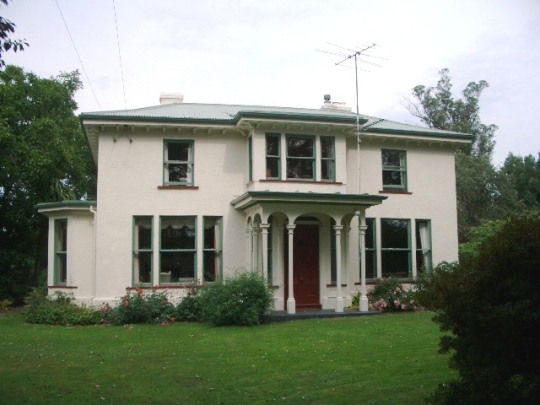
Physical Description

Current Description Johnstone Farmhouse is located at the end of Ashton Street, Mosgiel, 15 km from Dunedin. The predominant appearance of the land is that of a pastoral farming operation that includes significant fencing, shelterbelt planting, and large areas of open space. The area surrounding the property is residential to the east with extensive paddocks dominating the area to the west. The neighbour’s property has recently been rezoned residential. The house, which faces east, is two storeyed with a hipped roof, originally of slate and now corrugated iron. It was a large house at the time with 10 rooms. The front façade is symmetrical with a pillared entrance which has a square bay above. The exterior was roughcast sometime before 1940. It is timber framed other than one central brick firewall running through the house. The house is constructed of three main timber materials – Australian Jarrah, Baltic Pine and kauri. The framing and exterior bearing wall timber and front porch posts is Jarrah. The interior of the walls has a lath and plaster lining with the floors of Baltic Pine and the doors and wall panelling and some of the ceilings are kauri. The floors are hand sawn planks. The foundations of the house are a series of local basalt rock interspersed with bluestone rock. Two large double hung windows, one on either side of the front bay (containing the porch), look out from the dining and drawing rooms on the ground floor. On the first floor two smaller, double hung windows, one of either side of the bay containing a small sitting sunroom above the porch are centred above the two larger windows below. To the left of the house, facing towards the East Taieri Church, a bay window extends from the front drawing room. The porch is an open raised seam porch with a flat roof and a series of arches between the posts. An arch is also found above the main hallway and frames the entrance to the bay window in the drawing room. In addition, three narrow Italianate style round arch windows are found above the landing on the stairway. The interior has original elements such as wood panelling of the entrance foyer, wooden dados, original fireplaces and a pressed metal ceiling in the front drawing room. The main living areas are on the ground floor and the bedrooms are on the first floor. The two floors are connected by a stairway leading off from the ground floor main entrance hallway. Many of the ornate fixtures and fittings found on the porch posts and in the panelling below the main entrance windows and on the door are repeated throughout the house. There are four narrow double-hung windows surrounding the main door with a single ‘light’ window above the door. The eaves are wooden and consist of a plain soffit supported on ornately curved brackets, with T&G joinery between them. The eaves only extend around the front and onto one side of the house as others have been removed. Bullnose dado separates the wall panelling from the wall lining. The two types of wall panels are also found in the two main ceiling types found within the bedrooms. The ceilings in the drawing and dining rooms differ from the bedrooms and from each other. The drawing room has a pressed steel ceiling with a plaster ceiling above the bay window area. The dining room has a plaster ceiling. The moulding surrounding the ceilings is wither simple or a decorative variation on standard ogee moulding. In addition, all of the architraves and skirting boards have a standard decorative pattern which is seen throughout the house. The kauri staircase is simple in design. The house is surrounded by several significant trees, 100 years or older such as macrocarpa, Bluegum, Ash, English Walnut, Chestnut, Copper Beech, native Red Beech, Scarlet Oak and Bon Chretien Pear. Six of these are listed on the Dunedin City Council A1.3 Schedule of Trees. Many of these trees were planted by the various owners of the property, including a walnut tree that Jane Todd planted. Some of the trees that have been felled over the years have been used in some way within renovations in the house or for furniture within the house. Comparative Analysis This comparative analysis is drawing on the remaining listed residential homesteads designed by architect Robert A Lawson and other Taieri settler residences built in the early 1860s. Very few 1860s houses have survived on the Taieri Plain making Johnstone Farmhouse a rare structure in the area, especially one designed by a pre-eminent Victorian architect. RA Lawson Designed Homesteads Lawson designed 134 residences in his career, four of these were designed on the Taieri in the 1860s with only three of these residences remaining on the Taieri – Salisbury (List No 2125, Category 2 historic place), the North Taieri Manse (not listed) and Johnstone Farmhouse. Brooklands Homestead, Goodwood, North Otago (List No. 5238 Category 2 historic place) built 1867 is another remaining Lawson homestead in Otago. Lawson arrived in Dunedin in 1862, where his sketch plans had won the competition for the design of Dunedin’s First Church (built 1867-73). Lawson went on to become one of the most important architects in New Zealand and did more to shape the architectural face of Victorian Dunedin than any other architect. First Church is regarded as his masterpiece and one of the finest nineteenth century churches in New Zealand. He was also responsible for the design of the Trinity Church (now Fortune Theatre), Dunedin (1869-70), the East Taieri Presbyterian Church (1870), and Knox Church, Dunedin (1874). He designed Park's School (1864) and the ANZ Bank (originally Union Bank, 1874). While Lawson specialised in ecclesiastical and commercial buildings, he designed 134 residential buildings throughout his career with 67 of these built in the 1860s. His connections with the business community brought Lawson several commissions for large residences. The most famous of these is Larnach Castle on the Otago Peninsula, built for William Larnach. His other connections with the Presbyterian Church would have led to relationships with many of the Taieri settlers who were staunch Presbyterians and were instrumental in getting the East Taieri Church built. The Manse is not listed and the other two are significant examples of Lawson’s residential work. However, Johnstone Farmhouse retains its original 1864 design and has some aesthetic qualities, particularly the Italianate arched bay windows, which are a feature of RA Lawson’s architecture. Salisbury has had a significant 1873 addition to the 1864 house. Salisbury (List No. 2125, Category 2 Historic Place) Salisbury is a substantial two-storey brick residence built as the home for prominent settler, farmer and politician Donald Reid (1833-1919) between 1863 and 1873 at North Taieri, Taieri Plains. Like Andrew Todd Snr, Donald Reid was influential on the Taieri (North Taieri in this case) and was one of the early settlers who established a successful farm enterprise. The house was designed in two stages by RA Lawson, the first the same year as Johnstone Farmhouse, in April 1864 and the second in 1873. The house has architectural and historical significance, as an example of Lawson’s early residences and as one of the Taieri Plains most substantial estate homesteads. The development of farmhouses from small wattle and daub cottages to smaller houses, to substantial homesteads mirrored that of the Todd’s settlement experience. Both houses had influential early Scottish owners who played an important role in the development of agricultural practices and had business enterprises that remain today. Johnstone Farmhouse has a higher rarity value as the only 2 storey wooden residence still surviving on the Taieri Plain. Brooklands Homestead (List No 5238 Category 2 Historic Place) Designed in 1867 by RA Lawson, Brooklands estate is a landmark building at Goodwood, North Otago. It was built for Lawson’s brother-in-law James Paterson Hepburn. Like Johnstone Farmhouse, Brooklands Homestead has architectural significance as an example of Lawson’s residential designs (built within a few years of Johnstone Farmhouse) and historical significance for its association with the early European farming settlement in Otago. In 1857, George Hepburn (1803-1883) bought Brooklands for his sons James and George. Hepburn brought his wife and family of eight from Fifeshire to Dunedin in 1850, becoming a prominent businessman, churchman and politician. The house designed by Lawson was one-and-a-half storeys, with five small bedrooms on the first floor, and two living rooms with a lean-to kitchen, scullery and bathroom on the ground floor. Later, like Johnstone Farmhouse, the house was roughcast. The roof was also originally slate but later replaced with corrugated iron, as was Johnstone Farmhouse. However, unlike the larger, wooden Georgian style Johnstone farmhouse, Brooklands Homestead was built of locally quarried limestone and was built in a Scottish baronial style. Taieri Plains 1850-60s Residences Other similar aged residences have high significance due to their connection with early settler families on the Taieri Plain. Johnstone’s Farmhouse has an outstanding level of historical significance with its significant ties to the Todd family, the first family who began farming on the Taieri Plain. Other properties such as Janefield (List 4736 – Category 1) and Invermay (List 2350 – Category 1) are outstanding in their historical significance with connections to European settlers and Johnstone Farmhouse also clearly shows early and continuous occupation and connection to the land. Dunrobin, (List No 5242 – Category 2) is a contemporary of Johnstone Farmhouse and the only other Georgian style house on the Taieri Plains.   Janefield (List No 4736 Category 1) Janefield is considered to be the oldest house on the Taieri Plain still standing and lived in. David Oughton built it in the 1850s for his first wife, Jane Todd, after which it is named. It is an example of the typical simple wooden cottage of the moderately well-to-do pioneer family. This was presumably built by the owner, rather than designed by an architect and never eventuated into a more substantial two storey dwelling like Johnstone Farmhouse. Johnstone Farmhouse’s original owners have a longer and continuous occupation and connection to the land than Janefield.   Invermay (List No 2350 Category 1) John Gow arrived in New Zealand from Dunkeld, Perthshire, with his brother, James and sister and wife in 1852, a year after the arrival of the Todd’s. John Gow built first a sod cottage (where the Reverend Burns visited them in 1852), then a mud brick cottage and finally this substantial home, following a similar path to the Todd family and other successful Taieri settlers. The Land Registry records show that John Gow was in residence early enough to have built his house in 1862. However, it is likely that this building was constructed in the 1870s and no exact date has been determined. Although not as early as Johnstone Farmhouse, it is one of the larger homes on the Taieri and is in a setting of significantly listed trees and plantings although surrounding modern buildings have altered the historic setting. Unlike the wooden Johnstone Farmhouse, it is a technologically significant concrete Victorian house with some modifications and additions over the years.   Dunrobin (List No 5242 Category 2) The only other Georgian house on the Taieri is Dunrobin. This house was built as a home for Alexander McKay and his family sometime in early 1860s on land they were farming. The McKay’s were first recorded as living at the property by Rev. Thomas Burns in 1851 and they named it Dunrobin after Dunrobin Castle in Sutherlandshire near McKay’s birthplace. Built in Neo-Georgian style, the two-storey, square plan comprises of nine rooms with a double-hipped roof and is built of Baltic pine and kauri similar to Johnstone Farmhouse. It has rebated weatherboarding on the front facade, with decorative quoins on the front and dentils under the side bay window eaves. Four and 12 pane sash windows perforate the building. The south elevation features three two-paned double hung sash windows on the first floor, a central door flanked by two-paned double hung sash windows. In the 1970s a semi-circular porch with decorative brackets and pillars was installed over the central front door. The house has been largely relined, and the kitchen has been extensively remodelled with the inclusion of a concrete aggregate floor. Many heritage elements have been preserved such as windows, board and batten ceilings, fireplace surrounds, and the coal range.

Current Description Johnstone Farmhouse is located at the end of Ashton Street, Mosgiel, 15 km from Dunedin. The predominant appearance of the land is that of a pastoral farming operation that includes significant fencing, shelterbelt planting, and large areas of open space. The area surrounding the property is residential to the east with extensive paddocks dominating the area to the west. The neighbour’s property has recently been rezoned residential. The house, which faces east, is two storeyed with a hipped roof, originally of slate and now corrugated iron. It was a large house at the time with 10 rooms. The front façade is symmetrical with a pillared entrance which has a square bay above. The exterior was roughcast sometime before 1940. It is timber framed other than one central brick firewall running through the house. The house is constructed of three main timber materials – Australian Jarrah, Baltic Pine and kauri. The framing and exterior bearing wall timber and front porch posts is Jarrah. The interior of the walls has a lath and plaster lining with the floors of Baltic Pine and the doors and wall panelling and some of the ceilings are kauri. The floors are hand sawn planks. The foundations of the house are a series of local basalt rock interspersed with bluestone rock. Two large double hung windows, one on either side of the front bay (containing the porch), look out from the dining and drawing rooms on the ground floor. On the first floor two smaller, double hung windows, one of either side of the bay containing a small sitting sunroom above the porch are centred above the two larger windows below. To the left of the house, facing towards the East Taieri Church, a bay window extends from the front drawing room. The porch is an open raised seam porch with a flat roof and a series of arches between the posts. An arch is also found above the main hallway and frames the entrance to the bay window in the drawing room. In addition, three narrow Italianate style round arch windows are found above the landing on the stairway. The interior has original elements such as wood panelling of the entrance foyer, wooden dados, original fireplaces and a pressed metal ceiling in the front drawing room. The main living areas are on the ground floor and the bedrooms are on the first floor. The two floors are connected by a stairway leading off from the ground floor main entrance hallway. Many of the ornate fixtures and fittings found on the porch posts and in the panelling below the main entrance windows and on the door are repeated throughout the house. There are four narrow double-hung windows surrounding the main door with a single ‘light’ window above the door. The eaves are wooden and consist of a plain soffit supported on ornately curved brackets, with T&G joinery between them. The eaves only extend around the front and onto one side of the house as others have been removed. Bullnose dado separates the wall panelling from the wall lining. The two types of wall panels are also found in the two main ceiling types found within the bedrooms. The ceilings in the drawing and dining rooms differ from the bedrooms and from each other. The drawing room has a pressed steel ceiling with a plaster ceiling above the bay window area. The dining room has a plaster ceiling. The moulding surrounding the ceilings is wither simple or a decorative variation on standard ogee moulding. In addition, all of the architraves and skirting boards have a standard decorative pattern which is seen throughout the house. The kauri staircase is simple in design. The house is surrounded by several significant trees, 100 years or older such as macrocarpa, Bluegum, Ash, English Walnut, Chestnut, Copper Beech, native Red Beech, Scarlet Oak and Bon Chretien Pear. Six of these are listed on the Dunedin City Council A1.3 Schedule of Trees. Many of these trees were planted by the various owners of the property, including a walnut tree that Jane Todd planted. Some of the trees that have been felled over the years have been used in some way within renovations in the house or for furniture within the house. Comparative Analysis This comparative analysis is drawing on the remaining listed residential homesteads designed by architect Robert A Lawson and other Taieri settler residences built in the early 1860s. Very few 1860s houses have survived on the Taieri Plain making Johnstone Farmhouse a rare structure in the area, especially one designed by a pre-eminent Victorian architect. RA Lawson Designed Homesteads Lawson designed 134 residences in his career, four of these were designed on the Taieri in the 1860s with only three of these residences remaining on the Taieri – Salisbury (List No 2125, Category 2 historic place), the North Taieri Manse (not listed) and Johnstone Farmhouse. Brooklands Homestead, Goodwood, North Otago (List No. 5238 Category 2 historic place) built 1867 is another remaining Lawson homestead in Otago. Lawson arrived in Dunedin in 1862, where his sketch plans had won the competition for the design of Dunedin’s First Church (built 1867-73). Lawson went on to become one of the most important architects in New Zealand and did more to shape the architectural face of Victorian Dunedin than any other architect. First Church is regarded as his masterpiece and one of the finest nineteenth century churches in New Zealand. He was also responsible for the design of the Trinity Church (now Fortune Theatre), Dunedin (1869-70), the East Taieri Presbyterian Church (1870), and Knox Church, Dunedin (1874). He designed Park's School (1864) and the ANZ Bank (originally Union Bank, 1874). While Lawson specialised in ecclesiastical and commercial buildings, he designed 134 residential buildings throughout his career with 67 of these built in the 1860s. His connections with the business community brought Lawson several commissions for large residences. The most famous of these is Larnach Castle on the Otago Peninsula, built for William Larnach. His other connections with the Presbyterian Church would have led to relationships with many of the Taieri settlers who were staunch Presbyterians and were instrumental in getting the East Taieri Church built. The Manse is not listed and the other two are significant examples of Lawson’s residential work. However, Johnstone Farmhouse retains its original 1864 design and has some aesthetic qualities, particularly the Italianate arched bay windows, which are a feature of RA Lawson’s architecture. Salisbury has had a significant 1873 addition to the 1864 house. Salisbury (List No. 2125, Category 2 Historic Place) Salisbury is a substantial two-storey brick residence built as the home for prominent settler, farmer and politician Donald Reid (1833-1919) between 1863 and 1873 at North Taieri, Taieri Plains. Like Andrew Todd Snr, Donald Reid was influential on the Taieri (North Taieri in this case) and was one of the early settlers who established a successful farm enterprise. The house was designed in two stages by RA Lawson, the first the same year as Johnstone Farmhouse, in April 1864 and the second in 1873. The house has architectural and historical significance, as an example of Lawson’s early residences and as one of the Taieri Plains most substantial estate homesteads. The development of farmhouses from small wattle and daub cottages to smaller houses, to substantial homesteads mirrored that of the Todd’s settlement experience. Both houses had influential early Scottish owners who played an important role in the development of agricultural practices and had business enterprises that remain today. Johnstone Farmhouse has a higher rarity value as the only 2 storey wooden residence still surviving on the Taieri Plain. Brooklands Homestead (List No 5238 Category 2 Historic Place) Designed in 1867 by RA Lawson, Brooklands estate is a landmark building at Goodwood, North Otago. It was built for Lawson’s brother-in-law James Paterson Hepburn. Like Johnstone Farmhouse, Brooklands Homestead has architectural significance as an example of Lawson’s residential designs (built within a few years of Johnstone Farmhouse) and historical significance for its association with the early European farming settlement in Otago. In 1857, George Hepburn (1803-1883) bought Brooklands for his sons James and George. Hepburn brought his wife and family of eight from Fifeshire to Dunedin in 1850, becoming a prominent businessman, churchman and politician. The house designed by Lawson was one-and-a-half storeys, with five small bedrooms on the first floor, and two living rooms with a lean-to kitchen, scullery and bathroom on the ground floor. Later, like Johnstone Farmhouse, the house was roughcast. The roof was also originally slate but later replaced with corrugated iron, as was Johnstone Farmhouse. However, unlike the larger, wooden Georgian style Johnstone farmhouse, Brooklands Homestead was built of locally quarried limestone and was built in a Scottish baronial style. Taieri Plains 1850-60s Residences Other similar aged residences have high significance due to their connection with early settler families on the Taieri Plain. Johnstone’s Farmhouse has an outstanding level of historical significance with its significant ties to the Todd family, the first family who began farming on the Taieri Plain. Other properties such as Janefield (List 4736 – Category 1) and Invermay (List 2350 – Category 1) are outstanding in their historical significance with connections to European settlers and Johnstone Farmhouse also clearly shows early and continuous occupation and connection to the land. Dunrobin, (List No 5242 – Category 2) is a contemporary of Johnstone Farmhouse and the only other Georgian style house on the Taieri Plains.   Janefield (List No 4736 Category 1) Janefield is considered to be the oldest house on the Taieri Plain still standing and lived in. David Oughton built it in the 1850s for his first wife, Jane Todd, after which it is named. It is an example of the typical simple wooden cottage of the moderately well-to-do pioneer family. This was presumably built by the owner, rather than designed by an architect and never eventuated into a more substantial two storey dwelling like Johnstone Farmhouse. Johnstone Farmhouse’s original owners have a longer and continuous occupation and connection to the land than Janefield.   Invermay (List No 2350 Category 1) John Gow arrived in New Zealand from Dunkeld, Perthshire, with his brother, James and sister and wife in 1852, a year after the arrival of the Todd’s. John Gow built first a sod cottage (where the Reverend Burns visited them in 1852), then a mud brick cottage and finally this substantial home, following a similar path to the Todd family and other successful Taieri settlers. The Land Registry records show that John Gow was in residence early enough to have built his house in 1862. However, it is likely that this building was constructed in the 1870s and no exact date has been determined. Although not as early as Johnstone Farmhouse, it is one of the larger homes on the Taieri and is in a setting of significantly listed trees and plantings although surrounding modern buildings have altered the historic setting. Unlike the wooden Johnstone Farmhouse, it is a technologically significant concrete Victorian house with some modifications and additions over the years.   Dunrobin (List No 5242 Category 2) The only other Georgian house on the Taieri is Dunrobin. This house was built as a home for Alexander McKay and his family sometime in early 1860s on land they were farming. The McKay’s were first recorded as living at the property by Rev. Thomas Burns in 1851 and they named it Dunrobin after Dunrobin Castle in Sutherlandshire near McKay’s birthplace. Built in Neo-Georgian style, the two-storey, square plan comprises of nine rooms with a double-hipped roof and is built of Baltic pine and kauri similar to Johnstone Farmhouse. It has rebated weatherboarding on the front facade, with decorative quoins on the front and dentils under the side bay window eaves. Four and 12 pane sash windows perforate the building. The south elevation features three two-paned double hung sash windows on the first floor, a central door flanked by two-paned double hung sash windows. In the 1970s a semi-circular porch with decorative brackets and pillars was installed over the central front door. The house has been largely relined, and the kitchen has been extensively remodelled with the inclusion of a concrete aggregate floor. Many heritage elements have been preserved such as windows, board and batten ceilings, fireplace surrounds, and the coal range.

Reference

Historical and Associated Iwi / Hapū / Whānau

Completion Date

11th May 2025

Report Written By

Alison Breese

Information Sources

Heritage New Zealand Pouhere Taonga File

36007-785

Other Information

Disclaimer Please note that entry on the New Zealand Heritage List/Rārangi Kōrero identifies only the heritage values of the property concerned, and should not be construed as advice on the state of the property, or as a comment of its soundness or safety, including in regard to earthquake risk, safety in the event of fire, or insanitary conditions. Archaeological sites are protected by the Heritage New Zealand Pouhere Taonga Act 2014, regardless of whether they are entered on the New Zealand Heritage List/Rārangi Kōrero or not. Archaeological sites include ‘places associated with pre-1900 human activity, where there may be evidence relating to the history of New Zealand’. This List entry report should not be read as a statement on whether or not the archaeological provisions of the Act apply to the property (s) concerned. Please contact your local Heritage New Zealand Pouhere Taonga office for archaeological advice. A fully referenced New Zealand Heritage List/Rārangi Kōrero review report is available on request from the Southern Area Office of Heritage New Zealand Pouhere Taonga.

Historical and Associated Iwi / Hapū / Whānau

Completion Date

11th May 2025

Report Written By

Alison Breese

Information Sources

Heritage New Zealand Pouhere Taonga File

36007-785

Other Information

Disclaimer Please note that entry on the New Zealand Heritage List/Rārangi Kōrero identifies only the heritage values of the property concerned, and should not be construed as advice on the state of the property, or as a comment of its soundness or safety, including in regard to earthquake risk, safety in the event of fire, or insanitary conditions. Archaeological sites are protected by the Heritage New Zealand Pouhere Taonga Act 2014, regardless of whether they are entered on the New Zealand Heritage List/Rārangi Kōrero or not. Archaeological sites include ‘places associated with pre-1900 human activity, where there may be evidence relating to the history of New Zealand’. This List entry report should not be read as a statement on whether or not the archaeological provisions of the Act apply to the property (s) concerned. Please contact your local Heritage New Zealand Pouhere Taonga office for archaeological advice. A fully referenced New Zealand Heritage List/Rārangi Kōrero review report is available on request from the Southern Area Office of Heritage New Zealand Pouhere Taonga.

Further Information

Current Usages

Uses: Accommodation

Specific Usage: House

Former Usages

General Usage: Accommodation

Specific Usage: House

Current Usages

Uses: Accommodation

Specific Usage: House

Former Usages

General Usage: Accommodation

Specific Usage: House

Location

Loading
Related listings
Brooklands Homestead. November 1994. Original image submitted at time of registration
Brooklands Homestead
Salisbury, Dunedin. Image taken at a public event organised by the Rotary Club of the Taieri
Salisbury
Salisbury, Dunedin. Image taken at a public event organised by the Rotary Club of the Taieri
Salisbury
Brooklands Homestead. November 1994. Original image submitted at time of registration
Brooklands Homestead
Stay up to date with Heritage this month