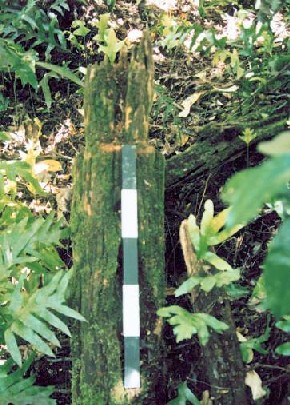
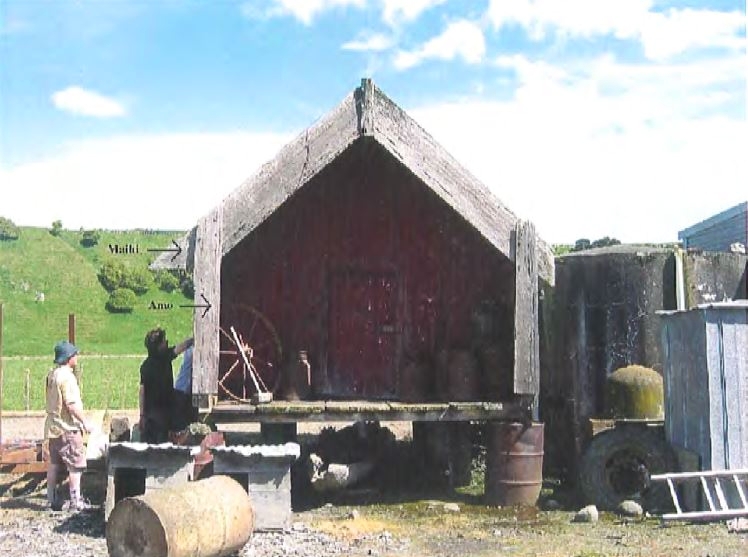
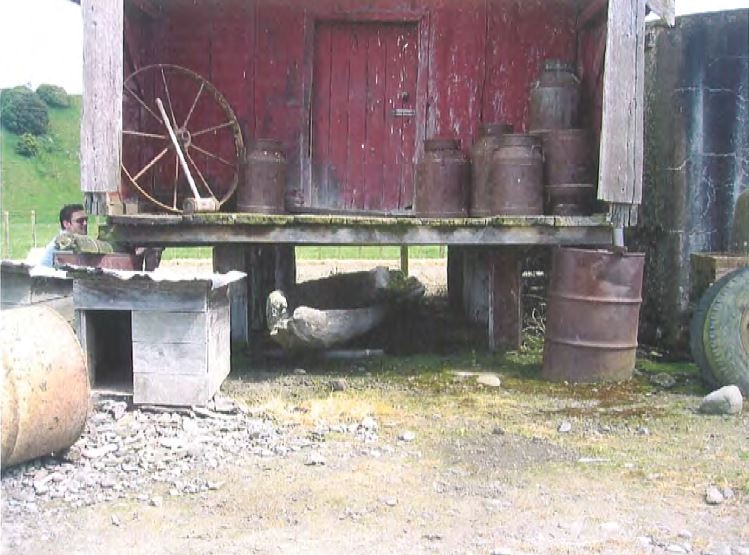
The pataka is of traditional slab construction with an uncarved maihi and amo frontage. 'Maihi' are the facing boards on the gable of a house and 'amo' are the upright supports at the lower end of the maihi. It is 3.44 metres wide, 4.9 metres long and has a height of 4.5 metres. Large slabs of adzed totara are positioned lengthways along the side walls, and vertically on the front and rear walls. The pataka rests upon large slab bearers which are supported by six piles, and petrol drums have been placed under the corners to provide additional support. These piles replaced the original piles when it was moved to its present location and it appears that the bearers were also placed upside down during its relocation as they are usually positioned with the bevelled surface facing downwards. New timber framing was also added during the pataka's reconstruction at the present site and corrugated iron roofing has also been added at a later stage. The waka is constructed out of a single piece of adzed totara and measures 5.5 metres in length. It has a thick profile section and may potentially be in an unfinished state.
List Entry Information
Status
Listed
List Entry Status
Historic Place Category 1
Access
Private/No Public Access
List Number
7608
Date Entered
24th June 2005
Date of Effect
24th June 2005
City/District Council
Rangitīkei District
Region
Horizons (Manawatū-Whanganui) Region
Extent of List Entry
The registration includes the pataka (and the waka situated underneath) on land comprised in RT WN230/289, Wellington Registry.
Legal description
Taraketi 2F3, Ongo SD (RT WN230/289), Wellington Land District
Location Description
The pataka is situated on the farm of John McManaway, one kilometre south of Rata. Turn right off State Highway 1 onto Te Houhou Road and conitnue for approximately 2km before turning right to the McManaway farm (see Appendix 3 of Registration Report). The pataka is situated with a complex of farm buildings to the right of the farm house.
Status
Listed
List Entry Status
Historic Place Category 1
Access
Private/No Public Access
List Number
7608
Date Entered
24th June 2005
Date of Effect
24th June 2005
City/District Council
Rangitīkei District
Region
Horizons (Manawatū-Whanganui) Region
Extent of List Entry
The registration includes the pataka (and the waka situated underneath) on land comprised in RT WN230/289, Wellington Registry.
Legal description
Taraketi 2F3, Ongo SD (RT WN230/289), Wellington Land District
Location Description
The pataka is situated on the farm of John McManaway, one kilometre south of Rata. Turn right off State Highway 1 onto Te Houhou Road and conitnue for approximately 2km before turning right to the McManaway farm (see Appendix 3 of Registration Report). The pataka is situated with a complex of farm buildings to the right of the farm house.
Why is this place significant?
Cultural Significance
Pataka: The pataka on McManaway's farm was nominated as a site of cultural significance by Te Runanga o Ngati Hauiti during consultation with the NZHPT as part of the Central Region Pilot Project. The pataka has cultural and traditional value to Te Runanga o Ngati Hauiti and is believed to have been originally located within the vicinity of Te Hou Hou kainga, which was the principal Ngati Hauiti settlement in the 19th century. The pataka was constructed by their tupuna and is the only remaining physical remnant of Ngati Hauiti occupation of the river flats (known generally as 'Te Hou Hou') in the Rata area. John McManaway informed the NZHPT that the pataka is also of cultural and traditional significance to the Taiuru whanau (Ngati Haukaha) who owned the land before it was purchased by John McManaway's great grandfather. Waka: The waka is also of cultural and traditional significance to Te Runanga o Ngati Hauiti as although the historical context cannot be confirmed, it is likely to have been associated with their ancestors' 19th century occupation of this land.
Historic Significance
Historical Significance or Value Pataka: The pataka at McManaway's farm is extremely significant within an historical context as there are very few pataka left standing in New Zealand. A second pataka was situated to the west of McManaway's farm at the former Ngati Hauiti kainga of Pourewa but this was dismantled by Rangipo Mete-Kingi and others in the early 1990s, and the timbers now lie in a paddock adjacent to its former location. Waka: Although the historical context of the waka is unclear, it still has historical significance through its general association with 19th century Maori occupation of the Rata district
Physical Significance
Pataka: The pataka has high architectural value, as it is an extremely rare example of an uncarved pataka. Most pataka had carvings on the maihi and amo and there are very surviving examples of pataka such as this one, which are completely free of carving.
Why is this place Category 1 / Category 2?
Detail Of Assessed Criteria
(d) The importance of the place to the tangata whenua. The pataka and waka are of considerable importance to Te Runanga o Ngati Hauiti as they are some of the few remaining physical traces of their ancestor's occupation within the Rata area during the nineteenth century. The pataka also has cultural and traditional value to the Taiuru whanau (Ngati Haukaha) who sold the land to John McManaway's great grandfather in the late 19th century. (g) The technical accomplishment or value, or design of the place. The pataka has high architectural value because of its lack of 'design'. The maihi and amo are completely devoid of carving which is very unusual as most known examples of pataka have carvings on the frontage. The craftsmanship of the pataka is also to be noted. Dean Whiting (Pouarahi Whakaora Taonga - Maori Built Heritage Conservator) and Jamie Tuuta (Pouarahi -Maori Heritage Advisor) of the NZHPT Maori Heritage Team both commented on the quality of the adzing during their recent site visit. (j) The importance of identifying rare types of historic places. The pataka on McManaway's farm is extremely rare as there are few pataka still standing today within the New Zealand landscape. This particular pataka has added rarity because it is of a plain design with no carvings on the maihi and amo. (k) The extent to which the place forms part of a wider historical and cultural complex or historical and cultural landscape. As the pataka and waka are not in their original locations, it is the objects rather than the 'place' that form part of a wider historical and cultural complex associated with Ngati Hauiti and Ngati Haukaha occupation of the Rata area during the nineteenth century. Other integral components of this historical and cultural complex include the dismantled pataka at the former site of Pourewa kainga, the nearby Pourewa urupa, the wharepuni at Rata marae (Ngati Hauiti), which was built in 1896, and Terukuatekawau whare at Tahuhu Marae (Ngati Haukaha) that dates to 1897.
Why is this place significant?
Cultural Significance
Pataka: The pataka on McManaway's farm was nominated as a site of cultural significance by Te Runanga o Ngati Hauiti during consultation with the NZHPT as part of the Central Region Pilot Project. The pataka has cultural and traditional value to Te Runanga o Ngati Hauiti and is believed to have been originally located within the vicinity of Te Hou Hou kainga, which was the principal Ngati Hauiti settlement in the 19th century. The pataka was constructed by their tupuna and is the only remaining physical remnant of Ngati Hauiti occupation of the river flats (known generally as 'Te Hou Hou') in the Rata area. John McManaway informed the NZHPT that the pataka is also of cultural and traditional significance to the Taiuru whanau (Ngati Haukaha) who owned the land before it was purchased by John McManaway's great grandfather. Waka: The waka is also of cultural and traditional significance to Te Runanga o Ngati Hauiti as although the historical context cannot be confirmed, it is likely to have been associated with their ancestors' 19th century occupation of this land.
Historic Significance
Historical Significance or Value Pataka: The pataka at McManaway's farm is extremely significant within an historical context as there are very few pataka left standing in New Zealand. A second pataka was situated to the west of McManaway's farm at the former Ngati Hauiti kainga of Pourewa but this was dismantled by Rangipo Mete-Kingi and others in the early 1990s, and the timbers now lie in a paddock adjacent to its former location. Waka: Although the historical context of the waka is unclear, it still has historical significance through its general association with 19th century Maori occupation of the Rata district
Physical Significance
Pataka: The pataka has high architectural value, as it is an extremely rare example of an uncarved pataka. Most pataka had carvings on the maihi and amo and there are very surviving examples of pataka such as this one, which are completely free of carving.
Why is this place Category 1 / Category 2?
Detail Of Assessed Criteria
(d) The importance of the place to the tangata whenua. The pataka and waka are of considerable importance to Te Runanga o Ngati Hauiti as they are some of the few remaining physical traces of their ancestor's occupation within the Rata area during the nineteenth century. The pataka also has cultural and traditional value to the Taiuru whanau (Ngati Haukaha) who sold the land to John McManaway's great grandfather in the late 19th century. (g) The technical accomplishment or value, or design of the place. The pataka has high architectural value because of its lack of 'design'. The maihi and amo are completely devoid of carving which is very unusual as most known examples of pataka have carvings on the frontage. The craftsmanship of the pataka is also to be noted. Dean Whiting (Pouarahi Whakaora Taonga - Maori Built Heritage Conservator) and Jamie Tuuta (Pouarahi -Maori Heritage Advisor) of the NZHPT Maori Heritage Team both commented on the quality of the adzing during their recent site visit. (j) The importance of identifying rare types of historic places. The pataka on McManaway's farm is extremely rare as there are few pataka still standing today within the New Zealand landscape. This particular pataka has added rarity because it is of a plain design with no carvings on the maihi and amo. (k) The extent to which the place forms part of a wider historical and cultural complex or historical and cultural landscape. As the pataka and waka are not in their original locations, it is the objects rather than the 'place' that form part of a wider historical and cultural complex associated with Ngati Hauiti and Ngati Haukaha occupation of the Rata area during the nineteenth century. Other integral components of this historical and cultural complex include the dismantled pataka at the former site of Pourewa kainga, the nearby Pourewa urupa, the wharepuni at Rata marae (Ngati Hauiti), which was built in 1896, and Terukuatekawau whare at Tahuhu Marae (Ngati Haukaha) that dates to 1897.
Construction Details
Start Year
1750
startYearCirca
Finish Year
1900
finishYearCirca
Type
Original Construction
Construction Materials
The pataka is of traditional slab construction with an uncarved maihi and amo frontage. The waka is constructed out of a single piece of adzed totara and measures 5.5 metres in length.
Notable Features
Uncarved panels on the pataka
Construction Details
Start Year
1750
startYearCirca
Finish Year
1900
finishYearCirca
Type
Original Construction
Construction Materials
The pataka is of traditional slab construction with an uncarved maihi and amo frontage. The waka is constructed out of a single piece of adzed totara and measures 5.5 metres in length.
Notable Features
Uncarved panels on the pataka
Ngati Hauiti believe that the pataka was originally located within the general vicinity of their settlement of Te Hou Hou which was situated on the bank of the Rangitikei River. Te Hou Hou was the principal historic settlement of Ngati Hauiti and was established during the early nineteenth century after they had made peace with Ngati Apa who occupied the southern Rangitikei. Te Hou Hou kainga was occupied through until the late 19th century when Ngati Hauiti relocated to higher ground as increased European settlement and the subsequent large scale felling of the forest had caused the Rangitikei River to flood on a frequent basis. The wharepuni at Ngati Hauiti's current marae at Rata was constructed in 1896 and Ngati Haukaha (the Taiuru whanau) also relocated their marae on higher ground during the late nineteenth century, building Terukuatekawau whare at Tahuhu Marae in 1897. John McManaway's great grandfather purchased the land containing the former site of Te Hou Hou from the Taiuru whanau, and it appears that the pataka was relocated to its present location during the late nineteenth or early twentieth century. Carvings from a whare at Te Hou Hou also remained within the McManaway family but were taken to Wellington and presented to Mr B.C. O'Connor of Wilton's Bush, Wadestown around 1918.
Ngati Hauiti believe that the pataka was originally located within the general vicinity of their settlement of Te Hou Hou which was situated on the bank of the Rangitikei River. Te Hou Hou was the principal historic settlement of Ngati Hauiti and was established during the early nineteenth century after they had made peace with Ngati Apa who occupied the southern Rangitikei. Te Hou Hou kainga was occupied through until the late 19th century when Ngati Hauiti relocated to higher ground as increased European settlement and the subsequent large scale felling of the forest had caused the Rangitikei River to flood on a frequent basis. The wharepuni at Ngati Hauiti's current marae at Rata was constructed in 1896 and Ngati Haukaha (the Taiuru whanau) also relocated their marae on higher ground during the late nineteenth century, building Terukuatekawau whare at Tahuhu Marae in 1897. John McManaway's great grandfather purchased the land containing the former site of Te Hou Hou from the Taiuru whanau, and it appears that the pataka was relocated to its present location during the late nineteenth or early twentieth century. Carvings from a whare at Te Hou Hou also remained within the McManaway family but were taken to Wellington and presented to Mr B.C. O'Connor of Wilton's Bush, Wadestown around 1918.
Pataka The pataka is 3.44 metres wide, 4.9 metres long and has a height of 4.5 metres. Large slabs of adzed totara are positioned lengthways along the side walls, and vertically on the front and rear walls. The pataka rests upon large slab bearers which are supported by six piles, and petrol drums have been placed under the corners to provide additional support. These piles replaced the original piles when it was moved to its present location and it appears that the bearers were also placed upside down during its relocation as they are usually positioned with the bevelled surface facing downwards. New timber framing was also added during the pataka's reconstruction at the present site and corrugated iron roofing has also been added at a later stage. Waka The waka has a thick profile section and may potentially be in an unfinished state.
Pataka The pataka is 3.44 metres wide, 4.9 metres long and has a height of 4.5 metres. Large slabs of adzed totara are positioned lengthways along the side walls, and vertically on the front and rear walls. The pataka rests upon large slab bearers which are supported by six piles, and petrol drums have been placed under the corners to provide additional support. These piles replaced the original piles when it was moved to its present location and it appears that the bearers were also placed upside down during its relocation as they are usually positioned with the bevelled surface facing downwards. New timber framing was also added during the pataka's reconstruction at the present site and corrugated iron roofing has also been added at a later stage. Waka The waka has a thick profile section and may potentially be in an unfinished state.
Historical and Associated Iwi / Hapū / Whānau
Report Written By
Jo Wylie
Information Sources
Colless, 1985
L. Colless, A. Snell and R. Cassels, 'An Archaeological Survey of the Lower Rangitikei River, North Island, New Zealand.' Palmerston North: Manawatu Museum Society Incorporated, 1985
Haywood, 2003
M Haywood, Rata: In the Heart of the Rangitikei. Hamilton: M Haywood, 2003
Phillips, 1955
William J. Phillips, Carved Maori Houses of Western and Northern Areas of New Zealand, Wellington, 1955
Simon, nd
M.T. Simon, 'Taku whare - my home my heart', Wanganui Regional Community College, Wanganui, n.d.
Other Information
Iwi - Ngati Hauiti Please note that entry on the New Zealand Heritage List/Rarangi Korero identifies only the heritage values of the property concerned, and should not be construed as advice on the state of the property, or as a comment of its soundness or safety, including in regard to earthquake risk, safety in the event of fire, or insanitary conditions.
Historical and Associated Iwi / Hapū / Whānau
Report Written By
Jo Wylie
Information Sources
Colless, 1985
L. Colless, A. Snell and R. Cassels, 'An Archaeological Survey of the Lower Rangitikei River, North Island, New Zealand.' Palmerston North: Manawatu Museum Society Incorporated, 1985
Haywood, 2003
M Haywood, Rata: In the Heart of the Rangitikei. Hamilton: M Haywood, 2003
Phillips, 1955
William J. Phillips, Carved Maori Houses of Western and Northern Areas of New Zealand, Wellington, 1955
Simon, nd
M.T. Simon, 'Taku whare - my home my heart', Wanganui Regional Community College, Wanganui, n.d.
Other Information
Iwi - Ngati Hauiti Please note that entry on the New Zealand Heritage List/Rarangi Korero identifies only the heritage values of the property concerned, and should not be construed as advice on the state of the property, or as a comment of its soundness or safety, including in regard to earthquake risk, safety in the event of fire, or insanitary conditions.
Former Usages
General Usage: Maori
Specific Usage: Pātaka
General Usage: Maori
Specific Usage: Waka
Themes
Of Significance to Maori
Former Usages
General Usage: Maori
Specific Usage: Pātaka
General Usage: Maori
Specific Usage: Waka
Themes
Of Significance to Maori