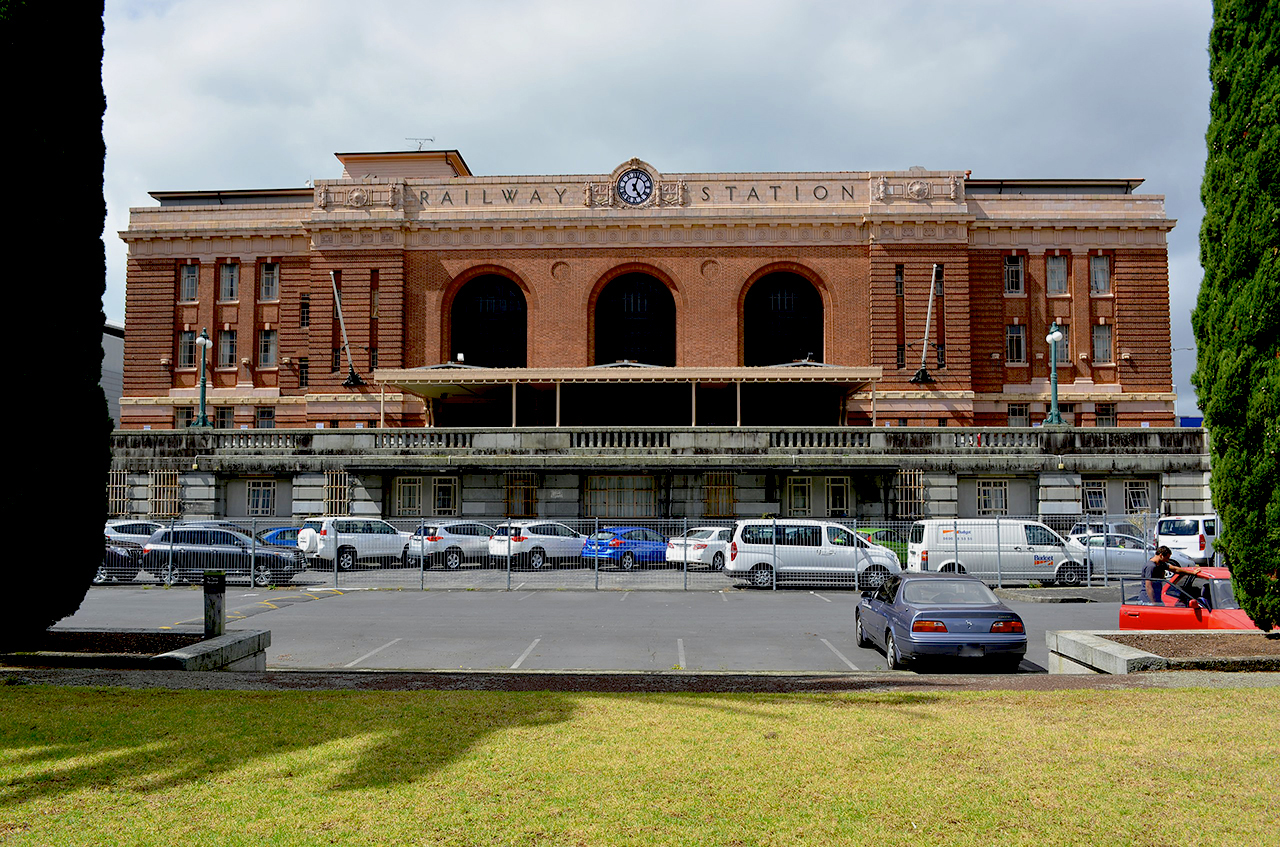
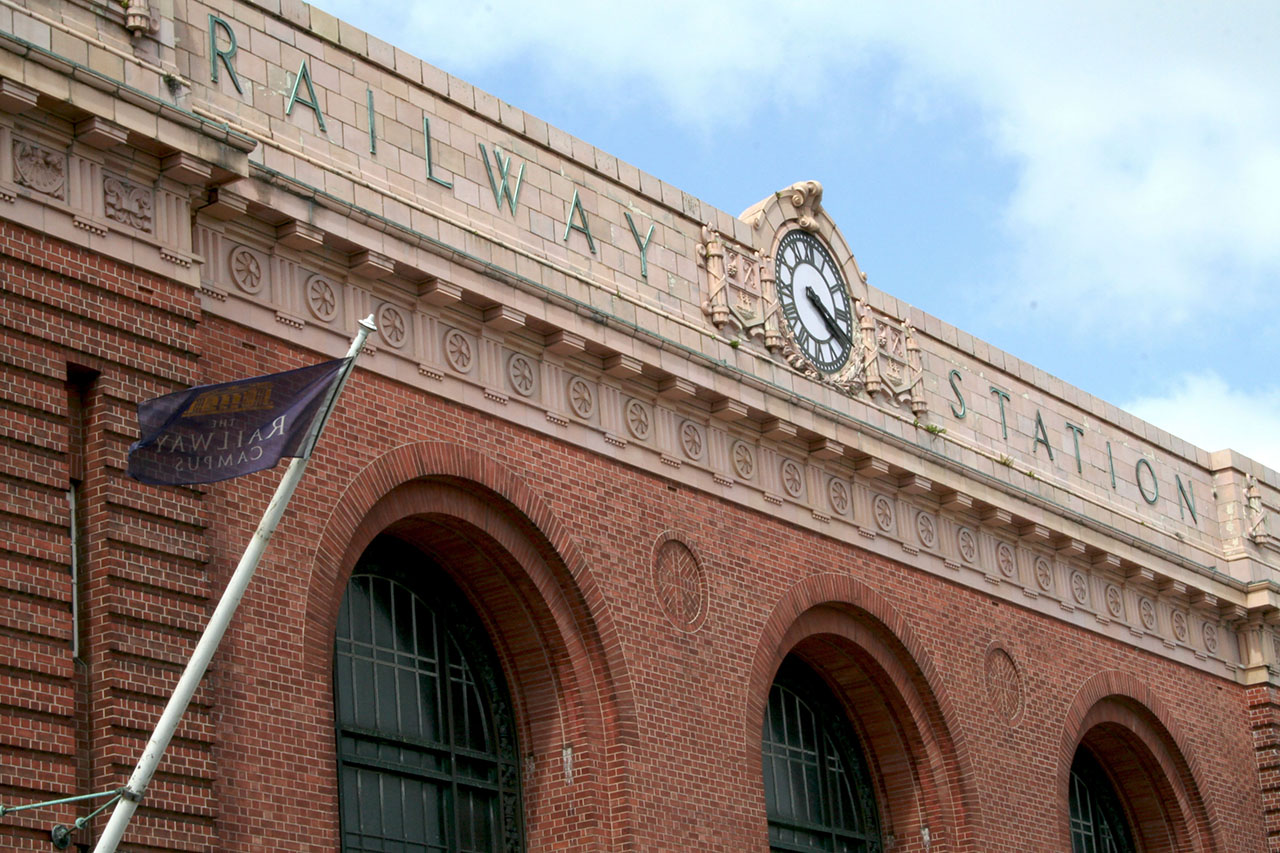
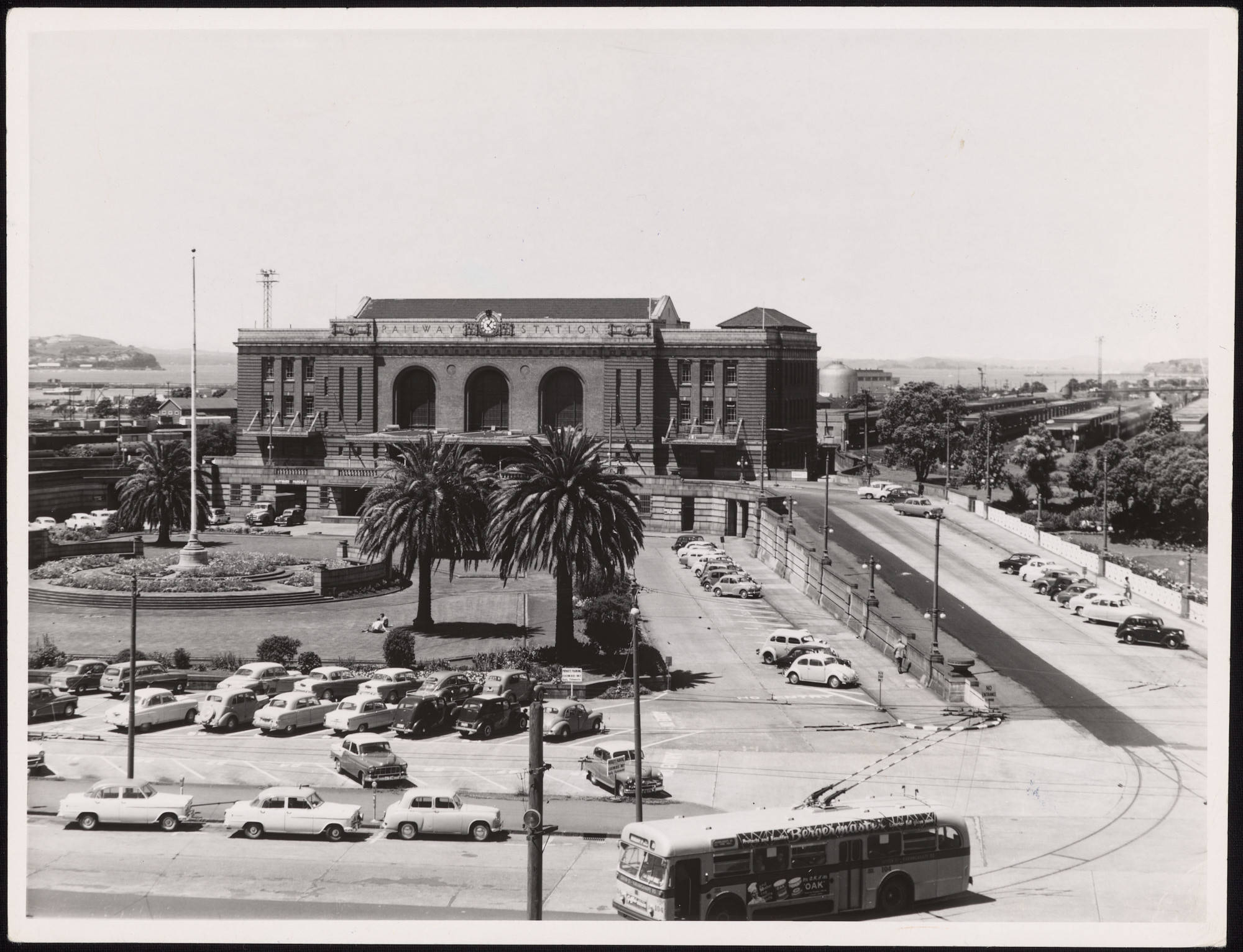
The former Auckland Railway Station was one of the most self-consciously monumental public buildings erected in early twentieth-century New Zealand, and remains a powerful statement on the importance of state-run transport in the Dominion (1907-1947). Built by the Public Works Department in 1928-1930, it sits on reclaimed land close to the wharves and replaced a smaller terminal nearer the centre of town (see 'Chief Post Office'). The grand and ornate Beaux Arts-style building was intended to stand as a gateway to the city, and its construction involved the largest independent contract issued in New Zealand at £320,000. Railways were important for the economic development of the country, and were often seen as symbolic of 'progress'.
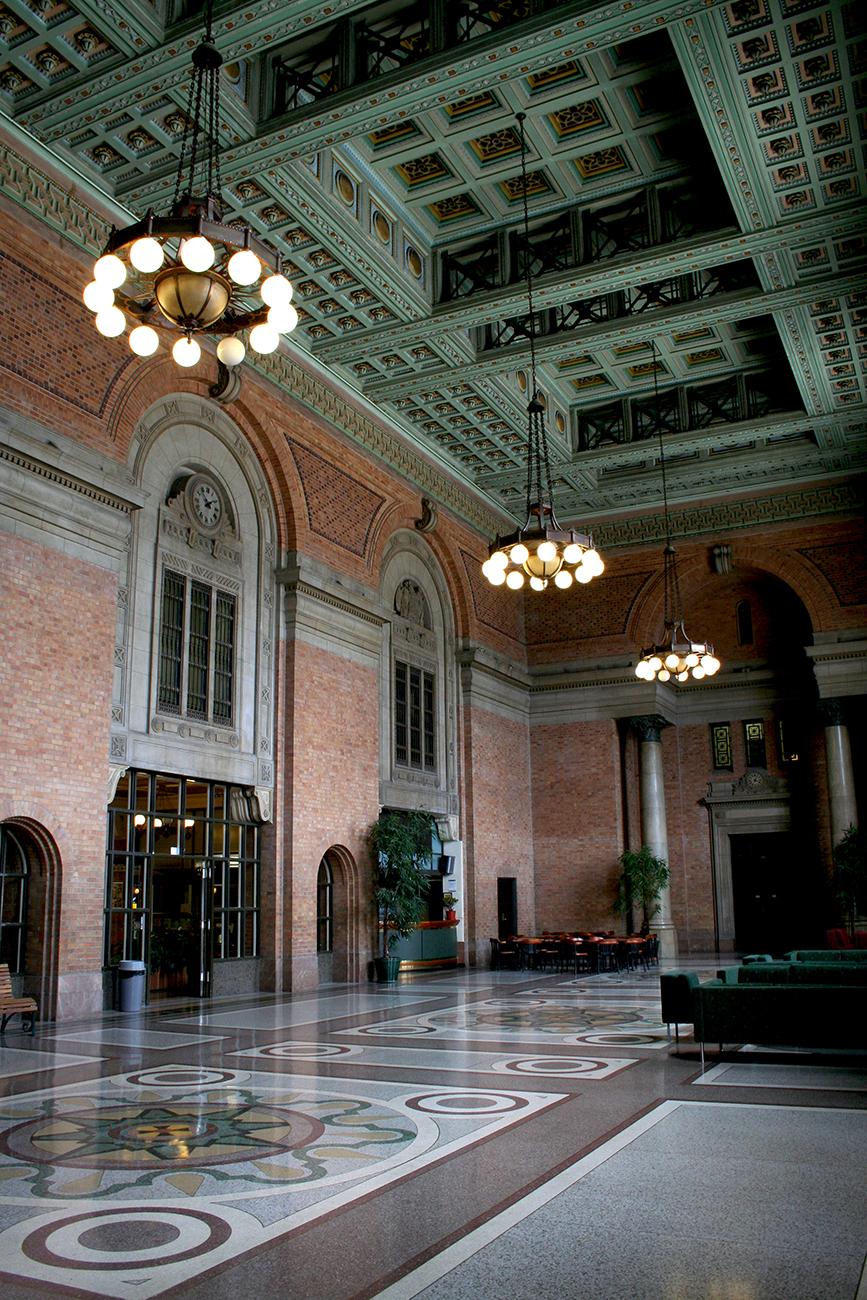
The building has a symmetrical facade, three storeys high, and is of reinforced concrete construction, faced with brick and granite. It is approached by a sweeping ramp on either side of the building, enclosing a landscaped garden immediately to the front. The building's design - by architects Gummer and Ford, and the railways' Chief Engineer, F. C. Widdop - was based on American models, such as Union Station (Washington) and Pennsylvania Station (New York), which were held to be the most beautiful and luxurious of the time. The Auckland Railway Station maintained these high standards with ornate public spaces and a wide variety of amenities, including waiting rooms, dining rooms, shops and a room for first aid. Underpasses and ramps within the building link it to an extended network of platforms to the rear, which contain elegant concrete canopies and other elements that are an integral part of its original design and function. The building was used, with modifications, as the main point of arrival for rail passengers in Auckland for most of the century. It was sold during the privatisation of the rail network in the 1990s, and has since been converted to student accommodation, although some of the platforms retain their original use.
The Auckland Railway Station is nationally significant as one of the largest and most ornate railway stations in the country. It was one of the most acclaimed structures designed by Gummer and Ford, who were New Zealand's premier architects in the early twentieth century. It has great historical importance for its associations with the public building programme of the 1920s, and with the central role played by the railways in national transport. It illustrates the then strongly held belief that state-run public services were associated with advanced social and political ideas. The building is also a prominent Auckland landmark, of significance for its connection with the surrounding historic landscape. The registered area is particularly valuable for its variety and extent, incorporating contiguous elements to the rear and sides of the building, which demonstrate the importance of the foreshore to the transport network.