Early History
Both iwi history and archaeological evidence show Māori occupation in the Ōtākou Otago region over an extended period, with the inhabitants utilising a wide variety of natural resources from the diverse environment. Archaeological evidence supports the date of earliest settlement around the 12th century.
Today, Kāi Tahu mana whenua is recognised over a large part of Te Wai Pounamu. Kāti Māmoe and Waitaha whakapapa and shared occupation are always acknowledged. Tūpuna such as Waitai, Tukiauau, Whaka-taka-newha, Rakiiamoa, Tarewai, Maru, Te Aparangi, Taoka, Moki II, Kapo, Te Wera, Tu Wiri Roa, Taikawa, and Te Hautapanuiotu are among Kāti Māmoe and Kāi Tahu tūpuna whose feats and memories are embedded in the landscape, bays, tides and whakapapa of Ōtākou Otago. The hapū Kai Te Pahi, Kāti Moki, and Kāti Taoka still maintain their presence and responsibility as kaitiaki in this region.
Historically, Kāi Tahu used the tauraka waka at Ōtepoti (Dunedin City) when they visited the head of the Ōtākou harbour as either the gateway to the route to Kaikarae (Green Island) or when off on other mahinga kai expeditions. The soft slope of the foreshore and the tidal flats in the upper harbour where the small stream, Toitū, entered the sea was bisected by a prominent hill Ngā-moana-e-rua (Bell Hill), the foot of which lay at the very edge of the high water mark. No permanent kaik or villages were situated at the mouth of the Toitū, simply because there was no need for it.
While not as densely populated as the North Island, numerous kaik in the Ōtākou region still hosted a good number of Waitaha, Kāti Mamoe and later Kāi Tahu peoples. Various bays and beaches around the Taiaroa Heads supported several hundred people with kaik in Karitāne, Waikouaiti and at the mouth of the Mata-au or Clutha hosting a similar number. Pā kāinga on the Ōtākou coast included Māpoutahi (Pūrākaunui), Pukekura (Taiaroa Head), Kōpūtai, Huriawa and Moturata (Taieri Island). Whareakeake, one of several pounamu manufacturing sites, attested to another facet of lifestyle for the artisans of the iwi. While the population numbers are still debated by academics and historians, there is no argument that through epidemics and intertribal warfare, the numbers of Kāi Tahu living in the region had dwindled considerably by the time the Treaty of Waitangi was signed at Ōtakou (Otago Heads), 13 June 1840. During the 1850s the population grew only slowly. It was the gold rushes, beginning in 1861, that transformed Dunedin. Its population nearly tripled by 1881. As it grew in population and wealth, the city began to invest in public works, religion, and education.
Early Chinese History
The Chinese in New Zealand, writes historian James Ng, ‘are collectively the biggest immigrant group of Asian origin in this country’ – and the first non-European group to come here in the nineteenth century and the ‘largest coloured racial minority’ and suffered much discrimination.’ The earliest migrants came as goldseekers, were virtually all men, and were ‘sojourners in outlook.’ Chinese were officially invited to Otago through the Chamber of Commerce in 1865, and agreed on the assurance of fair treatment by the European population after their experiences in Australia.
The early Chinese kept to their own culture and cuisine in New Zealand – virtually all were Cantonese in origin and came direct from Guangdong province. The key to their ability to maintain their Chinese lifestyle on the goldfields was the role of the Chinese merchants and shopkeepers. They also organised shipments of Chinese to Otago, first from Victoria and then directly from China. In the first few years, all of the Cantonese miners came to Otago from the goldfields of Victoria. The first direct shipments from China began in 1866, with three shiploads reaching Dunedin that year. Seven more ships were organised in 1871-72, bringing 2,000 new goldseekers in 1871. Chinese settlement in Otago peaked at just on 4,200. Almost all of these men were made up of kith and kin of those already there.
As well as organising the direct shipments from Guangdong, the Chinese leadership also made provision for an expanded reception system in Dunedin. Chinese merchant stores provided a welcome to the new arrivals, set them up with the gear and provisions they would need, and then despatched them inland along a chain of subsidiary stores leading to the gold field camps. This role was pivotal to the Chinese goldseeker presence in Otago. For much of the goldseekers era, the Mee Wah, Hip Fung Taai, Sew Hoy and Kwong Shing Wing stores were in Stafford Street and the Kum Yoon Lee store was at the Princes-Moray Place corner. Dunedin’s Stafford Street was the location of several Chinese merchants and the Sew Hoy store is a remnant of this system.
Choie Sew Hoy arrives in Dunedin
Choie Sew Hoy arrived in Dunedin in 1869 and joined an established community of Chinese merchants. His first store was on the northern side of Stafford Street. The location for his business was ideal; close to the jetty and transportation to the Otago interior, and with a ready made Cantonese community based in and around Flinders Lane, lower Stafford Street and the adjacent lower Hope and lower Walker streets . By late 1871 there were 96 Chinese merchants and storekeepers in Dunedin, inland Otago towns and in the field, serving 4,159 Chinese. Sew Hoy had built up a successful business importing goods and exporting scrap metal and wood ear fungus and also moved into market gardening. After the Lawrence merchant Wong On retired to China in 1882, Sew Hoy became the premier firm to supply all the stores of the Chinese miners in Otago and on the West Coast.
The Construction of 29 Stafford Street
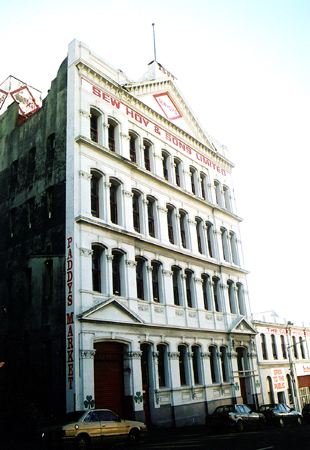
Sew Hoy expanded his premises in the mid-1890s, commissioning architect James Hislop to design his brick warehouse. Hislop invited tenders for the two storey building, with basement, in January 1894. The “1869” on the building lintel signifies the foundation of Sew Hoy’s business in that year. A detailed description of the building was published in the Otago Daily Times in June 1894, and is reproduced in part below.
“CITY IMPROVEMENTS: MR SEW HOY'S WAREHOUSE
A substantial addition has just been made to, and an improvement effected in, the architecture of Stafford street by the erection of an imposing stone and brick warehouse for Mr Sew Hoy, which comprises two storeys and a basement, and occupies a space of 105 ft deep by 30ft wide [32 by 9 metres].
The basement … is well built of Port Chalmers Stone and floored with concrete and well lighted. Through a large doorway at the back the men's kitchen is reached. This room … is fitted with sinks and other conveniences, and alongside it there is a back stairway, enclosed in brick walls, communicating with the ground floor, while from the basement also at the rear of the building there is a stairway, in a well-lighted position, leading to the ground floor, which is divided up in front into two offices … fitted with counter and wall fittings of figured red pine, on the left hand side of a passage …which is shut off from the street with swinging doors and a vestibule, and is finished at the back of the offices with a neat arch.
At the rear of the offices there is a floor space … to be used for storing goods, which can be delivered into the warehouse through a large doorway facing the right-of-way on the west side of the building; and behind the store a handsome and well-lighted show room … is provided. Alongside the latter room is a passage leading to the men's living room … and has off it a private staircase leading to the yard.
In a central position near the offices in front is placed the main stairway, leading to the first floor, which has a clear floor space of 68ft by 28ft [20.8 by 8.5 metres], while off this store there are two bedrooms. Each of these rooms is 12ft square [3.6 metres], and is fitted with fireplaces, and other conveniences, and well ventilated. Near these rooms, wash-hand basins and other conveniences are to be found, these are finished in the very best manner on the latest sanitary lines.
Every part of the building is particularly well lighted and thoroughly adapted for the use it will be put to. All the fireplaces in the building are fitted with concrete fenders, and the hearths are set into strong iron boxes... The store is lighted with windows in the front and right-of-way walls, as well as in the back, and all the openings are fitted with iron bars.
The roof of the building is sarked and felted and covered with iron, a cool and watertight roof being ensured in this way. The gutters are wide and deep, and are fitted with storm escapes in addition to the down pipes, which are of a large size.
The facade of the building facing Stafford Street is well broken up. It is started off a base of fine axed Port Chalmers stone, and the work above this is cemented and finished with bold pilasters, bearing ornamental capitals at the top. The pilasters are carried up through two floors, and are finished with characteristic panels between them at the level of the first floor, and with arched heads at the top. By this means the front obtains the appearance of additional height, besides being made proportionate. Above the pilasters there are a bold frieze and dentil cornice and parapet with the owner's name worked in cement letters. The decorative façade was stripped back at some stag, possibly in the 1950s (see Figure 1 and Figure 3).
The front has a very handsome and pleasing appearance, and adds considerably to the appearance of this part of the street.
… The whole of the sanitary work has been well and honestly carried out, and has been tested with a result that was most satisfactory and that reflected credit upon the workmen who were engaged on these particular works.
At the extreme end of the section there is an open store … for storing light goods and cases. The right-of-way and yard at the back have been well formed and metalled. Mr Sew Hoy has every reason to be satisfied with his compact and handsome warehouse, which has been faithfully built and carried out by Messrs Torrance and Simpson, contractors, from drawings prepared by, and under the supervision of, Mr James Hislop, architect.”
29 Stafford Street and the Nokomai Sluicing Company
In 1894 Sew Hoy and his son Kum Poy shifted their gold seeking attentions south to Nokomai. The Nokomai goldfield had been more or less abandoned however news of Sew Hoy’s interest sparked a major revival. A flood of mining applications and a sustained boom in mining followed. The Sew Hoys set up a major elevated hydraulic sluicing claim there and employed equal numbers of Chinese and Europeans. They invested a lot of money in the operation and eventually floated the company in 1898. It continued right through until Kum Poy’s death in 1942.
For a long time the Sew Hoys’ Nokomai Sluicing Company was the most successful sluicing operation in New Zealand. When it closed in 1943, it was the very last Chinese gold seeker operation in the country, bringing to a close the eighty-year period of Cantonese gold seeking in the south. The Sew Hoy operation was the largest and most successful Chinese endeavour in this ‘New Gold Hill’ and in the end, the last of them. The building at 29 Stafford Street was the registered office of the various Nokomai sluicing companies throughout the whole length of the Sew Hoy mining operation. The annual meetings were usually held there. The company’s sign can be seen in the 1939 photograph of the building, flanking the hanging Sew Hoy store sign (see Figure 1).
29 Stafford Street and the Chinese exhumations
Culturally it is essential for Chinese people to have their graves tended by their family to ensure a good afterlife for the deceased, and prosperity for their descendants. This can only be achieved if the person is buried where their family are, usually in their home village. To be buried where family cannot perform these cultural observances means the deceased will not be able to rest in peace. They become what is known as ‘hungry ghosts.’ To avoid this fate, overseas Chinese groups organised repatriation of the remains of sojourner Chinese who died while away from the homeland.
In 1869 the Panyu-Fah-Tsongfa group [Sam Yip] of Chinese arranged to form a burial society in New Zealand to send deceased remains back to China. Named the Cheong Shing Tong it was a branch of a charitable society in Panyu. The formal founding date is noted as 1878, and with Sew Hoy as president, their later activities became centred at 29 Stafford Street.
The first exhumation in 1883 uplifted at least 230 bodies and repatriated about 40 old men. The second project, in 1890, prioritised those old men without funds for a return to China and exhumed around 55 bodies. A cemetery ground was purchased in upper Panyu for men whose families had died and those families who were too poor to buy village grave sites for them.
The third and final exhumation began in 1900 and was organised from Stafford Street. It exhumed 474 Poonyu-Far-Tsongfa bodies as well as providing room for the dead of other groupings on the ship. Choie Sew Hoy, who had died suddenly in 1901, numbered among them. In a devastating turn of events, the ship chartered to return the remains to China, SS Ventnor, sank off the Hokianga and only ten boxes of bones came ashore. Sew Hoy’s family erected a memorial grave to him in his village cemetery and a silver plaque was buried there to represent his physical remains.
29 Stafford Street and Kum Poy Sew Hoy
Choie Sew Hoy had two sons and two daughters with his wife Young Soy May in China. Both of his sons, Kum Yok (1855-1932) and Kum Poy (1868-1942), joined their father in Otago for a time. Kum Yok subsequently returned to Guangzhou but Kum Poy was a partner in his father’s extensive sluicing operations at Nokomai and after Sew Hoy’s death inherited both his business interests and his leadership role in the Chinese community in Otago. He remained as adviser, merchant and sometime banker to the Panyu Cantonese until his death in Dunedin in 1942. His base was the store at 29 Stafford Street which was a centre of communal activity for the Panyu Cantonese. Every year on his birthday Kum Poy gave a dinner and the Panyu and Fah Cantonese in Dunedin gave him another in return.
29 Stafford Street and Hugh Sew Hoy
Hugh Sew Hoy (1901–1996) was born as Choie Bak Pang in Guangzhou city, Guangdong in 1901. He was the younger son of Choie Kum Yok, Choie Sew Hoy’s elder son. After spending some time in Otago with his father Kum Yok he had returned to Guandong in 1897 and thereafter maintained the family’s merchant interests in Guangzhou, operating a timber warehouse and general merchant’s business in the suburb of Wong Sha. He was manager of a travel agency and depot in Guangzhou and Hong Kong for a number of Panyu villages to two main destinations – Canada and New Zealand.
Hugh spent three years in Dunedin in the early 1920s with his uncle Kum Poy, working as a clerk at the Stafford Street store. At that time they mainly sold Chinese food products and silk, the latter its main item of trade with Europeans. In 1923 Hugh returned to China to marry Kong Yow Yoon [Fanny] and take over his father’s mercantile business in Guangzhou. In 1938 Hugh finally came back to Dunedin to try and arrange his family’s immigration as the Japanese threatened southern China. Soon after he left, however, his wife - pregnant with their sixth child - had to flee north from Guangzhou.
It would be over nine years before the family could be reunited in Dunedin during which time Hugh Sew Hoy took over the Sew Hoy store upon the death of his uncle, Kum Poy, in 1942. Hugh reinvigorated the business, which had been faltering, by beginning the producton of speciality Chinese sausages. He later on-sold these and other Chinese foodstuffs to New Zealand European stores.
In 1947 Hugh’s family finally arrived and settled into life in Dunedin, living upstairs at 29 Stafford Street. In 1958 Hugh diversified his business interests by established a clothing firm with his sons. The private company was named Sew Hoy and Sons and it prospered. It eventually expanded to six clothing factories, employing up to 600 workers and winning an export award. Tariff removal and other economic changes in the 1980s, however, undermined the viability of the local textile industry and spelled an end to many manufacturers like Sew Hoy and Sons.
Throughout the height of Sew Hoy and Sons’ expansion, Hugh still held on to the general merchandise shop at 29 Stafford Street. Hugh venerated his grandfather’s memory and swore that he would never sell the store that he had established. Hugh Sew Hoy inherited the mantle of Chinese leadership in Otago from his older brother, King Lim, his uncle Kum Poy and his grandfather. From the 1940s he was a leading figure in the Otago Southland branch of the New Zealand Chinese Association and maintained a high profile in civic affairs. He attended nearly all Chinese weddings, funerals and public events from the 1960s and was acknowledged as the foremost Chinese community leader by Chinese and European alike. He and his wife were pillars of the Dunedin Chinese Church. In 1980 Hugh was awarded the OBE in recognition of his service to business and the general community. He died in 1996, survived by his wife and a large family of descendants.