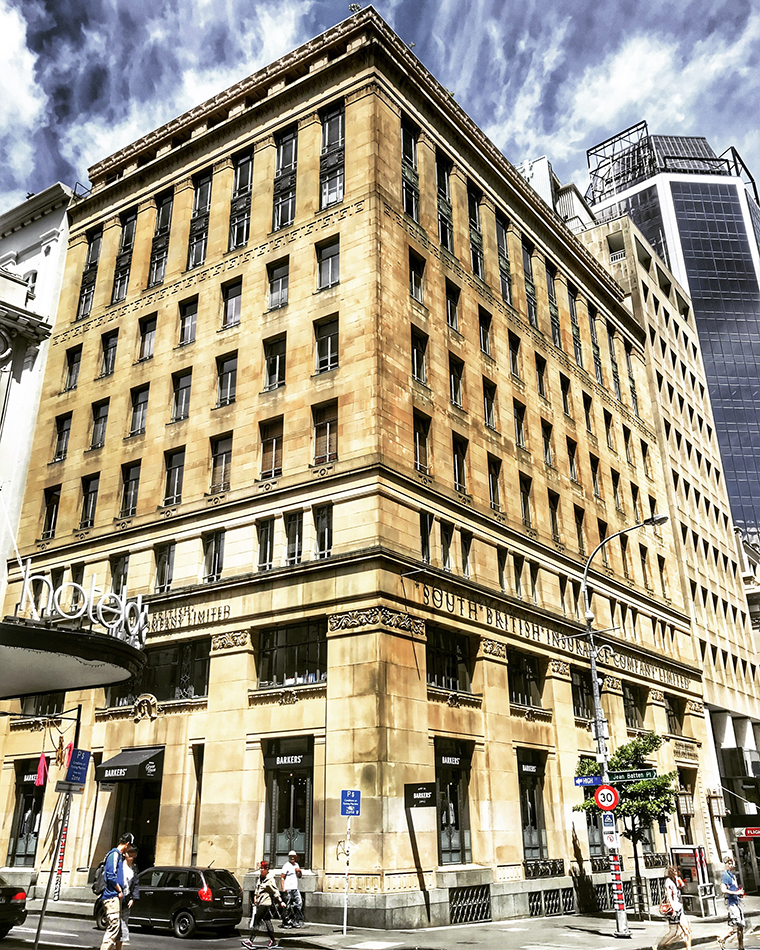
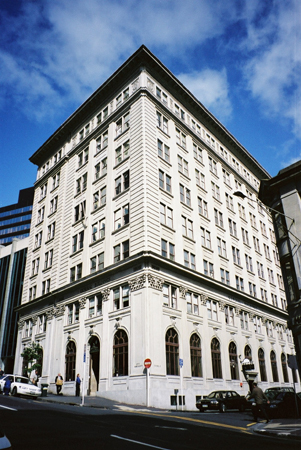
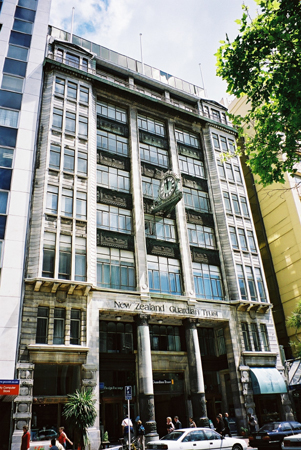
Blackett's Building is one of the earliest surviving structures in Queen Street, the main commercial thoroughfare of colonial Auckland. Erected in a prime corner location close to the wharf in 1878-1879, the building housed the head office of the South British Insurance Company Limited. The firm had been founded by a group of wealthy Auckland businessmen in 1872 to provide fire and marine insurance. In a town built of timber and supplied largely by sea, this was a profitable enterprise that expanded rapidly to become a worldwide venture.
The nature and prosperity of the business was reflected in the building, which was built of fireproof brick and decorated with unusually ornate plasterwork for the period. A statue of Britannia surmounting its facade emphasised the name and imperial nature of the enterprise. The three-storey building harked back to similar structures erected in mid nineteenth-century Britain and was raised by a floor in the early 1900s as the business expanded. The addition was built in a similar Italianate style to the original construction, reflecting continuity in the function and tenancy of the office. The company vacated the premises for a much larger headquarters building in 1929 (see 'South British Insurance Building'), when the statue of Britannia was removed. The building was subsequently leased to a variety of tenants, and is currently used as offices and shops.
The building is significant for its associations with the New Zealand insurance industry and the development of one of its most prosperous companies. It demonstrates the global nature of commerce in the colonial period and Auckland's growing status as a financial centre. The original structure is a fine example of an early insurance office in New Zealand, and one of the best remnants of 1870s commercial architecture in Auckland. It is one of the few remaining examples in the city centre of the work of Richard Keals, founder of the oldest firm of architects in Auckland. The building makes a significant contribution to the urban streetscape, and is of particular value for its close associations with nearby financial and commercial structures, including the later South British Insurance Company Building in Shortland Street. It illustrates the commercial character of lower Queen Street in the late nineteenth century, and the smaller scale of nineteenth-century insurance buildings compared to their office-block successors.
The nature and prosperity of the business was reflected in the building, which was built of fireproof brick and decorated with unusually ornate plasterwork for the period. A statue of Britannia surmounting its facade emphasised the name and imperial nature of the enterprise. The three-storey building harked back to similar structures erected in mid nineteenth-century Britain and was raised by a floor in the early 1900s as the business expanded. The addition was built in a similar Italianate style to the original construction, reflecting continuity in the function and tenancy of the office. The company vacated the premises for a much larger headquarters building in 1929 (see 'South British Insurance Building'), when the statue of Britannia was removed. The building was subsequently leased to a variety of tenants, and is currently used as offices and shops.
The building is significant for its associations with the New Zealand insurance industry and the development of one of its most prosperous companies. It demonstrates the global nature of commerce in the colonial period and Auckland's growing status as a financial centre. The original structure is a fine example of an early insurance office in New Zealand, and one of the best remnants of 1870s commercial architecture in Auckland. It is one of the few remaining examples in the city centre of the work of Richard Keals, founder of the oldest firm of architects in Auckland. The building makes a significant contribution to the urban streetscape, and is of particular value for its close associations with nearby financial and commercial structures, including the later South British Insurance Company Building in Shortland Street. It illustrates the commercial character of lower Queen Street in the late nineteenth century, and the smaller scale of nineteenth-century insurance buildings compared to their office-block successors.
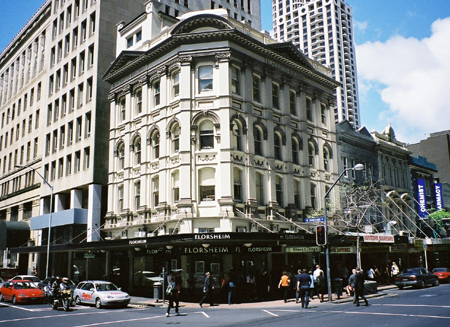
Blackett's Building | Martin Jones | 18/09/2001 | Heritage New Zealand Pouhere Taonga
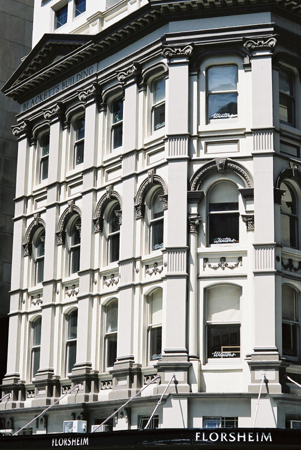
null | Martin Jones | 18/09/2001 | Heritage New Zealand Pouhere Taonga
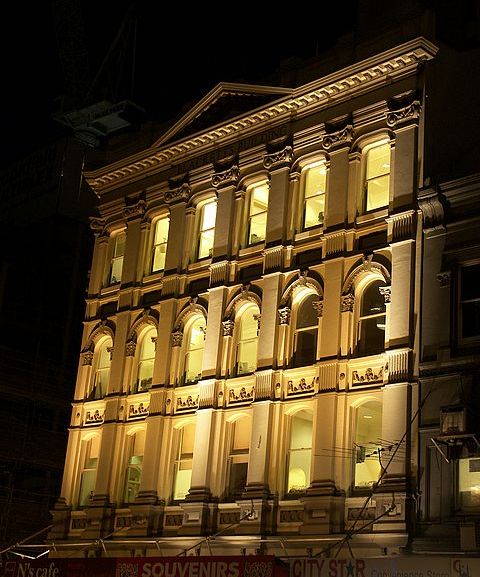
Blacketts Building | www.cepolina.com
Blackett's Building | Martin Jones | 18/09/2001 | Heritage New Zealand Pouhere Taonga
null | Martin Jones | 18/09/2001 | Heritage New Zealand Pouhere Taonga
Blacketts Building | www.cepolina.com