Early History of the Site
Prior to European colonisation One-Panea, the bay which now borders Auckland’s commercial centre, was linked with settlement in the valley of Waihorotiu and its adjoining headlands – traditionally associated with Ngāti Huarere, Te Waiohua and Ngāti Whātua Ōrākei. Noted as the ancestral waters of numerous iwi including Ngāti Whātua Ōrākei, Waitematā is named to reference its waters which are smooth and glisten like māta (black obsidian rock). Waitematā was an important food-gathering place, with numerous kāinga and pā established around its shoreline, and many whakatauakī that speak to the richness of its marine and terrestrial resources. Pare Tuhu was a settlement on the foreshore (now under Lower Albert Street), with Ngā-Ū-Wera being an associated pā on the adjoining headland. Prior to European arrival, the mouth of Waihorotiu and the wider shoreline were used for gathering kaimoana, and as a place of arrival and departure for waka.
Following the commencement of European settlement in 1840, One-Panea was renamed Commercial Bay by the colonial administration and served as the main landing point for goods and settlers. Māori traders were key participants and beneficiaries of the coastal shipping, trade and exchange which occurred in this location, and to the east at Te Tōangaroa (Mechanics Bay) in the early years. Te Tōangaroa was also the site of the Waipapa Māori Hostel, developed for the express purpose of extending manaaki to those iwi groups and entrepreneurs who had travelled from as far away as Te Tai Rāwhiti and Te Tai Tokerau to bring their produce to market to feed the settlers. Successive reclamations were carried out to improve port facilities and expand commercial land as the town’s economy developed. In the late nineteenth century, Auckland was one of the ‘big four’ ports of New Zealand, which collectively handled three-quarters of the colony’s import and export business.
From 1871, all activity connected with Auckland’s harbours was controlled by the Auckland Harbour Board (AHB), which had been founded in the same year. The AHB managed a large area, extending from the Tāmaki River south of the nineteenth-century city, to Rangitoto and the North Shore further north. A major civic body and employer, the organization was traditionally dominated by members with strong mercantile connections. Its board was made up of individuals that were appointed or elected by the government, city council, adjoining Highway Boards, the Chamber of Commerce, and the payers of Harbour dues.
In 1903, following a rapid increase in trading activity, the AHB employed engineer, W.H. Hamer (1869-1940) to prepare plans and oversee works for further extensions to the port facilities. Hamer had previously occupied the important role of Resident Engineer of the London and India Dock Company, based at the Royal Victoria and Albert Docks in London. His innovative 1904 plan for Auckland included the construction of a network of reinforced concrete finger-wharves at right angles or inclined from the Quay Street frontage, a design that was at the forefront of technological developments in New Zealand.
By 1908, works extended Hobson Street and created a finger wharf at its north end, west of the current site. Larger ferro-concrete wharves were constructed further east at Railway (later Kings) Wharf in 1904-8, and Queens Wharf in 1907-13.
Imperial ties and the outbreak of war
This general expansion of facilities under Hamer prefaced what has been termed ‘The Queen City’s reign’. Between 1911 and 1930, Auckland increased its share of New Zealand’s import and export trade from a quarter to a third. As a major facility dealing with overseas trade, the port’s ties with the other parts of the British Empire were strong. This was particularly true after the opening of the Panama Canal in 1914, when British cargo was increasingly shipped directly to the city.
The port’s connections with Great Britain were mirrored by sentiment in much of broader society. When Britain declared war on Germany in August 1914, a large number of New Zealanders volunteered for military service immediately. The ensuing international conflict - considered the first global, industrialised war in human history – lasted until 1918 and had a seismic effect on many nations, including New Zealand. Almost a tenth of this country’s contemporary population is estimated to have served overseas, many travelling abroad for the first time. Considerable numbers were killed, wounded or incapacitated through illness. Due in part to its traumas, the war is believed by many to have fostered a new sense of national identity.
The AHB quickly demonstrated its support for the military cause by donating the considerable sum of £1000 to the Auckland Patriotic Fund. The body was heavily involved in the preparations for conflict, providing storage space for cargo on Queens Wharf and organising the departure of the troops from the Auckland wharves. In late September 1914, 2000 soldiers marched through the city to the wharves to board troop ships, cheered by large crowds. Troops continued to embark from these facilities on many other occasions during the war. Embarking forces included the 1st and 2nd Māori Contingents in 1915 and the 3rd Māori Contingent in 1916, which encompassed Pasifika soldiers from the Cook Islands, Fiji, Niue, Tonga, Kiribati, Tuvalu and other Pacific nations as well as Māori from across New Zealand.
Many AHB employees volunteered for overseas service, causing a serious reduction in the organisation’s personnel. In spite of this, the AHB initially continued to develop its waterfront facilities. In 1915, it commenced the Quay Street West extension scheme, which involved lengthening Quay Street to Hobson Wharf and providing the extension with a new harbour wall. Five launch landings and two shelter sheds were also erected in association with this work for smaller crafts engaged in excursions around the Hauraki Gulf.
On 13 September 1915 - just over a year after the declaration of war - the AHB resolved to erect a memorial obelisk to remember its numerous employees who had enlisted. Recognising both their patriotism and sacrifice, this was to be associated with the new works.
Construction of the Memorial Beacon (1915)
The AHB’s decision was a groundbreaking one, involving the first built monument to the Great War erected in New Zealand. Pre-existing memorials to the conflict by communities in this country largely consisted of tree plantings and boards of honour. In its monumental intention and appearance, the AHB memorial was to form the earliest New Zealand example of an international phenomenon demonstrating the impact of global, industrialised conflict through commemorative built edifices. Not only were such monuments to eventually become commonplace throughout New Zealand, but also in other nations touched by the war, including Russia, Canada, Australia, and Great Britain. First World War Memorial Beacon reflects how impactful the high levels of enlistment and participation in the war effort were on local communities, even before the scale of later losses were felt.
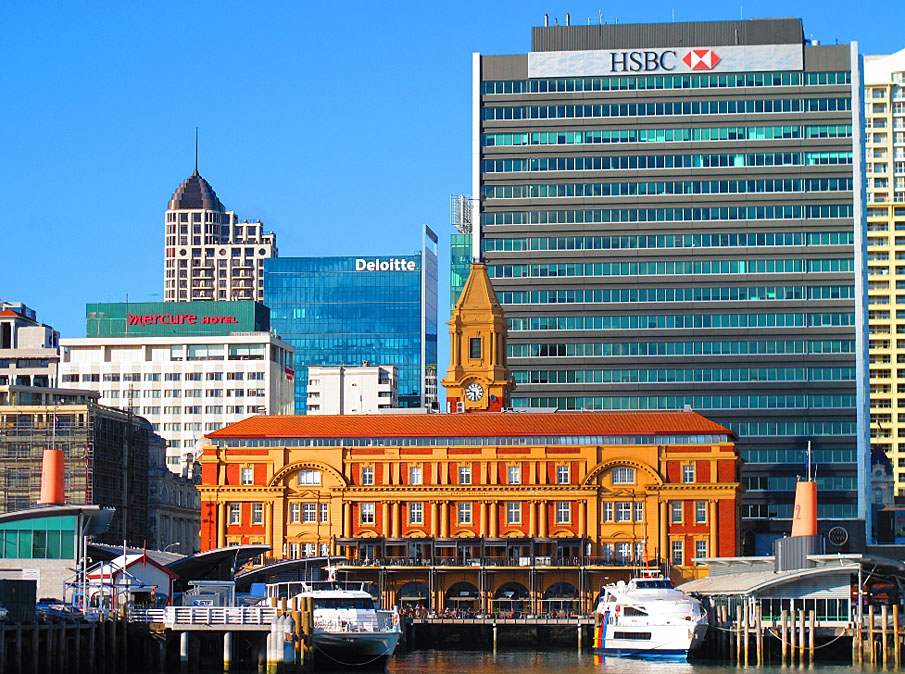
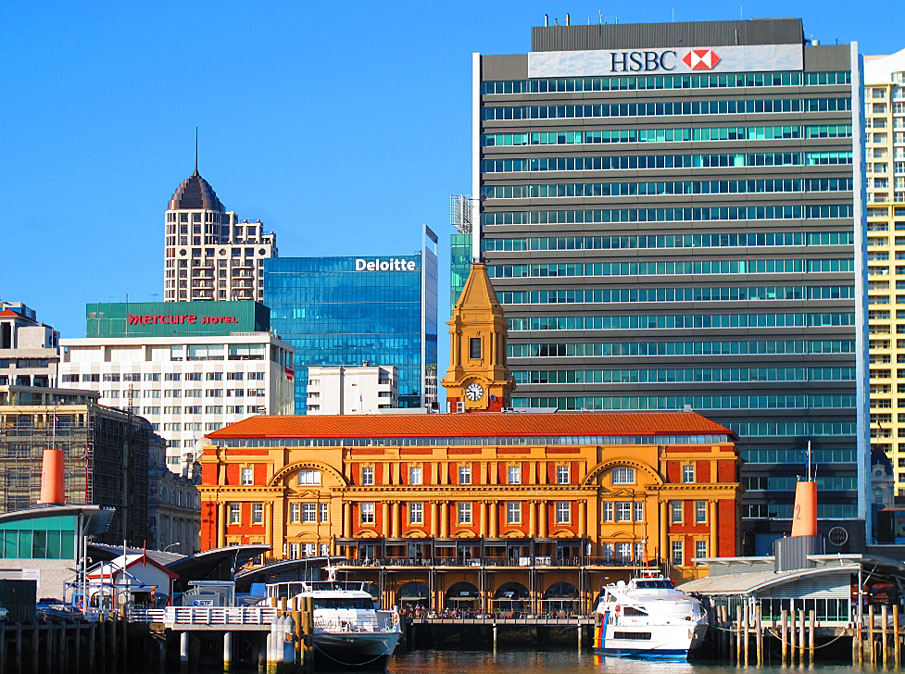
The AHB monument was to be erected beside the new launch landings on Quay Street, and to simultaneously function as a daylight beacon and a guiding light at night. The decision to create the memorial was accompanied by an AHB resolution to grant its permanent officers on active service further leave of absence on half pay. The Board rescinded an earlier decision to erect a roll of honour in the Board’s public office. The site chosen for the new memorial was immediately between the new shelter sheds on the edge of the waterfront - a short distance to the west of the recently-built Ferry Building (1909-12), itself a major symbol of AHB activity and the main commuter gateway in and out of Auckland.
Significantly, the AHB memorial was created while local troops, including many AHB employees named on the monument, were fighting at Gallipoli (April-December 1915), considered a landmark event in the development of New Zealand’s national identity during the war. Individuals named on the monument who fought at this battle included Arthur Stanley Corlett, carpenter; Douglas Selwood Hewett, clerk; Charles Edward Stewart, seaman; Reginald Arthur Basley, draughtsman; and Seymour Thomason Spencer, civil engineer. Soon after the Gallipoli campaign began, memorial services were widely held to collectively remember the fallen and injured. The number of honour boards placed in sports clubs, schools and churches throughout the country increased. By July 1915, calls for permanent, built war memorials emerged, most prominently by the mayor of Auckland, J. H. Gunson, who favoured the construction of a utilitarian monument that would include a roll of honour. Memorial trees were also planted in the same month, including two pōhutukawa at Eastbourne.
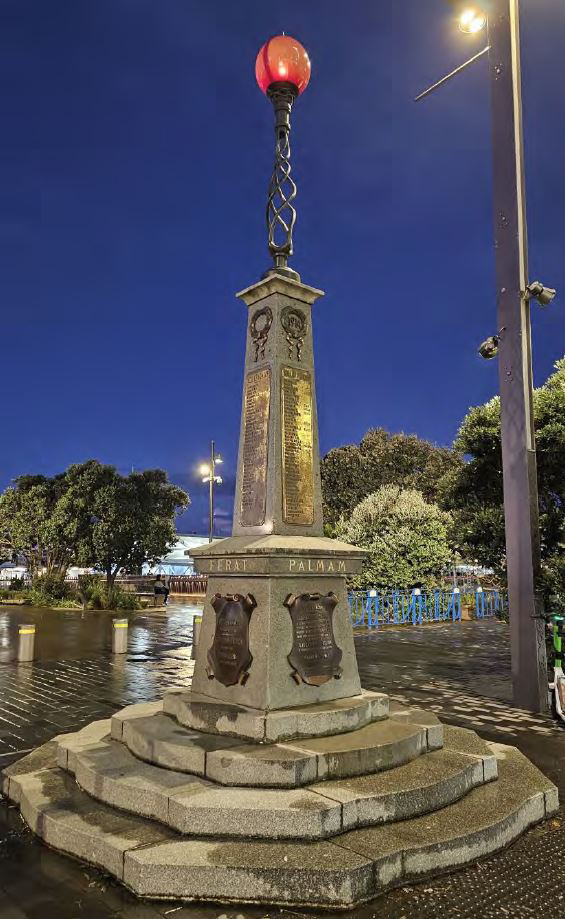
The AHB memorial conformed to Gunson’s suggestion in its inclusion of a roll of honour and functionality. The nineteen-foot (5.8 metres) high structure was designed by W.H. Hamer, who initially prepared two proposals for consideration. The chosen design comprised a stone obelisk, surmounted by decorative ironwork and an electric lamp. Incorporation of the latter, associated with the recent establishment of new generation plants that expanded electricity supply to much of the central city, reflected the AHB’s wider modernisation of its facilities in the early 1900s. The memorial was constructed by John Bouskill, a monumental mason, who won the tender with an estimate of £187. Bouskill had previously created a monument to the New Zealand Wars at Pokeno (1898), the imaginative concept of which has been described as ‘a foretaste of a new era in monument-building’. Bouskill’s firm went on to erect eleven First World War monuments by 1925.
The AHB memorial beacon was first lit on 17 December 1915, in the same week that New Zealand troops were being withdrawn from Gallipoli (15-20 December). The monument was completed in less than the estimated time, despite waterfront strikes in October and November that year.
The completion of the monument was reported in the Auckland Star as follows:
‘Workmen were engaged putting the finishing touches this morning to the new beacon erected in Quay Street, near the launch landings, opposite the Sailors' Home. This, besides being a guide for launch vessels, will also serve the important purpose of bearing the roll of honour of employees of the Harbour Board who have gone to the front. The list of names inscribed already totals 40, and there is another plate left vacant for those who are yet to go in the future. The beacon takes the form of an obelisk erected on a base of five tiers of steps of unpolished Coromandel granite. This is surmounted by a square, solid block of granite, polished, and above is a shaft of the same material beautifully finished. Above this is an artistic twisted metal support, on top of which is a red globe, which at night time will show a light. Under the regulations of the Harbour Board, launches coming to the landings have to sight this beacon and get in line with a white diamond affixed to the front of the Sailors' Home before they turn to run in…’
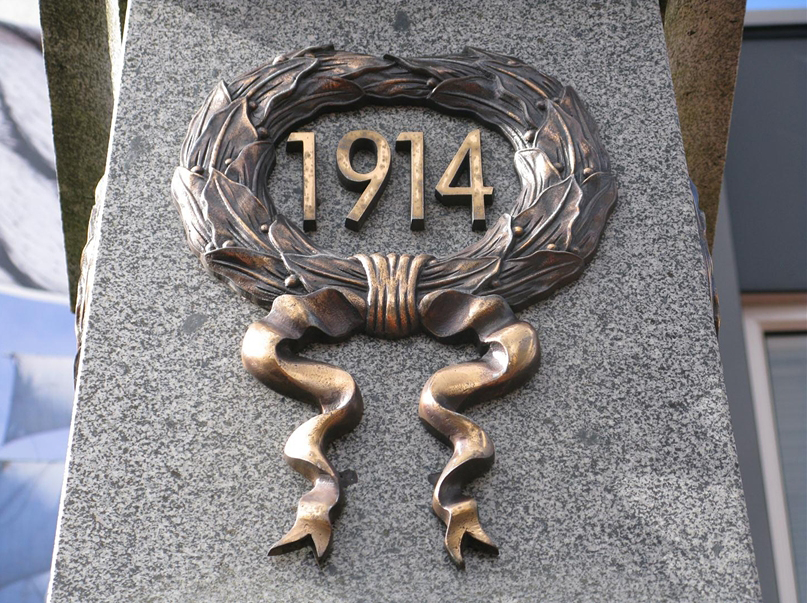
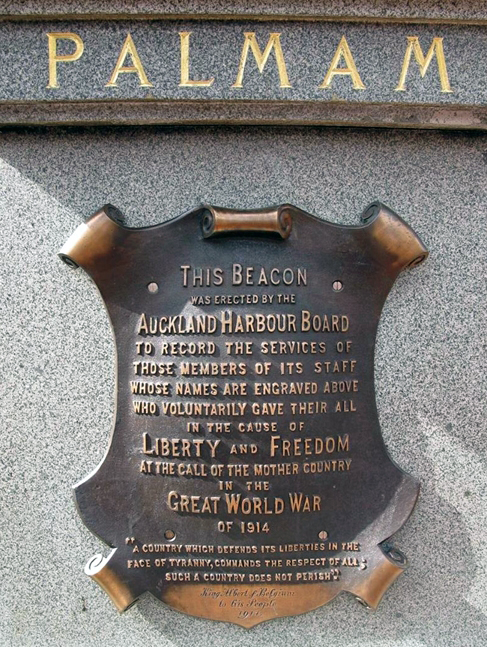
Hamer’s specifications included tablets and shields for each face of the monument, but not all of these appear to have been attached when it was first erected. Brass name tablets were placed on two faces of the main obelisk, and on the base there were at least two attached shields. One of the latter was inscribed with the words, ‘This beacon was erected by the Auckland Harbour Board to record the services of those members of its staff whose names are inscribed above, who voluntarily gave their all in the cause of liberty and freedom at the call of the Mother Country in the Great World War of 1914’. A second shield listed the names of the current Board members of the AHB. The Latin words ‘Qui moruit ferat palmam’ (let him who has won his laurels wear them) were also inscribed around the monument. The most public side, facing Quay Street, featured the roll of honour; the shield outlining the purpose of the memorial; the word ‘palmam’; and the date ‘1914’ inside an attached metal wreath.
The memorial represents an early response to the conflict that was later taken up around the country in a national outpouring of commemoration. The beacon’s incorporation of an obelisk - an ambiguous symbol of both life and death, frequently associated with funerary commemoration - became widely utilised and formed a departure from pre-existing monuments to the 1899-1902 South African War.
Several aspects of the design emphasised the importance of ties with Great Britain, and the AHB’s support for the British Empire. Announcing the monument’s completion, the chairman of the AHB, H. D. Heather emphasised the resilience of such notions, stating that ‘…we can and shall stand as an Empire, like the beacon we have now erected, “Four square to every wind that blows”’.
Other aspects of the monument’s design continued earlier traditions that did not find common currency as the Great War wore on. For example, it named all of those who served in the war rather than only those who had been killed. New Zealand was to lose 18,166 men and women during the conflict, encompassing the highest percentage of military aged men in the British Dominion per head of population. Two-thirds of them died during the Western Front campaign (1916-18), after the erection of the memorial beacon. As casualties mounted, an increasing emphasis emerged to commemorate those who would not return.
This shift in perspective may also explain why the use of a beacon as a visual and functional form was also not widely adopted for further war memorials but remained unique. Its evident symbolism as a shining example, a beacon of hope and a guiding light to ensure safe passage was superseded. It was also to remain the only built occupational monument erected during the conflict, the creation of most other memorials being organised by local communities, churches and schools.
It was, however, intended to be very publicly visible. In January 1916, the AHB asked to install a bright light on the side of the street opposite the beacon ‘to set off the roll of honour at night’, a request that was acceded to.
Subsequent modification and removal (1916-68)
Throughout the First World War, troopships and warships continued to arrive and depart from the port. From 1917, the wharves were put under military control and manned with armed guards. Harbour fortifications on North Head were also manned and an examination anchorage off the head was brought into operation. This monitored vessels coming and going from the port.
The memorial continued to be serve as a living monument to the AHB’s enlisted employees throughout the war. Subsequent to its erection, the second attached tablet was inscribed with 40 names; a third plate was added with the names of another 36 men; and the notation ‘Killed’, or ‘Died’ was inscribed alongside fifteen of the names on the tablets. These plaques may have been altered or added as men enrolled during the remainder of the war, although a newspaper article at the end of 1918 suggested that the roll of honour was still incomplete at that time.
Two further bronze shields were also subsequently inscribed or added to the monument. One of these listed overseas places New Zealand soldiers fought or were stationed during the war. Individuals named on the memorial also served in these places including David Walter Johnson who was killed in action at the Somme, and James Pollock who was killed in action at Passchendaele. The other shield was inscribed with the words: ‘War Declared 4th August 1914. Victorious Peace signed at Versailles 26th June 1919’. The monument consequently mapped development of the war, its impacts on serving soldiers, and ultimate resolution through peace. During peace celebrations in 1919, the memorial beacon was draped in festoons of lights.
From 1915, members of the AHB proposed turning a vacant block to the south of the beacon into a larger ‘peace memorial’. After the war, the Board drew up plans for the proposed memorial park which included a Corinthian column and war trophies on each apex of the triangle. Auckland City Council initially supported the scheme as well as plans to erect the Auckland War Memorial Museum in the Auckland Domain. However, in 1920 it withdrew its support for the park due to a lack of public support.
In April 1919 the Māori Battalion, the only force to return as a unit, disembarked at nearby Queen’s Wharf before parading up Queen Street to a formal reception at Auckland Domain.
In 1922-3, Quay Street was straightened with further reclamation of the harbour, distancing the memorial from the waterfront and possibly removing or modifying its need as a beacon. The memorial remained on its original site but was now incorporated into an enlarged triangular block. The flanking shelter sheds were moved north onto the newly reclaimed land, beside a new harbourfront wall. During the same period Hobson Wharf was replaced and renamed Princes Wharf (1921-4).
By 1933, a small garden had been planted around the monument. During the Second World War (1939-45), the Public Works Department constructed a large concrete warehouse on the associated block, to store supplies for the US forces and to house the United States Joint Purchasing Board staff stationed in Auckland. Princes Wharf was leased to the US military from August 1942 for the duration of the war. The memorial was still on the same site in 1968, when detailed photographs of the structure were taken. At that time, there were three rolls of honour in place, and four shields - one of which was blank. The latter appears to have replaced the original shield which listed names of AHB Board members.
Removal of the memorial from its original site occurred when the AHB undertook substantial changes to the organisation of the port. The memorial was taken from the site sometime between 1968 and 1973, when the Travelodge (now Copthorne Hotel) and Downtown car park were constructed as part of the AHB’s ‘Downtown scheme’. These alterations were intended to revitalise the waterfront area, providing income for port operations and developments that included redesigning the wharves to accommodate container ships. Removal took place at a time of growing anti-war sentiment and protest, linked with reactions to the Cold War and conflict in Vietnam. Many war memorials during this period were allowed to decline and decay. In 1988, Ports of Auckland Limited replaced the AHB.
Initial Restoration and Re-siting (1999-2021)
Although participation in war commemoration declined in the mid- to late-twentieth century, from the 1980s events such as Anzac Day underwent a renaissance, with an increased number of young people attending services that commemorated New Zealanders killed in war and returned service men and women, which also became associated with the emergence of a distinct New Zealand identity. On 24 April 1999, on the eve of Anzac Day, the New Zealand Herald reported that the dismantled obelisk and associated rolls of honour had been discovered in Shed 51 on Bledisloe Wharf. The shields were later found in the New Zealand Maritime Museum, but the ironwork spire orb and wreaths were not recovered.
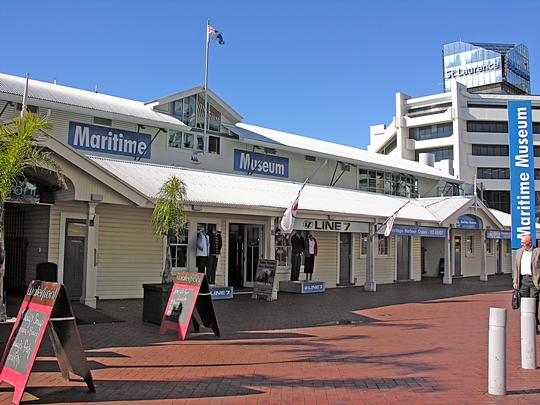
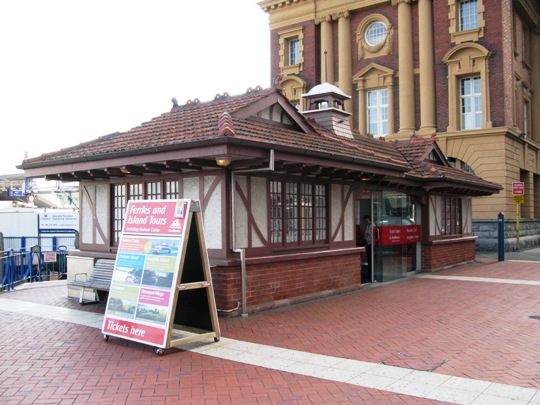
Auckland City Council approved restoration and re-installation of remaining parts of the memorial beacon after an anonymous Jewish German benefactor, who had migrated to New Zealand prior to the Second World War, offered to fund it - a contribution that can be seen to reflect the suffering of Jewish communities during that later conflict. The monument was restored in early 2000, with plaques and new wreaths re-attached to the obelisk and a new stone ball on its apex replacing the original ironwork spire and orb. It was re-erected on the corner of Quay and Hobson Streets, outside the Launch Offices (also known as Launchmans building) which had become part of the New Zealand Maritime Museum Hui Te Ananui a Tangaroa in 1993. The memorial was officially unveiled shortly after Anzac Day in 2000.
Centenary, relocation and refurbishment (2021 onwards)
Remembrance of the First World War and other conflict continued to increase in importance into the early twenty-first century. Between 2014 and 2018, centenary commemorations of the Great War were observed around New Zealand with national and local events. Intending to ‘foster a better understanding among New Zealanders of our military heritage and the impact of the First World War on families, communities and those who served overseas’, central government appointed notable public figures to help guide and plan the centenary. Members of the national committee included Sir Bob Harvey, former mayor of Waitakere City, and noted historians Dame Anne Salmond and Monty Soutar. Auckland Council similarly appointed a committee to organise Auckland-specific activity, with politician and historian Sandra Coney as the inaugural chair. In 2014 Harvey, who was also the chair of Waterfront Auckland, proposed re-siting the First World War Memorial Beacon closer to its original position. The location and reduced scale of the monument as re-erected in 2000 was not felt to reflect its high level of value as a war memorial and heritage structure. This plan was subsequently presented to and endorsed by the Auckland commemoration committee and
later supported by Auckland Council. Discussion between the latter and Heritage New Zealand Pouhere Taonga secured a site and commitment to refurbish commensurate with its importance and impact as initially conceived and built.
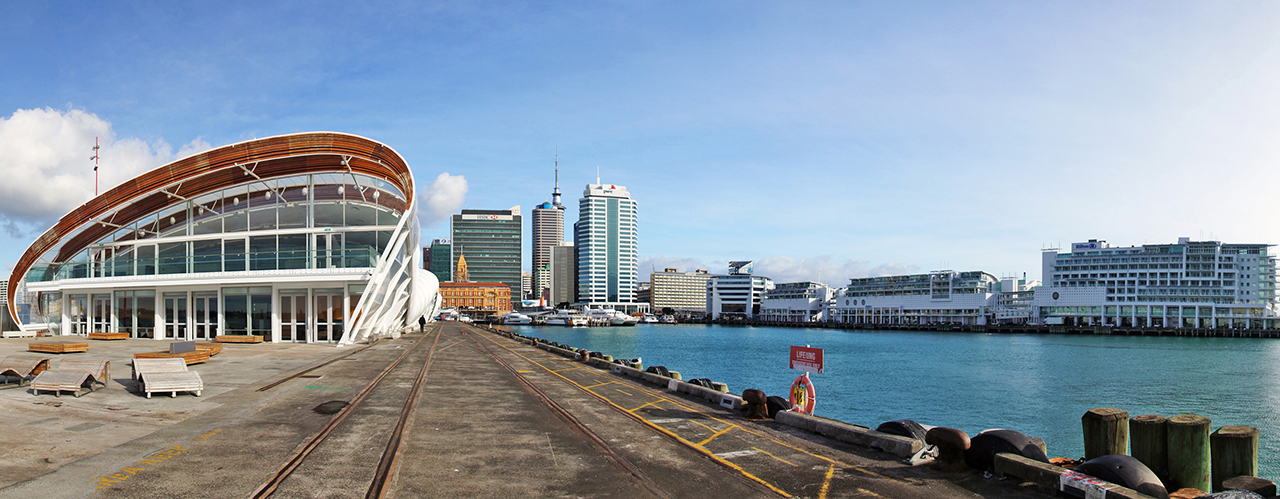
In 2021, in tandem with a $350 million Auckland waterfront public space redevelopment, the memorial was relocated to a new position very close to its original site, on the land reclaimed by the AHB in 1922-3. Prominently positioned beside the waterfront on Quay Street and opposite Lower Albert Street, the new site restored the monument’s relationship with important historical components of its contemporary landscape when initially built. This was achieved through reinstating the monument’s proximal relationship to notable AHB buildings such as the 1913 shelter sheds (relocated in 1922-3), which once again flanked the memorial, and the adjacent Ferry Building. Visual connections to and from the Waitematā Harbour were also restored.
Refurbishment returned the memorial to its original design and monumental scale. This initially involved reconstructing previously missing steps forming the lower base of the monument. In November 2022 a replica ironwork spire and a handblown glass beacon, complete with functioning light, were installed on top of the obelisk. Lit up each night, this directly added to the monument’s impact as a visual and commemorative landmark. Completion of the restoration was announced by national television news. At this time, Council staff noted that ‘the opportunity to restore an important part of the city’s history … has been an honour’.
Prominently positioned in a popular pedestrian thoroughfare for both commuters and international cruise passengers, it is highly accessible attraction for public appreciation and understanding about the memorial and its meaning.