Māori Occupation of the Catlins District
Today, Kāi Tahu mana whenua is recognised over a large part of Te Wai Pounamu. In Murihiku (Southland) the early tribes of Hāwea and Rapuwai eventually intermarried with Waitaha and Kāti Māmoe, who were gradually incorporated into Kāi Tahu in the 1800s. Hāwea, Rapuwai, Kāti Māmoe and Waitaha whakapapa and shared occupation are always acknowledged.
Tāhaukupu (Tahakopa) is an isolated part of eastern Murihiku south of Owaka. The bush, the rivers and sea provided rich resources for Māori living in the area. Mahinga kai and nohoanga are common along the coast with evidence of moa hunting in camps at Tāhaukupu (Tahakopa) Bay. The Tāhaukupu (Tahakopa Estuary) is a significant waterway. The Tāhaukupu River has its origins in in Kā Pukemāeroero (Maclennan Range), a place where māeroero (metaphysical beings) lived in what was heavily forested with rimu, totara, miro and matai. Southwest of the mouth of the Tāhaukupu River are the Tautuku Native Reserve (result of a Native Land Court Award 1868) and the Tautuku and Waikawa South Island Landless Native Reserve (SILNA) lands.
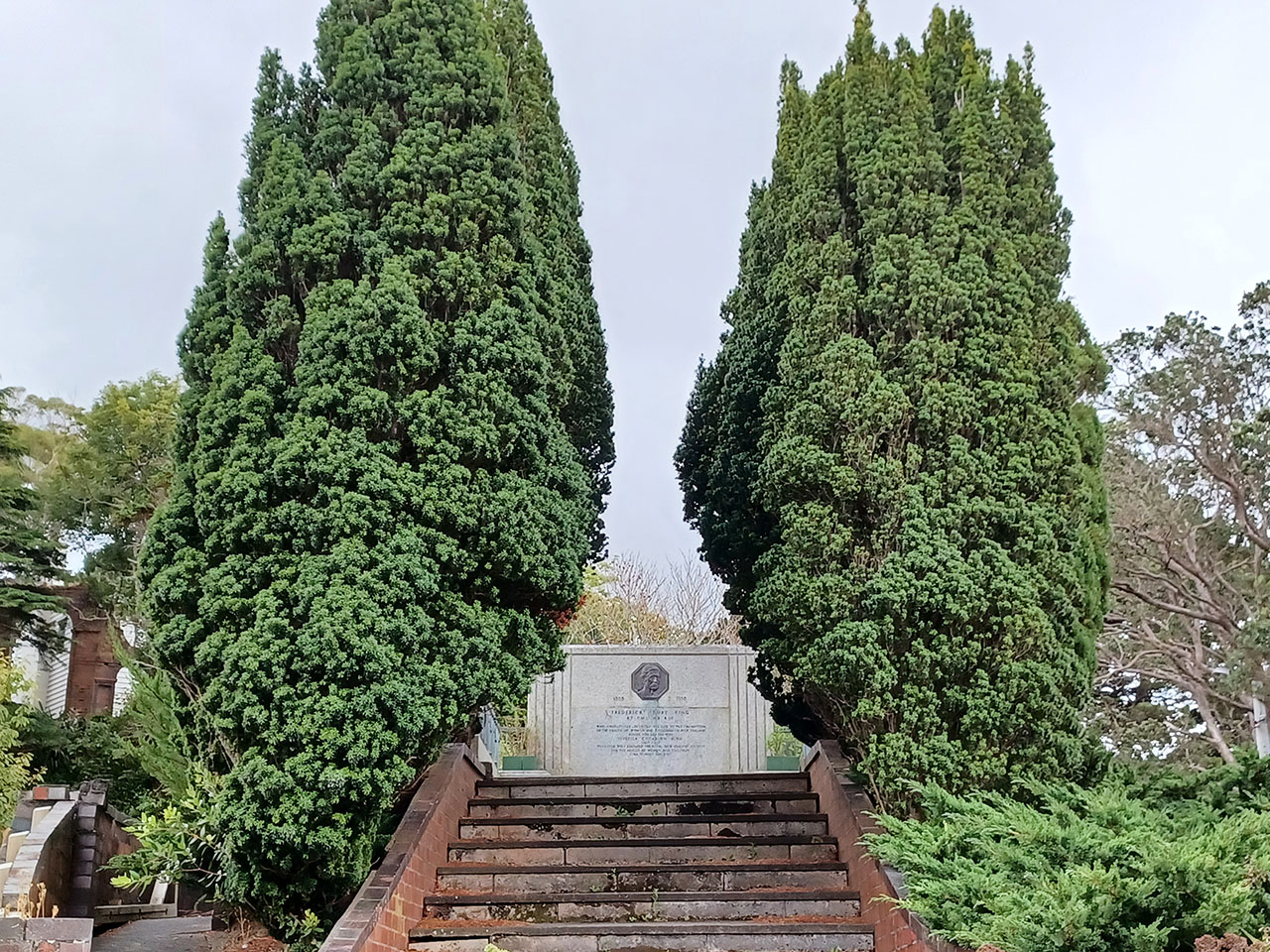
Dr Frederic Truby King (1858-1938)
Born just prior to the gold rush that set Otago a-light with immigrants, energetic, charismatic, enthusiastic and curious, Truby King was not content to confine himself to revolutionizing the care of the insane at Seacliff Mental Asylum, nor that of the nation’s mothers and infants through his Plunket Society. Truby King needed a business venture.
The Kings had been impressed by the beauty of the Catlins when on a camping trip in 1893. As Mrs King wrote at the time ‘the scene is altogether too beautiful for description…The Doctor is looking and feeling very well indeed, and he says he has never enjoyed a holiday so much’. Born in New Plymouth, Truby King referred to the Catlins as a ‘second Taranaki’ from the dairying point of view.
In 1906 Truby King bought Mr G. Scott’s farm in Tahakopa - a land area of some 750 acres. This was the beginning of land holdings which would eventually consist of six farms and a whole new field for his endeavours - from dairying to a technologically-advanced milking shed, to providing his own electricity.
Truby King also joined the Catlins-Tahakopa Railway League to help push the railway through to Tahakopa. In 1913, when the government proposed to change the terminus of the line from Tahakopa to Papatowai, it was made clear that Truby King had brought land in Tahakopa, and decided ‘to throw in his lot with them’, on the understanding the rail line would reach there. Truby King had plans for Tahakopa and a railway service was essential.
Truby King’s sawmill
In 1907 Truby King became part owner of an old saw mill in Tautuku, near Tahakopa. He was convinced that the timber industry would provide a ‘great impetus’ to the Tahakopa Valley – ‘What the district needed was the railway and population and live, energetic development…[with] the expansion of the resources of the valley conducted on modern, progressive, systematic, and scientific lines’. In mid-1914 Truby King made preliminary arrangements for the erection of a sawmill at Tahakopa. By 1915 he had leased land from the Government with a license to mill timber. His own holdings also covered 1,500 acres and most were in bush.
In February 1915 the line to Tahakopa was officially opened. Truby King’s efforts as part of the Railway League had been rewarded, and his enterprises could now take full advantage of the proximity of the railway.
In July 1915 the Lauriston Timber Company was registered as a private company to take over ownership of the sawmill. It was a family affair, with Truby King the largest shareholder, followed by his brother Newton King (1855-1927) and Dr Sydney Allen (1878-1960). Syd, as he was known, had worked briefly for Truby King at Seacliff and married King’s niece. Newton took ‘an active and practical interest, perhaps keeping brother Truby’s excesses somewhat curbed’. In May 1916 the Clutha Leader noted that the Lauriston Timber Company was not yet ready to start operations but was not far off.
Lauriston Timber Company sawmill, still known locally as Dr Truby King’s mill, was heralded as one of the largest and most modern mills in the Catlins. After the mill opened, the Southland Times described it as ‘one of the most up-to-date that has been erected in the dominion, everything connected with it being of the very latest and best’. The Clutha Leader wrote the mill was ‘well and substantially built, providing ample room and containing all kinds of labour-saving appliances’. Mill manager, Mr McDonald, also invented a widely lauded overhead log haulage system to deliver timber from the milling site to the sawmill. Producing over a million super feet of timber annually, it was one of the larger mills operating in the area.
Truby King’s correspondence show a detailed interest in the sawmill, its costs and expenditure. He dealt with the mill ‘in a business-like spirit’ but also collegially - ‘I want you to help me form sound conclusions as to the best course’. His involvement was not only managerial but practical – for example, popping in to Wellington’s Railway Department requesting type D tyres for their loco.
The first bridge
In February 1916 Truby King asked the Clutha District Council for permission to lay a steel tramline for sawmill purposes, across the district road and the Tahakopa River. Truby King’s plan was for NZR wagons to be hauled from the Tahakopa Railway Station along a private siding directly to the mill site, where logs were loaded and then taken back to the Station. This was more efficient than loading and reloading from private wagons. In March 1916 the Company called for tenders for the formation of the tramline.
The NZR ‘loaned’ ganger A.T. Heydon to supervise the building of the line to the standard railways plan. It was one of the few private railway lines in New Zealand built to the NZR’s satisfaction. Chapman notes King’s construction was more rigorous than the norm, “Unusually, the railway lines were steel, not the wooden ones of less ambitious mills.” This meant the lines were suitable for government railway wagons. He also purchased a second hand loco from NZR to haul their wagons.
In February 1917 the Clutha Leader noted that the ‘Lauriston railway, which leads from the terminus to the sawmill, is being pushed ahead, more than half the distance having rails and sleepers laid down, while a start has been made with the ballasting.’
Little is known about the first bridge taking the line across the Tahakopa River. It was no doubt of timber construction. It was also a sturdy edifice - during the June 1917 flood which washed away other sawmill’s bridges, Truby King’s railway only had some ballast displaced.
Truby King and Tahakopa
By 1915 Truby King was the ‘principal employer of labour in the Catlins district’. As King ‘set about stamping his manic personality on Tahakopa’, he built 24 rent free houses and single men’s quarters for his sawmill employees - to ‘a considerably higher standard than elsewhere’. Truby King also offered prizes for the best kept house and garden – the more children in the home, the bigger the prize. Employees were also supplied with milk fresh from his farm and free medical care from the doctor - he visited everyone in the settlement on his trips ‘from babies to bushmen’.
It was always a great day when he arrived, and no little child ever knew what would emerge from those bulging pockets, from boiled lollies, to sausages or toys.
Truby King was also the founder and president of Tahakopa’s first industry – the local cheese factory. On his farms, he built the most hygienic and up-to-date cow byre in the South Island. He also brought his Seacliff patients to Tahakopa to work on the farm. He and daughter Mary spent school holidays thinning out rows of turnips.
Truby King supervised the design and construction of the new school, donating timber from the Lauriston mill. When the community decided to build a hall, Truby King donated the timber. His local advocacy extended to consistently petitioning the Council to improve local roads and offering to contribute to the cost.
Truby King, company manager
Although King was one of three Directors, he took the lead – ‘leave it with me to decide finally what to do. I want your help and advice, but I think you will realise that it will be best to leave me a free hand’.
By 1922 the Lauriston Timber Company’s affairs were in disarray. There was perceived mismanagement at the Tahakopa mill and the Dunedin office. Truby King declared the Company Secretary’s condition as ‘bodily and mental failure – euphemistically described as a nervous breakdown but really, I should suppose amounting practically to insanity’. Meanwhile the Company’s salesperson had a ‘disobliging attitude to…customers…No doubt this was partly due to his being almost stone deaf, and unable to use the telephone’.
No orders had come in and timber was not being sold: ‘I don’t suppose it is fair to blame him [the Company Secretary] for all our troubles but he has been with us from the beginning and we have never done any good… I was astonished at the accumulation of timber’. Truby King offered to take a few thousand feet of stockpiled timber to use at Karitane – but only at a 33 per cent discount. Yet, despite the many struggles, Truby King remained optimistic: ‘I have always believed that we would make a success of the Lauriston Company, and I am satisfied that we will’.
The new bridge
In 1922 Truby King’s first bridge across the Tahakopa River was declared unfit for purpose. A local ganger inspected the bridge annually as the NZR ‘insisted that the lines be built and maintained to a quality standard sufficient to safely host their precious wagons’.
Truby King was not pleased – ‘in the absence of any facts or recommendations re rebuilding the main bridge, it is useless for the Secretary to ask what is to be done’. He asked the Secretary to obtain a quote, and then he would approach the bank for a loan. As the overdraft had been cleared and incomings were now exceeding outgoings, he reasoned the loan would be approved if the bank was approached with ‘clearness, confidence and reasonable optimism…’
The most common type of bridge in nineteenth century New Zealand, given our plentiful supply of timber, was the truss bridge - a structure of connected elements forming triangular units. Most New Zealand timber truss bridges used the Warren Truss, invented by Captain James Warren, a British engineer. The Warren Truss was used particularly for railway bridges.
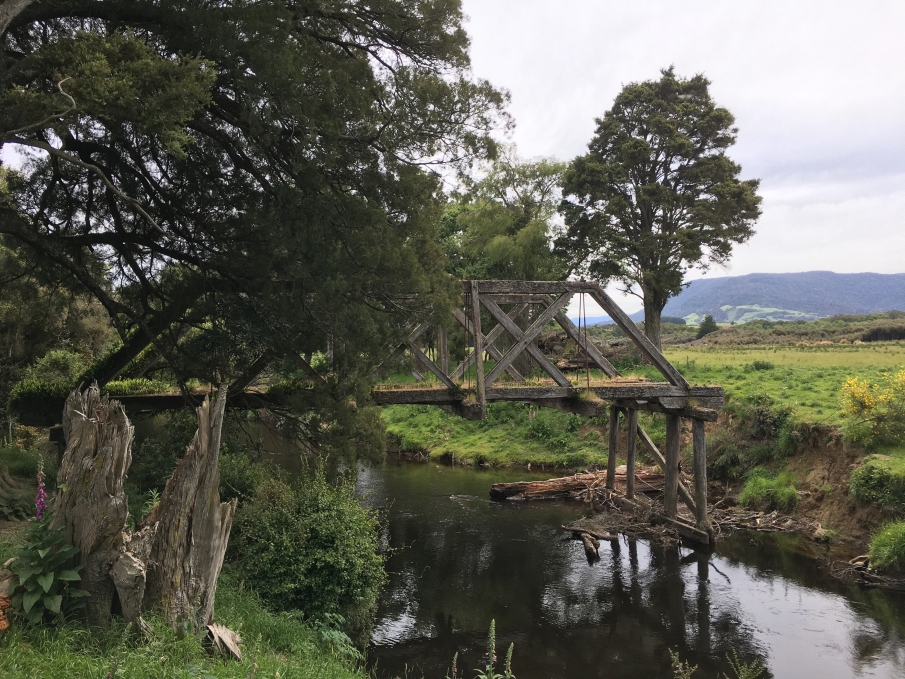
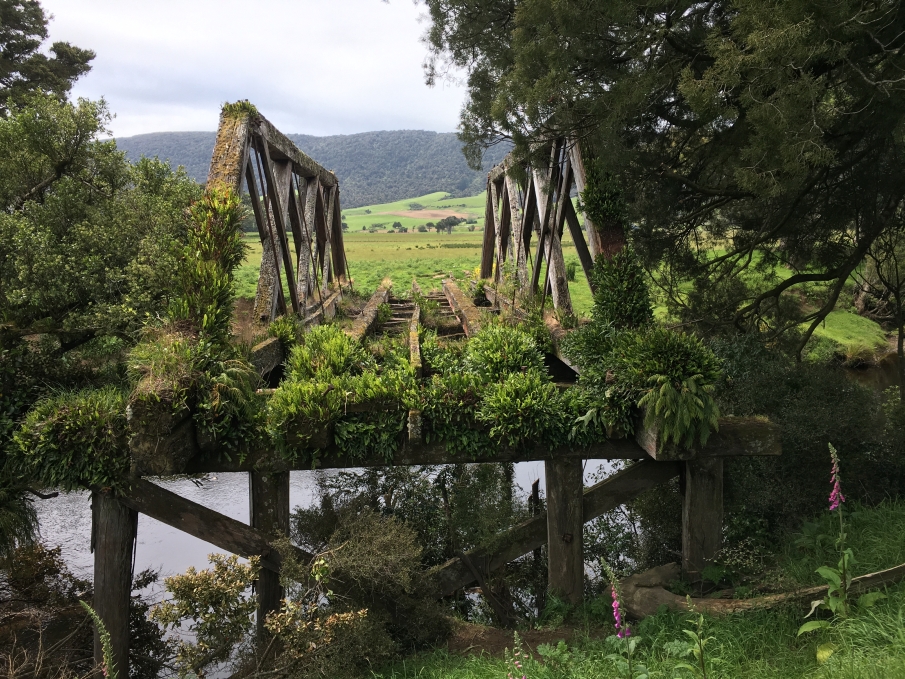
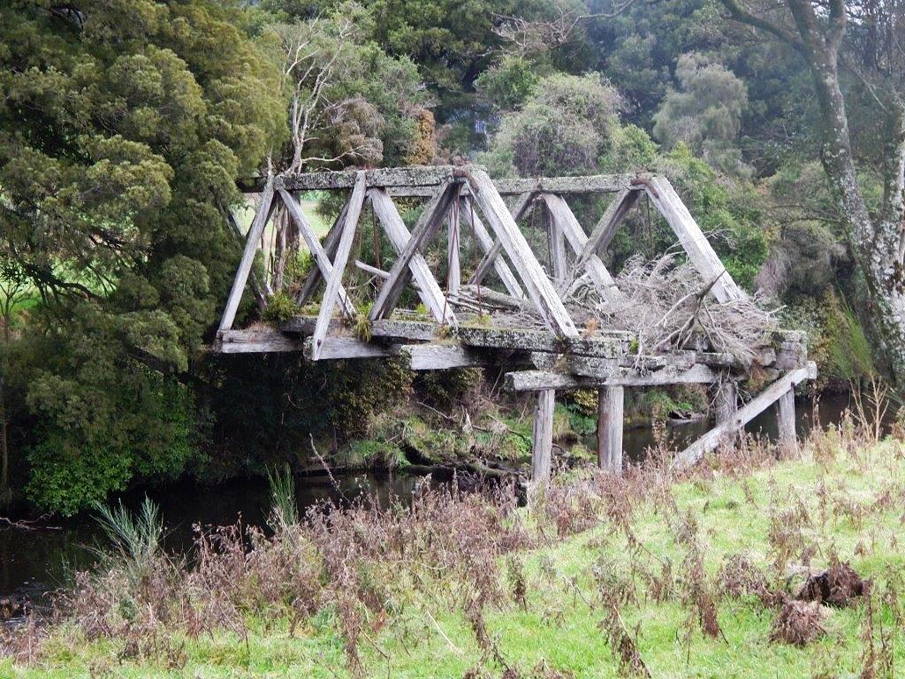
Truby King’s new bridge was also a truss design – but not the typical Warren Truss. King used the Howe Truss design, which was commonly used in New Zealand for road bridges. American, William Howe, patented his truss design in 1840. It commonly had six bays (or panels) with top and bottom chords and diagonal members in timber, and vertical rods of steel. When used for rail bridges, the heavier loads required that the bottom chords were often made of steel rather than timber, although unusually in this bridge timber was used for the bottom chords as well.
For NZR wagons to be carried on the line, the new bridge had to be constructed to NZR standards. The Department ‘set high and uniform standards, achieving economies through standard design and construction details….’ Although the exact plan could not be identified it appears similar to the ‘New Zealand Railways, standard drawing, 40 feet span bridge truss (new design), A.A. Wrigg’. There are similarities between King’s bridge and three timber truss bridges built in 1920-1921 to cross the Akatarawa River, between Upper Hutt and Waikanae (all now demolished). Given the considerable timber milling in the Akatarawa Forrest at the time, they were built to the Public Works Department standard plan of 60 feet and 80 feet trusses, ‘designed for traction engine traffic’. Truby King’s bridge may have used the same plan, given its similar purpose. There are also parallels with several rail bridges built by New Zealand Railways that are still standing and in use, including the Mahinapua Bridge, 1905, on the Hokitika to Ross line, the Waimea Creek bridge, c.1905, on the Greymouth to Hokitika line and there are several others on the West Coast. Bridge 1 Rapahoe over the Grey River and the Arahura River Bridge, both with multiple Howe truss spans, have been demolished in recent years.
King was known in Tahakopa for always doing ‘the best of the best’ and his bridge was no exception. Constrained by cost, most post-war and depression bridges used local soft woods, and by the 1930s many were due for replacement. Even hardwood bridges built during the war years were deteriorating by the 1930s as the timber supplied was ‘not nearly as good as usual’. Truby King, however, insisted on good quality hard wood: ‘Not content with a makeshift bridge, he used imported Australian hardwood and constructed a magnificent edifice’.
According to local memory, Truby King ensured the railway line sleepers between the rails were placed unusually close together. Pedestrians could then walk across the bridge without getting their feet caught between the sleepers. The children of the sawmill employees used the bridge every day to walk to school and locals also made good use of it – thanks to Truby King’s forethought.
The new bridge was rebuilt between 1922 and 1923. The Company’s 1923 March balance sheet listed the ‘Re-erection of the Main Bridge, condemned by the N.Z. Gov. Railways. Dept.’ The total cost, including wages and sundries, was £338:18:8. It is likely that parts of the first bridge, including the steel rail lines and perhaps the timber piles, were reused in the construction.
Truby King considered the line and the bridge a ‘very strong point’ in the Company’s favour.
We have steel rails and locomotive handling Government trucks and every year’s work will increase our distance from the railway station, and therefore the length of tram-line that any competitor would have to construct…Yes, we are on a very good wicket indeed…it might cause comment on the part of some of our communities or Bolshevistic friends. They always forget the risk we have run, and the long, lean years behind us…’
The end of the line
At the time of the bridge’s completion, timber prices were on the increase. The Directors, against the advice of the sawmill manager, decided to establish a second smaller bush mill. The new mill’s first contract was supplying 80,000 feet of timber a month for six months for the 1925-26 International South Seas Exhibition buildings in Dunedin. By May 1925 the main mill was producing 73,025 super feet of timber worth £964. The second mill was producing 48,641 super feet at a value of £223. The Company was £400 in debt.
In April 1927 Truby King called a Directors’ meeting to discuss the future of the Company. He scheduled it for the same day as the ‘big formal Opening of the Plunket Society’s Hospital and the Emulsion Factory. Of course this will be a very busy day for me, but we can squeeze in an hour or two…’
Newton died in 1927. His last advice was to wind up the Company. Instead Truby King listened to the Manager’s pleas to leave it running- ‘when a man of his class is forced to conform against his will…he is very liable to fail’. If the Mill did not pay in three months, however, they would move to contract logging:
I spoke to the Mill hands, and explained just how matters stood. I told them that the question of whether they could look to the continuance of a good job with good wages and exceptionally good houses for their wives and families would depend on whether they could satisfy the Directors’…
Unsentimentally, King also reasoned they were likely to get a better price for the sawmill in summer.
On 16 July 1929 an accident saw the mill temporarily close. Truby King then instructed the Company be wound up. Although £16,000 was spent on the sawmilling venture in total, there was little profit left over for the shareholders.
Today, Truby King’s ghost has all but departed the Catlins. The mill closed in 1929 and the mill houses were moved to other places. …Only the railway bridge stands proud but bemused, bereft of railway line and shrouded by willows.
Reconnecting with the past
In 2017 a group of locals set about reclaiming Tahakopa’s history, and its unlikely link to one of our national icons. Determined to raise the former Sir Truby King Railway Bridge to prominence as a memorial to the innovative man who created such ‘a vibrant community’. It began with the creation of a heritage film about Truby King.
The bridge is intended to be the main attraction of a picnic area, walkway and accompanying carpark. The proposal for the walkway attracted $8000 funding from the Walking Access Commission to create interpretation panels to accompany this project.