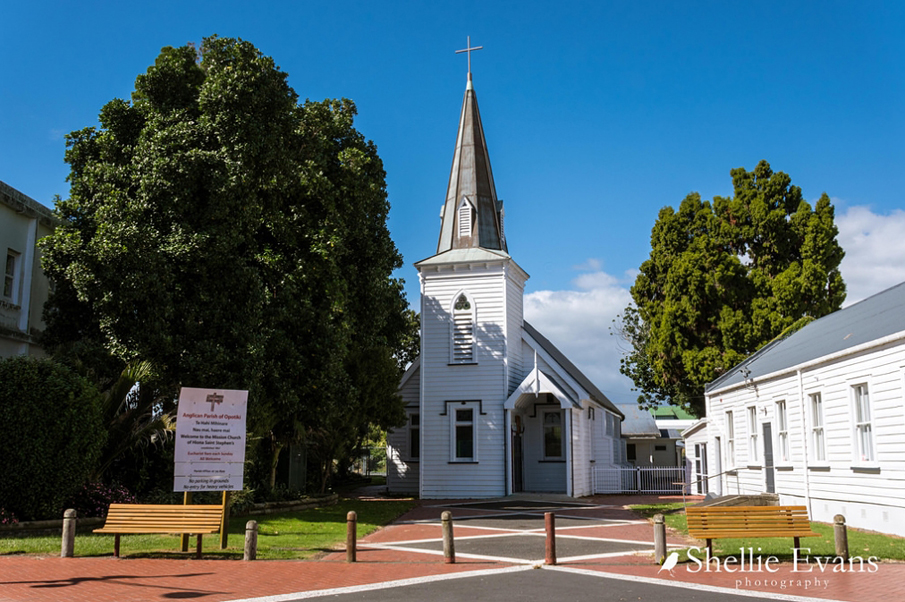
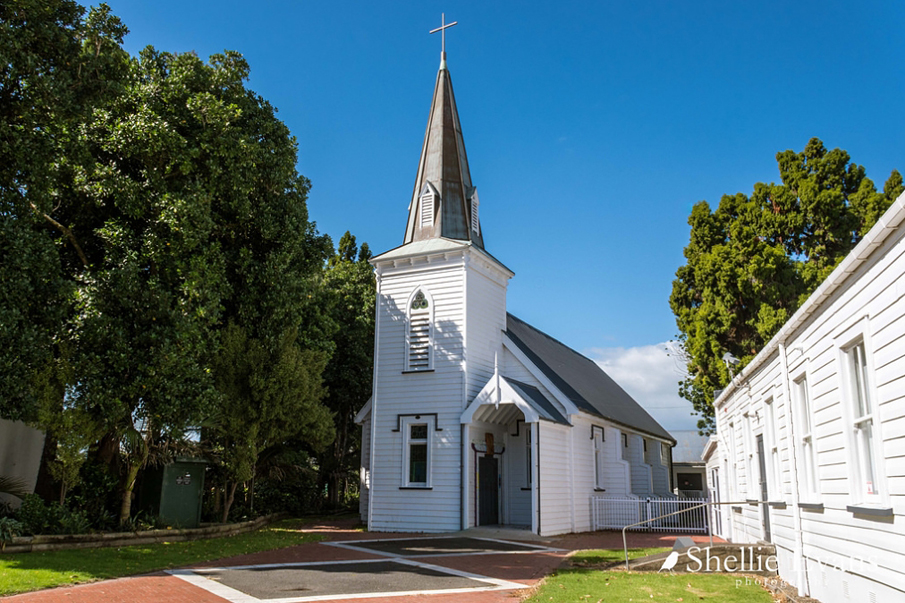
Initially known as Hiona (Zion), the church consisted of a nave, with a tower and steeple at its western end. It was erected by two Auckland builders, Thomas Bridson and John Wilson at a cost of more than £600, with local Maori contributing most of the funds. The rimu used in its construction is believed to have been felled and pit-sawn by members of Ngati Porou at nearby Waioeka, who were familiar with colonial timber-working methods. Possibly designed by Völkner himself, the church is said to resemble churches from the European continent. It is also similar, however, to earlier CMS churches in New Zealand such as the 1839 structure at Te Waimate mission (see 'Church of St John the Baptist, Waimate North').
The opening of the church in January 1864 coincided with attempts by Whakatohea to help defend the Waikato and Tauranga against military colonial invasion in the third New Zealand - or Waikato - War (1863-1864). During this period Völkner actively passed on information to the colonial authorities and may have been partly blamed for the death of Whakatohea chief Te Aporotanga, who was killed following the Battle of Te Kaokaoroa (1864). After returning from a trip to Auckland in March 1865, Völkner was taken prisoner by visiting adherents of the Pai Marire faith, and was hanged from a willow tree near the church. His companion, Thomas Grace (1815-1879), was also put on trial in the church the following day, but was spared. The killing spread alarm in the New Zealand settler community, particularly when details emerged that Völkner's body had been decapitated and his eyes consumed, evoking fears that earlier cannibal traditions were being revived. Völkner's remains were buried outside the east end of the church, the closest location to the altar.
The killing instigated an invasion of Opotiki by colonial forces in late 1865, when the church was used as a military headquarters and enclosed within a redoubt. Early settlers who arrived after the subsequent confiscation of Whakatohea lands often took shelter in the building as Maori resistance continued. Taken over by the Armed Constabulary in 1868, the tower was used as secure accommodation for prisoners. The church was also employed for dancing and other entertainment. The building was eventually refurbished and consecrated in 1874-1875 as St Stephen the Martyr, a title reflecting the settler belief that Völkner had died for his faith. Used as a parish church since that time, the structure was enlarged in 1910, enclosing the site of Völkner's burial within a chancel at its eastern end. The church has since become a symbol of reconciliation, with tukutuku panels created by Maori parishioners erected in the interior in 1978-1979 and its name changed to Hiona St Stephen's in 1995.
Hiona St Stephen's Church is nationally significant for its association with the events surrounding the death of Carl Völkner, the subsequent military invasion of the eastern Bay of Plenty and the alienation of Whakatohea lands. It has close associations with the activities of the Church Missionary Society, and is one of few remaining CMS churches in New Zealand. The church demonstrates the Maori origins of Opotiki, and is the earliest surviving building in the town. It has been at the heart of religious and community life in the settlement for most of its 140 years, and continues to have important symbolic meanings including that of reconciliation, to both Maori and Pakeha New Zealanders. The church is associated with other activities of significance, including military fortification, imprisonment and public entertainment in Opotiki. The building is an important local landmark, and forms a fundamental part of a well-preserved historical and cultural landscape. The latter encompasses the archaeological remains of both Maori and early colonial settlement, the 1860s town layout, and numerous later nineteenth- and early twentieth-century buildings.
List Entry Information
Status
Listed
List Entry Status
Historic Place Category 1
Access
Private/No Public Access
List Number
142
Date Entered
18th May 1989
Date of Effect
18th May 1989
City/District Council
Ōpōtiki District
Region
Bay of Plenty Region
Legal description
Allot 49 Sec 1 Town of Opotiki (RT GS2C/1061), Gisborne Land District
Status
Listed
List Entry Status
Historic Place Category 1
Access
Private/No Public Access
List Number
142
Date Entered
18th May 1989
Date of Effect
18th May 1989
City/District Council
Ōpōtiki District
Region
Bay of Plenty Region
Legal description
Allot 49 Sec 1 Town of Opotiki (RT GS2C/1061), Gisborne Land District
Why is this place significant?
Historic Significance
Historical Significance or Value The church that Volkner has built was originally called Zion - Hione in Maori. It is the events that led up to its reconsecration as St Stephen the Martyr which invest it with its very great historical significance. The church was opened in January 1864 and dedicated as Hione. Volkner reported an attendance of 500 at the opening service. The church was to have played an important part in the Church Missionary Society's missions on the East Coast. However, Volkner became practically involved in the military activities in the area leading to his alienation from the Maori people and his eventual murder in 1865. Throughout 1864 Volkner had kept Governor Grey informed of the state of affairs among the Whakatohea people of Opotiki and neighbouring tribes. He also was instrumental in the removal from his post of Father Garavel, the Roman Catholic Priest in Opotiki. In March 1865 Volkner was seized by the followers of the Hauhau leaders Kereopa and Patara. On 2 March he was hanged and decapitated, his eyes being swallowed by Kereopa in the presence of the Whakatohea people. This was followed by the passing of the communion chalice filled with blood. A burial service was held for Volkner on 13 March 1864 and his body was interred at the east end of the church. Punative military action was taken against the Whakatohea people who were driven from Opotiki. The church itself was fortified and used as a sanctuary for local Europeans. In 1874 the local European community requested the appointment of a residential clergyman. An approach to Government through Donald McLean resulted in a promise to meet the cost of the restoration of the Church. After refurbishment it was rededicated on 21 November 1875 by Bishop William Williams as the Church of St Stephen the Martyr.
Physical Significance
ARCHITECTURAL SIGNIFICANCE: The design of St Stephen's has more in common with non-conformist church architecture of the nineteenth century than with conventional Gothic designs. This indicates that Volkner's grounding in the Lutheran Church may have influenced the design, particularly the placing of the entrance through the tower of the western end. Volkner may have based his ideas on small parish churches in his native land. The church has the ecclesiastically correct orientation of apsidal end in the east but does not display any other features which would suggest an architect's ecclesiastical design. Bishop Selwyn is unlikely to have concerned himself with the design since the Ministry was to be 'Low Church'- Church Missionary Society rather than 'High Church' - Society for the Propagation of the Gospel as were most European churches built at this time in New Zealand. LANDMARK/TOWNSCAPE SIGNIFICANCE The tall spire of St Stephen's and its prominent siting on Church Street with orientation to the road make it a significant architectural landmark in the town.
Why is this place significant?
Historic Significance
Historical Significance or Value The church that Volkner has built was originally called Zion - Hione in Maori. It is the events that led up to its reconsecration as St Stephen the Martyr which invest it with its very great historical significance. The church was opened in January 1864 and dedicated as Hione. Volkner reported an attendance of 500 at the opening service. The church was to have played an important part in the Church Missionary Society's missions on the East Coast. However, Volkner became practically involved in the military activities in the area leading to his alienation from the Maori people and his eventual murder in 1865. Throughout 1864 Volkner had kept Governor Grey informed of the state of affairs among the Whakatohea people of Opotiki and neighbouring tribes. He also was instrumental in the removal from his post of Father Garavel, the Roman Catholic Priest in Opotiki. In March 1865 Volkner was seized by the followers of the Hauhau leaders Kereopa and Patara. On 2 March he was hanged and decapitated, his eyes being swallowed by Kereopa in the presence of the Whakatohea people. This was followed by the passing of the communion chalice filled with blood. A burial service was held for Volkner on 13 March 1864 and his body was interred at the east end of the church. Punative military action was taken against the Whakatohea people who were driven from Opotiki. The church itself was fortified and used as a sanctuary for local Europeans. In 1874 the local European community requested the appointment of a residential clergyman. An approach to Government through Donald McLean resulted in a promise to meet the cost of the restoration of the Church. After refurbishment it was rededicated on 21 November 1875 by Bishop William Williams as the Church of St Stephen the Martyr.
Physical Significance
ARCHITECTURAL SIGNIFICANCE: The design of St Stephen's has more in common with non-conformist church architecture of the nineteenth century than with conventional Gothic designs. This indicates that Volkner's grounding in the Lutheran Church may have influenced the design, particularly the placing of the entrance through the tower of the western end. Volkner may have based his ideas on small parish churches in his native land. The church has the ecclesiastically correct orientation of apsidal end in the east but does not display any other features which would suggest an architect's ecclesiastical design. Bishop Selwyn is unlikely to have concerned himself with the design since the Ministry was to be 'Low Church'- Church Missionary Society rather than 'High Church' - Society for the Propagation of the Gospel as were most European churches built at this time in New Zealand. LANDMARK/TOWNSCAPE SIGNIFICANCE The tall spire of St Stephen's and its prominent siting on Church Street with orientation to the road make it a significant architectural landmark in the town.
Construction Professional
Name
Volkner, Carl Sylvius
Type
Designer
Biography
C S Volkner was the Anglican missionary stationed at Opotiki from 1861-1865. Although he had no background in church design prior to this he seems to have conceived of the need for a church, engaged the carpenters, given them an architectural brief and overseen the construction of the church. Volkner was born in 1820 in Hesse Cassel, situated in Modern Germany. He trained as a Lutheran missionary and came to New Zealand in 1849 as one of the reinforcements for a small Lutheran mission that had been active in New Zealand since the arrival of European colonists at Nelson in 1843. Because there were insufficient funds available to the Lutheran mission to appoint him to a church position, he left their employ and joined the Church of England Mission as a lay catechist in 1852. He was soon appointed to assist at the Church Missionary Society settlement in Tauranga, was ordained, first as a deacon in 1860, and then as priest in September 1862 by Bishop William Williams. In 1954, Volkner married Emma Lanfear the sister of the Reverend Thomas Lanfear of Tauranga. They settled at Opotiki in 1861. Their objective was the conversion of the Maori population to Anglicanism. After the mission had been conducted for a time, Volkner was approached by the local Whakatohea people to design a church. They pledged their labour to cut timber for the new building to replace the 1843 raupo church built in 1893 by John Alexander Wilson, the previous missionary.
Name
Bridson, Thomas
Type
Builder
Biography
No biography is currently available for this construction professional
Name
Wilson, John
Type
Builder
Biography
Of John Wilson little is known. Wilson reportedly suffered a mental breakdown soon after work on the church began, and was taken back to Auckland.
Construction Details
Start Year
1891
Finish Year
1892
Type
Modification
Description
Buttresses added, and other modifications including doorway in south wall of tower
Start Year
1910
Type
Addition
Description
Chancel added over burial site of Carl Völkner
Start Year
1953
Type
Addition
Description
Porch
Start Year
1978
Finish Year
1979
Type
Modification
Description
Erection of tukutuku panels
Start Year
1843
Type
Other
Description
Possible site of raupo church
Start Year
1862
Finish Year
1864
Type
Original Construction
Description
Church (builders: Thomas Bridson and John Wilson)
Start Year
1865
startYearCirca
Type
Modification
Description
Loopholes created and surrounding redoubt built
Start Year
1874
Finish Year
1875
Type
Modification
Description
Repairs and modification to church, and probable removal of redoubt defences (builder: Thomas Abott)
Start Year
1877
Type
Modification
Description
Formal grave created around burial site of Carl Völkner
Construction Materials
The church is of timber construction with an iron (originally zinc) roof. It is 60' (18.3m) x 27' (8.2m) and was placed on wooden blocks provided by the Maori people. The tower, 11' (3.4m) square, is topped by a steeple. The church was constructed over two years using rimu from three trees milled in the nearby Otara and Waioeka valleys, pitsawn by the Maori workmen, then handwrought. The flooring was planed and gauged and the lining planed and match jointed. All nails, ironwork and zinc was provided by the contractors. Kauri was shipped from Auckland for the interior fittings, and the Ngai Tai tribe helped to transfer it from the water to the church site.
Notable Features
Grave of Carl Sylvius Volkner in the sanctuary.
Construction Professional
Name
Volkner, Carl Sylvius
Type
Designer
Biography
C S Volkner was the Anglican missionary stationed at Opotiki from 1861-1865. Although he had no background in church design prior to this he seems to have conceived of the need for a church, engaged the carpenters, given them an architectural brief and overseen the construction of the church. Volkner was born in 1820 in Hesse Cassel, situated in Modern Germany. He trained as a Lutheran missionary and came to New Zealand in 1849 as one of the reinforcements for a small Lutheran mission that had been active in New Zealand since the arrival of European colonists at Nelson in 1843. Because there were insufficient funds available to the Lutheran mission to appoint him to a church position, he left their employ and joined the Church of England Mission as a lay catechist in 1852. He was soon appointed to assist at the Church Missionary Society settlement in Tauranga, was ordained, first as a deacon in 1860, and then as priest in September 1862 by Bishop William Williams. In 1954, Volkner married Emma Lanfear the sister of the Reverend Thomas Lanfear of Tauranga. They settled at Opotiki in 1861. Their objective was the conversion of the Maori population to Anglicanism. After the mission had been conducted for a time, Volkner was approached by the local Whakatohea people to design a church. They pledged their labour to cut timber for the new building to replace the 1843 raupo church built in 1893 by John Alexander Wilson, the previous missionary.
Name
Bridson, Thomas
Type
Builder
Biography
No biography is currently available for this construction professional
Name
Wilson, John
Type
Builder
Biography
Of John Wilson little is known. Wilson reportedly suffered a mental breakdown soon after work on the church began, and was taken back to Auckland.
Construction Details
Start Year
1891
Finish Year
1892
Type
Modification
Description
Buttresses added, and other modifications including doorway in south wall of tower
Start Year
1910
Type
Addition
Description
Chancel added over burial site of Carl Völkner
Start Year
1953
Type
Addition
Description
Porch
Start Year
1978
Finish Year
1979
Type
Modification
Description
Erection of tukutuku panels
Start Year
1843
Type
Other
Description
Possible site of raupo church
Start Year
1862
Finish Year
1864
Type
Original Construction
Description
Church (builders: Thomas Bridson and John Wilson)
Start Year
1865
startYearCirca
Type
Modification
Description
Loopholes created and surrounding redoubt built
Start Year
1874
Finish Year
1875
Type
Modification
Description
Repairs and modification to church, and probable removal of redoubt defences (builder: Thomas Abott)
Start Year
1877
Type
Modification
Description
Formal grave created around burial site of Carl Völkner
Construction Materials
The church is of timber construction with an iron (originally zinc) roof. It is 60' (18.3m) x 27' (8.2m) and was placed on wooden blocks provided by the Maori people. The tower, 11' (3.4m) square, is topped by a steeple. The church was constructed over two years using rimu from three trees milled in the nearby Otara and Waioeka valleys, pitsawn by the Maori workmen, then handwrought. The flooring was planed and gauged and the lining planed and match jointed. All nails, ironwork and zinc was provided by the contractors. Kauri was shipped from Auckland for the interior fittings, and the Ngai Tai tribe helped to transfer it from the water to the church site.
Notable Features
Grave of Carl Sylvius Volkner in the sanctuary.
Construction Professionals: Volkner was approached by the local Whakatohea people to design a church. They pledged their labour to cut timber for the new building to replace the 1843 raupo church built by John Alexander Wilson, the previous missionary. Volkner was struck by the resemblance of his "call" to Opotiki with that of the Apostle Paul to Macedonia, so the property that was given by the local Maori people for a mission site was named Berea - translated into Maori as Peria - after the town in which Paul had preached. Of Thomas Bridson and John Wilson little is known. Wilson reportedly suffered a mental breakdown soon after work on the church began, and Bridson took him back to Auckland, returning alone to finish the building of St Stephen's. ARCHITECTURAL DESCRIPTION (STYLE) By the mid nineteenth century, Anglican churches were almost exclusively designed in the Gothic style, but this church is not "High Victorian Gothic" in its use of architectural motifs or ornament. Internally, the church was originally bare apart from a pulpit and reredos with communion rail. The Maori congregation would have been expected to sit on the floor as in the Rangiatea Church, Otaki (1848) and there are therefore no aisles or seating arrangements which were characteristic of Gothic European churches in New Zealand at this time. The Gothic features of St Stephens are the octagonal broad spire and lancet windows.
Historical and Associated Iwi / Hapū / Whānau
Completion Date
27th June 2007
Report Written By
Martin Jones and Shirley Arabin
Information Sources
Appendices to the Journals of the House of Representatives (AJHR)
Appendices to the Journals of the House of Representatives
Anon, n.d.
Anon, Hiona St Stephens Anglican Church, Opotiki, New Zealand, Gisborne, n.d.
Belich, 1986
James Belich, 'The New Zealand Wars and the Victorian Interpretation of Racial Conflict', Auckland, 1986
Cyclopedia of New Zealand, 1902
Cyclopedia Company, Industrial, descriptive, historical, biographical facts, figures, illustrations, Wellington, N.Z, 1897-1908, Vol.2, Christchurch, 1902
Dictionary of New Zealand Biography
Matthews & Matthews Architects Ltd, 2006
Matthews & Matthews Architects Ltd., Lyn Williams, R. A. Skidmore and Associates and Archaeology B.O.P., 'Opotiki Town Centre Historic Heritage Study, Part Two: Inventory and Record Forms', [Auckland], 2006
New Zealand Heritage
Rosevear, 1963
William Rosevear, Hiona: A Centennial History of the Church of St Stephen the Martyr, Opotiki, [Opotiki], 1963
Clark, 1975
Paul Clark, 'Hauhau'/The Pai Marire Search for Maori Identity, Auckland, 1975
Oliver, 1960
W H Oliver, The Story of New Zealand, (London, 1960)
Journal of the Polynesian Society
Historical Review
Historical Review
Other Information
This historic place was registered under the Historic Places Act 1980. This report includes the text from the original Building Classification Committee report considered by the NZHPT Board at the time of registration. Please note that entry on the New Zealand Heritage List/Rarangi Korero identifies only the heritage values of the property concerned, and should not be construed as advice on the state of the property, or as a comment of its soundness or safety, including in regard to earthquake risk, safety in the event of fire, or insanitary conditions.
Historical and Associated Iwi / Hapū / Whānau
Completion Date
27th June 2007
Report Written By
Martin Jones and Shirley Arabin
Information Sources
Appendices to the Journals of the House of Representatives (AJHR)
Appendices to the Journals of the House of Representatives
Anon, n.d.
Anon, Hiona St Stephens Anglican Church, Opotiki, New Zealand, Gisborne, n.d.
Belich, 1986
James Belich, 'The New Zealand Wars and the Victorian Interpretation of Racial Conflict', Auckland, 1986
Cyclopedia of New Zealand, 1902
Cyclopedia Company, Industrial, descriptive, historical, biographical facts, figures, illustrations, Wellington, N.Z, 1897-1908, Vol.2, Christchurch, 1902
Dictionary of New Zealand Biography
Matthews & Matthews Architects Ltd, 2006
Matthews & Matthews Architects Ltd., Lyn Williams, R. A. Skidmore and Associates and Archaeology B.O.P., 'Opotiki Town Centre Historic Heritage Study, Part Two: Inventory and Record Forms', [Auckland], 2006
New Zealand Heritage
Rosevear, 1963
William Rosevear, Hiona: A Centennial History of the Church of St Stephen the Martyr, Opotiki, [Opotiki], 1963
Clark, 1975
Paul Clark, 'Hauhau'/The Pai Marire Search for Maori Identity, Auckland, 1975
Oliver, 1960
W H Oliver, The Story of New Zealand, (London, 1960)
Journal of the Polynesian Society
Historical Review
Historical Review
Other Information
This historic place was registered under the Historic Places Act 1980. This report includes the text from the original Building Classification Committee report considered by the NZHPT Board at the time of registration. Please note that entry on the New Zealand Heritage List/Rarangi Korero identifies only the heritage values of the property concerned, and should not be construed as advice on the state of the property, or as a comment of its soundness or safety, including in regard to earthquake risk, safety in the event of fire, or insanitary conditions.
Current Usages
Uses: Religion
Specific Usage: Church
Former Usages
General Usage: Law Enforcement
Specific Usage: Gaol/Lock-up
General Usage: Religion
Specific Usage: Church
Web Links
description: Waiapu Diocese
url: http://www.waiapu.com/index.php?page=hiona---st-stephens-opotiki
Current Usages
Uses: Religion
Specific Usage: Church
Former Usages
General Usage: Law Enforcement
Specific Usage: Gaol/Lock-up
General Usage: Religion
Specific Usage: Church
Web Links
description: Waiapu Diocese
url: http://www.waiapu.com/index.php?page=hiona---st-stephens-opotiki
Location
Related listings


Stay up to date with Heritage this month