Quick links


Quick links
Quick links
Quick links
Quick links
Quick links
Whitaker Street, Te Aroha Hot Springs Domain, TE AROHA
Public
Historic Place Category 2
List No. 766
List Entry Information
Status
Listed
List Entry Status
Historic Place Category 2
Access
Able to Visit
List Number
766
Date Entered
11th December 2003
Date of Effect
11th December 2003
City/District Council
Matamata-Piako District
Region
Waikato Region
Extent of List Entry
Registration includes the structure, its footings and the ground beneath its footprint (see plan in Appendix 4). It includes all fixtures and finishes.
Legal description
Sec 16 Blk IX Aroha SD (Recreation Reserve NZ Gazette 1882 p.1860)
Why is this place significant?
Historic Significance
Historical Significance or Value The structure has historical value as a remaining building from a period when the Hot Springs Domain was the most popular government spa resort in New Zealand. It is also significant for indicating the use of the spa as a place where people came for recreation as well as to enjoy the therapeutic quality of the waters, the late nineteenth-century popularity of brass bands, and the specific connection between spa resorts and 'genteel' public congregation.
Physical Significance
The Band Rotunda has aesthetic value for its ornate appearance, which contributes to the Picturesque nature of the Te Aroha Hot Springs Domain. It is architecturally significant as a remnant of the 1897-1898 alterations to the Domain, when the Cadman Bath House was also constructed.
Why is this place Category 1 / Category 2?
Detail Of Assessed Criteria
The Band Rotunda reflects important aspects of New Zealand history, notably the development of Crown-owned spa resorts for health and recreational tourism. Located in a public park and tourist destination, it has potential for public education about the role of music and public recreation in late nineteenth-century society. The rotunda is part of an important historical and cultural landscape at the Hot Springs Domain, which is considered to be the best-preserved Victorian and Edwardian spa in New Zealand. The significance of this landscape has been recognised by the NZHPT/Pouhere Taonga in its registration of the Domain as a Historic Area (#7012).
Construction Professional
Name
Vickerman, Charles
Type
Engineer
Biography
Charles Ranken Vickerman, District Engineer of the Public Works Department.
Construction Details
Start Year
1898
Type
Original Construction
Description
Original construction of Band Rotunda in front of Cadman Bath House.
Start Year
1904
Finish Year
1905
Type
Relocation
Description
Relocated to current position.
Start Year
1911
Type
Addition
Description
Electric light installed.
Start Year
1918
Type
Other
Description
Repairs to timberwork.
Start Year
1924
Type
Other
Description
Further repairs following land slip.
Start Year
1950
Finish Year
1951
Type
Other
Description
Re-blocked.
Construction Materials
Timber, with concrete and timber piles, and a corrugated iron roof.
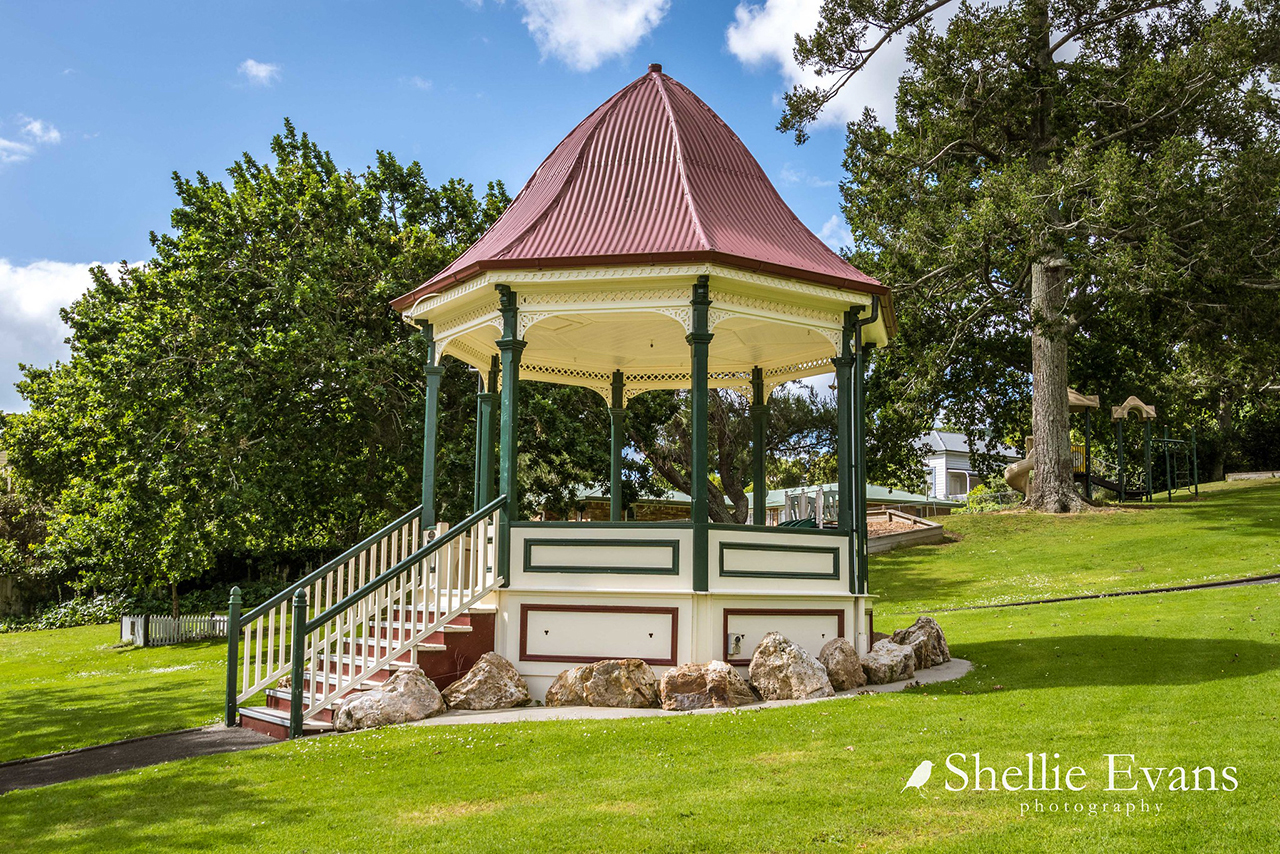
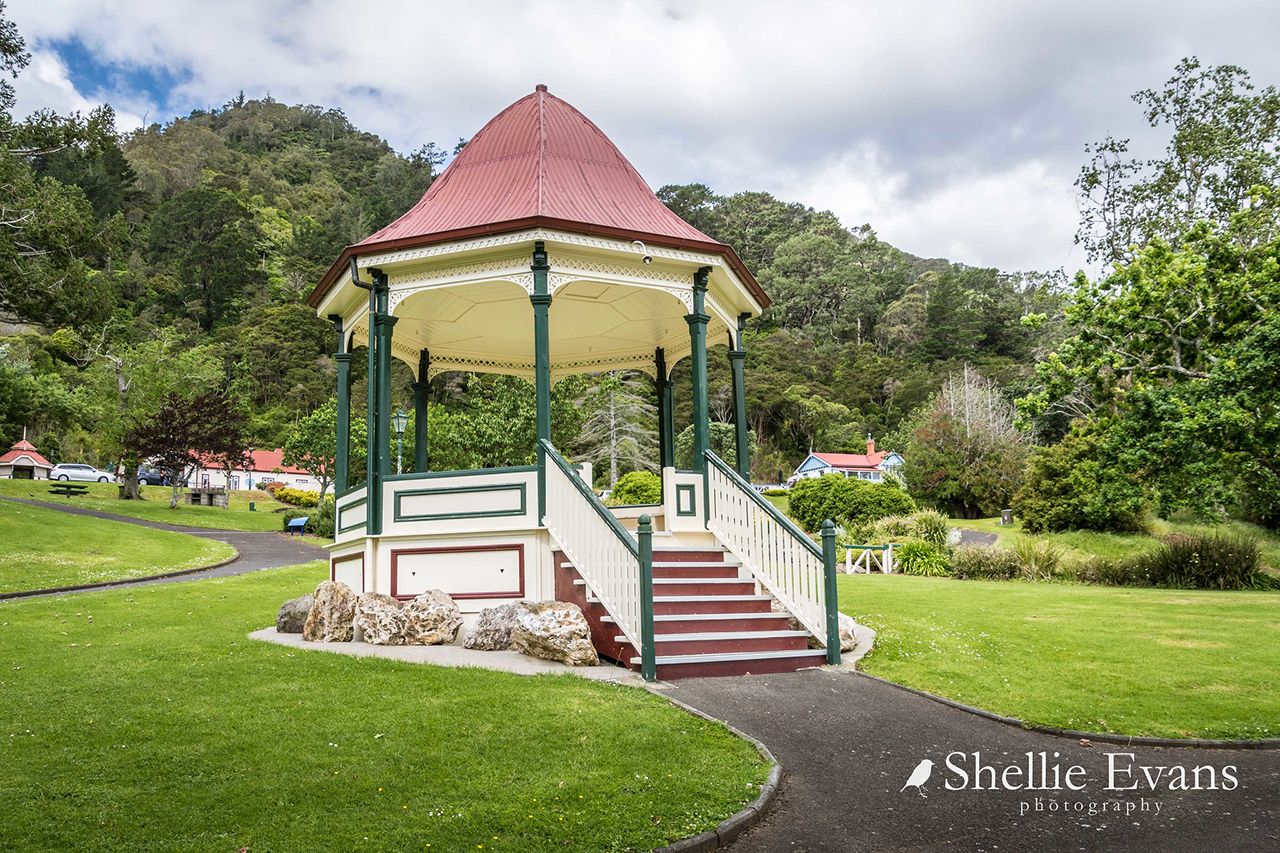
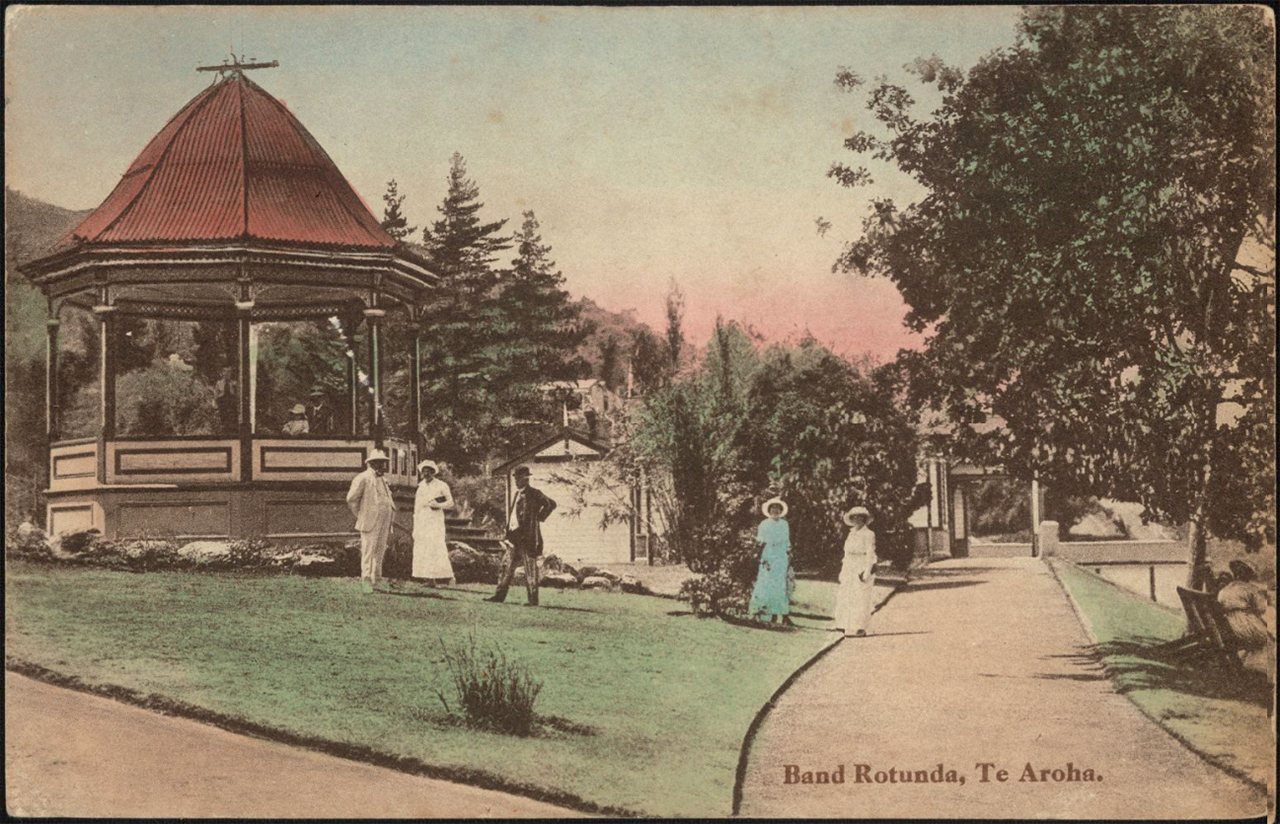
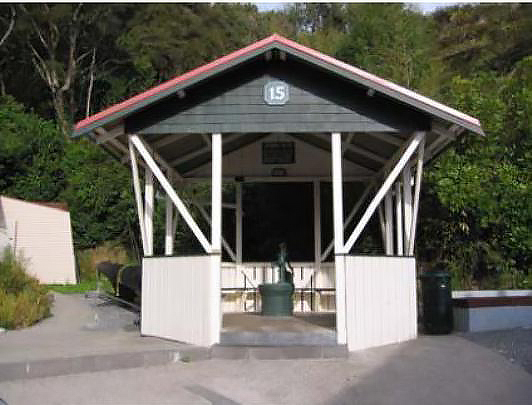
The Band Rotunda is located in the northern part of the Te Aroha Hot Springs Domain, between the Cadman Bath House and the northern entrance to the Domain grounds. It occupies a slightly elevated position on the lower slopes of Mount Te Aroha, affording extensive views across parts of Te Aroha township and the Hauraki Plain. It is picturesquely positioned with grass and trees surrounding it on most sides. A tarmac path leads up to its front steps. Slightly exotic in its appearance, the rotunda has open sides and a steep pitched roof. The structure is octagonal in plan, with wooden steps leading to an open entrance in its western side. The enclosed platform contains fixed seating around its outer edges, except where the entrance is located. Its ceiling incorporates patterned timber planking, which consists of an octagonal centrepiece and radiating panels. The centre of the ceiling contains a small aperture indicating the previous existence of an electric light A trap door provides access to the sub-floor area, while there is also a hatch in the ceiling. The rotunda's raised timber floor is made up of narrow boards, supported by concrete and timber piles. The sub-floor is clad with plywood panels and surrounded externally by decorative boulders. All eight sides of the rotunda feature chamfered posts with capitals and pierced timber brackets, which support a horizontal lattice architrave. Its lower sides are filled with solid timber panels bearing decorative, rectangular recesses. The eaves are supported by brackets located above each post, and feature a dentilated cornice. An octagonal roof is covered with corrugated iron, accommodating a steeper, convex pitch towards its apex. The structure lies on the site of an earlier structure associated with the Domain, whose archaeological remains may survive.
The Band Rotunda is located in the northern part of the Te Aroha Hot Springs Domain, between the Cadman Bath House and the northern entrance to the Domain grounds. It occupies a slightly elevated position on the lower slopes of Mount Te Aroha, affording extensive views across parts of Te Aroha township and the Hauraki Plain. It is picturesquely positioned with grass and trees surrounding it on most sides. A tarmac path leads up to its front steps. Slightly exotic in its appearance, the rotunda has open sides and a steep pitched roof. The structure is octagonal in plan, with wooden steps leading to an open entrance in its western side. The enclosed platform contains fixed seating around its outer edges, except where the entrance is located. Its ceiling incorporates patterned timber planking, which consists of an octagonal centrepiece and radiating panels. The centre of the ceiling contains a small aperture indicating the previous existence of an electric light A trap door provides access to the sub-floor area, while there is also a hatch in the ceiling. The rotunda's raised timber floor is made up of narrow boards, supported by concrete and timber piles. The sub-floor is clad with plywood panels and surrounded externally by decorative boulders. All eight sides of the rotunda feature chamfered posts with capitals and pierced timber brackets, which support a horizontal lattice architrave. Its lower sides are filled with solid timber panels bearing decorative, rectangular recesses. The eaves are supported by brackets located above each post, and feature a dentilated cornice. An octagonal roof is covered with corrugated iron, accommodating a steeper, convex pitch towards its apex. The structure lies on the site of an earlier structure associated with the Domain, whose archaeological remains may survive.
Historical and Associated Iwi / Hapū / Whānau
Information Sources
Cyclopedia of New Zealand, 1902
Cyclopedia Company, Industrial, descriptive, historical, biographical facts, figures, illustrations, Wellington, N.Z, 1897-1908, Vol.2, Christchurch, 1902
Mackay, 1993
Jamie Mackay, 'The Te Aroha Hot Springs Domain Conservation Area, Te Aroha, New Zealand', NZHPT report, Wellington, 1993.
Rockel, 1986
Ian Rockel, Taking the Waters: Early Spas in New Zealand, Wellington, 1986
Conservation Plan
Conservation Plan
Other Information
A fully referenced version of this report is available from the NZHPT Northern Region Office. Please note that entry on the New Zealand Heritage List/Rarangi Korero identifies only the heritage values of the property concerned, and should not be construed as advice on the state of the property, or as a comment of its soundness or safety, including in regard to earthquake risk, safety in the event of fire, or insanitary conditions.
Current Usages
Uses: Civic Facilities
Specific Usage: Bandstand/Rotunda
Former Usages
General Usage: Civic Facilities
Specific Usage: Bandstand/Rotunda
Current Usages
Uses: Civic Facilities
Specific Usage: Bandstand/Rotunda
Former Usages
General Usage: Civic Facilities
Specific Usage: Bandstand/Rotunda
Location
Get the latest heritage news, features and events delivered
straight to your inbox.
