

The earliest permanent buildings in the Domain were erected soon after the reserve was brought under the Public Domains Act in 1882, and were overseen by the Te Aroha Hot Springs Board. By 1887, there were seven bath houses and a drinking fountain, with extensive grounds laid out to plans drawn up by Henry Crump, a local engineer and architect. Government money largely financed the development of the facilities, as well as the establishment of a railway from Auckland in 1886. As the centrepiece of the now-burgeoning town of Te Aroha, the spa became the first geothermal resort in the country to receive thousands of visitors on an annual basis. People came to bathe or ingest its waters for health reasons, but also to promenade, listen to music or play genteel forms of sport such as tennis, croquet and bowls. Spas had important associations in nineteenth-century European society as places where the well-to-do could relax and congregate in refined and beautiful surroundings.
Although the health and leisure aspects of the reserve were heavily promoted when it was taken over by the Department of Tourism and Health Resorts in 1903, the facilities went into a slow decline after government funding and visitor attention were steadily drawn to Rotorua. The Domain nevertheless remained an extremely popular destination until after the First World War (1914-1918), and continued in a reduced capacity as a spa thereafter. Following closure of many of its facilities in the 1950s and 1960s, the Domain was transferred to the control of the local council (now Matamata-Piako District Council) in 1979, while formally remaining in Crown ownership.
The No.2 Bath House is one of only two surviving buildings in the Domain probably dating from the 1880s. The existing structure, constructed in 1886 however, is not the first bath house on the site. The spring was probably used prior to the 1880s by both Maori and Pakeha residents, as well as visitors to the area. The first known attempt to construct a bath at the spring was in the early 1880s, when the wife of the proprietor of the Hot Springs Hotel, a Mrs O'Halloran, donated a piano case to sink in a hole excavated at the top of the spring. By 1883 a temporary bath house had been constructed, which was accessible for a small charge. It may have been remodelled or rebuilt later in the year, possibly to plans by Thomas Mahoney of Auckland. Immersion in the baths associated with the No.2 spring - one of the hottest in the Domain - gained a reputation as an effective treatment for rheumatism and related ailments. A large entourage accompanying the visit of King Tawhiao (?-1894) in 1885 is said to have bathed in its waters.
The increasing popularity of the bath led to plans for a new building. Tenders for this were received in February 1886. A contract was awarded to F. Booth to erect a simple wooden structure, which may have incorporated the 1883 pool as well as a new bath. The architect is uncertain, although Henry Crump had been commissioned to prepare plans for a plunge bath in the previous year. This structure forms the nucleus of the present bath house.
Alterations to the new building were carried out in 1898, when the timber sides of the northern pool were replaced with concrete under the supervision of the engineer Charles Vickerman. It is possible that the 1883 bath was covered over at this time and the two current rooms at the southern end of the building added. Further modifications were made in 1902, when the building was extended to its current size. This allowed steps to be incorporated into the existing pool at its northern end. The provision of improved access took place soon after a visit by Dr Arthur Wohlmann - appointed Government Balneologist in the same year - who subsequently noted that the bath was 'excellent...and popular'. Aspects of the building's design were made to be similar to the 1897-1898 Cadman Bath House in an attempt to provide some uniformity in the Domain building's visual presentation.
Both throughout the late 1800s and after the 1902 alterations, separate hours of use were in operation for men and women, an example of how medical treatment and recreation were conducted along gendered lines. By the 1940s, however, the building appears to have been reserved exclusively for men. In 1967-1968, the bath house reverted back to staggered openings for men and women due to the conversion of the No 1 Ladies Bath into a private general bath. More recently, mixed bathing has been allowed.
Although becoming increasingly run down during the course of the twentieth century, the building remained largely unaltered until the 1990s apart from minor repairs. Substantial conservation work was carried out in 1997, when the pool was incorporated into a concrete raft on which the timber superstructure now stands. Since the end of the 1990s the building has been attached to an outdoor pool complex constructed to its north and east. The building remains in use for recreation and medical treatment, taking most of its water from the Mokeno geyser rather than from the No.2 spring as it once did.
List Entry Information
Status
Listed
List Entry Status
Historic Place Category 2
Access
Able to Visit
List Number
2698
Date Entered
11th December 2003
Date of Effect
11th December 2003
City/District Council
Matamata-Piako District
Region
Waikato Region
Extent of List Entry
Registration includes the structure, its footings and the ground beneath its footprint. It includes all fixtures and finishes.
Legal description
Sec 16 Blk IX Aroha SD (Recreation Reserve NZ Gazette 1882 p.1860)
Status
Listed
List Entry Status
Historic Place Category 2
Access
Able to Visit
List Number
2698
Date Entered
11th December 2003
Date of Effect
11th December 2003
City/District Council
Matamata-Piako District
Region
Waikato Region
Extent of List Entry
Registration includes the structure, its footings and the ground beneath its footprint. It includes all fixtures and finishes.
Legal description
Sec 16 Blk IX Aroha SD (Recreation Reserve NZ Gazette 1882 p.1860)
Why is this place significant?
Cultural Significance
The Bath House has social value as a place of recreation and medical treatment, which has been in continuous use for nearly 120 years.
Historic Significance
Historical Significance or Value It is historically significant for its association with the early growth of Te Aroha Domain as a spa resort, the development of recreation and medical treatment in New Zealand, and social attitudes towards gender roles.
Physical Significance
The No.2 Bath House is aesthetically significant for contributing to the Picturesque nature of the Te Aroha Hot Springs Domain. It has archaeological value for retaining substantial evidence of nineteenth-century baths within and beneath its structure. The building is architecturally significant as one of few working bath houses from the major spa resorts of 1880s New Zealand, and the oldest to survive in the Domain.
Why is this place Category 1 / Category 2?
Detail Of Assessed Criteria
The No. 2 Bath House reflects important and representative aspects of New Zealand's history, including government involvement in the development of New Zealand's spas, and bathing as a recreational and medicinal activity in nineteenth-century society. The building is associated with people of importance to New Zealand's history, the pool preserved beneath the existing structure having been used by King Tawhiao's entourage in 1885. Located in a public park and tourist venue, and as an operating bath house, the structure has considerable potential to provide for public education on the history of bathing. It has rarity value as a functioning late nineteenth- and early twentieth-century timber bath house retaining its original pool. The building is an early part of an important historical and cultural landscape at the Hot Springs Domain, which is considered to be the best-preserved Victorian and Edwardian spa in New Zealand. This landscape has been recognised in the Domain's registration by the New Zealand Historic Places Trust /Pouhere Taonga as a Historic Area (#7012).
Why is this place significant?
Cultural Significance
The Bath House has social value as a place of recreation and medical treatment, which has been in continuous use for nearly 120 years.
Historic Significance
Historical Significance or Value It is historically significant for its association with the early growth of Te Aroha Domain as a spa resort, the development of recreation and medical treatment in New Zealand, and social attitudes towards gender roles.
Physical Significance
The No.2 Bath House is aesthetically significant for contributing to the Picturesque nature of the Te Aroha Hot Springs Domain. It has archaeological value for retaining substantial evidence of nineteenth-century baths within and beneath its structure. The building is architecturally significant as one of few working bath houses from the major spa resorts of 1880s New Zealand, and the oldest to survive in the Domain.
Why is this place Category 1 / Category 2?
Detail Of Assessed Criteria
The No. 2 Bath House reflects important and representative aspects of New Zealand's history, including government involvement in the development of New Zealand's spas, and bathing as a recreational and medicinal activity in nineteenth-century society. The building is associated with people of importance to New Zealand's history, the pool preserved beneath the existing structure having been used by King Tawhiao's entourage in 1885. Located in a public park and tourist venue, and as an operating bath house, the structure has considerable potential to provide for public education on the history of bathing. It has rarity value as a functioning late nineteenth- and early twentieth-century timber bath house retaining its original pool. The building is an early part of an important historical and cultural landscape at the Hot Springs Domain, which is considered to be the best-preserved Victorian and Edwardian spa in New Zealand. This landscape has been recognised in the Domain's registration by the New Zealand Historic Places Trust /Pouhere Taonga as a Historic Area (#7012).
Construction Professional
Name
Booth, F.
Type
Builder
Biography
No biography is currently available for this construction professional
Name
Corlett, B.S.
Type
Engineer
Biography
Benjamin Stott Corlett, (1841-?) was architect for the Bath House and possibly also the Rotunda at the Rotorua Government Gardens. He was also responsible for the No. 2 Bathhouse, Te Aroha Domain, (Record no. 2698). He became the Inspector of Government Works at Rotorua.
Name
Vickerman, Charles
Type
Engineer
Biography
Charles Ranken Vickerman, District Engineer of the Public Works Department.
Name
Crump, Henry
Type
Architect
Biography
Little is known of the life of Henry Crump, other than that he worked in the fields of architecture, surveying, town planning and engineering. About 1873 he was involved with mine engineering in Coromandel and by 1883 he was involved in surveying water races, batteries and furnace sites at Te Aroha. As an architect he was responsible for a villa residence at Manawaru (1882), and additions to the British (now Grand) and Hot Springs Hotels, both at Te Aroha, in 1885.
Construction Details
Start Year
1883
Type
Other
Description
Site of temporary bath house
Start Year
1886
Type
Original Construction
Description
Original construction of No.2 Bath House
Start Year
1898
Type
Modification
Description
Modifications, including replacement of timber bath with concrete lining
Start Year
1902
Type
Addition
Description
Northern extension added, and other modifications
Start Year
1907
startYearCirca
Type
Addition
Description
Toilet addition
Start Year
1951
Type
Modification
Description
Modifications, including re-blocking
Start Year
1997
Type
Modification
Description
Modifications, including construction of concrete floor slab
Construction Materials
Timber frame with weatherboards, concrete slab footings and corrugated iron roof
Construction Professional
Name
Booth, F.
Type
Builder
Biography
No biography is currently available for this construction professional
Name
Corlett, B.S.
Type
Engineer
Biography
Benjamin Stott Corlett, (1841-?) was architect for the Bath House and possibly also the Rotunda at the Rotorua Government Gardens. He was also responsible for the No. 2 Bathhouse, Te Aroha Domain, (Record no. 2698). He became the Inspector of Government Works at Rotorua.
Name
Vickerman, Charles
Type
Engineer
Biography
Charles Ranken Vickerman, District Engineer of the Public Works Department.
Name
Crump, Henry
Type
Architect
Biography
Little is known of the life of Henry Crump, other than that he worked in the fields of architecture, surveying, town planning and engineering. About 1873 he was involved with mine engineering in Coromandel and by 1883 he was involved in surveying water races, batteries and furnace sites at Te Aroha. As an architect he was responsible for a villa residence at Manawaru (1882), and additions to the British (now Grand) and Hot Springs Hotels, both at Te Aroha, in 1885.
Construction Details
Start Year
1883
Type
Other
Description
Site of temporary bath house
Start Year
1886
Type
Original Construction
Description
Original construction of No.2 Bath House
Start Year
1898
Type
Modification
Description
Modifications, including replacement of timber bath with concrete lining
Start Year
1902
Type
Addition
Description
Northern extension added, and other modifications
Start Year
1907
startYearCirca
Type
Addition
Description
Toilet addition
Start Year
1951
Type
Modification
Description
Modifications, including re-blocking
Start Year
1997
Type
Modification
Description
Modifications, including construction of concrete floor slab
Construction Materials
Timber frame with weatherboards, concrete slab footings and corrugated iron roof
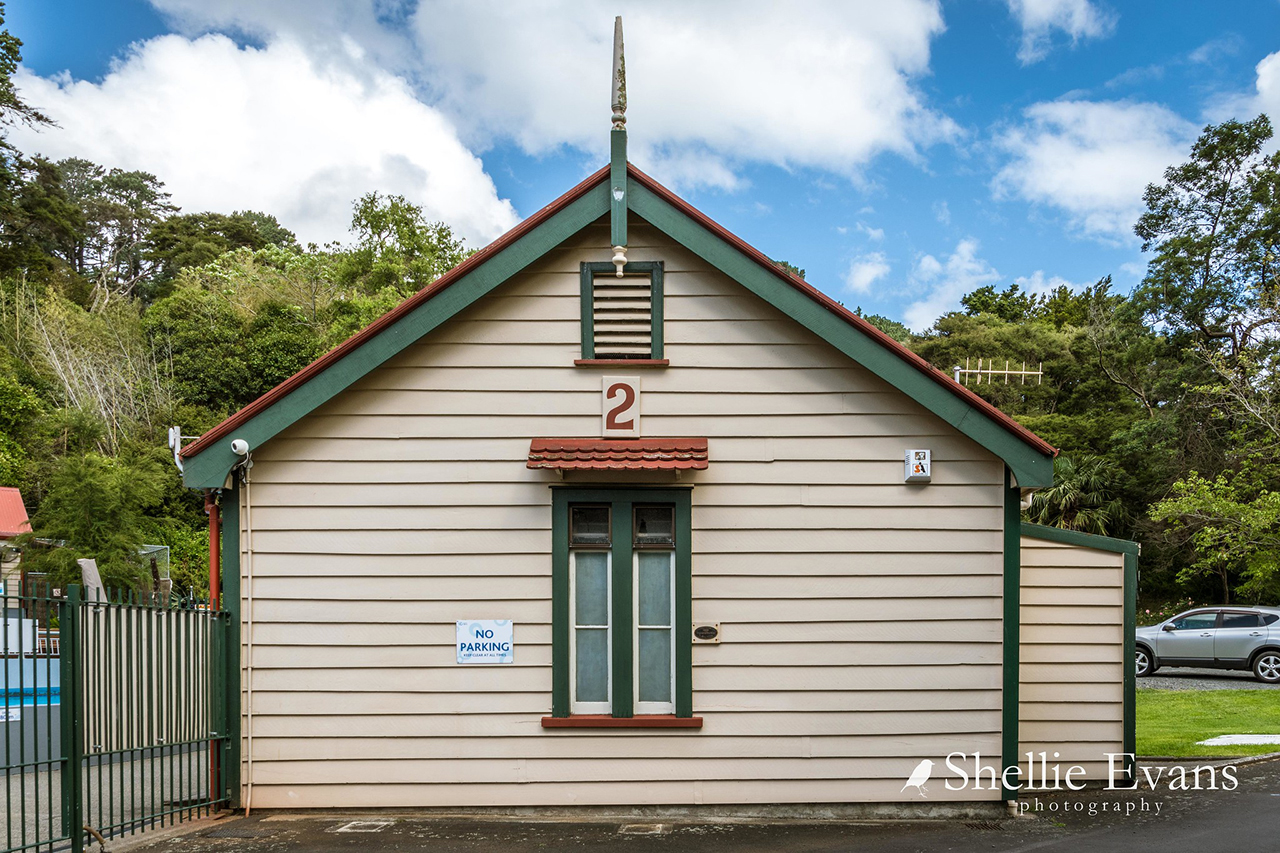
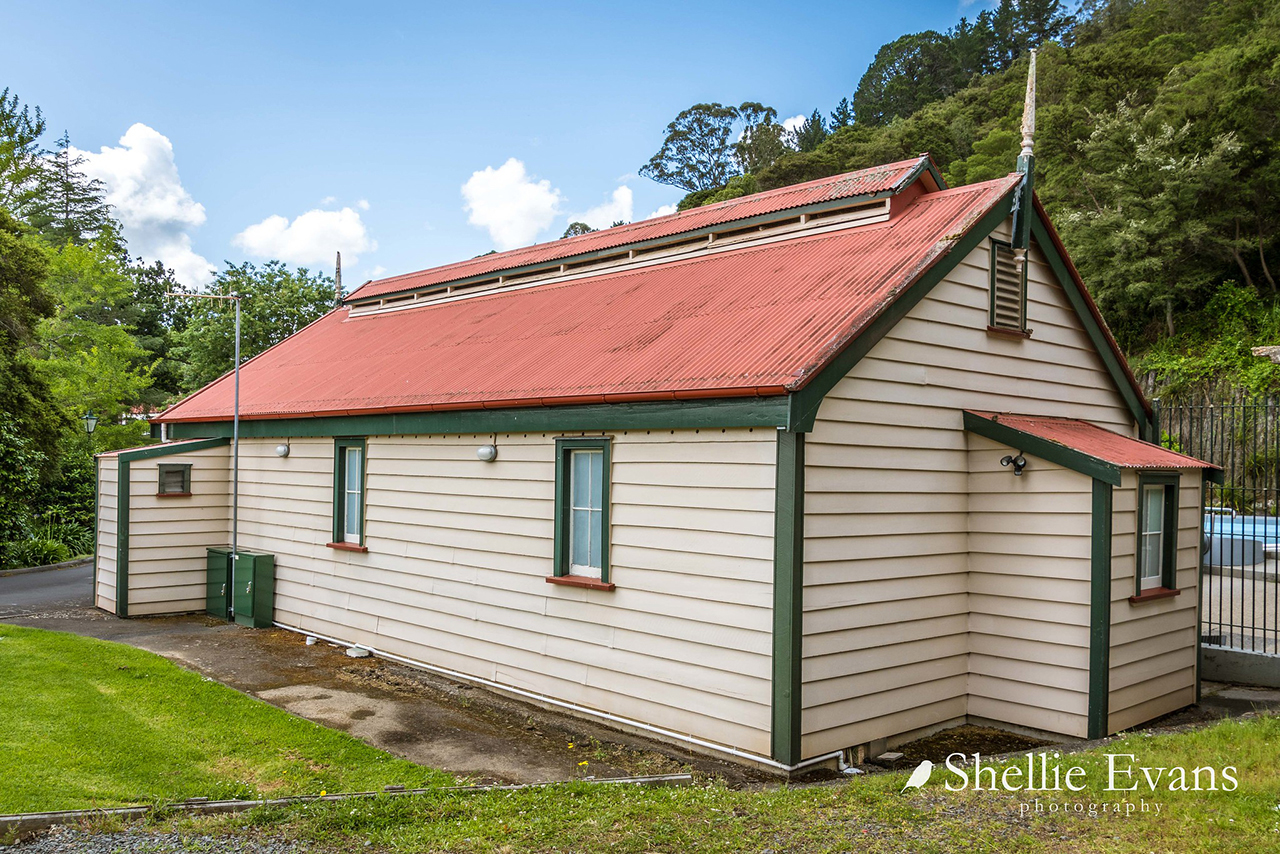
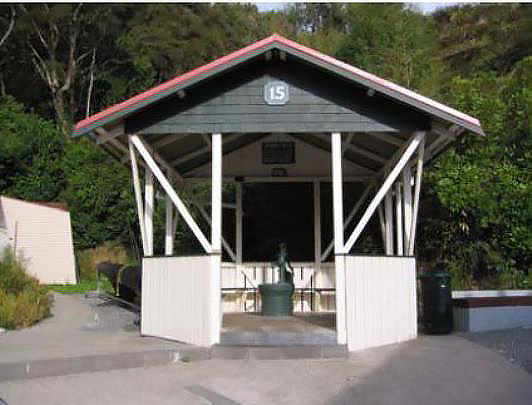
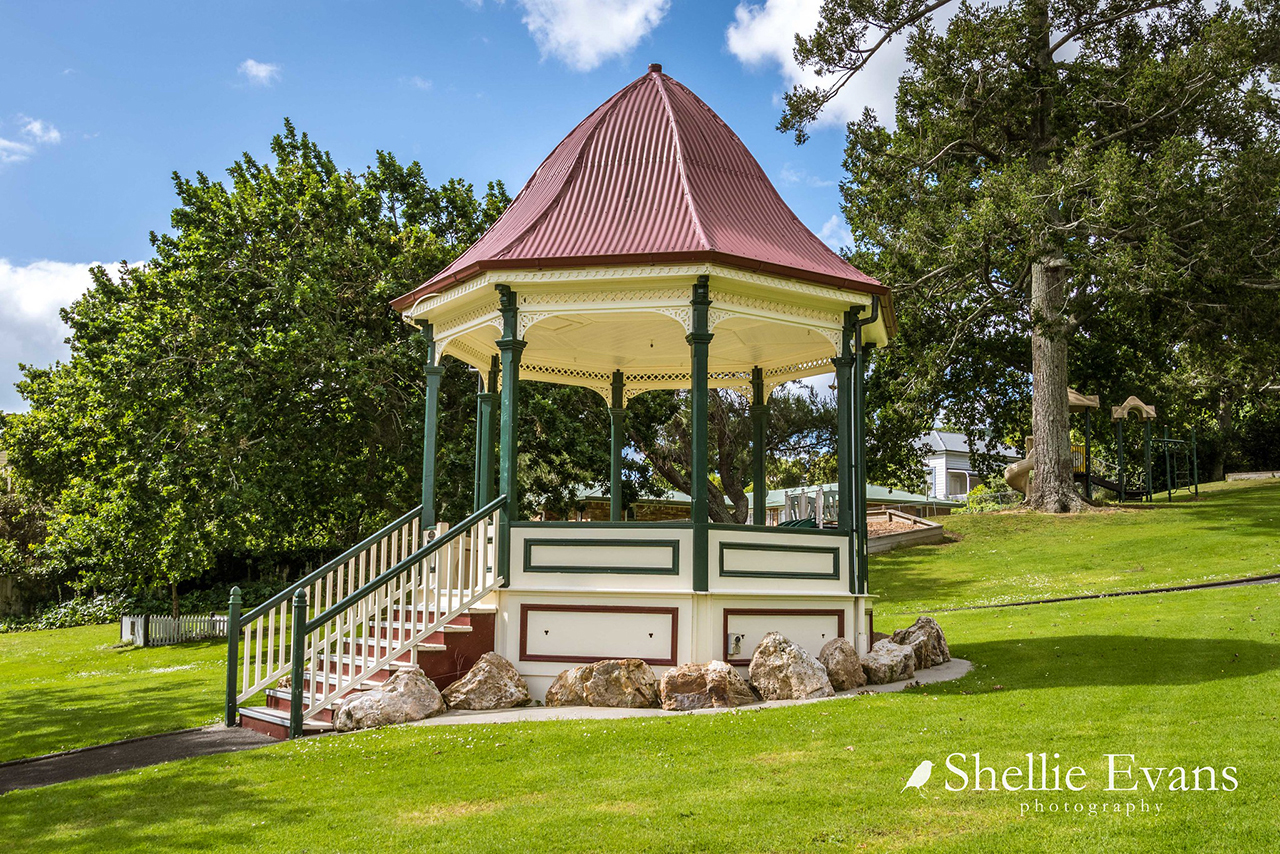
The No.2 Bath House is located close to the southern boundary of the original 1881-1882 Te Aroha Hot Springs Domain. It lies immediately to the west of the Gazebo over the No.15 Spring, at the junction between the formal part of the park and the 'wilderness' area on the lower slopes of Bald Spur. The structure currently forms part of the western enclosure boundary of a recently constructed outdoor leisure pool. It lies a short distance to the east of the former Tea House. The No.2 Bath House is a simple rectangular structure built mostly of timber. It has a small lean-to porch at its southern end and a projecting lean-to toilet near its north-western corner. The building is gabled at its northern and southern ends, with finials, vents and plain bargeboards. Its pitched roof has a ventilating monitor along most of its ridge, and is covered with corrugated iron. The timber-framed structure is externally clad with bevel-backed weatherboards and boxed corners. Its attached porch and toilet are similarly constructed. The building sits on concrete slab footings, which replaced a piled timber floor during works carried out in the 1970s and 1990s. Quantities of wall timber were also replaced during the latter period Internally the building contains one large room at its northern end, and two smaller rooms either side of a central corridor leading from the southern porch. The northern room contains a large concrete bath measuring 6.8 m x 2.7 m, which holds hot spring water bubbling up from below. Access to the pool is from a set of steps at its northern end. The room has an external door in its eastern wall and windows on its northern, western and eastern elevations. The northern window is based on those used in the Cadman Bath House, reflecting a conscious attempt to create a more unified image in the Domain during the first years of the twentieth century, when this end of the building was added on to an 1880s structure. The two rooms at the southern end of the building are currently used for showering, and are lit with original 1886 pivot-windows. During substantial conservation of the building in 1997, the remains of an earlier concrete and timber-lined bathing pool were uncovered beneath the southern end of the structure. This is an archaeological remnant of - probably - the early 1880s bath house, and has been covered over without alteration. Other archaeological deposits and remains of water supply systems may survive outside the structure, although the area to the east has been significantly modified by the recent construction of an outside bathing pool.
The No.2 Bath House is located close to the southern boundary of the original 1881-1882 Te Aroha Hot Springs Domain. It lies immediately to the west of the Gazebo over the No.15 Spring, at the junction between the formal part of the park and the 'wilderness' area on the lower slopes of Bald Spur. The structure currently forms part of the western enclosure boundary of a recently constructed outdoor leisure pool. It lies a short distance to the east of the former Tea House. The No.2 Bath House is a simple rectangular structure built mostly of timber. It has a small lean-to porch at its southern end and a projecting lean-to toilet near its north-western corner. The building is gabled at its northern and southern ends, with finials, vents and plain bargeboards. Its pitched roof has a ventilating monitor along most of its ridge, and is covered with corrugated iron. The timber-framed structure is externally clad with bevel-backed weatherboards and boxed corners. Its attached porch and toilet are similarly constructed. The building sits on concrete slab footings, which replaced a piled timber floor during works carried out in the 1970s and 1990s. Quantities of wall timber were also replaced during the latter period Internally the building contains one large room at its northern end, and two smaller rooms either side of a central corridor leading from the southern porch. The northern room contains a large concrete bath measuring 6.8 m x 2.7 m, which holds hot spring water bubbling up from below. Access to the pool is from a set of steps at its northern end. The room has an external door in its eastern wall and windows on its northern, western and eastern elevations. The northern window is based on those used in the Cadman Bath House, reflecting a conscious attempt to create a more unified image in the Domain during the first years of the twentieth century, when this end of the building was added on to an 1880s structure. The two rooms at the southern end of the building are currently used for showering, and are lit with original 1886 pivot-windows. During substantial conservation of the building in 1997, the remains of an earlier concrete and timber-lined bathing pool were uncovered beneath the southern end of the structure. This is an archaeological remnant of - probably - the early 1880s bath house, and has been covered over without alteration. Other archaeological deposits and remains of water supply systems may survive outside the structure, although the area to the east has been significantly modified by the recent construction of an outside bathing pool.
Historical and Associated Iwi / Hapū / Whānau
Completion Date
6th September 2004
Report Written By
Heather Bauchop
Information Sources
Mackay, 1993
Jamie Mackay, 'The Te Aroha Hot Springs Domain Conservation Area, Te Aroha, New Zealand', NZHPT report, Wellington, 1993.
Rockel, 1986
Ian Rockel, Taking the Waters: Early Spas in New Zealand, Wellington, 1986
Conservation Plan
Conservation Plan
Other Information
A fully referenced version of this report is available from the NZHPT Northern Regional Office. Please note that entry on the New Zealand Heritage List/Rarangi Korero identifies only the heritage values of the property concerned, and should not be construed as advice on the state of the property, or as a comment of its soundness or safety, including in regard to earthquake risk, safety in the event of fire, or insanitary conditions.
Historical and Associated Iwi / Hapū / Whānau
Completion Date
6th September 2004
Report Written By
Heather Bauchop
Information Sources
Mackay, 1993
Jamie Mackay, 'The Te Aroha Hot Springs Domain Conservation Area, Te Aroha, New Zealand', NZHPT report, Wellington, 1993.
Rockel, 1986
Ian Rockel, Taking the Waters: Early Spas in New Zealand, Wellington, 1986
Conservation Plan
Conservation Plan
Other Information
A fully referenced version of this report is available from the NZHPT Northern Regional Office. Please note that entry on the New Zealand Heritage List/Rarangi Korero identifies only the heritage values of the property concerned, and should not be construed as advice on the state of the property, or as a comment of its soundness or safety, including in regard to earthquake risk, safety in the event of fire, or insanitary conditions.
Current Usages
Uses: Civic Facilities
Specific Usage: Bathhouse/ mineral baths/ geothermal baths
Former Usages
General Usage: Civic Facilities
Specific Usage: Bathhouse/ mineral baths/ geothermal baths
Current Usages
Uses: Civic Facilities
Specific Usage: Bathhouse/ mineral baths/ geothermal baths
Former Usages
General Usage: Civic Facilities
Specific Usage: Bathhouse/ mineral baths/ geothermal baths
Location
Related listings
Sign up to hear more
Get the latest heritage news, features and events delivered
straight to your inbox.
