DonateMembershipVisit Heritage
  • Tūrangawaewae
    Places
  • Tira Māori
    Māori Heritage
  • Poutairangahia
    Archaeology
  • Rauemi
    Resources
  • Mō Tātou
    About Us
  • New Zealand Heritage List
  • Nominate and submit
  • Explore the List
  • National Historic Landmarks
  • Plaques
  • Rainbow List Project
  • Lost heritage
  • Visit Heritage
  • Our properties
  • Turnbull House Project
  • Collections
  • Shop
  • Tohu Whenua
  • Tira Māori
  • Conserving Māori heritage
  • Marae built heritage
  • Māori heritage on the List
  • Hinemihi—Te Hokinga Mai
  • What is archaeology?
  • Is there a site on my property?
  • What are my legal requirements?
  • Affecting an archaeological site
  • Declaring an archaeological site
  • Archaeology FAQs
  • Archaeology Digital Library
  • Archaeology guidelines and templates
  • Resources
  • Funding
  • Publications
  • Sustainable management guides
  • Disaster recovery
  • Podcasts & digital resources
  • Education Hub
  • Conservation plans
  • About
  • Board
  • Māori Heritage Council
  • Senior Staff
  • Offices
  • Contact us
  • Careers
  • Covenants
  • Fast-track
  • Corporate documents
  • Currently consulting on
  • Our submissions
  • News
  • Covid-19 response
Quick links
Rārangi Kōrero | The List
Explore the List
National Historic Landmarks
Ngā Manawhenua o Aotearoa me ōna Kōrero Tūturu
Quick links
Tapuwae
A Vision for Places of Māori Heritage
Funding for Māori Heritage
Resources
Quick links
Archaeological Authority Portal
Applying for an archaeological authority
Archaeology FAQs
Browse the most frequently asked questions about archaeological authorities and the archaeological process.
Quick links
Quick links
News
News Keep up to date with Heritage New Zealand Pouhere Taonga
Membership
Membership Find out more and sign up today
DonateMembershipVisit Heritage
  • Tūrangawaewae
    Places
  • Tira Māori
    Māori Heritage
  • Poutairangahia
    Archaeology
  • Rauemi
    Resources
  • Mō Tātou
    About Us
  • New Zealand Heritage List
  • Nominate and submit
  • Explore the List
  • National Historic Landmarks
  • Plaques
  • Rainbow List Project
  • Lost heritage
  • Visit Heritage
  • Our properties
  • Turnbull House Project
  • Collections
  • Shop
  • Tohu Whenua
  • Tira Māori
  • Conserving Māori heritage
  • Marae built heritage
  • Māori heritage on the List
  • Hinemihi—Te Hokinga Mai
  • What is archaeology?
  • Is there a site on my property?
  • What are my legal requirements?
  • Affecting an archaeological site
  • Declaring an archaeological site
  • Archaeology FAQs
  • Archaeology Digital Library
  • Archaeology guidelines and templates
  • Resources
  • Funding
  • Publications
  • Sustainable management guides
  • Disaster recovery
  • Podcasts & digital resources
  • Education Hub
  • Conservation plans
  • About
  • Board
  • Māori Heritage Council
  • Senior Staff
  • Offices
  • Contact us
  • Careers
  • Covenants
  • Fast-track
  • Corporate documents
  • Currently consulting on
  • Our submissions
  • News
  • Covid-19 response
Quick links
Rārangi Kōrero | The List
Explore the List
National Historic Landmarks
Ngā Manawhenua o Aotearoa me ōna Kōrero Tūturu
Quick links
Tapuwae
A Vision for Places of Māori Heritage
Funding for Māori Heritage
Resources
Quick links
Archaeological Authority Portal
Applying for an archaeological authority
Archaeology FAQs
Browse the most frequently asked questions about archaeological authorities and the archaeological process.
Quick links
Quick links
News
News Keep up to date with Heritage New Zealand Pouhere Taonga
Membership
Membership Find out more and sign up today
  • Nominate and submit
  • National Historic Landmarks
  • Nominate and submit
  • National Historic Landmarks
  • Conserving Māori heritage
  • Marae built heritage
  • Conserving Māori heritage
  • Marae built heritage
  • Archaeological authorities
  • Archaeology Digital Library
  • Archaeological authorities
  • Archaeology Digital Library
  • All resources
  • Publications
  • Funding
  • All resources
  • Publications
  • Funding
  • FAQs
  • FAQs
Follow us on:
Places
  • Nominate and submit
  • National Historic Landmarks
Tira Māori
  • Conserving Māori heritage
  • Marae built heritage
Archaeology
  • Archaeological authorities
  • Archaeology Digital Library
Resources
  • All resources
  • Publications
  • Funding
FAQs
  • FAQs
Follow us on
HomePrivacyTerms and conditionsAbout this site
© Heritage New Zealand Pouhere Taonga 2026.
 
Band Rotunda

Whitaker Street, Te Aroha Hot Springs Domain, TE AROHA

Public

Historic Place Category 2

List No. 766

Quick links:
List GalleryLocationDetails
During the late nineteenth and early twentieth centuries, the Hot Springs Domain at Te Aroha was the most popular geothermal resort in New Zealand. The Domain was initially established as a reserve in 1881, incorporating an area of 9.1 hectares (20 acres) on the lower slopes of Mount Te Aroha. The many hot springs in this area lay within the traditional territory of Ngati Rahiri, a hapu of Ngati Maru of Hauraki, and had long been frequented by Maori for their perceived healing qualities. By the late 1870s the site had become a popular destination for Pakeha visitors, with tourist numbers increasing after the discovery of gold on Mount Te Aroha in 1880 and the development of Te Aroha township as a mining settlement. The Domain was acquired by the government soon after the passing of the 1881 Thermal Springs District Act, with local Maori - who had played an instrumental role in initially promoting the resort - retaining the right of free access to the waters. The 1881 Act had been introduced to promote Crown ownership of New Zealand's thermal resources, partly in response to their increasing purchase and commercial exploitation by private entrepreneurs.

The earliest permanent buildings in the Domain were erected soon after the reserve was brought under the Public Domains Act in 1882, and were overseen by the Te Aroha Hot Springs Board. By 1887, there were seven bath houses and a drinking fountain, with extensive grounds laid out to plans drawn up by Henry Crump, a local engineer and architect. Government money largely financed the development of the facilities, as well as the establishment of a railway from Auckland in 1886. As the centrepiece of the now-burgeoning town of Te Aroha, the spa became the first geothermal resort in the country to receive thousands of visitors on an annual basis. People came to bathe or ingest its waters for health reasons, but also to promenade, listen to music or play genteel forms of sport such as tennis, croquet and bowls. Spas had important associations in nineteenth-century European society as places where the well-to-do could relax and congregate in refined and beautiful surroundings.

Although the health and leisure aspects of the reserve were heavily promoted when it was taken over by the Department of Tourism and Health Resorts in 1903, the facilities went into a slow decline after government funding and visitor attention were steadily drawn to Rotorua. The Domain nevertheless remained an extremely popular destination until after the First World War (1914-1918), and continued in a reduced capacity as a spa thereafter. Following closure of many of its facilities in the 1950s and 1960s, the Domain was transferred to the control of the local council (now Matamata-Piako District Council) in 1979, while formally remaining in Crown ownership.

The Band Rotunda was constructed as part of a £3,860 programme of work carried out on the Domain in 1897-1898, which formed the largest single development of the spa. This included the construction of the adjacent Cadman Bath House, and improvements to the No.2 Bath House. The work was supervised by the District Engineer of the Public Works Department (PWD), Charles Vickerman (1855-1940), and was carried out using cooperative labour. Cooperative labour was introduced by the first Liberal government in the early 1890s as a way of providing work relief for the unemployed.

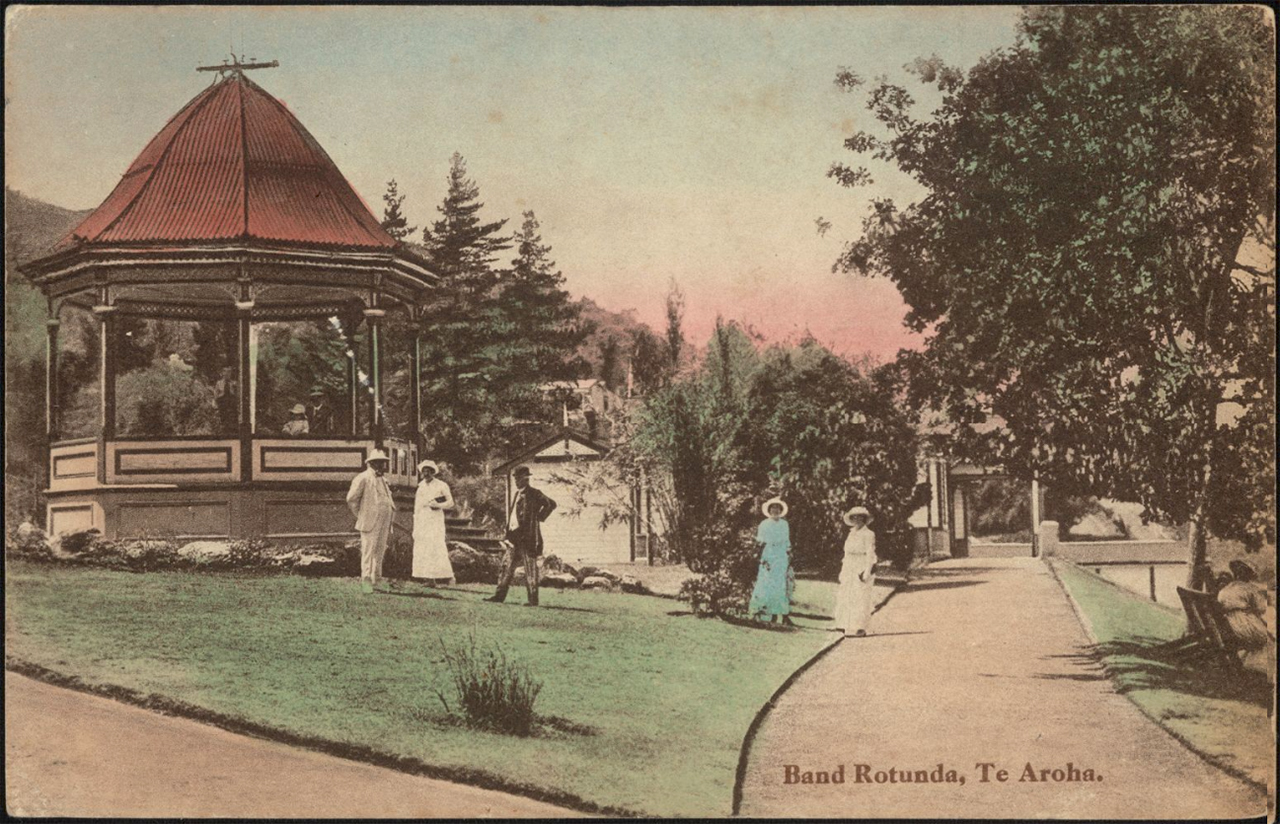
The rotunda itself cost £80, and was erected in 1898. It was originally sited in the centre of the front lawn, between the Cadman Bath House and the main frontage of the Domain on Whitaker Street. The structure replaced an earlier bandstand, which had been located on the site of the Cadman Bath House itself. In 1904-1905 the rotunda was moved to its current location, west of the Cadman Bath House, possibly to accommodate the growing number of croquet and bowls lawns that were added to the earlier tennis courts. An earlier structure of uncertain purpose may have previously occupied the new site.

The rotunda now overlooked the sporting areas from an elevated position alongside the Cadman Bath House, and was utilised by a local band mainly in the evenings and on Sunday afternoon. It also saw use from occasional visiting groups such as the Auckland City Brass Band, which played there during Easter 1918. Their performances complemented regular open-air concerts by the Te Aroha Municipal Band during the season, when the Domain was lit by Japanese lanterns hanging from lamp poles. The number of visitors attracted to Te Aroha by these and other activities was considerable. On New Years day 1912, 7000 visitors arrived in the town for the day.

Alterations to the rotunda have included the provision of electric lighting in 1911, while repairs were carried out in 1918 and again in about 1924. The structure was re-blocked in 1950-1951, and remains in everyday use as a place for the public to sit in and absorb the view.
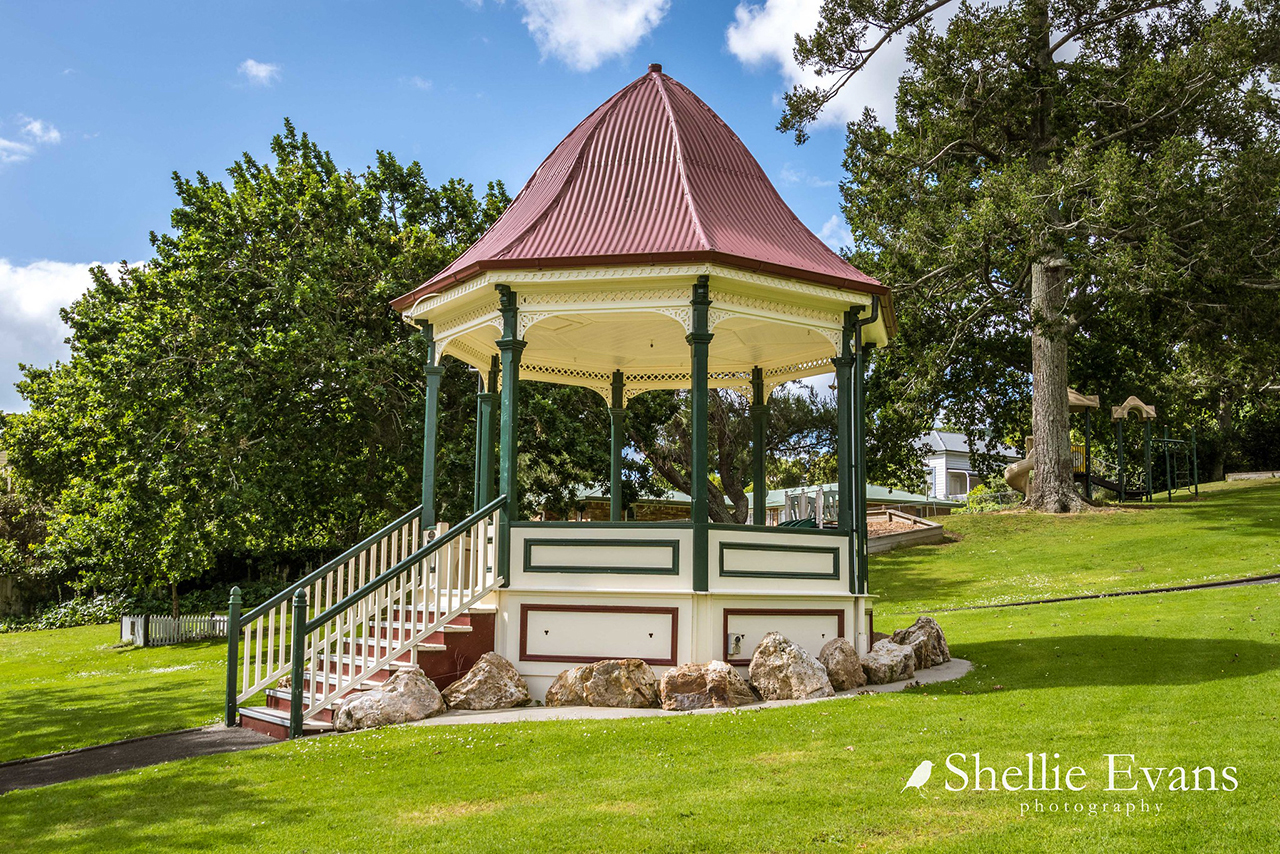
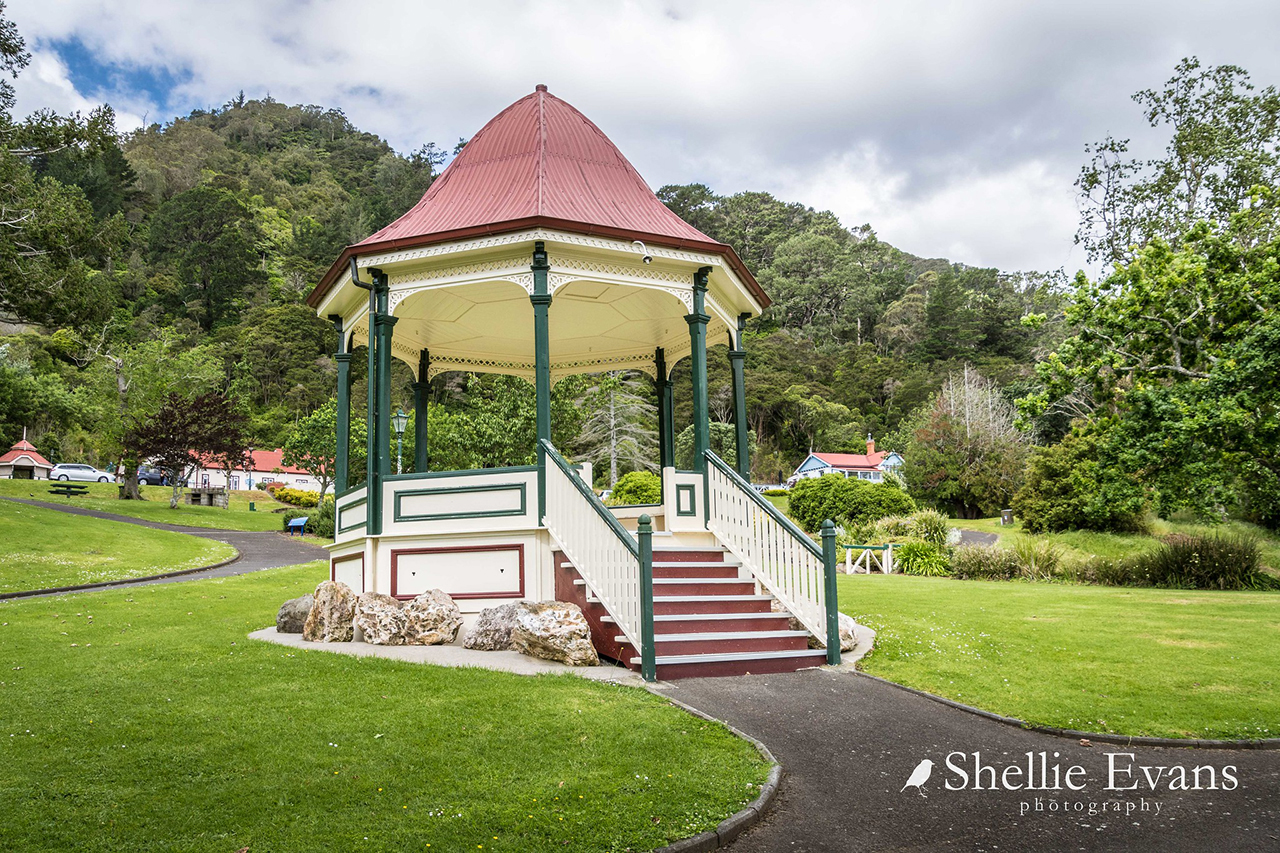
Band Rotunda, Te Aroha. CC BT-NC-ND 2.0 Image courtesy of www.flickr.com | Shellie Evans – flyingkiwigirl | 25/11/2022 | Shellie Evans
Band Rotunda, Te Aroha. Postcard c.1910-1919 Image courtesy of Auckland Libraries Heritage Collections, Record #1293-16 | No Known Copyright Restrictions
Band Rotunda, Te Aroha. CC BT-NC-ND 2.0 Image courtesy of www.flickr.com | Shellie Evans – flyingkiwigirl | 25/11/2022 | Shellie Evans
Band Rotunda, Te Aroha. Postcard c.1910-1919 Image courtesy of Auckland Libraries Heritage Collections, Record #1293-16 | No Known Copyright Restrictions

List Entry Information

Overview

Status
Listed

List Entry Status
Historic Place Category 2

Access
Able to Visit

List Number
766

Date Entered
11th December 2003

Date of Effect
11th December 2003

City/District Council
Matamata-Piako District

Region
Waikato Region

Extent of List Entry

Registration includes the structure, its footings and the ground beneath its footprint (see plan in Appendix 4). It includes all fixtures and finishes.

Legal description

Sec 16 Blk IX Aroha SD (Recreation Reserve NZ Gazette 1882 p.1860)

Detailed List Entry
Significance

Historic Significance

Historical Significance or Value The structure has historical value as a remaining building from a period when the Hot Springs Domain was the most popular government spa resort in New Zealand. It is also significant for indicating the use of the spa as a place where people came for recreation as well as to enjoy the therapeutic quality of the waters, the late nineteenth-century popularity of brass bands, and the specific connection between spa resorts and 'genteel' public congregation.

Physical Significance

The Band Rotunda has aesthetic value for its ornate appearance, which contributes to the Picturesque nature of the Te Aroha Hot Springs Domain. It is architecturally significant as a remnant of the 1897-1898 alterations to the Domain, when the Cadman Bath House was also constructed.

Detail Of Assessed Criteria

The Band Rotunda reflects important aspects of New Zealand history, notably the development of Crown-owned spa resorts for health and recreational tourism. Located in a public park and tourist destination, it has potential for public education about the role of music and public recreation in late nineteenth-century society. The rotunda is part of an important historical and cultural landscape at the Hot Springs Domain, which is considered to be the best-preserved Victorian and Edwardian spa in New Zealand. The significance of this landscape has been recognised by the NZHPT/Pouhere Taonga in its registration of the Domain as a Historic Area (#7012).

Construction Professional

Name

Vickerman, Charles

Type

Engineer

Biography

Charles Ranken Vickerman, District Engineer of the Public Works Department.

Construction Details

Start Year

1898

Type

Original Construction

Description

Original construction of Band Rotunda in front of Cadman Bath House.

Start Year

1904

Finish Year

1905

Type

Relocation

Description

Relocated to current position.

Start Year

1911

Type

Addition

Description

Electric light installed.

Start Year

1918

Type

Other

Description

Repairs to timberwork.

Start Year

1924

Type

Other

Description

Further repairs following land slip.

Start Year

1950

Finish Year

1951

Type

Other

Description

Re-blocked.

Construction Materials

Timber, with concrete and timber piles, and a corrugated iron roof.

Physical Description

The Band Rotunda is located in the northern part of the Te Aroha Hot Springs Domain, between the Cadman Bath House and the northern entrance to the Domain grounds. It occupies a slightly elevated position on the lower slopes of Mount Te Aroha, affording extensive views across parts of Te Aroha township and the Hauraki Plain. It is picturesquely positioned with grass and trees surrounding it on most sides. A tarmac path leads up to its front steps. Slightly exotic in its appearance, the rotunda has open sides and a steep pitched roof. The structure is octagonal in plan, with wooden steps leading to an open entrance in its western side. The enclosed platform contains fixed seating around its outer edges, except where the entrance is located. Its ceiling incorporates patterned timber planking, which consists of an octagonal centrepiece and radiating panels. The centre of the ceiling contains a small aperture indicating the previous existence of an electric light A trap door provides access to the sub-floor area, while there is also a hatch in the ceiling. The rotunda's raised timber floor is made up of narrow boards, supported by concrete and timber piles. The sub-floor is clad with plywood panels and surrounded externally by decorative boulders. All eight sides of the rotunda feature chamfered posts with capitals and pierced timber brackets, which support a horizontal lattice architrave. Its lower sides are filled with solid timber panels bearing decorative, rectangular recesses. The eaves are supported by brackets located above each post, and feature a dentilated cornice. An octagonal roof is covered with corrugated iron, accommodating a steeper, convex pitch towards its apex. The structure lies on the site of an earlier structure associated with the Domain, whose archaeological remains may survive.

Reference

Information Sources

Cyclopedia of New Zealand, 1902

Cyclopedia Company, Industrial, descriptive, historical, biographical facts, figures, illustrations, Wellington, N.Z, 1897-1908, Vol.2, Christchurch, 1902

Mackay, 1993

Jamie Mackay, 'The Te Aroha Hot Springs Domain Conservation Area, Te Aroha, New Zealand', NZHPT report, Wellington, 1993.

Rockel, 1986

Ian Rockel, Taking the Waters: Early Spas in New Zealand, Wellington, 1986

Conservation Plan

Conservation Plan

Report Written By

A fully referenced version of this report is available from the NZHPT Northern Region Office. Please note that entry on the New Zealand Heritage List/Rarangi Korero identifies only the heritage values of the property concerned, and should not be construed as advice on the state of the property, or as a comment of its soundness or safety, including in regard to earthquake risk, safety in the event of fire, or insanitary conditions.

Further Information

Current Usages

Uses: Civic Facilities

Specific Usage: Bandstand/Rotunda

Former Usages

General Usage:: Civic Facilities

Specific Usage: Bandstand/Rotunda

Themes

Web Links

Overview

Status

Listed

List Entry Status

Historic Place Category 2

Access

Able to Visit

List Number

766

Date Entered

11th December 2003

Date of Effect

11th December 2003

City/District Council

Matamata-Piako District

Region

Waikato Region

Extent of List Entry

Registration includes the structure, its footings and the ground beneath its footprint (see plan in Appendix 4). It includes all fixtures and finishes.

Legal description

Sec 16 Blk IX Aroha SD (Recreation Reserve NZ Gazette 1882 p.1860)

Status

Listed

List Entry Status

Historic Place Category 2

Access

Able to Visit

List Number

766

Date Entered

11th December 2003

Date of Effect

11th December 2003

City/District Council

Matamata-Piako District

Region

Waikato Region

Extent of List Entry

Registration includes the structure, its footings and the ground beneath its footprint (see plan in Appendix 4). It includes all fixtures and finishes.

Legal description

Sec 16 Blk IX Aroha SD (Recreation Reserve NZ Gazette 1882 p.1860)

Significance

Why is this place significant?

Historic Significance

Historical Significance or Value The structure has historical value as a remaining building from a period when the Hot Springs Domain was the most popular government spa resort in New Zealand. It is also significant for indicating the use of the spa as a place where people came for recreation as well as to enjoy the therapeutic quality of the waters, the late nineteenth-century popularity of brass bands, and the specific connection between spa resorts and 'genteel' public congregation.

Physical Significance

The Band Rotunda has aesthetic value for its ornate appearance, which contributes to the Picturesque nature of the Te Aroha Hot Springs Domain. It is architecturally significant as a remnant of the 1897-1898 alterations to the Domain, when the Cadman Bath House was also constructed.

Why is this place Category 1 / Category 2?

Detail Of Assessed Criteria

The Band Rotunda reflects important aspects of New Zealand history, notably the development of Crown-owned spa resorts for health and recreational tourism. Located in a public park and tourist destination, it has potential for public education about the role of music and public recreation in late nineteenth-century society. The rotunda is part of an important historical and cultural landscape at the Hot Springs Domain, which is considered to be the best-preserved Victorian and Edwardian spa in New Zealand. The significance of this landscape has been recognised by the NZHPT/Pouhere Taonga in its registration of the Domain as a Historic Area (#7012).

Why is this place significant?

Historic Significance

Historical Significance or Value The structure has historical value as a remaining building from a period when the Hot Springs Domain was the most popular government spa resort in New Zealand. It is also significant for indicating the use of the spa as a place where people came for recreation as well as to enjoy the therapeutic quality of the waters, the late nineteenth-century popularity of brass bands, and the specific connection between spa resorts and 'genteel' public congregation.

Physical Significance

The Band Rotunda has aesthetic value for its ornate appearance, which contributes to the Picturesque nature of the Te Aroha Hot Springs Domain. It is architecturally significant as a remnant of the 1897-1898 alterations to the Domain, when the Cadman Bath House was also constructed.

Why is this place Category 1 / Category 2?

Detail Of Assessed Criteria

The Band Rotunda reflects important aspects of New Zealand history, notably the development of Crown-owned spa resorts for health and recreational tourism. Located in a public park and tourist destination, it has potential for public education about the role of music and public recreation in late nineteenth-century society. The rotunda is part of an important historical and cultural landscape at the Hot Springs Domain, which is considered to be the best-preserved Victorian and Edwardian spa in New Zealand. The significance of this landscape has been recognised by the NZHPT/Pouhere Taonga in its registration of the Domain as a Historic Area (#7012).

Construction Information

Construction Professional

Name

Vickerman, Charles

Type

Engineer

Biography

Charles Ranken Vickerman, District Engineer of the Public Works Department.

Construction Details

Start Year

1898

Type

Original Construction

Description

Original construction of Band Rotunda in front of Cadman Bath House.

Start Year

1904

Finish Year

1905

Type

Relocation

Description

Relocated to current position.

Start Year

1911

Type

Addition

Description

Electric light installed.

Start Year

1918

Type

Other

Description

Repairs to timberwork.

Start Year

1924

Type

Other

Description

Further repairs following land slip.

Start Year

1950

Finish Year

1951

Type

Other

Description

Re-blocked.

Construction Materials

Timber, with concrete and timber piles, and a corrugated iron roof.

Construction Professional

Name

Vickerman, Charles

Type

Engineer

Biography

Charles Ranken Vickerman, District Engineer of the Public Works Department.

Construction Details

Start Year

1898

Type

Original Construction

Description

Original construction of Band Rotunda in front of Cadman Bath House.

Start Year

1904

Finish Year

1905

Type

Relocation

Description

Relocated to current position.

Start Year

1911

Type

Addition

Description

Electric light installed.

Start Year

1918

Type

Other

Description

Repairs to timberwork.

Start Year

1924

Type

Other

Description

Further repairs following land slip.

Start Year

1950

Finish Year

1951

Type

Other

Description

Re-blocked.

Construction Materials

Timber, with concrete and timber piles, and a corrugated iron roof.

Physical Description

The Band Rotunda is located in the northern part of the Te Aroha Hot Springs Domain, between the Cadman Bath House and the northern entrance to the Domain grounds. It occupies a slightly elevated position on the lower slopes of Mount Te Aroha, affording extensive views across parts of Te Aroha township and the Hauraki Plain. It is picturesquely positioned with grass and trees surrounding it on most sides. A tarmac path leads up to its front steps. Slightly exotic in its appearance, the rotunda has open sides and a steep pitched roof. The structure is octagonal in plan, with wooden steps leading to an open entrance in its western side. The enclosed platform contains fixed seating around its outer edges, except where the entrance is located. Its ceiling incorporates patterned timber planking, which consists of an octagonal centrepiece and radiating panels. The centre of the ceiling contains a small aperture indicating the previous existence of an electric light A trap door provides access to the sub-floor area, while there is also a hatch in the ceiling. The rotunda's raised timber floor is made up of narrow boards, supported by concrete and timber piles. The sub-floor is clad with plywood panels and surrounded externally by decorative boulders. All eight sides of the rotunda feature chamfered posts with capitals and pierced timber brackets, which support a horizontal lattice architrave. Its lower sides are filled with solid timber panels bearing decorative, rectangular recesses. The eaves are supported by brackets located above each post, and feature a dentilated cornice. An octagonal roof is covered with corrugated iron, accommodating a steeper, convex pitch towards its apex. The structure lies on the site of an earlier structure associated with the Domain, whose archaeological remains may survive.

The Band Rotunda is located in the northern part of the Te Aroha Hot Springs Domain, between the Cadman Bath House and the northern entrance to the Domain grounds. It occupies a slightly elevated position on the lower slopes of Mount Te Aroha, affording extensive views across parts of Te Aroha township and the Hauraki Plain. It is picturesquely positioned with grass and trees surrounding it on most sides. A tarmac path leads up to its front steps. Slightly exotic in its appearance, the rotunda has open sides and a steep pitched roof. The structure is octagonal in plan, with wooden steps leading to an open entrance in its western side. The enclosed platform contains fixed seating around its outer edges, except where the entrance is located. Its ceiling incorporates patterned timber planking, which consists of an octagonal centrepiece and radiating panels. The centre of the ceiling contains a small aperture indicating the previous existence of an electric light A trap door provides access to the sub-floor area, while there is also a hatch in the ceiling. The rotunda's raised timber floor is made up of narrow boards, supported by concrete and timber piles. The sub-floor is clad with plywood panels and surrounded externally by decorative boulders. All eight sides of the rotunda feature chamfered posts with capitals and pierced timber brackets, which support a horizontal lattice architrave. Its lower sides are filled with solid timber panels bearing decorative, rectangular recesses. The eaves are supported by brackets located above each post, and feature a dentilated cornice. An octagonal roof is covered with corrugated iron, accommodating a steeper, convex pitch towards its apex. The structure lies on the site of an earlier structure associated with the Domain, whose archaeological remains may survive.

Reference

Historical and Associated Iwi / Hapū / Whānau

Information Sources

Cyclopedia of New Zealand, 1902

Cyclopedia Company, Industrial, descriptive, historical, biographical facts, figures, illustrations, Wellington, N.Z, 1897-1908, Vol.2, Christchurch, 1902

Mackay, 1993

Jamie Mackay, 'The Te Aroha Hot Springs Domain Conservation Area, Te Aroha, New Zealand', NZHPT report, Wellington, 1993.

Rockel, 1986

Ian Rockel, Taking the Waters: Early Spas in New Zealand, Wellington, 1986

Conservation Plan

Conservation Plan

Other Information

A fully referenced version of this report is available from the NZHPT Northern Region Office. Please note that entry on the New Zealand Heritage List/Rarangi Korero identifies only the heritage values of the property concerned, and should not be construed as advice on the state of the property, or as a comment of its soundness or safety, including in regard to earthquake risk, safety in the event of fire, or insanitary conditions.

Historical and Associated Iwi / Hapū / Whānau

Information Sources

Cyclopedia of New Zealand, 1902

Cyclopedia Company, Industrial, descriptive, historical, biographical facts, figures, illustrations, Wellington, N.Z, 1897-1908, Vol.2, Christchurch, 1902

Mackay, 1993

Jamie Mackay, 'The Te Aroha Hot Springs Domain Conservation Area, Te Aroha, New Zealand', NZHPT report, Wellington, 1993.

Rockel, 1986

Ian Rockel, Taking the Waters: Early Spas in New Zealand, Wellington, 1986

Conservation Plan

Conservation Plan

Other Information

A fully referenced version of this report is available from the NZHPT Northern Region Office. Please note that entry on the New Zealand Heritage List/Rarangi Korero identifies only the heritage values of the property concerned, and should not be construed as advice on the state of the property, or as a comment of its soundness or safety, including in regard to earthquake risk, safety in the event of fire, or insanitary conditions.

Further Information

Current Usages

Uses: Civic Facilities

Specific Usage: Bandstand/Rotunda

Former Usages

General Usage: Civic Facilities

Specific Usage: Bandstand/Rotunda

Current Usages

Uses: Civic Facilities

Specific Usage: Bandstand/Rotunda

Former Usages

General Usage: Civic Facilities

Specific Usage: Bandstand/Rotunda

Location

Loading
Related listings
Cadman Bath House (Former), Te Aroha. CC BY-NC-ND 2.0 Image courtesy of www.flickr.com
Cadman Bath House (Former)
Domain Office (Former), Te Aroha
Domain Office (Former)
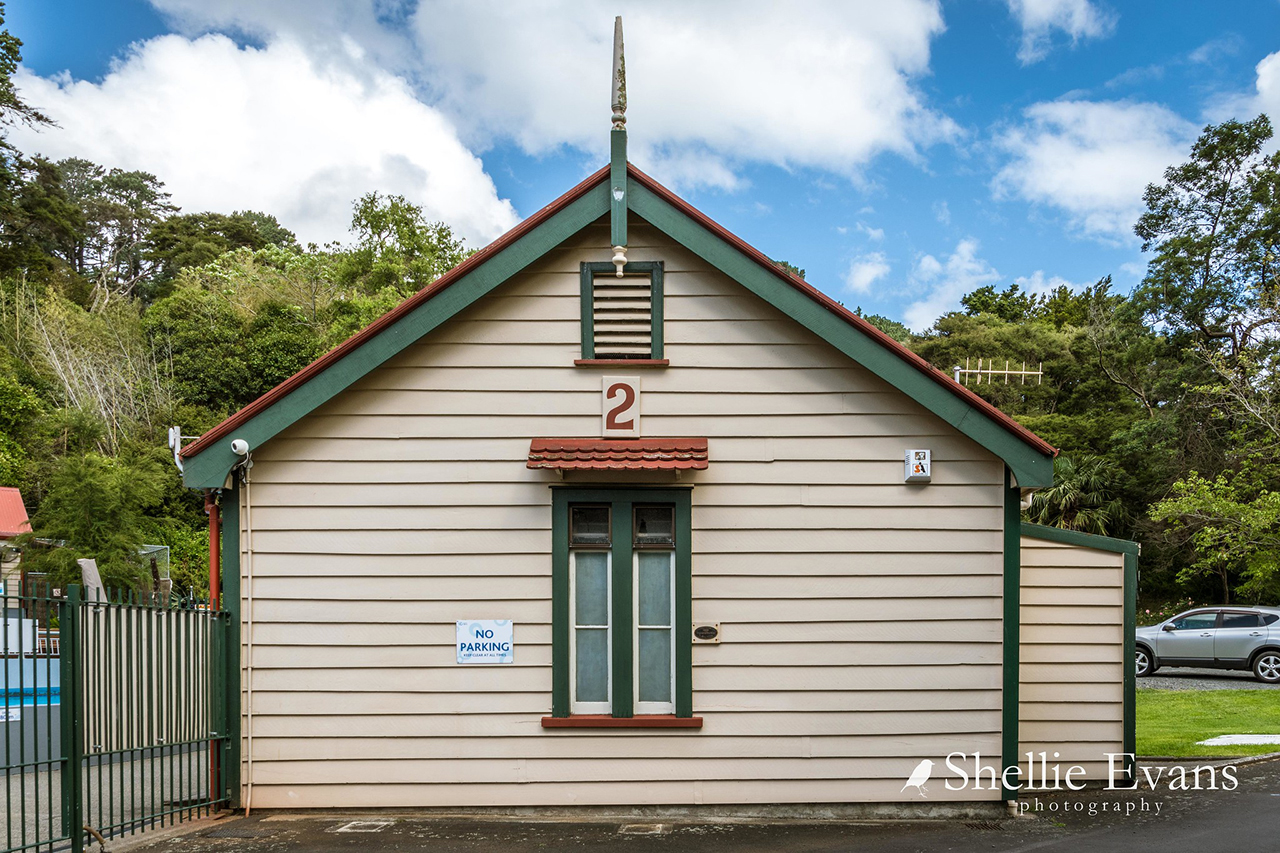
No.2 Bath House, Te Aroha. CC BY-NC-ND 2.0 Image courtesy of www.flickr.com
No 2 Bath House
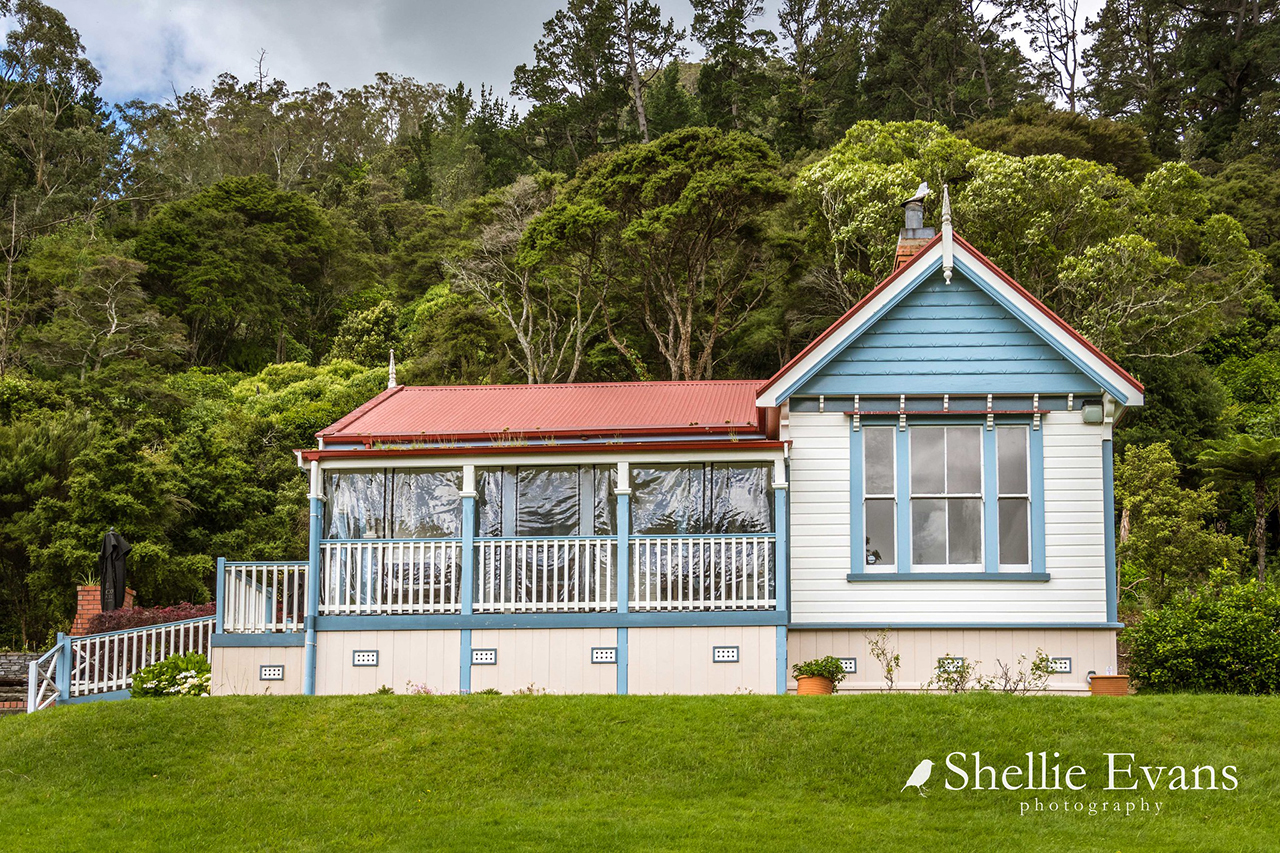
Head Gardener’s Cottage (Former), Te Aroha. CC BY-NC-ND 2.0 Image courtesy of www.flickr.com
Head Gardener’s Cottage (Former)
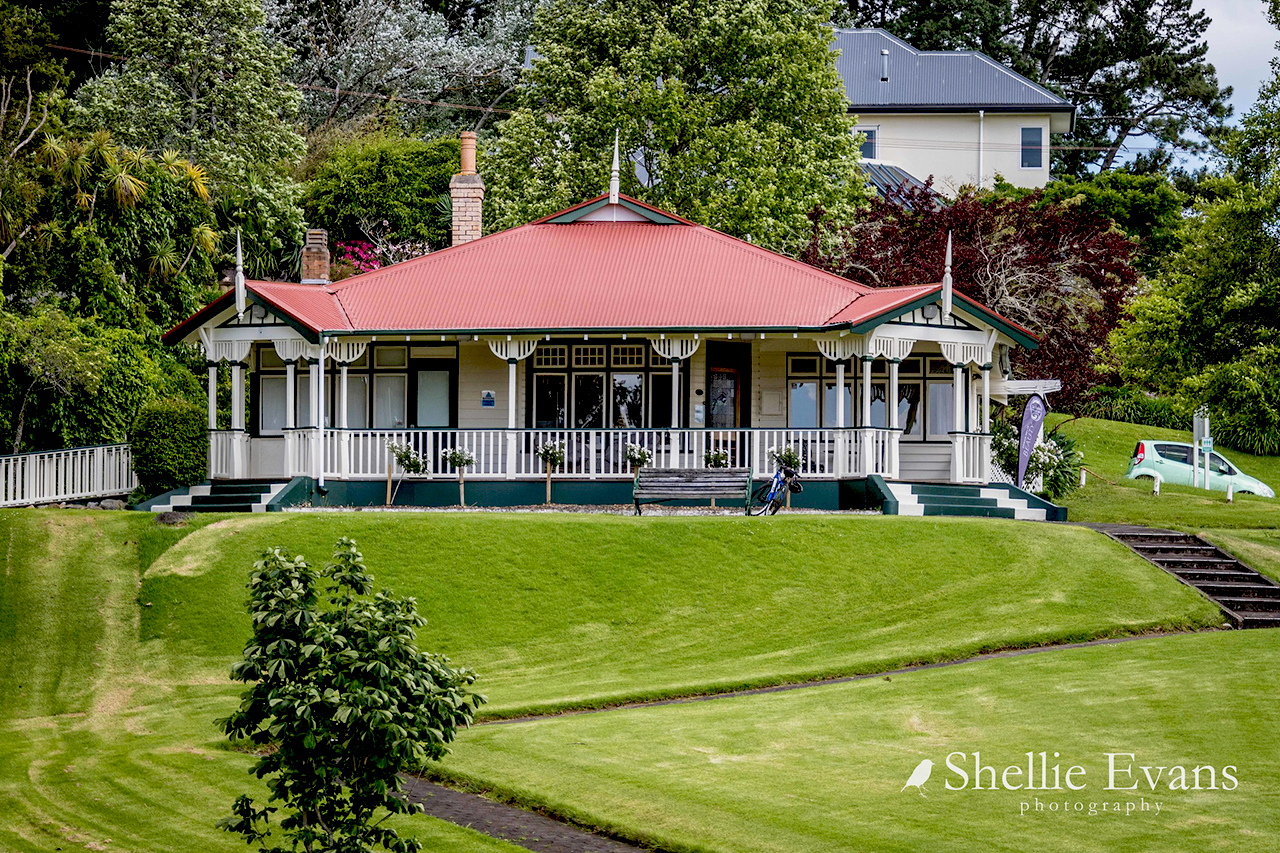
Tea House, Te Aroha. CC BY-NC-ND 2.0 Image courtesy of www.flickr.com
Tea House
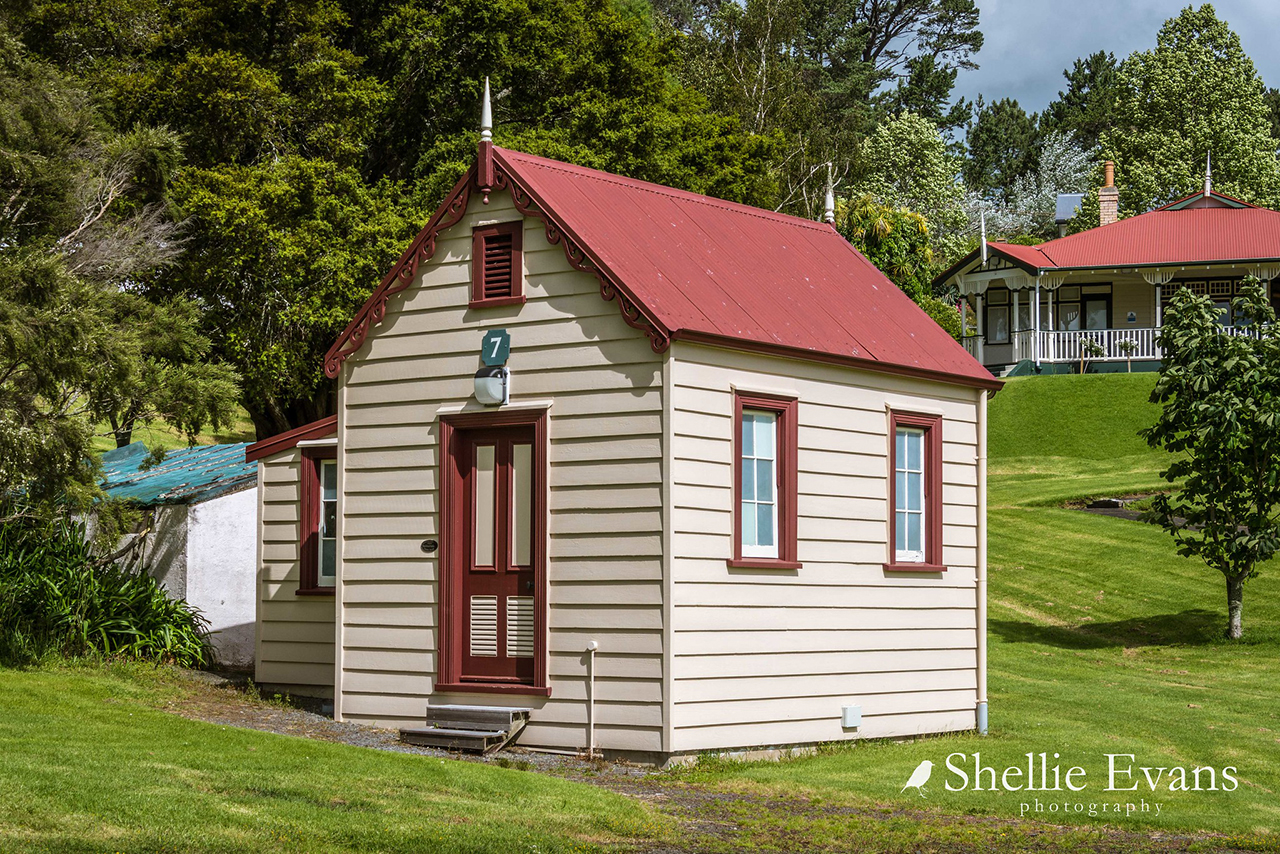
No. 7 Bath House, Te Aroha. CC BY-NC-ND 2.0 Image courtesy of www.flickr.com
No 7 Bath House
Gazebo over No.15 Spring, Aroha Hot Springs Domain, Te Aroha
Gazebo over No 15 Spring
Te Aroha Domain Historic Area. Entrance. CC BY-NC-ND 2.0 Image courtesy of www.flickr.com
Te Aroha Hot Springs Historic Area
Tea House, Te Aroha. CC BY-NC-ND 2.0 Image courtesy of www.flickr.com
Tea House
Cadman Bath House (Former), Te Aroha. CC BY-NC-ND 2.0 Image courtesy of www.flickr.com
Cadman Bath House (Former)
No. 7 Bath House, Te Aroha. CC BY-NC-ND 2.0 Image courtesy of www.flickr.com
No 7 Bath House
Domain Office (Former), Te Aroha
Domain Office (Former)
Gazebo over No.15 Spring, Aroha Hot Springs Domain, Te Aroha
Gazebo over No 15 Spring
No.2 Bath House, Te Aroha. CC BY-NC-ND 2.0 Image courtesy of www.flickr.com
No 2 Bath House
Te Aroha Domain Historic Area. Entrance. CC BY-NC-ND 2.0 Image courtesy of www.flickr.com
Te Aroha Hot Springs Historic Area
Head Gardener’s Cottage (Former), Te Aroha. CC BY-NC-ND 2.0 Image courtesy of www.flickr.com
Head Gardener’s Cottage (Former)
Stay up to date with Heritage this month